15 Nov 2015
by Jim Rose
in labour economics, labour supply, occupational choice
Tags: British economy, compensating differentials, Germany, health insurance, labour force participation, male labour force participation, Obamacare, part-time work, social insurance
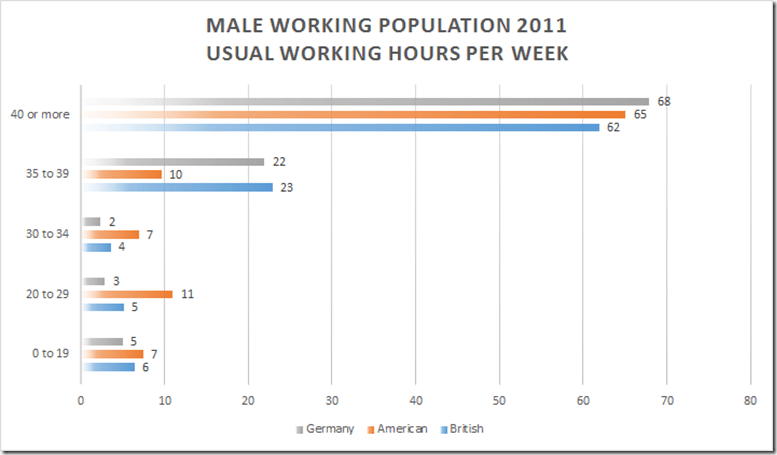
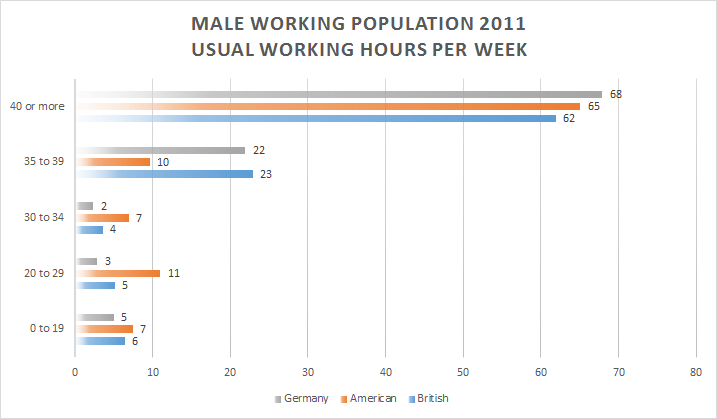
Few men work part-time. Many that do are teenagers. Two-thirds of male workers in America, Britain and Germany work at least 40 hours a week and another quarter worked 35 to 40 hours a week except in the USA. A surprising number of Americans, 11%, worked 20 to 29 hours. If they work that 30th hour, the employer must provide them with health insurance under Obamacare.
Source: OECD Family Database.
13 Nov 2015
by Jim Rose
in economics of love and marriage, labour supply, politics - Australia, politics - New Zealand, politics - USA
Tags: Australia, British economy, France, Ireland, Italy, maternal labour supply, single parents, sole parents, welfare state
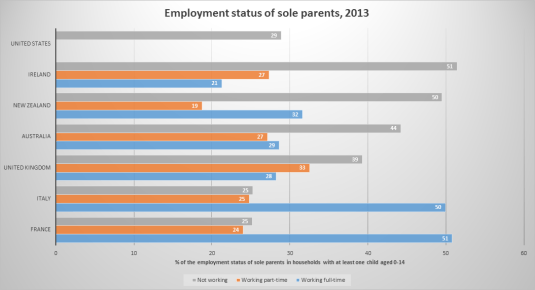
Despite supposedly having stingy welfare states, both New Zealand and Australia have a lot of sole parents who do not work at all. There is no separate breakdown of full-time and part-time work status in the USA. About 72% of sole parents in the USA either work full-time or part-time.
Source: OECD Family Database.
13 Nov 2015
by Jim Rose
in applied price theory, applied welfare economics, economic history, industrial organisation, labour economics, labour supply, survivor principle
Tags: British economy, British history, creative destruction, endogenous growth theory, labour reallocation, technological unemployment
10 Nov 2015
by Jim Rose
in business cycles, economic history, economics of regulation, Euro crisis, job search and matching, labour economics, labour supply, macroeconomics
Tags: British economy, employment law, equilibrium unemployment rate, Eurosclerosis, France, Germany, Italy, labour market reforms, Margaret Thatcher, Thatchernomics, The British Disease
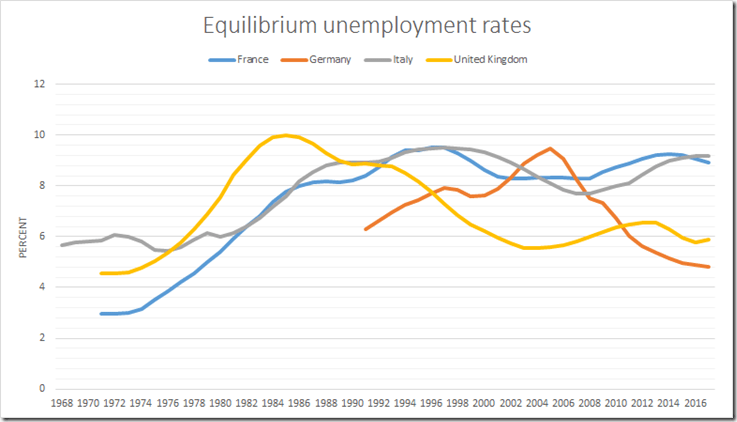
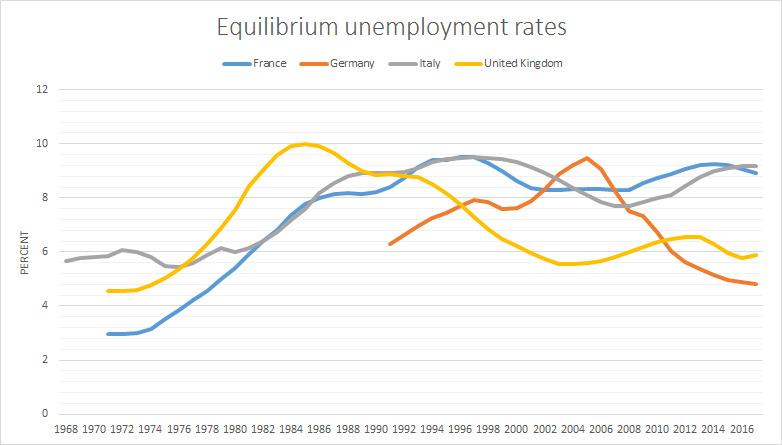
Unlike the USA, the German, Italian, British and French equilibrium unemployment rates all show fluctuations that reflect changes in their underlying economic circumstances and labour market reforms. The case of the British, the rise of the British disease and Thatchernomics. The case of German, its equilibrium unemployment rate rose after German unification and then fell after the labour market reforms of 2002 to 2005.
Source: OECD Economic Outlook November 2015 Data extracted on 10 Nov 2015 07:07 UTC (GMT) from OECD.Stat.
03 Nov 2015
by Jim Rose
in applied welfare economics, economic growth, economic history, macroeconomics, poverty and inequality
Tags: British economy, British politics, Margaret Thatcher, Tony Blair
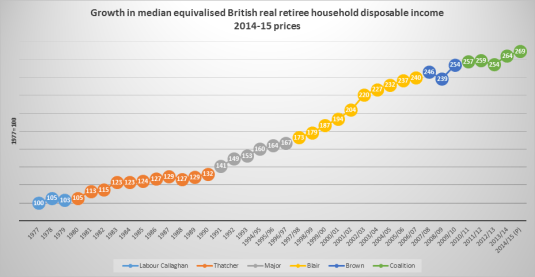
The British disease and the horrors of Thatchernomics past British retirees by as did pretty much the Global Financial Crisis. Slow and steady as she goes under every Prime Minister since 1977 has been year in year out result for the real disposable median incomes of British retired households. Despite it all, British retiree household incomes increased by 170% since the winter of discontent. The fastest growth in retiree incomes was under Tony Blair.
Source: Release Edition Reference Tables – ONS.
Notes:
1 Households are ranked by their equivalised disposable incomes, using the modified-OECD scale.
2 1994/95 represents the financial year ending 1995, and similarly through to 2014/15, which represents the financial year ending 2015.
3 Income figures have been deflated to 2014/15 prices using an implied deflator for the household sector.
It has been a much rockier ride for British households yet to retire. Once again, the only time a sustained real income increases for non-retired households was under Thatcher and Blair. Despite it all, household real incomes have doubled since the winter of discontent. The majority of that doubling was under the dead hand of Tony Blair. British Labour now spends a considerable amount of time repudiating that time of unusually rapid household income growth across all of British society.
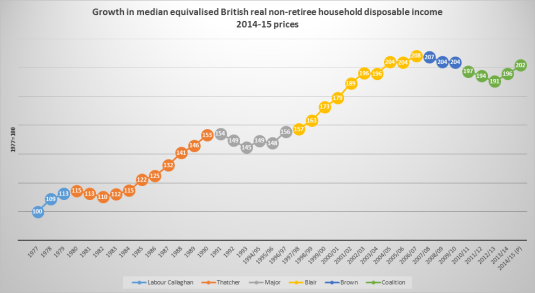
Source: Release Edition Reference Tables – ONS.
Notes:
1 Households are ranked by their equivalised disposable incomes, using the modified-OECD scale.
2 1994/95 represents the financial year ending 1995, and similarly through to 2014/15, which represents the financial year ending 2015.
3 Income figures have been deflated to 2014/15 prices using an implied deflator for the household sector.
25 Oct 2015
by Jim Rose
in discrimination, economics of education, gender, human capital, labour economics, occupational choice, politics - Australia, politics - USA
Tags: Australia, British economy, Canada, reversing gender gap
There are marked differences in progress in tertiary educational attainment between countries and across the generations. For example, while a few more American women have tertiary degrees as compared to their mothers, there’s been no change for American men for a generation.
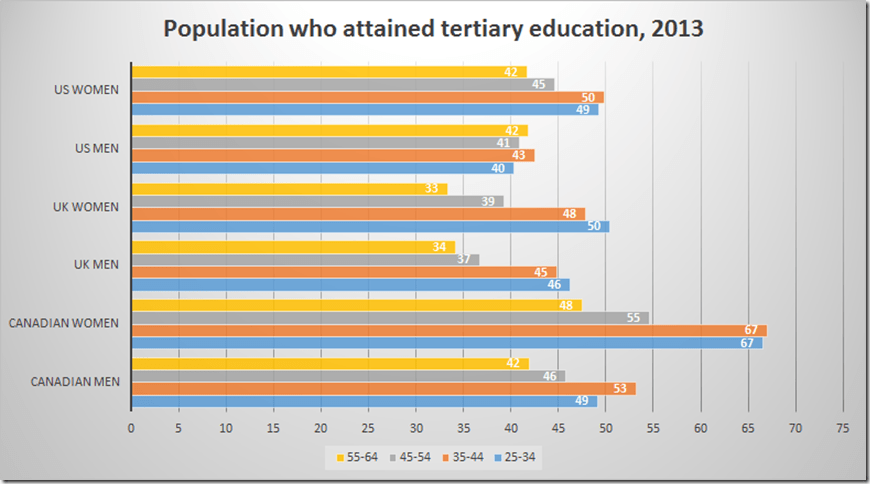
Source: Indicators of Gender Equality in Education – OECD.
Canada is firing ahead in both tertiary educational attainment and reversing the gender gap in education for good. Two thirds of prime age Canadian women have a tertiary degree as compared to half of their mothers.
The number of British women with tertiary degrees is also much higher than their mothers. British men are trying their best to keep up.
19 Oct 2015
by Jim Rose
in discrimination, economics of education, gender, human capital, labour economics, occupational choice, politics - Australia, politics - New Zealand, politics - USA
Tags: Australia, British economy, Canada, College premium, education premium, gender wage gap, Ireland, New Zealand, reversing gender gap
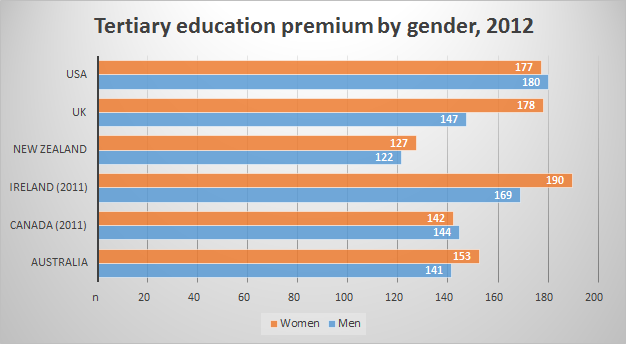
There are large differences in the education premium between English speaking countries and also by gender. The tertiary premium in New Zealand is pretty poor compared to the USA, UK or Ireland and is still mediocre when compared to Australia and Canada.
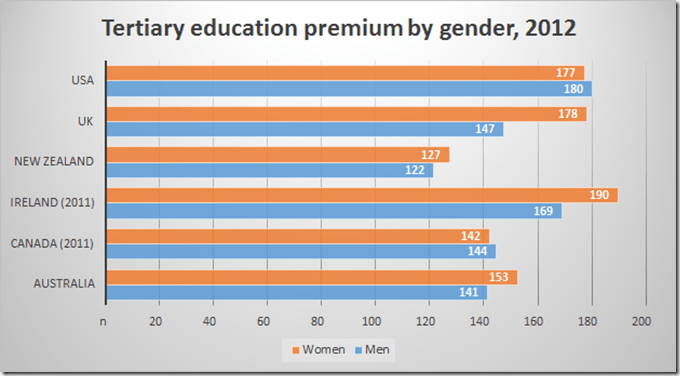
Source: Education at a Glance 2014.
Previous Older Entries Next Newer Entries

 Utopia, you are standing in it!
Recent Comments