Poverty rates among immigrants and natives across the OECD
16 Jul 2015 Leave a comment
in income redistribution, labour economics, politics - Australia, politics - New Zealand, politics - USA, poverty and inequality, welfare reform Tags: Australia, child poverty, economics of immigration, family poverty
If government “programmes have been doing very little to help children out of poverty”, what halved child poverty in the last 20 years? Economic growth?
16 Jul 2015 Leave a comment
in economic growth, labour economics, labour supply, minimum wage, politics - New Zealand, poverty and inequality, unemployment, welfare reform Tags: child poverty, family poverty, family tax credits, in-work tax credits, social insurance, welfare reform, welfare state

RNZ: Govt advised in 2013 "social mobility" approach won't materially address child poverty. rnz.to/1RwVWoj http://t.co/nfd2gY0qcH—
Alastair Thompson (@althecat) July 14, 2015
Figure 1: child poverty (%) in New Zealand (before and after housing costs), 1982 – 2013
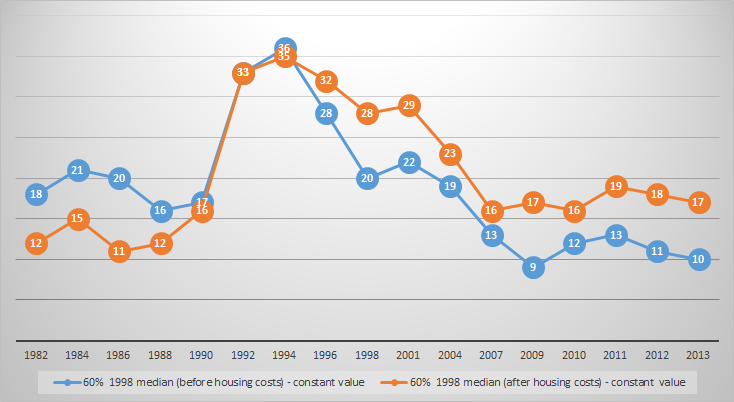
Source: Bryan Perry, Household incomes in New Zealand: Trends in indicators of inequality and hardship 1982 to 2013. Ministry of Social Development (July 2014), Tables F.6 and F.7.
A stunning aspect of The Great Escape since my parents were born
13 Jul 2015 Leave a comment
in applied welfare economics, development economics, economic history, growth disasters, growth miracles, health economics Tags: Africa, British economy, British history, child mortality, child poverty, infant mortality, life expectancies, The Great Enrichment, The Great Escape, The Great Fact
"Today, children in sub-Saharan Africa are more likely…"—Prof. Angus Deaton, @Princeton
Data: buff.ly/1K2tELk http://t.co/lrTdiLi3F7—
HumanProgress.org (@humanprogress) July 12, 2015
Poverty rates by age of youngest child – USA, UK, Canada and Australia
11 Jul 2015 Leave a comment
in economics of love and marriage, labour economics, labour supply, law and economics, politics - Australia, politics - USA, poverty and inequality, welfare reform Tags: Australia, British economy, Canada, child poverty, family poverty, marriage and divorce, single mothers, single parents
Figure 1: poverty rates by age of youngest child, 2004

The Great Escape: infant mortality since 1990
10 Jul 2015 Leave a comment
in development economics, growth disasters, growth miracles, health economics Tags: child poverty, extreme poverty, global poverty, infant mortality, life expectancies, The Great Enrichment, The Great Escape, The Great Fact
Child mortality declined in all world regions.
Here is by how much: http://t.co/06lS3ZELKr—
Max Roser (@MaxCRoser) June 26, 2015
Has NZ child poverty doubled as @MaxRashbrooke said?
09 Jul 2015 1 Comment
in applied welfare economics, economic history, economics of regulation, labour economics, law and economics, politics - New Zealand, poverty and inequality, property rights Tags: Auckland urban limit, child poverty, Director's Law, expressive voting, family poverty, family tax credits, in-work tax credits, land use planning, median voter theorm, rational ignorance, rational irrationality, RMA, top 1%, working for families
Lindsay Mitchell put me onto a quote by veteran grumbler Max Rashbrooke that the child poverty rate doubled in New Zealand:
In a system where income goes disproportionately to the already well-off, ordinary workers are missing out on the rewards of their efforts, to the tune of billions of dollars a year. Welfare benefits, cut by a quarter in 1991 and increased just 8 per cent in the last budget, are far too low to meet people’s basic needs.
The result is a doubling of child poverty and the return of childhood diseases unknown in most developed countries – a national embarrassment, as one researcher described it.
Poverty, income and inequality data is collected in loving detail by Brian Perry every year for the Ministry of Social Development.
Figure 1: % child poverty in New Zealand (before and after housing costs), 60% 1998 median constant value, 1982 – 2013
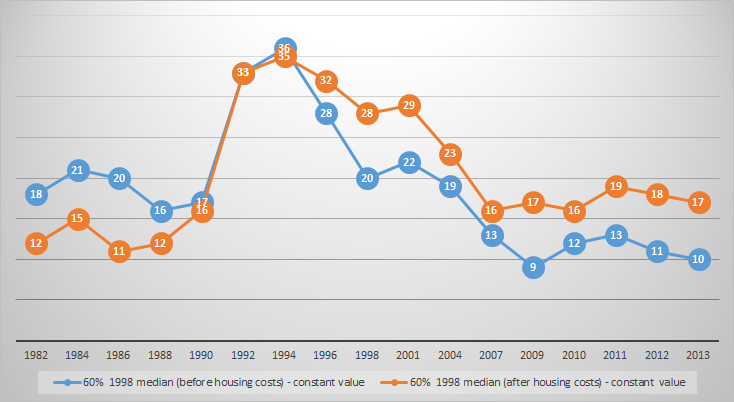
Source: Bryan Perry, Household incomes in New Zealand: Trends in indicators of inequality and hardship 1982 to 2013. Ministry of Social Development (July 2014), Tables F.6 and F.7.
The only thing noticeable in the downward trend in child poverty in New Zealand since its doubling with the sharp recession in 1990 with double-digit unemployment rates is child poverty stop falling shortly after in-work family tax credits were introduced in the form of Working for Families in 2005.
New QV figures show Auckland house prices are up a massive 16.1% on last year, now estimated to reach $1m by Aug '16. http://t.co/DwAU79ozCy—
New Zealand Labour (@nzlabour) June 09, 2015
There was a break in trend in the long decline in child poverty as soon as in-work family tax credits were introduced in New Zealand. I’m sure this is a coincidence because, as Brian Perry said when discussing the introduction of Working for Families in 2005:
The 2004 to 2007 period was the only one in the 25 years to 2007 in which the incomes of low- to middle-income households grew more quickly than those of households above the median.
The real killer in New Zealand in terms of poverty and inequality are housing costs. Housing costs are wholly under the control of government through its control of the supply of land, which is restricted at the behest of the parties of the left.
Figure 2: real equivalised household incomes (before and after housing costs): changes at the top of lowest income decile, New Zealand, 1982 to 2013

Source: Bryan Perry, Household incomes in New Zealand: Trends in indicators of inequality and hardship 1982 to 2013. Ministry of Social Development (July 2014), tables D.2 and D.4.
Figure 2 shows that real equivalised household income after housing costs has not grown and in fact has fallen for the bottom 10% of the income distribution in New Zealand.

It is the left-wing parties who oppose measures to reduce housing costs and and increase the supply of land through reforms to the Resource Management Act and the relaxation of the Auckland metropolitan urban limit.

Labour and the Greens are in effect keeping the poor poor to win middle-class votes.
Figure 3: real equivalised household incomes (before and after housing costs): changes at the top of the top, middle and lowest lowest income deciles, New Zealand, 1982 to 2013
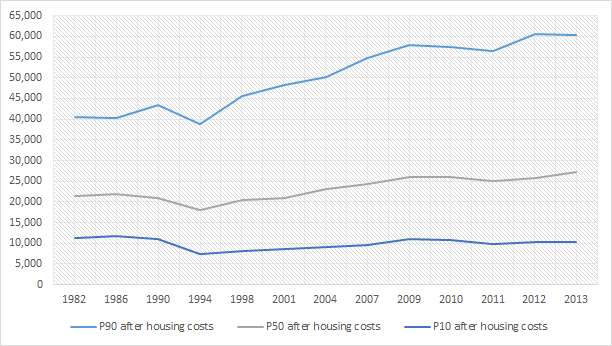
Source: Bryan Perry, Household incomes in New Zealand: Trends in indicators of inequality and hardship 1982 to 2013. Ministry of Social Development (July 2014), tables D.2 in D.4.
Figure 3 shows that those in the middle and higher deciles, a political territory rich in swinging voters, are still doing well after housing costs. The parties of the left are collaborating with a middle-class home owning voter while betraying the working class and its aspirations from home ownership and quite simply affordable housing costs when they rent.
The increases for all groups may be understated by the inability of living standards measures to adequately account for new goods, product upgrades and rising life expectancies.
Poverty rates by number of children – USA, UK, Canada and Australia
08 Jul 2015 Leave a comment
in labour economics, politics - Australia, politics - USA, population economics, poverty and inequality, welfare reform Tags: child poverty, family poverty, single mothers, single parents
Figure 1: poverty rates of adults aged 20 to 54 by presence of children, 2004

Are the rich getting richer, poor getting poorer as @MaxRashbrooke once again suggests?
08 Jul 2015 Leave a comment
in applied welfare economics, economic history, labour economics, politics - New Zealand, poverty and inequality, technological progress Tags: child poverty, family poverty, Leftover Left, Max Rashbrooke, The Great Enrichment, top 1%
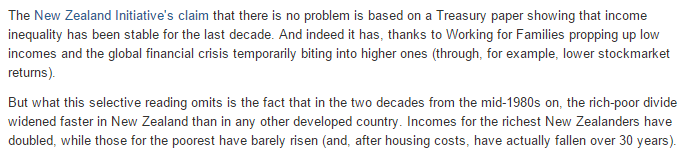
Max Rashbrooke has been at it again in the paper today.

Don’t these graphs show that everyone is richer in New Zealand than 30 years ago and there has been not much change in either child poverty or inequality for coming on for 20 years? The fall in child poverty started before the introduction of Working for Families.
Technological progress in the form of new goods and product upgrades are poorly captured in measures of living standards over time as is increases in life expectancies.
1993 vs 2013: http://t.co/tdnNqmRmcS—
History Pics (@HistoryPixs) January 08, 2014
HT: Suffer the little children – Inequality and child poverty – Closer TogetherCloser Together.
Poverty in the UK
07 Jul 2015 Leave a comment
in poverty and inequality Tags: British economy, child poverty, family poverty
More young adults in poverty as rate drops to record low for pensioners bit.ly/1qZiPnZ http://t.co/3QhofXekWP—
Guardian Data (@GuardianData) November 24, 2014
Only one line in this chart matters
04 Jul 2015 Leave a comment
in applied welfare economics, development economics, economic history, growth disasters, growth miracles Tags: capitalism and freedom, child poverty, extreme poverty, global poverty, Malaysia, The Great Escape, The Great Fact
In #Malaysia inequality and poverty are falling.
More at: bit.ly/1KLUA02 http://t.co/aXEmuA0bnb—
Max Roser (@MaxCRoser) July 02, 2015
Child poverty certainly didn’t go up after the 1996 federal welfare reforms
01 Jul 2015 1 Comment
in gender, labour economics, labour supply, poverty and inequality, welfare reform Tags: 1996, child poverty, economics of fertility, single mothers, single parents, taxation and the labour supply, welfare reforms
Working population poverty is unchanged despite declines in elderly and child poverty #PovertyIs http://t.co/i7O7dTEUg2—
Political Line (@PoliticalLine) June 19, 2015
Child poverty across Europe
28 Jun 2015 Leave a comment
in Euro crisis, poverty and inequality Tags: child poverty, EU, Eurosclerosis, family poverty
Spain's lost decade: one in three Spanish kids live in poverty or at risk of social exclusion: gu.com/p/42yx7/tw http://t.co/qg8PDla19z—
Guardian Data (@GuardianData) October 28, 2014
Food is now much smaller share of the average family’s budget than in the 60s
28 Jun 2015 Leave a comment
in applied welfare economics, labour economics, population economics, welfare reform Tags: child poverty, family poverty, poverty line, poverty measurement, statistics
Child poverty rates in single parent and couple families, Anglo-Saxon countries
22 Jun 2015 Leave a comment
in labour economics, politics - Australia, politics - New Zealand, politics - USA, population economics, poverty and inequality, welfare reform Tags: Australia, British economy, Canada, child poverty, economics of the family, family poverty, Ireland, single mothers, single parents
Figure 1: Child poverty rates by family type, Anglo-Saxon countries, 2010
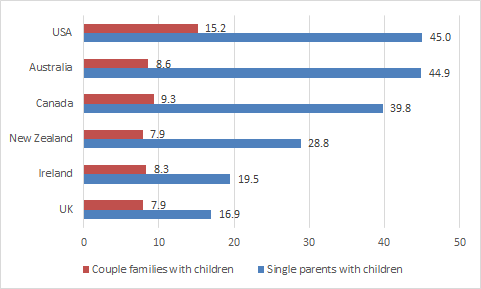
Source: OECD Family Database; Poverty thresholds are set at 50% of the median income of the entire population.
What happened to black family formation in the 1970s?
22 Jun 2015 Leave a comment
in economics of love and marriage, labour economics, labour supply, law and economics, occupational choice Tags: child poverty, economics of the family, family poverty, single mothers, single parents
The War On Poverty has been a disaster for black kids. 2x kids living with unmarried mom. bit.ly/1alPWKB http://t.co/Cwi4C5NtHz—
Old Whig (@aClassicLiberal) April 12, 2015
 Utopia, you are standing in it!
Recent Comments