THE PARIS CLIMATE AGREEMENT WON’T CHANGE THE CLIMATE
17 Feb 2017 Leave a comment
in applied price theory, environmental economics, global warming, Public Choice Tags: climate alarmism, climate treaties, free riding, international public goods
The Paris treaty on global warming explained
07 Jan 2016 Leave a comment
in energy economics, environmental economics, global warming Tags: climate alarmism, climate treaties, free riding, rational irrationality
RT @GreenpeaceNZ are right: Do not send anyone to @cop21 The summit is waste of time
25 Sep 2015 Leave a comment
in environmental economics, global warming, politics - Australia, politics - New Zealand, politics - USA, Public Choice Tags: China, climate alarmism, climate treaties, global warming, green tariffs, Greenpeace, international environmental law, Paris Summit 2015, Twitter left
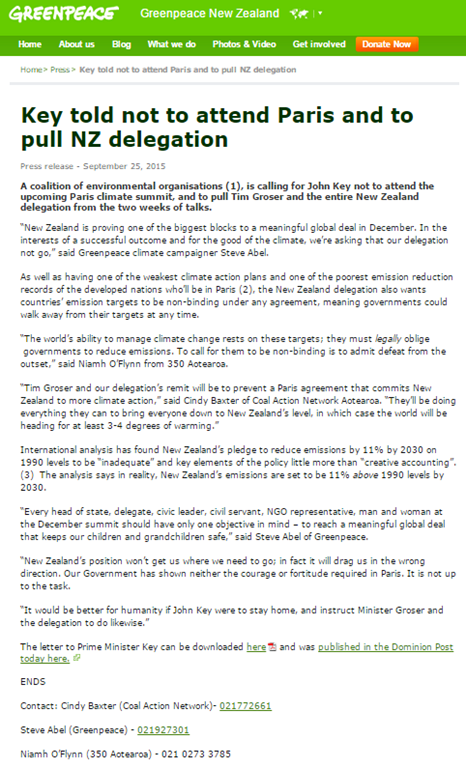
Greenpeace is right in saying in their open letter with others that New Zealand should not send a minister to the climate talks in Paris later this year. I agree for different reasons.
An open letter from @GreenpeaceNZ, @350nz & @coalaction to @johnkeypm not to send anyone to #climate talks in Paris. http://t.co/C1hBJ1teNU—
ActionStation (@actionstation) September 25, 2015
In common with many previous climate summits, the Paris talks will be a futile gesture that will have no significant effect on the pace of global warming and holding the summit is a waste of taxpayers money.
Nothing will come of them because the developing countries have no interest in postponing their development because of a minor inconvenience from global warming.
Do us all a favour @JohnKeyPM, don't send Tim to Paris >> stuff.co.nz/environment/cl… #GroserDontGo #COP21 http://t.co/DaqvPGZ4Ls—
Greenpeace NZ (@GreenpeaceNZ) September 25, 2015
The easy way to tell if there is anything going to happen at a climate summit is the seniority of the delegation.

The Chinese made it clear at the Copenhagen summit in 2009 that they were not interested in an agreement by sending a Vice Minister of Foreign Affairs to a key side meeting of the American and French presidents, the British Prime Minister and the German Chancellor. All subsequent policy manoeuvrings by the Chinese on global warming are an attempt to head off green tariffs on their exports.
Why Obama’s Climate-Change Plan Is Hopeless Without China
05 Aug 2015 Leave a comment
in environmental economics, global warming, politics - USA Tags: China, climate treaties, global warming


What difference did the Kyoto protocol make and that’s before you consider 3rd World development
04 Aug 2015 Leave a comment
in development economics, economic history, energy economics, environmental economics, global warming, growth miracles, politics - Australia, politics - New Zealand, politics - USA Tags: climate alarmism clock, climate treaties, expressive voting, free-riders, Kyoto Protocol, rational ignorance, rational irrationality
Why do @NZGreens want NZ to lead the world by example on a carbon tax, but not unilateral free trade?
31 Jul 2015 Leave a comment
in David Friedman, environmental economics, global warming, international economics, Milton Friedman, Murray Rothbard, politics - New Zealand Tags: antiforeign bias, antimarket bias, carbon tax, carbon trading, climate treaties, expressive voting, free trade, global warming, left-wing double standards, Left-wing hypocrisy, New Zealand Greens, protectionism, rational ignorance, rational irrationality, unilateral free trade


NZ’s greenhouse gas emissions are high per person and unit of GDP but have fallen since 1990 oe.cd/10z http://t.co/f5BMLMvTjq—
OECD Publications (@OECD_Pubs) June 10, 2015
Jane Kelsey opposes handcuffs on the democratic choices of future governments! Does she oppose labour and environmental standards in trade agreements too?
30 Jul 2015 6 Comments
in applied price theory, applied welfare economics, comparative institutional analysis, constitutional political economy, economics of regulation, environmental economics, health economics, industrial organisation, international economic law, international economics, International law, law and economics, property rights, Public Choice Tags: climate treaties, copyrights, customs unions, environmental standards, free trade agreements, free trade zones, intellectual property law, ISDS, Jane Kelsey, Labour standards, Left-wing hypocrisy, neocolonialism, patents, preferential trading agreeents, regional trade agreements, regulatory harmonisation, TPA, TPPA, WTO
Jane Kelsey in a television interview said she opposes the reductions in sovereignty in trade agreements that result from investor-state dispute settlement (ISDS) provisions because they limit the democratic choices of future governments.
If so, she must oppose environmental and labour standards in trade agreements and, more importantly, binding the hands of future governments with climate treaties. All international treaties are about restrictions on sovereignty.
Environmental and labour clauses in trade agreements and climate treaties all limit the powers of governments to legislate on environmental and employment law in accordance with the will of the people as expressed in the most recent election and change of government. Power to the people.
https://twitter.com/rorymccourt/status/625540621457960960
Jane Kelsey would do better focusing on those parts of the TPPA deal that lowers the net value of the deal such as those extending the term of patents over the drugs. All international treaties are about trade-offs.

The most important reason for focusing on intellectual property law in trade agreements is Kelsey is likely to actually win people over that are not on the far left, including many on the right of politics over to her cause. Kelsey is too busy rounding up the usual suspects.

Ranting about big corporate conspiracies and the investor state dispute settlement clauses puts people off.
As copyright duration's at play in #TPPA, a reminder of the costs when copyright's too long.
offsettingbehaviour.blogspot.co.nz/2014/03/orphan… http://t.co/tOtihpDmSU—
Eric Crampton (@EricCrampton) July 29, 2015
These gusts of paranoia lose support on issues where there is common ground to be suspicious about the growing scope of trade agreements and their reach behind borders.

Regulatory harmonisation is advisable only when there are compelling reasons such as the prevention of hazards or technical compatibility of products – do the plugs fit into each other? As Sykes argues:
as a normative matter, harmonization is inferior to a legal system that tolerates regulatory differences subject to legal constraints, and that relies on mutual recognition where appropriate (the exception to this claim being matters of technical compatibility between products).
Related, as a positive manner, harmonization will often lack any political constituency and thus instances of true harmonization will be rare.
How to argue for doing nothing about global warming when arguing for a climate club enforced by green tariffs!
08 Jun 2015 1 Comment
in environmental economics, global warming, politics - Australia, politics - New Zealand, politics - USA, Public Choice Tags: climate treaties, club goods, free-riders, global warming, green tariffs, international public goods
The best case I’ve seen recently for doing nothing about global warming was put by those arguing with the greatest sincerity and considerable technical skill that the next international climate treaty should be built around a climate club of those that comply with its obligations with green tariffs on those who do not join.
I have long argued that green tariffs are the only reason to do anything about climate change. Much better to collect the revenue ourselves than let it go into the pockets of a foreign taxman.
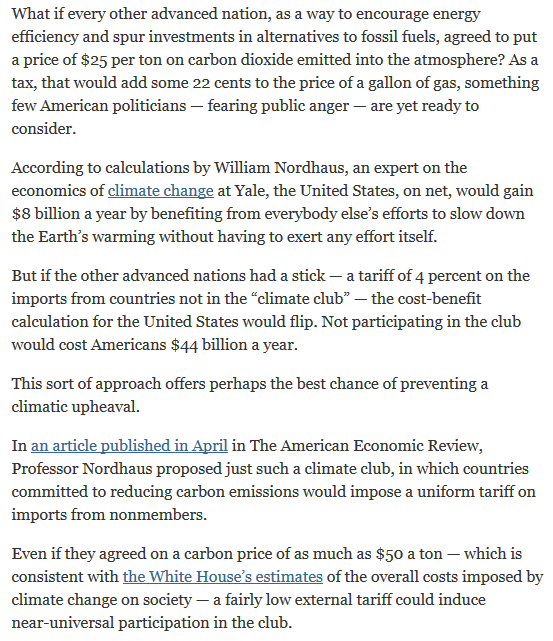
William Nordhaus has proposed climate clubs as a way of overcoming free riding in international climate negotiations. Specifically, the international climate treaty should authorise members to impose green tariffs on non-members to encourage them to impose their own carbon taxes and carbon emission targets. This has been done before with the Montréal protocol on CFCs. To encourage the phase-out of CFCs countries that did not commit to do so simply could not trade in those goods with members of the club.
via Climate Deal Badly Needs a Big Stick – NYTimes.com.
4%! A 4% global green tariff is all that is necessary under a climate change treaty that proposes that a carbon price of $50 to apply globally! A 4% green tariff is hardly worth worrying about considering tariffs used to be much much higher than that.
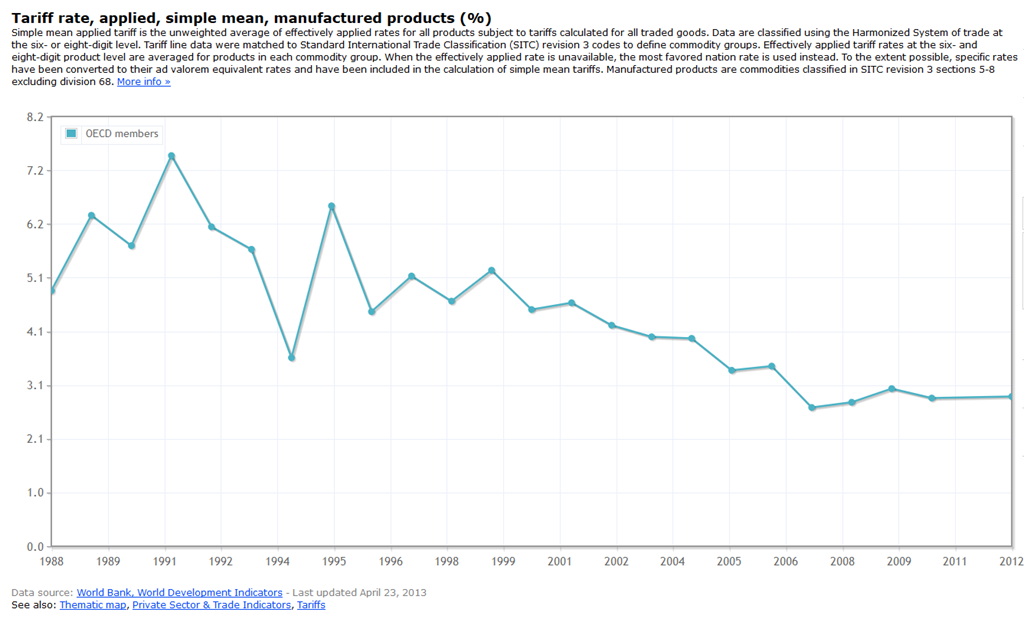
Given all the stories of why woe and doom touted out by the climate alarmists, climate salvation and the keys to environmental heaven should cost much more than 4% tax?! Your sins are forgiven for a 4% green tariff! Big problems such as a climate crisis are not solved with a 4% green tariff.
I think this green tariff of 4% is an own goal. It reinforces the clear message from the economics of climate change that global warming is actually a small economic problem not a large one.
For developed countries, global warming will be at most a minor irritant. For developing countries, their best solution and the solution they have most control over is to develop faster and become a developed country.
 Utopia, you are standing in it!
Recent Comments