More evidence on the emergence of the working rich
25 Oct 2015 Leave a comment
in applied price theory, applied welfare economics, economics of education, entrepreneurship, human capital, labour economics, labour supply, Marxist economics, occupational choice Tags: College premium, creative destruction, education premium, entrepreneurial alertness, graduate premium, Leftover Left, superstar wages, superstars, top 1%
Tertiary education premium by gender in the English-speaking countries, 2012
19 Oct 2015 1 Comment
in discrimination, economics of education, gender, human capital, labour economics, occupational choice, politics - Australia, politics - New Zealand, politics - USA Tags: Australia, British economy, Canada, College premium, education premium, gender wage gap, Ireland, New Zealand, reversing gender gap
There are large differences in the education premium between English speaking countries and also by gender. The tertiary premium in New Zealand is pretty poor compared to the USA, UK or Ireland and is still mediocre when compared to Australia and Canada.
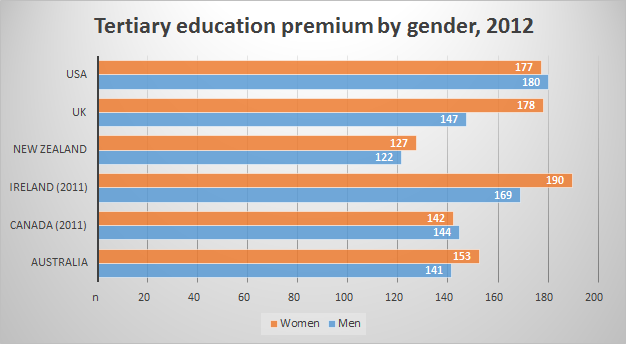
Source: Education at a Glance 2014.
The dating gap on campus
06 Oct 2015 Leave a comment
in economics of education, economics of love and marriage, gender, health and safety, labour economics Tags: assortative mating, asymmetric marriage premium, College premium, dating market, marriage market, power couples, reversing gender gap, search and matching
Why dating in America for college-educated women is completely unfair wapo.st/1L1lULW http://t.co/hTCYCR5GCm—
Know More (@knowmorewp) September 09, 2015
The reversing gender gap in graduate education
01 Oct 2015 Leave a comment
in discrimination, economics of education, gender, human capital, labour economics, occupational choice, politics - USA Tags: College premium, graduate premium, reversing gender gap
6 years of women earning most PhDs, outnumbering men in grad school 136 to100 @Mark_J_Perry khttp://goo.gl/4uoYLV http://t.co/1hYfbDpdST—
AEIdeas Blog (@AEIdeas) September 17, 2015
The explosion in health workers supply
28 Sep 2015 Leave a comment
in economics of education, health economics, human capital, labour supply Tags: College premium, economics of healthcare, education premium, graduate premium
Will the standard policy response to a labour market crisis reduce inequality?
24 Sep 2015 2 Comments
in applied price theory, applied welfare economics, economic history, economics of bureaucracy, economics of education, human capital, labour economics, occupational choice, poverty and inequality, Public Choice Tags: assortative mating, asymmetric marriage premium, College premium, economics of higher education, economics of schooling, economics of universities, graduate premium, marriage and divorce, power couples, university premium
Whenever there is a crisis in the labour market, the standard policy response is send them on a course. That makes you look like you care and by the time they graduate the problem will probably fixed itself. Most problems do. I found this bureaucratic response to labour market crises to repeat itself over and over again while working in the bureaucracy.
Inequality – What can be done?
Stefan Thewissen reviews Tony Atkinson’s book
bit.ly/1h0KDDF http://t.co/KiiGgFQJau—
Max Roser (@MaxCRoser) September 27, 2015
The standard policy response to a normal problem in the labour market is send them on a course. Clever geeks as yourself sitting at your desk as a policy analysis or minister did well at university. You assume others will as well including those who have neither the ability or aptitude to succeed in education. Lowering university tuition fees and easing the terms of student loans simply means that those who do well at university will not have to pay back as much to the government. People who succeed at university already have above average IQs so they already had a good head start in life.
Will more education decrease inequality? A simulation provided an answer. nyti.ms/1xw5m9W http://t.co/paQp19BEWc—
The Upshot (@UpshotNYT) March 31, 2015
The standard solution to growing inequality is to send people on a course. Trouble is that just make smart people wealthier without helping the not so smart and increases the chance of smart men and women marrying off together. This increases the inequality between power couples and the rest.
Higher education is a dog of an investment in #NewZealand
14 Sep 2015 Leave a comment
in economics of education, human capital, labour economics, labour supply, occupational choice, politics - New Zealand Tags: College premium, education premium, graduate premium
How much more will you earn by going to university? It depends hugely on which country you're from http://t.co/7RMnUTM8nj—
paulkirby (@paul1kirby) September 11, 2015
Long-term evidence of the college premium
12 Sep 2015 Leave a comment
in economics of education Tags: College premium, education premium, graduate premium
Always exceptions but BA+ earn more on average than everyone else. seii.mit.edu/wp-content/upl… @anamfores http://t.co/gtO69MetqB—
S Dynarski (@dynarski) September 09, 2015
Does the minimum wage increase unemployment?
20 Aug 2015 Leave a comment
in labour economics, minimum wage, unemployment Tags: College premium, compensating differentials, education premium, evidence-based policy, offsetting behaviour, The fatal conceit, The pretence to knowledge, unintended consequences
https://twitter.com/MiltonFriedmanS/status/630956276554444800/photo/1
#Australia:highest minimum wage in OECD relative to purchasing power. Increases #youthunemployment #auspol #jobsearch http://t.co/HML9l2rD7R—
Bob Day (@senatorbobday) August 11, 2015
Graduate premium in starting wages
31 Jul 2015 Leave a comment
in economics of education, human capital, labour economics, labour supply Tags: College premium, graduate premium
The gender wage gap by educational attainment
28 Jul 2015 Leave a comment
in discrimination, economics of education, gender, human capital, labour economics, occupational choice Tags: College premium, education premium, gender wage gap
Men's and Women's Earnings by Education (Ph'Ds are the most equal) bit.ly/153m9jZ http://t.co/IPfT15Qwiz—
Catherine Mulbrandon (@VisualEcon) September 03, 2013
What group has by far the lowest jobless rate?
17 Jul 2015 Leave a comment
in economics of education, human capital, job search and matching, labour economics, labour supply, occupational choice, unemployment Tags: College premium, compensating differentials, graduate premium, labour demographics
What group has by far the lowest jobless rate? College grads on.wsj.com/1Mtk8l9 http://t.co/27ft9qYjvz—
WSJ Central Banks (@WSJCentralBanks) June 05, 2015
Does education pay in New Zealand?
14 Jul 2015 Leave a comment
in economics of education, human capital, labour economics, occupational choice, politics - Australia, politics - New Zealand, politics - USA Tags: College premium, graduate premium
 Utopia, you are standing in it!

Recent Comments