Over 20 years ago, some middling economists (cite) estimated that the Small Business Set-Aside program reduced Forest Service Timber prices by 15%. By limiting the potential pool of available bidders to only smaller lumber mills, you get less competition and worse prices. Now San Francisco is re-learning that lesson. In 2016, it refused to do…
Using procurement for political ends gives you worse prices.
Using procurement for political ends gives you worse prices.
09 Mar 2024 Leave a comment
in applied price theory, economics of bureaucracy, entrepreneurship, income redistribution, industrial organisation, law and economics, politics - USA, Public Choice, public economics, rentseeking, theory of the firm, transport economics, urban economics Tags: cartels, competition and monopoly, competition law
Four Myths about Price Discrimination
26 Feb 2024 Leave a comment
in applied price theory, history of economic thought, industrial organisation Tags: competition and monopoly

In an earlier post, Soda Prices are Too Low for the FTC, the Biden Administration seems to be trying to turn back the clock to a time when price discrimination was viewed as bad. Lest we repeat the mistakes of the past, it is worthwhile to remember its lessons. See this 2003 talk by some middling FTC…
Four Myths about Price Discrimination
Quotation of the Day…
07 Oct 2023 Leave a comment
in applied price theory, economic history, history of economic thought, industrial organisation Tags: competition and monopoly, competition law
Tweet… is from page 5 of Gabriel Kolko’s 1963 book, The Triumph of Conservatism: Contrary to the consensus of historians, it was not the existence of monopoly that caused the federal government to intervene in the economy [in the late 19th and early 20th centuries], but the lack of it. DBx: Market competition is astonishingly…
Quotation of the Day…
Initial Reactions to the Amazon Antitrust Case
28 Sep 2023 Leave a comment
in industrial organisation, law and economics Tags: competition and monopoly, competition law
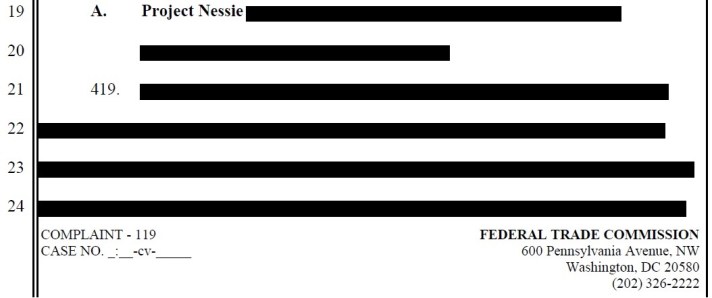
The Federal Trade Commission and 17 state attorneys general have sued Amazon.com, as the FTC press release says, “alleging that the online retail and technology company is a monopolist that uses a set of interlocking anticompetitive and unfair strategies to illegally maintain its monopoly power.” The FTC complaint filed with the US District Court for…
Initial Reactions to the Amazon Antitrust Case
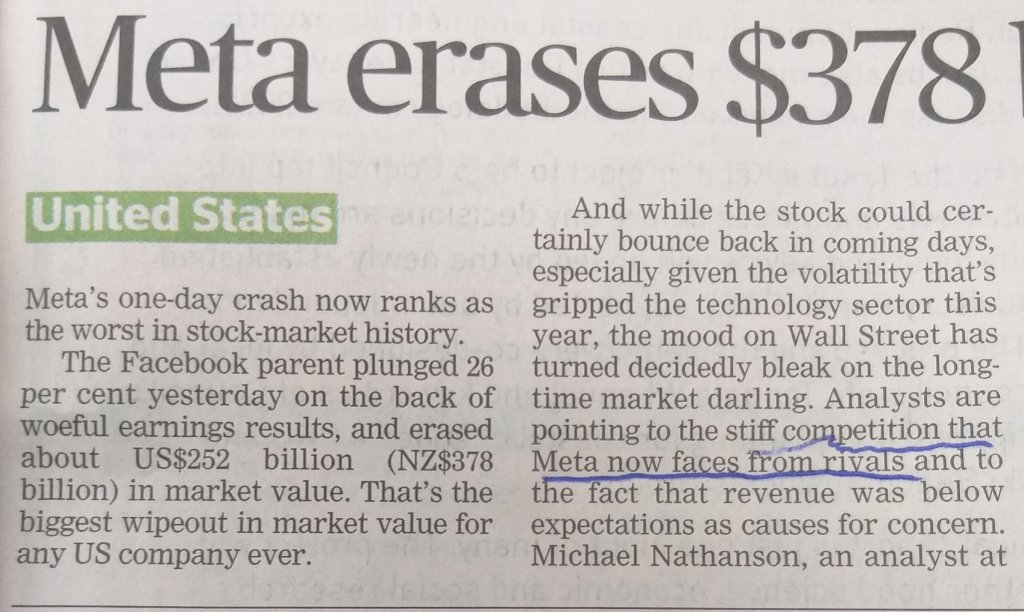
But @Facebook is decried as a monopoly!?
05 Feb 2022 Leave a comment
in applied price theory, entrepreneurship, financial economics, industrial organisation, law and economics, politics - USA Tags: competition and monopoly, competition law, creative destruction
Judge Frank Easterbrook on antitrust law history
23 Sep 2020 Leave a comment
in Adam Smith, applied price theory, applied welfare economics, Austrian economics, comparative institutional analysis, economic history, economics of bureaucracy, economics of crime, economics of education, economics of information, economics of regulation, entrepreneurship, history of economic thought, industrial organisation, law and economics, politics - USA, Public Choice, rentseeking, Richard Posner, Ronald Coase, Ronald Coase, survivor principle Tags: competition and monopoly, competition law, creative destruction, offsetting behaviour, patents and copyright, The fatal conceit, The meaning of competition, unintended consequences
Wonder if @NZComCom shared this conclusion back then about successful browser monopolization?
16 Mar 2019 Leave a comment
in applied price theory, Austrian economics, economic history, entrepreneurship, industrial organisation, law and economics, survivor principle Tags: competition and monopoly, creative destruction, natural monopolies

The Costs and Benefits of Monopoly
18 Dec 2017 Leave a comment
in applied price theory, industrial organisation Tags: competition and monopoly, creative destruction
Anti-competitive mergers make little sense to me
04 Aug 2016 Leave a comment
in applied price theory, industrial organisation, survivor principle Tags: competition and monopoly, competition law, mergers and takeovers
There are two main arguments against mergers and acquisitions. The first of these is that they are paper shuffling with little in the way of cost advantages. The second is they allow the combined firm to raise its prices because it faces less competition.
I find these arguments to be in direct contradiction. Anti-competitive mergers must be high risk venture if there is little in the way of cost savings. Two previously efficient firm sizes are disturbed permanently in the hope of some ability to raise prices in the future without provoking too much new entry or expansion from the competitive fringe.
It is far better just to keep on colluding or just compete rather than risk permanently damaging the efficient operation of both firms.
Why are there too many castles on the Rhine river?
09 Jul 2016 Leave a comment
in applied price theory, industrial organisation Tags: competition and monopoly, monopoly pricing
Is Monopoly a Justification for Government Regulation?
08 Jun 2016 Leave a comment
in applied price theory, Austrian economics, economics, economics of regulation, industrial organisation, survivor principle Tags: antitrust economics, competition and monopoly, monopoly, natural monopolies
Milton Friedman on the ultimate consumer protection
03 Oct 2015 Leave a comment
in applied price theory, applied welfare economics, entrepreneurship, industrial organisation, Milton Friedman, survivor principle Tags: competition and monopoly, consumer protection, consumer sovereignty, The meaning of competition
Mises on entrepreneurs and consumer sovereignty
21 Sep 2015 Leave a comment
in applied price theory, Austrian economics, economic history, industrial organisation, Ludwig von Mises, survivor principle Tags: competition and monopoly, consumer sovereignty, creative destruction, entrepreneurial alertness, market selection, The meaning of competition
 Utopia, you are standing in it!
Recent Comments