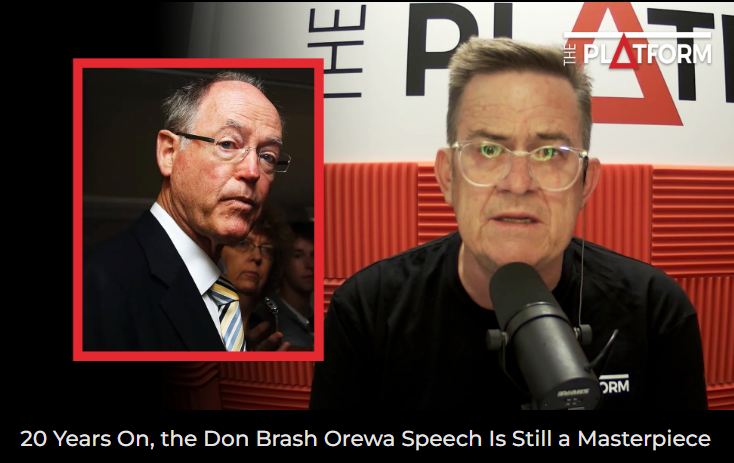
On February 1 Sean Plunket re-played the audio of Don Brash’s 2004 Orewa speech at The Platform. To listen to the entire speech, go here. Alternatively, the full text of the speech is reproduced below. Today Don reflects: “It’s very long – really far too long for a Rotary Club speech. I should have taken…
Last year, I criticized the lawsuit of Disney against Florida after losing its special status in the former Reedy Creek Improvement District. U.S. District Judge Allen Winsor in Tallahassee appears to view the matter as dimly as I did. He just dismissed the action in a major loss for the House of Mouse.
Why try to stop that evolution? Brian Easton writes – In 1956, historian Ruth Ross presented her investigations of the treaty signed at Waitangi on 6 February 1840 to a seminar concluding, ‘The [Māori and Pakeha] signatories of 1840 were uncertain and divided in their understanding of [Te Tiriti’s] meaning; who can say now what […]
Below is my column in The Hill on the worsening situation at the Southern border and how the Supreme Court laid the seeds for this crisis over a decade ago. The courts have left few options for either the states or Congress in compelling the enforcement of federal law. Here is the column:
Last Sunday, the Sunday Star-Times recalled on its front page the “fiery debate” triggered by my speech to the Orewa Rotary Club just 20 years earlier. Articles by several authors in the same paper brought the debate up-to-date and warned of the dangers of ACT’s Treaty Principles Bill, which the National Party’s coalition agreement with…
Michael Bassett writes – Shane Jones deserves full support for his round-arm swing at the Waitangi Tribunal which is now fiddling about with a constitutional inquiry and deciding who can take part in it. A clause in New Zealand First’s coalition agreement with the National Party commits the government to amending the Waitangi Tribunal’s legislation […]
Shane Jones deserves full support for his round-arm swing at the Waitangi Tribunal which is now fiddling about with a constitutional inquiry and deciding who can take part in it. A clause in New Zealand First’s coalition agreement with the National Party commits the government to amending the Waitangi Tribunal’s legislation so that the body…
The King returned from the hospital today after undergoing treatment for an enlarged prostate on Friday. According to the BBC, there was no delegation of royal authority during his stay in the hospital. This approach is in marked contrast to that of the United States where Presidents have temporarily transferred their powers to the Vice-President […]
When ACT’s leader said they wanted legislation to state what the Treaty Principles mean, my first thought was this will controversial and divisive. Clearly it is. The first reference to the Principles of the Treaty were contained in the 1975 Act establishing the Treaty of Waitangi Tribunal. But the Principles were not defined by Parliament, then or […]
Buzz from the Beehive Just one statement has been posted on the government’s official website since Attorney-General Judith Collins announced the appointment of a new High Court Judge late last week. It deals with education and the government’s aims to get better results from school students.
Two years ago, I wrote a column denouncing Canadian Prime Minister Justin Trudeau’s use of a counter-terrorism law to shut down the Freedom Convoy trucker protests as an authoritarian attack on free speech. Now, a Canadian court has agreed and ruled that the use of the Emergencies Act was unlawful and “unreasonable.” Despite Trudeau’s attacks […]
The Cavalier Parliament of England lasted from May 8, 1661 until January 24, 1679. It was the longest English Parliament, and longer than any Great British or UK Parliament to date, enduring for nearly 18 years of the quarter-century reign of King Charles II of England, Scotland and Ireland. Like its predecessor, the Convention Parliament, […]
Screeds have been written about the Treaty of Waitangi. And there’s more to come as division over race and rights ramps up.Its content and meaning are getting lost in the crossfire and the danger of ‘contestants’ talking past each other looms, if not already happening.When matters get murky, and misunderstandings abound, there is also a…
Last Friday night, TV One’s lead item on the 6pm news was a story by reporter Te Aniwa Hurihanganui. She had scored a leaked piece of advice not yet considered by Cabinet that was intended to warn ministers in the new government that they would run into trouble with Maori if they backed David Seymour’s…
Why Evolution is True is a blog written by Jerry Coyne, centered on evolution and biology but also dealing with diverse topics like politics, culture, and cats.
In Hume’s spirit, I will attempt to serve as an ambassador from my world of economics, and help in “finding topics of conversation fit for the entertainment of rational creatures.”


Recent Comments