Facebook is now worth more than Walmart
buff.ly/1fuvV7V h/t @DKThomp
$FB $WMT buff.ly/1fuvSZB http://t.co/FtIIJP3EGN—
Ninja Economics (@NinjaEconomics) June 22, 2015
Facebook is now worth more than Wal-Mart
25 Jun 2015 Leave a comment
in economic history, economics of media and culture, entrepreneurship, financial economics, industrial organisation, survivor principle Tags: creative destruction, entrepreneurial alertness, Facebook, Walmart
Creative destruction in electronic devices
23 Jun 2015 Leave a comment
in economic history, economics of media and culture, entrepreneurship, technological progress Tags: creative destruction, smartphone, The Great Enrichment
Innovation is letting us accomplish more with less. Learn more: buff.ly/1LmtAZD #tech #progress http://t.co/e2kQlGu3NA—
HumanProgress.org (@humanprogress) June 22, 2015
GM’s 1956 vision of a self drive car by 1976
22 Jun 2015 Leave a comment
in economic history, economics of media and culture, entrepreneurship, industrial organisation, survivor principle, transport economics Tags: creative destruction, self drive cars
How planes evolved
21 Jun 2015 Leave a comment
in technological progress, transport economics Tags: aviation, creative destruction, innovation
Someone figured out that planes evolve like birds… and made charts about it! My favorite! sciencecodex.com/law_of_physics… http://t.co/NxqgWtXjZ2—
Tyler Vigen (@TylerVigen) July 23, 2014
Creative destruction in legacy media revenues
16 Jun 2015 Leave a comment
in economics of media and culture, entrepreneurship, industrial organisation, survivor principle Tags: creative destruction, economics of advertising, entrepreneurial alertness, legacy media, market selection
The media needs a new formula for paying for news gathering, says @bradwarthen: brook.gs/1JlfWUT http://t.co/QDGti24x1f—
Brookings (@BrookingsInst) May 15, 2015
Is Uber taking British customers for a ride?
14 Jun 2015 Leave a comment
in economics of regulation, entrepreneurship, industrial organisation, survivor principle Tags: creative destruction, taxi regulation, Uber
Is Uber taking British customers for a ride? i100.io/40kqOqH http://t.co/ok7UJmmgNQ—
i100 (@thei100) June 11, 2015

The digital consumption boom continues in New Zealand
12 Jun 2015 Leave a comment
in economics of media and culture, industrial organisation, politics - New Zealand Tags: creative destruction, ICT

TIL America Online is still in business
12 Jun 2015 Leave a comment
in economic history, entrepreneurship, industrial organisation, survivor principle Tags: creative destruction, entrepreneurial alertness, market selection
After 18 years of acquisitions, sales, and spinoffs, AOL is still holding its own bloom.bg/1IwBaQp http://t.co/Qjwd94THPB—
Bloomberg VisualData (@BBGVisualData) May 17, 2015
The rising gales of creative destruction in brewing
09 Jun 2015 Leave a comment
in economic history, economics of regulation, entrepreneurship, health economics, industrial organisation, survivor principle Tags: alcohol regulation, beer brewing, creative destruction, entrepreneurial alertness, innovation
Breweries in the US http://t.co/rcYlpmJspa—
Charts and Maps (@ChartsandMaps) April 11, 2015
Rise of private R&D and the fall of public R&D
06 Jun 2015 Leave a comment
in applied price theory, economic history, entrepreneurship, industrial organisation, politics - USA, rentseeking, survivor principle, technological progress Tags: creative destruction, entrepreneurial alertness, private R&D, public R&D, R&D

Creative destruction in digital devices
01 Jun 2015 Leave a comment
in economics of media and culture, entrepreneurship, industrial organisation, survivor principle, technological progress Tags: cell phones, creative destruction, entrepreneurial alertness, PCs, smart phones, The Great Enrichment
1993 vs 2013: http://t.co/tdnNqmRmcS—
History Pics (@HistoryPixs) January 08, 2014
How much of the top 0.1% are now working rich in the USA, 1916–2013, and Canada, 1946–2007
01 Jun 2015 Leave a comment
in economic history, entrepreneurship, human capital, industrial organisation, labour economics, labour supply, occupational choice, survivor principle Tags: Canada, CEO pay, creative destruction, entrepreneurial alertness, super-entrepreneurs, superstar wages, superstars, top 0.1%, top 1%, working rich
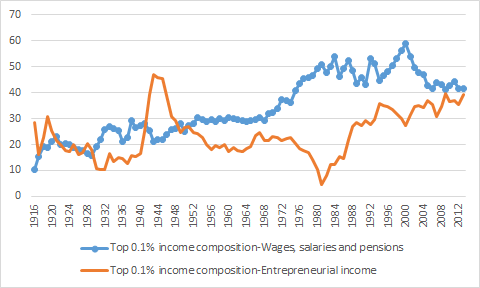
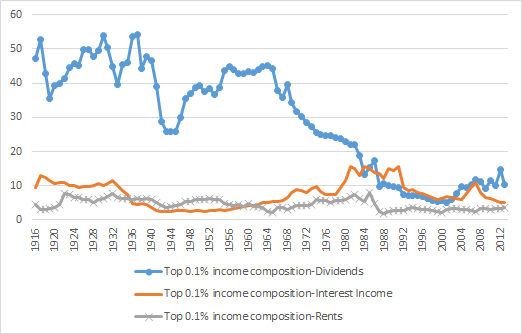
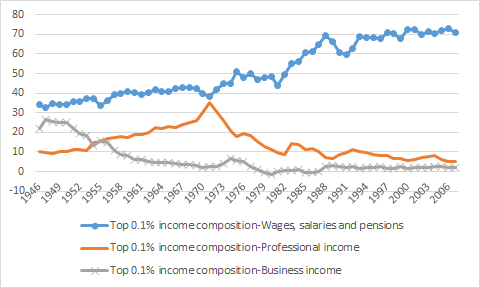
Piketty and Saez (2003) concluded that a substantial fraction of the rise in top incomes was due to surging top wage incomes. They concluded that top executives (the ‘working rich’) replaced top capital owners (the ‘rentiers’) at the top of the income hierarchy.
That conclusion still holds for both the USA and Canada. The largest portion of the top 0.1% in both countries have become those earning wages. The top 0.1% are top wage earners who work for their livings founding, building or directing businesses.
Figure 1: percentage of top 0.1% with wages, salaries, pensions or entrepreneurial incomes, USA, 1916 – 2013
Source: Alvaredo, Facundo, Anthony B. Atkinson, Thomas Piketty and Emmanuel Saez, The World Top Incomes Database.
Figure 2: percentage of top 0.1% with incomes from interest, dividends and rents, USA, 1916 – 2013
Source: Alvaredo, Facundo, Anthony B. Atkinson, Thomas Piketty and Emmanuel Saez, The World Top Incomes Database.
Figure 3: percentage of top 0.1% with wage salary and pension incomes, business incomes and professional incomes, Canada, 1946 – 2007
source : Alvaredo, Facundo, Anthony B. Atkinson, Thomas Piketty and Emmanuel Saez, The World Top Incomes Database.
Figure 4: percentage of top 0.1% with dividend, interest or investment incomes, Canada, 1946 – 2007

Source: Alvaredo, Facundo, Anthony B. Atkinson, Thomas Piketty and Emmanuel Saez, The World Top Incomes Database.
Creative destruction in television prices in New Zealand
01 Jun 2015 1 Comment
in economics of media and culture, entrepreneurship, politics - New Zealand, technological progress Tags: creative destruction, good old days


Recent Comments