Why do inmates tattoo their faces?
30 Sep 2015 Leave a comment
Alan Blinder and Fed Speak
18 Sep 2015 Leave a comment
in business cycles, macroeconomics, monetary economics, organisational economics Tags: central banks, cheap talk, credible commitments, economics of central banking, Fed speak, inflation targeting, The Fed
When President Clinton appointed Alan Blinder to be deputy chair of the Fed, his big hope was to find out what Alan Greenspan really thought rather than the public facade of gobbledygook. The term Fedspeak (also known as Greenspeak) is what Alan Blinder called "a turgid dialect of English" used by Federal Reserve Board chairmen in making wordy, vague, and ambiguous statements. Greenspan described it this way:

To Blinder’s astonishment, Alan Greenspan spoke just the same as he did at monetary policy meetings of the Fed as he did in public! Blinder never disagreed fundamentally with Greenspan about monetary policy.
Greg Mankiw on the zero influence of modern macroeconomics on monetary policy making
17 Sep 2015 1 Comment
in business cycles, history of economic thought, inflation targeting, macroeconomics, managerial economics, monetarism, monetary economics, organisational economics Tags: Alan Blinder, Alan Greenspan, credible commitments, Greg Mankiw, modern macroeconomics, monetary policy, neo-Keynesian macroeconomics, new classical macroeconomics, The Fed, timing inconsistency
Two of my brothers studied economics in the early 1970s and then went on to different paths in law and computing respectively. If Greg Mankiw is right, my two older brothers could happily conduct a conversation with a modern central banker. Their 1970s macroeconomics, albeit batting for memory, would be enough for them to hold their own.
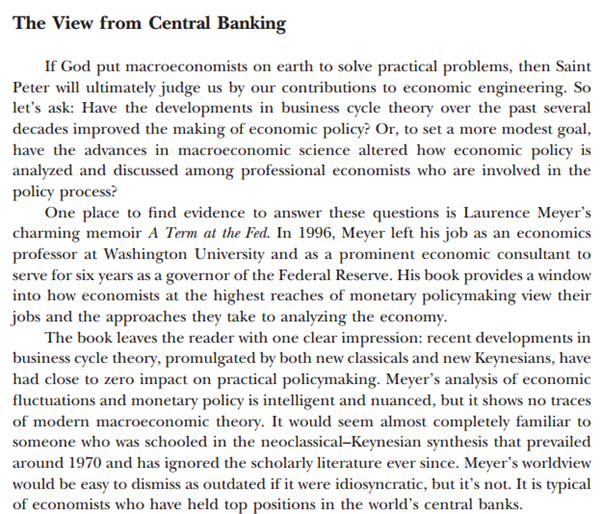
Source: AEAweb: JEP (20,4) p. 29 – The Macroeconomist as Scientist and Engineer – Greg Mankiw (2006).
I would spend my time arguing with a central banker that Milton Friedman may be right and central banks should be replaced with a computer. The success of inflation targeting is forcing me to think more deeply about that position. In particular the rise of pension fund socialism means that most voters are very adverse to inflation because of their retirement savings and that is before you consider housing costs are much largest proportions of household budgets these days.
Explanation of the Greece Bailout in 90 Seconds
13 Aug 2015 Leave a comment
in budget deficits, business cycles, currency unions, economic growth, fiscal policy, international economic law, international economics, International law, macroeconomics Tags: credible commitments, Eurosclerosis, game theory, Greece, sovereign bailouts, sovereign defaults
The Power of Propaganda and the Japanese Empire
09 Aug 2015 Leave a comment
in laws of war, Public Choice, war and peace Tags: atomic bombings, credible commitments, game theory, Japan, World War II
The quote of Schuler is an excellent summary of the difficulty of bringing a war to an end rather than give time to regroup and attack again.

Economist Kurt Schuler has a fascinating post on the various currencies that were used in mainland East Asia during World War II over at the Free Banking group blog.
Unfortunately, there are three paragraphs in the post that attempt to take libertarians to task for daring to challenge both the narrative of the state and the narrative of the nation regarding that horrific reminder of humanity’s shortcomings. He is writing of the certainty of the US’s moral clarity when it came to fighting Japan (the post was published around Pearl Harbor remembrance day):
The 1940 U.S embargo of certain materials frequently used for military purposes was intended to pressure Japan to stop its campaign of invasion and murder in China. The embargo was a peaceful response to violent actions. Japan could have stopped; it would have been the libertarian thing to do. For libertarians to claim that the embargo was…
View original post 1,475 more words


How to negotiate a treaty on global warming
20 Mar 2014 Leave a comment
in climate change, economics, environmental economics, politics, Thomas Schelling Tags: credible commitments, free riding, international collective action, treaty negotiations
I found the best writer on global warming to be Thomas Schelling. Schelling has been involved with the global warming debate since chairing a commission on the subject for President Carter in 1980.

Schelling is an economist who specialises in strategy so he focuses on climate change as a bargaining problem. Schelling drew from his experiences with the negotiation of the Marshall Plan and NATO.
International agreements rarely work if they talk in terms of results. They work better if signatories promise to supply specific inputs – to perform specific actions now.
- Individual NATO members did not, for example, promise to slow the Soviet invasion by 90 minutes if it happened after 1962.
- NATO members promised to raise and train troops, procure equipment and supplies, and immediately deploy these assets geographically. All of these actions can be observed, estimated and compared quickly. The NATO treaty was a few pages long.
The Kyoto Protocol commitments were not based on actions but on results, to be measured after more than a decade and several elections and a recession or two in between.
Climate treaties should promise to do certain actions now such as invest in R&D and develop carbon taxes that return the revenue as tax cuts. If the carbon tax revenue is fully refunded as tax cuts, less reliable countries, in particular, have an additional incentive to collect the carbon tax properly to keep their budget deficits under control.
Si vies pacem, para bellum
17 Mar 2014 Leave a comment
in Public Choice, Thomas Schelling, war and peace Tags: credible commitments, Strategy of Conflict, Thomas Schelling, war and diplomacy
The Roman maxim ‘If you want peace, prepare for war’ is about the power of credible commitments in avoiding a violent form of bargaining called war. If you look threatening – have a great power to hurt – you can compel people to do what you want, which includes not attack you. Threats are cheap especially when you do not have to carry them out. You get what you want without any fighting.
Those that show the greatest credible prior commitment – those that burn their bridges – extract much more from bargaining that those that have options to fall back on. People fear cornered opponents.
Who picks a fight with someone who looks crazy or cannot back down? Who picks a fight with someone who carries himself or herself like a seasoned bar fighter?
As explained by David Friedman:
“Consider a bar room quarrel that starts with two customers arguing about baseball teams and ends with one dead and the other standing there with a knife in his hand and a dazed expression on his face.
Seen from one standpoint, this is a clear example of irrational and therefore uneconomic behaviour; the killer regrets what he has done as soon as he does it, so he obviously cannot have acted to maximize his own welfare.
Seen from another standpoint, it is the working out of a rational commitment to irrational action – the equivalent, on a small scale, of a doomsday machine going off.
Suppose I am strong, fierce, and known to have a short temper with people who do not do what I want. I benefit from that reputation; people are careful not to do things that offend me.
Actually beating someone up is expensive; he may fight back, and I may get arrested for assault. But if my reputation is bad enough, I may not have to beat anyone up.
To maintain that reputation, I train myself to be short-tempered. I tell myself and others that I am a real he-man, and he-men don’t let other people push them around. I gradually expand my definition of “push me around” until it is equivalent to “don’t do what I want.”
We usually describe this as an aggressive personality, but it may make just as much sense to think of it as a deliberate strategy rationally adopted.
Once the strategy is in place, I am no longer free to choose the optimal response in each situation; I have invested too much in my own self-image to be able to back down…
Not backing down once deterrence has failed may be irrational, but putting yourself in a situation where you cannot back down is not. Most of the time I get my own way; once in a while I have to pay for it.
I have no monopoly on my strategy; there are other short-tempered people in the world.
I get into a conversation in a bar. The other guy fails to show adequate deference to my opinions.
I start pushing. He pushes back. When it is over, one of us is dead.”
Tom Schelling’s fellow Nobel Prize winning game theorist Robert Aumann argued well that the way to peace is like bargaining in a medieval bazaar. Never look too keen, and bargain long and hard, for otherwise people will take great advantage of you! But again to quote Schelling:
“A government never knows just how committed it is to action until the occasion when its commitment is challenged.
Nations, like people, are continually engaged in demonstrations of resolve, tests of nerve, and explorations for understandings and misunderstandings…
This is why there is a genuine risk of major war not from ‘accidents’ in the military machine but through a diplomatic process of commitment that is itself unpredictable.”
That is why there was World War I. A state also can be tempted to start a war now to avoid having to deal with a stronger opponent in the future. That is why Britain and France declared war on Germany in 1939.
 Utopia, you are standing in it!
Recent Comments