

Celebrating humanity's flourishing through the spread of capitalism and the rule of law
17 Sep 2015 Leave a comment
in economics of crime, economics of education, human capital, labour supply, occupational choice, poverty and inequality Tags: behavioural genetics, crime and punishment, criminal deterrence, economics of early childhood education, economics of families, economics of fertility, economics of personality traits, marriage and divorce, single parents
17 Sep 2015 Leave a comment
in applied price theory, economics of crime Tags: cognitive psychology, crime and punishment, criminal deterrence, economics of personality traits, psychiatry, psychopaths, Robert Hare, social psychology
17 Sep 2015 2 Comments
in economic history, economics of crime, law and economics, politics - USA Tags: crime and punishment, crime rates, criminal deterrence, law and order, New York City
I went looking for the uptick in murders in U.S. cities. Here’s what I found. wapo.st/1QdNA0m http://t.co/w2dc8rnoFu—
Max Ehrenfreund (@MaxEhrenfreund) September 04, 2015
17 Sep 2015 2 Comments
in economics of crime, law and economics, politics - USA Tags: crime and punishment, law and order, police, police shootings, road accidents, road safety
I followed the coding by the Guardian despite reservations. Including those struck by police cars in routine accidents, none of them police chases, conflates one database with another and does not touch on the issue of the wisdom of police car chases. Including people who drive cars at police or flee with kidnapped children in a car is stretching the definition of unarmed. The wisdom of shooting at a car with children in it is a separate issue. The safety of the hostage taker is not a responsibility of the police, the safety of the children kidnapped in that car was.

Source: The Counted: people killed by police in the United States in 2015 – interactive | US news | The Guardian accessed 1 p.m. 16 September 2015 New Zealand standard Time.
About 10% of police shootings of unarmed people resulted in murder charges and a few of those still under investigation read as suspicious and may result in charges as well as more evidence is gathered.
Our count as of this afternoon is 823. Have a tip? Tweet us at @thecounted or visit theguardian.com/thecounted/tips http://t.co/96AM7pNPGH—
The Counted (@thecounted) September 14, 2015
That 10% figure of police shootings that result in murder charges is much higher if you exclude people who collapsed while in contact with police from underlying poor health either in a struggle or after being tasered – 20 or more out of 62, drove cars at police (3), killed in crossfire (2) or were killed in police car accidents (5). The figure is even higher when you exclude a good number of those who are struggling with police and the police fired in self defence lawfully. That is, if a police officer shoot someone at a safe distance without good cause, they face a high probability of being charged with murder.
The database I used today for the above figure on shooting of unarmed Blacks takes less than an hour to work your way through to code them for yourself, so if you doubt my coding, do your own coding and put up a rival figure. I will even consider a guest blog by you if you lack a forum.
Update: When I shared this post on the dataisbeautiful sub-reddit, the first comment on that post was to denounce me as a racist for sharing.
16 Sep 2015 Leave a comment
in economics of crime, law and economics, politics - New Zealand Tags: crime and punishment, criminal deterrence, law and order, police, police shootings

Source: The Counted: people killed by police in the United States in 2015 – interactive | US news | The Guardian Accessed 1 a.m. New Zealand standard Time 15th September 2015.

Source: The Counted: people killed by police in the United States in 2015 – interactive | US news | The Guardian Accessed 1 a.m. New Zealand standard Time 15th September 2015.

Source: The Counted: people killed by police in the United States in 2015 – interactive | US news | The Guardian Accessed 1 a.m. New Zealand standard Time 15th September 2015.

15 Sep 2015 1 Comment
in economics of crime, law and economics, politics - USA, transport economics Tags: crime and punishment, law and order, police, police shootings, road accidents, road safety
I am surprised that the Guardian did not do this graphical analysis themselves. My analysis below shows the quite a few people were unarmed but many more were carrying guns, knives or other weapons.

Source: The Counted: people killed by police in the United States in 2015 – interactive | US news | The Guardian Accessed 1 a.m. New Zealand standard Time 15th September 2015.
You have to read through every individual data entry to work out how many of those killed had guns, and the many of these were shooting at police when they were shot dead. The same legwork is required to find out how many officers are on murder charges after killing civilians.
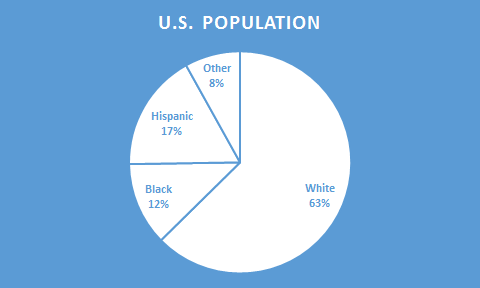
13 Sep 2015 Leave a comment
in economic history, economics of crime, economics of media and culture, health and safety, health economics, labour economics, law and economics, Music, occupational choice Tags: crime and punishment, homicide rates, law and order, suicide
What kills popular musicians? Depends on the genre http://t.co/BTDvdWOS4F—
paulkirby (@paul1kirby) September 11, 2015
12 Sep 2015 Leave a comment
in economics of crime, law and economics Tags: crime and punishment, criminal deterrence, law and order, marriage and divorce
Domestic murder rates in the U.S. have fallen by nearly 50 percent for female partners. buff.ly/1Nksz5C http://t.co/ihEfDir6mj—
HumanProgress.org (@humanprogress) September 07, 2015
An update on ‘Better Angels’ by S. Pinker bit.ly/1M4mhUJ
New data shows violence remains in retreat overall. http://t.co/zgR41QxsZO—
Max Roser (@MaxCRoser) September 12, 2015
11 Sep 2015 2 Comments
in economics of crime, law and economics, politics - USA Tags: body cameras, crime and punishment, criminal deterrence, law and economics of evidence, law and order, Leftover Left, police, police shootings, presumption of innocence, William Blackstone
The Guardian is so anti-police that they included in their interactive database a drunk that drove into a police car and some poor bastard run over by the police cruiser searching for him at night.
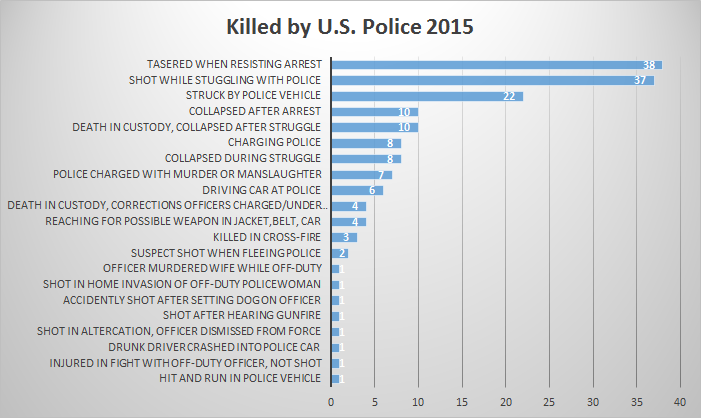
Another handy hint for an unarmed suspect is do not flee police by stealing a police cruiser with the officer dragging behind you. He may well shoot you. Police will certainly shoot an unarmed suspect if they flee arrest in a police cruiser, kidnapping the two children who happened to be in the back – their parents expect no less.

Most of the police killings of the unarmed in circumstances where better evidence would resolve doubts.

The Guardian would do a lot better by arguing that all Tasers should have cameras on them, all police cruisers should have cameras in them, and all police officers should have cameras on their lapels. These cameras are excellent for collecting evidence against criminals. There should also be plenty of cameras in police stations.

The first randomized controlled trial of police body cameras in the USA showed that cameras sharply reduce the use of force by police and the number of citizen complaints. In Seattle, the police department has set up its own YouTube channel, broadcasting a stream of blurred images to protect privacy.
Update: I recoded charging police and reaching for a possible weapon on your person or in a car into separate categories
10 Sep 2015 Leave a comment
in economics of crime, law and economics, politics - USA Tags: crime and punishment, deaths in custody, expressive voting, law and order, Leftover Left, police, police shootings
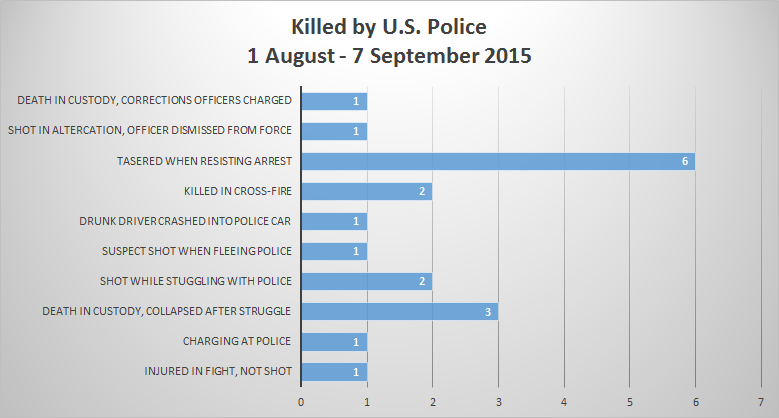
In coding the data from The Guardian interactive website, I included all 19 people they classified as unarmed and killed by police including
Unarmed people should not charge at armed police, struggle for their guns, or refuse to comply when threatened with a Taser, especially if poor of health or have a weak heart.
In the only two cases of police malfeasance – three corrections officer beating a prisoner to death or a trigger-happy police officer – charges have been laid or the officer dismissed pending further investigation. The man shot while fleeing police was a murder suspect.
War on Police? Or one of the safest years in law enforcement since 1887? @Mark_J_Perry goo.gl/qNQ2lO http://t.co/2zPjZmG2fQ—
AEIdeas Blog (@AEIdeas) September 09, 2015
28 Aug 2015 Leave a comment
in discrimination, economics of crime, economics of love and marriage, labour economics, law and economics, politics - New Zealand, population economics, poverty and inequality, unemployment, urban economics, welfare reform Tags: crime and punishment, criminal deterrence, economics of the family, racial discrimination, single mothers, single parents, teen pregnancies
Did Mass Incarceration Destroy the Black Family? Not exactly. bit.ly/1f8jgXm http://t.co/1q2nKJnU9W—
City Journal (@CityJournal) August 13, 2015
27 Aug 2015 Leave a comment
in economics of crime, law and economics, technological progress Tags: creative destruction, crime and punishment, drones, entrepreneurial alertness
I welcome #amazon drones. But I also think future drone rustlers will shoot down or net them. New crime opportunity. http://t.co/KjAuqhA8Lm—
Danny Rose (@_DannyRose) July 30, 2015
15 Aug 2015 2 Comments
in applied price theory, economics of bureaucracy, economics of crime, history of economic thought, industrial organisation, law and economics, liberalism, Milton Friedman, Public Choice Tags: cartel theory, crime and punishment, criminal deterrence, organised crime, war on drugs
14 Aug 2015 Leave a comment
in economic history, economics of crime, law and economics, politics - USA Tags: crime and punishment, criminal deterrence, law and order, New York City
Nice WSJ graph of the remarkable decline in crime in NYC since 2002. on.wsj.com/19XvVY5 http://t.co/iLDNufelVB—
Miles Kimball (@mileskimball) December 31, 2013
Celebrating humanity's flourishing through the spread of capitalism and the rule of law
Scholarly commentary on law, economics, and more
Beatrice Cherrier's blog
Celebrating humanity's flourishing through the spread of capitalism and the rule of law
Celebrating humanity's flourishing through the spread of capitalism and the rule of law
Celebrating humanity's flourishing through the spread of capitalism and the rule of law
Why Evolution is True is a blog written by Jerry Coyne, centered on evolution and biology but also dealing with diverse topics like politics, culture, and cats.
Celebrating humanity's flourishing through the spread of capitalism and the rule of law
Celebrating humanity's flourishing through the spread of capitalism and the rule of law
A rural perspective with a blue tint by Ele Ludemann
DPF's Kiwiblog - Fomenting Happy Mischief since 2003
Celebrating humanity's flourishing through the spread of capitalism and the rule of law
The world's most viewed site on global warming and climate change
Tim Harding's writings on rationality, informal logic and skepticism
A window into Doc Freiberger's library
Let's examine hard decisions!
Commentary on monetary policy in the spirit of R. G. Hawtrey
Thoughts on public policy and the media
Celebrating humanity's flourishing through the spread of capitalism and the rule of law
Politics and the economy
A blog (primarily) on Canadian and Commonwealth political history and institutions
Reading between the lines, and underneath the hype.
Economics, and such stuff as dreams are made on
"The British constitution has always been puzzling, and always will be." --Queen Elizabeth II
Celebrating humanity's flourishing through the spread of capitalism and the rule of law
Celebrating humanity's flourishing through the spread of capitalism and the rule of law
WORLD WAR II, MUSIC, HISTORY, HOLOCAUST
Undisciplined scholar, recovering academic
Celebrating humanity's flourishing through the spread of capitalism and the rule of law
Res ipsa loquitur - The thing itself speaks
Celebrating humanity's flourishing through the spread of capitalism and the rule of law
Researching the House of Commons, 1832-1868
Articles and research from the History of Parliament Trust
Reflections on books and art
Posts on the History of Law, Crime, and Justice
Celebrating humanity's flourishing through the spread of capitalism and the rule of law
Exploring the Monarchs of Europe
Cutting edge science you can dice with
Small Steps Toward A Much Better World
“We do not believe any group of men adequate enough or wise enough to operate without scrutiny or without criticism. We know that the only way to avoid error is to detect it, that the only way to detect it is to be free to inquire. We know that in secrecy error undetected will flourish and subvert”. - J Robert Oppenheimer.
The truth about the great wind power fraud - we're not here to debate the wind industry, we're here to destroy it.
Celebrating humanity's flourishing through the spread of capitalism and the rule of law
Celebrating humanity's flourishing through the spread of capitalism and the rule of law
Economics, public policy, monetary policy, financial regulation, with a New Zealand perspective
Celebrating humanity's flourishing through the spread of capitalism and the rule of law
Restraining Government in America and Around the World

/cdn0.vox-cdn.com/uploads/chorus_asset/file/3966560/11754389_920572351334762_1285855543300283646_o.jpg)


 Utopia, you are standing in it!
Recent Comments