Spurious correlations alert: executions and murder rates – updated

– Updated

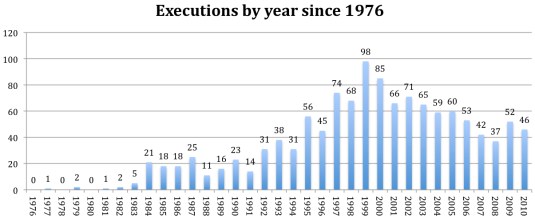
Many a data shyster will make hay with the above chart on the simple correlation between executions and the drop in the US murder rate.

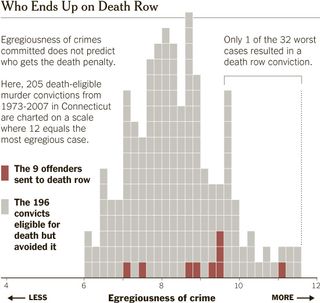
The reality is there are so few executions and they are so infrequent with the exception of Texas that any purported correlation between the death penalty and murder rates requires careful study.

f2tcnowyz0wa9sdjikdrhg

Indeed, for some condemned prisoners, gang bangers are an example, their life expectancy may be increased by the long time they spend on death row versus been murdered by a business associated or a business rival on the streets. As Levitt noted:

no rational criminal should be deterred by the death penalty, since the punishment is too distant and too unlikely to merit much attention.

As such, economists who argue that the death penalty works are put in the uncomfortable position of having to argue that criminals are irrationally overreacting when they are deterred by it.

08editorial-grx-popup

The occupational hazard of been murdered by business rival for gang bangers is higher than the chance of them been arrested, tried , convicted, and condemned to death and then executed after a long appeals process. Not surprisingly, Levitt argued that:

…the quality of life in prison is likely to have a greater impact on criminal behaviour than the death penalty.

Using state-level panel data covering the period 1950–90, we demonstrate that the death rate among prisoners (the best available proxy for prison conditions) is negatively correlated with crime rates, consistent with deterrence. This finding is shown to be quite robust.

In contrast, there is little systematic evidence that the execution rate influences crime rates in this time period.

Chapple and Boston on the extent of welfare benefit fraud in New Zealand

What is more surprising about this honest disclosure of welfare  fraud to the Household Labour Force Survey of Statistics New Zealand in 2011 is  these welfare beneficiaries were so upfront about their criminal fraud.

These estimates must underestimate the extent of welfare fraud because some of these criminals would be aware that they should be slightly discreet in the company of any government official when discussing their eligibility for welfare benefits and any false information supplied in their claims for welfare benefits.

Some welfare cheats are alert to this  basic criminal skill and do not claim their benefit if called in to the welfare benefits  office for a reassessment of their eligibility. They don’t have the front to go near a government official while defrauding the taxpayer.

Yes, welfare fraud is a crime so people who perpetrated these crimes by obtaining welfare benefits under false pretences are criminals. If these criminals are caught, they are prosecuted for a crime and sometimes sent to prison.

HT: Muriel Newman

There is nearly a 70% chance that an African American man without a high school diploma will be imprisoned by his mid-30s.

Does going to prison deter crime – evidence from prison overcrowding litigation

Steve Levitt is known for the clever use of data to test hypothesis, for present purposes, of the deterrent effect of prison.

The econometrics of deterrence are complicated by the fact that increases in the number of prisoners are likely to reduce crime, but rising crime rates also translate into larger prison populations. Which came first?

Levitt found a clever way of testing whether the imprisonment had a deterrent effect by looking at what happened after successful litigation against overcrowded prisons.

When prisons became less crowded, were more people willing to risk prison because it was a less unpleasant experience?

Overcrowding litigation reduces the number of people in prison, but this change in the size of the prison population is unlikely to be related to fluctuations in the crime rate.

These lawsuits affect prison populations, but may be otherwise unrelated to crime rates especially because they take a decade or more to resolve. The prison population is falling because of the successful litigation and nothing else.

In 13 states, lawsuits affected a state’s entire prison system. In the three years after a final judgement was handed down, prison populations fell by 14.3% compared to the population of the nation as a whole; violent and property crime rates increased 10.2% and 5.5% respectively.

Levitt found that the responsiveness of crime to prison populations was two to three times greater than previous studies:

For each one-prisoner reduction induced by prison overcrowding litigation, the total number of crimes committed increases by approximately 15 per year.

The social benefit from eliminating those 15 crimes is approximately $45,000; the annual per prisoner costs of incarceration are roughly $30,000.

In another study, Levitt found the quality of life in prison has a greater impact on crime than the death penalty. He showed the death rate among prisoners (the best proxy for prison conditions) is negatively correlated with crime rates, consistent with deterrence. Criminals do not like to be sent to unpleasant, dangerous prisons.

Speeding fines are rather steep in Victoria

Can crime be deterred: hijackings as a case study of the increase in the probability of apprehension

In 1977, William Landes published a classic study of crime and punishment. He investigated what happened to the number of hijackings in the USA after mandatory screening of passengers and their carry-on luggage was introduced in 1973.

During the peak period of hijackings, 1968 to 1972, the probability of apprehension the hijacker was 15%. For those hijackers that were caught, their average prison sentence was 30 years in 1972 to 1974. One quarter of hijackers were committed to mental institutions. Hijackings became so common that:

[a]irliners carried approach plans for the Havana airport and crews were instructed not to resist hijackers. There were also standard diplomatic procedures for obtaining the return of planes and passengers

No hijackers were killed during the course of their crimes until 1971. After that, there is about a 10% chance of the hijacker being shot dead. Air marshals started riding on US planes in 1970;  there were about 1200 of these  air marshals, who had to be about the most boring job in the world.

The primary purpose of hijackings in the USA in the late 60s and early 70s in the USA initially was to obtain free transport to Cuba for the political purposes or to avoid prosecution for crimes. However, in the early 1970s, this demand for air transport started to decline as news filtered back about how poorly these hijackers were treated in Cuba. A few of these hijackers chose to return to the United States.

Interestingly, the substitute for flying to Cuba was para-hijackers. They demanded a ransom of an average of $300,000 and then parachuted out of the plane.  One out of 18 succeeded. Their average prison sentence for the 11 that survived was 43 years.

Hijacking incidences from 1930-1976 from the study of William Landes of University of Chicago Law School focused on hijacking's economic impact. Study was done in year 1977.

As the table above shows, the number of hijackings in the USA  immediately fell from over 20 per year, with a maximum of 38 in 1969, to one or two per year after the introduction of mandatory screening of passengers and their carry-on luggage In 1973.

All hijackers were apprehended between 1973 and 1976. Apparently, hijackers  of all breeds and political complexions do not enjoy the prison experience. Criminals don’t like to be caught.

Interestingly, lunatics could be deterred. They retained sufficient capacity for planning to abandon their plans to hijack a plane because of the inevitability of arrest at the boarding gate after the metal detector sounded off from 1973 onwards. Only to the 12 offenders that were apprehended for attempted hijacking between 1973 and 1976 were committed to mental institutions. The remaining 10 were just plain stupid.

If lunatics cannot be deterred, do not respond incentives, they should  have continued to hijack planes at the same rate as prior to the introduction of mandatory screening in 1973.

That said, mandatory screening was not cheap, which may explain why airlines and their passengers were putting up with up to 40 hijackings per year, as Landes explained using 1977 dollar, which was back when a dollar actually bought something:

Although the mandatory screening program is highly effective in terms of the number of hijackings prevented, its costs appear enormous.

The estimated net increase in security costs due to the screening program (which does not include the time and inconvenience costs to persons searched) is $194.24 million over the 1973 to 1976 period.

This, in turn, translates into a $3.24 to $9.25 million expenditure to deter a single hijacking. Put differently, if the dollar equivalent of the loss to an individual hijacked passenger were in the range of $76,718 to $219,221, then the costs of screening would just offset the expected hijacking losses.

I should add, however,that air travel was much more expensive and much less frequent in 1973. The jumbo jet had only been introduced two years previous. Air travel is much more frequent these days so would the contemporary travelling public be willing to put up with the equivalent of hundreds of hijackings per year?

cuba plane hijacked, Northwest Orient Airlines plane

Caption: A Northwest Orient Airlines plane that was hijacked on July 1, 1968, is pictured at the Miami International Airport after returning from Cuba.

What did happen after the crackdown on hijacking  was the terrorists change tactics.  Embassy takeovers another type of sieges surged. Prior to the crackdown on hijacking, these were rare.

When embassies became fortified, the terrorists instead started kidnapping or murdering diplomats after they left the Embassy compound. As Walter Enders and Todd Sandler found

The existence of complements and substitutes means that policies designed to reduce one type of attack may affect other attack modes.

For example, the installation of metal detectors in airports reduced skyjackings and diplomatic incidents but increased other kinds of hostage attacks (barricade missions, kidnappings) and assassinations.

In the long run, embassy fortification decreased barricade missions but increased assassinations.

Well, It was an emergency

Image

The spill-over benefits of unobservable victim precautions such as Lojack

Ian Ayres and Steven Levitt looked at the impact of Lojack  –  a hidden radio-transmitter device used for retrieving stolen vehicles.

There is no external indication that Lojack has been installed, so it does not directly affect the likelihood that a protected car will be stolen. 

Ian Ayres and Steven Levitt attempted to measure its general deterrence effect: they found  that the availability of Lojack is associated with a sharp fall in auto theft. Rates of other crime do not change appreciably. There was also a small but observable tendency for older-model cars to be stolen. presumably because these were somewhat less likely to have a Lojack transmitter.


The marginal social benefit of an additional unit of Lojack has been fifteen times greater than the marginal social cost in high crime areas. Those who install Lojack obtain less than 10 percent of the total social benefits, leading to under-provision by the market.

The impact of the burglar resistant locks and windows on burglary rates

The Dutch government mandated the use of burglar-resistant locks and window and door frames in all new residential construction as of January 1, 1999. The regulation has now affected close to a million homes. The security was built-in and did not require any change in behaviour.

Figure 1:. Victimisation of burglary by year of construction of the home, the Netherlands

When comparing homes built just before and just after the change in the regulation, Vollaard and Van Ours (2011) found that homes with the built-in security to have a 26% lower rate of burglary.

HT: voxeu.org/reducing-invitation-crime

How to spot law-abiding people with DUI convictions

Fraudster Alan Knight jailed for £40,000 scam after pretending to be in a coma for two years | Daily Mail Online

But doctors spotted Knight - pictured with wife, Helen - eating, wiping his face and writing while he was in hospital for observations

doctors spotted Knight – pictured with wife, Helen – eating, wiping his face and writing while he was in hospital for observations

via Fraudster Alan Knight jailed for £40,000 scam after pretending to be in a coma for two years | Daily Mail Online.

Does the lower crime rate in the USA have something to do with harsher penalties and three strikes laws?

Source: DavidSkarbek

The World’s Most Corrupt Diplomats, As Told Through Parking Tickets

parking

Kuwait tops the list, with 246 violations per diplomat, followed by Egypt (under Mubarack), Chad, Sudan and Bulgaria. At the bottom, with no violations, are 21 diverse countries including not just the ever-polite U.K., Japan and Canada.

Most U.N. diplomats have improved their parking behaviour since 2002 when the U.S. began withholding parking fines from foreign aid payments: violations fell by 90% immediately after the measure was passed.

The British High Commissioner to New Zealand, plate DC1, nearly ran me over at pedestrian crossing yesterday outside the Wellington library, so this is not an unbiased post.

He was travelling too fast to stop in the central business district, where the speed limit is 30 kilometres per hour. You should not speed near pedestrian crossings because people are trying to walk out onto it. 

The politics of women’s self defence tips

Image

The deterrent effect of the sentences handed down in the immediate aftermath of the London riots 2011

Savage criminal sentences were handed down by the courts in the days after the London riots in 2011.

  • Nicholas Robinson (aged 23) was sentenced to 6 months imprisonment for stealing bottles of water (worth £3.50) from a looted shop in Brixton. His previous good character and early plea of guilty to a non-dwelling burglary, as well as the low value of goods stolen, the fact he was in education, and his remorse, were in his favour. These meant the magistrate decided to not send him up to the Crown Court where he would face a possible higher sentence.
  • Danielle Corns (19) was sentenced to 10 months for stealing two left-footed trainers in Wolverhampton and leaving them outside the shop.
  • Two 20-year olds were sentenced to 4 years imprisonment for creating a Facebook riot event in Northwich (which didn’t occur and to which no one attended).

7 out of 10 of sentences issued in the aftermath of the London riots were upheld in full in the Court of Appeal. Any reductions were modest. The longer sentence handed out was 23 years for conspiracy to murder to the leader of a gang who planned to drive to the riots carrying guns to attack the police.

Carpetright store after Tottenham riots.jpg

Brian Bell, Laura Jaitman and Stephen Machin (2014) used this sudden change in the judicial wind to measure the impact of tough sentences on crime.

Across London, they found a significant drop in “riot crimes” – burglary, criminal damage and violence against the person – over the six months following the riots.

Other crimes showed a tendency to increase, as though criminals were substituting away from these “expensive” crimes and towards the “cheaper” ones.

Crime is occupation choice: criminals commit crime because they find that profitable to do so. When criminals  anticipate that crime will be less profitable and more likely to be accompanied by the prison experience, less crimes are committed.

HT: timharford.com

Previous Older Entries Next Newer Entries

Bassett, Brash & Hide

Celebrating humanity's flourishing through the spread of capitalism and the rule of law

Truth on the Market

Scholarly commentary on law, economics, and more

The Undercover Historian

Beatrice Cherrier's blog

Matua Kahurangi

Celebrating humanity's flourishing through the spread of capitalism and the rule of law

Temple of Sociology

Celebrating humanity's flourishing through the spread of capitalism and the rule of law

Velvet Glove, Iron Fist

Celebrating humanity's flourishing through the spread of capitalism and the rule of law

Why Evolution Is True

Why Evolution is True is a blog written by Jerry Coyne, centered on evolution and biology but also dealing with diverse topics like politics, culture, and cats.

Down to Earth Kiwi

Celebrating humanity's flourishing through the spread of capitalism and the rule of law

NoTricksZone

Celebrating humanity's flourishing through the spread of capitalism and the rule of law

Homepaddock

A rural perspective with a blue tint by Ele Ludemann

Kiwiblog

DPF's Kiwiblog - Fomenting Happy Mischief since 2003

The Dangerous Economist

Celebrating humanity's flourishing through the spread of capitalism and the rule of law

Watts Up With That?

The world's most viewed site on global warming and climate change

The Logical Place

Tim Harding's writings on rationality, informal logic and skepticism

Doc's Books

A window into Doc Freiberger's library

The Risk-Monger

Let's examine hard decisions!

Uneasy Money

Commentary on monetary policy in the spirit of R. G. Hawtrey

Barrie Saunders

Thoughts on public policy and the media

Liberty Scott

Celebrating humanity's flourishing through the spread of capitalism and the rule of law

Point of Order

Politics and the economy

James Bowden's Blog

A blog (primarily) on Canadian and Commonwealth political history and institutions

Science Matters

Reading between the lines, and underneath the hype.

Peter Winsley

Economics, and such stuff as dreams are made on

A Venerable Puzzle

"The British constitution has always been puzzling, and always will be." --Queen Elizabeth II

The Antiplanner

Celebrating humanity's flourishing through the spread of capitalism and the rule of law

Bet On It

Celebrating humanity's flourishing through the spread of capitalism and the rule of law

History of Sorts

WORLD WAR II, MUSIC, HISTORY, HOLOCAUST

Roger Pielke Jr.

Undisciplined scholar, recovering academic

Offsetting Behaviour

Celebrating humanity's flourishing through the spread of capitalism and the rule of law

JONATHAN TURLEY

Res ipsa loquitur - The thing itself speaks

Conversable Economist

Celebrating humanity's flourishing through the spread of capitalism and the rule of law

The Victorian Commons

Researching the House of Commons, 1832-1868

The History of Parliament

Articles and research from the History of Parliament Trust

Books & Boots

Reflections on books and art

Legal History Miscellany

Posts on the History of Law, Crime, and Justice

Sex, Drugs and Economics

Celebrating humanity's flourishing through the spread of capitalism and the rule of law

European Royal History

Exploring the Monarchs of Europe

Tallbloke's Talkshop

Cutting edge science you can dice with

Marginal REVOLUTION

Small Steps Toward A Much Better World

NOT A LOT OF PEOPLE KNOW THAT

“We do not believe any group of men adequate enough or wise enough to operate without scrutiny or without criticism. We know that the only way to avoid error is to detect it, that the only way to detect it is to be free to inquire. We know that in secrecy error undetected will flourish and subvert”. - J Robert Oppenheimer.

STOP THESE THINGS

The truth about the great wind power fraud - we're not here to debate the wind industry, we're here to destroy it.

Lindsay Mitchell

Celebrating humanity's flourishing through the spread of capitalism and the rule of law

Alt-M

Celebrating humanity's flourishing through the spread of capitalism and the rule of law

croaking cassandra

Economics, public policy, monetary policy, financial regulation, with a New Zealand perspective

The Grumpy Economist

Celebrating humanity's flourishing through the spread of capitalism and the rule of law

International Liberty

Restraining Government in America and Around the World