Oh my, the violent crime rate in Europe is higher than the US (and growing). onlinelibrary.wiley.com/doi/10.1111/j.… HT: @danarchism http://t.co/B8PH9xtIVE—
David Skarbek (@DavidSkarbek) August 29, 2014
Source: DavidSkarbek
Celebrating humanity's flourishing through the spread of capitalism and the rule of law
04 Sep 2014 Leave a comment
in applied price theory, economics of crime, law and economics Tags: crime and punishment, deterrence, incapacitation, three strikes laws, transatlantic crime rates
Oh my, the violent crime rate in Europe is higher than the US (and growing). onlinelibrary.wiley.com/doi/10.1111/j.… HT: @danarchism http://t.co/B8PH9xtIVE—
David Skarbek (@DavidSkarbek) August 29, 2014
Source: DavidSkarbek
30 Aug 2014 Leave a comment
in development economics, economics of crime, growth disasters, growth miracles, law and economics, liberalism Tags: crime and punishment, diplomatic corruption, diplomatic parking tickets, official corruption

Kuwait tops the list, with 246 violations per diplomat, followed by Egypt (under Mubarack), Chad, Sudan and Bulgaria. At the bottom, with no violations, are 21 diverse countries including not just the ever-polite U.K., Japan and Canada.
Most U.N. diplomats have improved their parking behaviour since 2002 when the U.S. began withholding parking fines from foreign aid payments: violations fell by 90% immediately after the measure was passed.
The British High Commissioner to New Zealand, plate DC1, nearly ran me over at pedestrian crossing yesterday outside the Wellington library, so this is not an unbiased post.

He was travelling too fast to stop in the central business district, where the speed limit is 30 kilometres per hour. You should not speed near pedestrian crossings because people are trying to walk out onto it.
05 Aug 2014 Leave a comment
in economics of crime, law and economics Tags: crime and punishment, criminal deterrence, London riots 2011
Savage criminal sentences were handed down by the courts in the days after the London riots in 2011.
7 out of 10 of sentences issued in the aftermath of the London riots were upheld in full in the Court of Appeal. Any reductions were modest. The longer sentence handed out was 23 years for conspiracy to murder to the leader of a gang who planned to drive to the riots carrying guns to attack the police.

Brian Bell, Laura Jaitman and Stephen Machin (2014) used this sudden change in the judicial wind to measure the impact of tough sentences on crime.
Across London, they found a significant drop in “riot crimes” – burglary, criminal damage and violence against the person – over the six months following the riots.
Other crimes showed a tendency to increase, as though criminals were substituting away from these “expensive” crimes and towards the “cheaper” ones.
Crime is occupation choice: criminals commit crime because they find that profitable to do so. When criminals anticipate that crime will be less profitable and more likely to be accompanied by the prison experience, less crimes are committed.
HT: timharford.com
03 Aug 2014 Leave a comment
in economics of crime, labour economics, law and economics, occupational choice Tags: crime and punishment, H.L Mencken

HT: David Skarbek
11 Jun 2014 Leave a comment
in David Friedman, economics of crime, labour economics, law and economics Tags: crime and punishment, David Friedman, prison numbers
How can prison numbers be too high? There are unsolved crimes: murders, robberies, sexual assaults and burglaries to name a few.
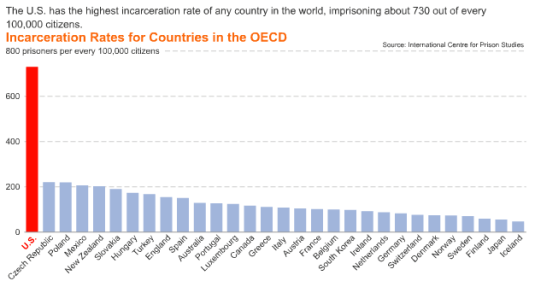
There are people out there who should have been arrested, convicted and sent to prison for serious crimes. Many of them are repeat offenders and career criminals.

I have never understood the reasoning behind the notion that prison numbers are too high.
Concerns about prison numbers being too high is exclusively a concern about the criminals who were sent to prison. Their victims are never mentioned nor are victims of unsolved crime who have been denied justice.
There is an economic literature on the efficient level of crime. Those that are concerned about prison numbers being too high explicitly reject the economics of crime literature for the purpose of framing public policy about criminal justice. The reason is obvious from this passage by David Friedman:
The economic analysis of crime starts with one simple assumption: Criminals are rational.
A mugger is a mugger for the same reason I am a professor-because that profession makes him better off, by his own standards, than any other alternative available to him.
Here, as elsewhere in economics, the assumption of rationality does not imply that muggers (or economics professors) calculate the costs and benefits of available alternatives to seventeen decimal places-merely that they tend to choose the one that best achieves their objectives.
If muggers are rational, we do not have to make mugging impossible in order to prevent it, merely unprofitable.
If the benefits of a profession decrease or its costs increase, fewer people will enter it-whether the profession is plumbing or burglary.
If little old ladies start carrying pistols in their purses, so that one mugging in ten puts the mugger in the hospital or the morgue, the number of muggers will decrease drastically-not because they have all been shot but because most will have switched to safer ways of making a living.
If mugging becomes sufficiently unprofitable, nobody will do it.
Putting more offenders in prison should decrease crime by both incapacitating incarcerated offenders and deterring potential offenders.

14 Apr 2014 Leave a comment
in applied price theory, behavioural economics, economics of crime, entrepreneurship, experimental economics, industrial organisation, market efficiency, survivor principle Tags: behavioural economics, crime and punishment, criminal deterrence, experimental economics, Gordon Tullock, token economies, Vernon Smith
The rationality postulate is under attack from the other people are stupid fallacy: not you, not me, not present company, of course, but the nameless them over there; the perpetually baffled, every man jack of them.
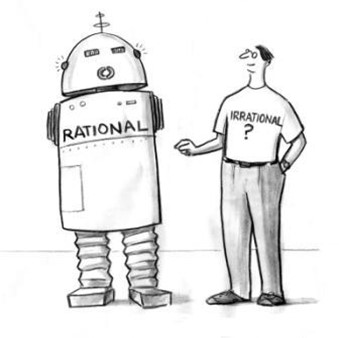
These no-hopers are deemed competent to vote and DRIVE CARS, but they cannot get their head around a credit card. How the them over there find their way to work every morning must be a mystery to behavioural economists. One summary of behavioural labour economics is this:
The key empirical findings from field research in behavioural economics imply that individuals can make systematic errors or be put off by complexity, that they procrastinate, and that they hold non-standard preferences and non-standard beliefs
I found the chapter in Tullock and McKenzie’s book on token economies in mental hospitals to be most enlightening.
The tokens were for spending money at the hospital canteen and trips to town and other privileges. They were earned by keeping you and your area clean and helping out with chores.
The first token economies were for chronic, treatment-resistant psychotic inpatients.
In 1977, a major study, still considered a landmark, successfully showed the superiority of a token economy compared to the standard treatments. Despite this success, token economies disappeared from the 1980s on.
Experiments which would now be unethical showed that the occupational choices and labour supply of certified lunatics responded to incentives in the normal, predictable way.
For example, tokens were withdrawn for helping clean halls and common areas. The changes in occupational choice and reductions in labour supply was immediate and as predicted by standard economics.
Some patients would steal the tokens for other patients, so the token individually marked, and the thefts almost stopped. Crime must pay even for criminally insane inpatients.
Kagel reported that:
The results have not varied with any identifiable trait or characteristic of the subjects of the token economy – age, IQ, educational level, length of hospitalization, or type of diagnosis.

Behavioural economics is an excellent example of how engaging in John S. Mill’s truth that engaging with people who are partly or totally wrong sharpens your arguments, improves their presentation and deepens your analysis.
People have a better understanding of rationality such as through the work of Vernon Smith on ecological and constructivist rationality and of how people deal with human frailties and correct error through specialisation, exchange and learning.
What is inefficient about the world, said Kirzner, is at each instant, an opportunity for improvements, in one way or another and is yet simply not yet noticed. The lure of pure entrepreneurial profits harnesses the systematic elimination of errors and points the way to the market generated institutions necessary for steady social improvements to emerge. Brand names are an obvious example of an institution to overcome doubts about product quality. Middle-men and brokers specialise in performing much of the calculation burdens in their markets.
Many still compare real-world marketplaces to idealised regulation overseen by bureaucrats free of the very biases they are nudging us along to overcome. There are real constraints that limit the options available to fix what are seen as problems to be solved.
Vernon Smith when asked about behavioural economics, wondered how so cognitively flawed a creature made it out of the caves. Vernon Smith argued that the answer had a lot to do with the institutions that emerged to overcome human limitations:
Markets are about recognizing that information is dispersed in all social systems and that the problem of society is to find, devise, and discover institutions that incentivize and enable people to make the right decisions without anyone having to tell them what to do.
Smith and Hayek both posit that market institutions rather than individuals bear the primary cognitive burden in coordinating economic activity. To quote Vernon Smith:
What we learn from experiments is that any group of people can walk into a room, be incentivized with a well-defined private economic environment, have the rules of the oral double auction explained to them for the first time, and they can make a market that usually converges to a competitive equilibrium, and is 100 per cent efficient—they maximize the gains from exchange—within two or three repetitions of a trading period.
Yet knowledge is dispersed, with no participant informed of market supply and demand, or even understanding what that means.
This strikingly demonstrates what Adam Smith called ”a certain propensity in human nature . . . to truck, barter, and exchange one thing for another”
These double oral auctions converged to the competitive price even with as few as three or four sellers with neither the buyers nor sellers knowing anything of the values or costs of others in the market. Price-taking behaviour was not necessary to reach these competitive outcomes.
Behavioural economics is a clumsy way of discussing the pervasiveness of errors because insufficient attention is paid to decentralised, emergent market processes that correct them, often long ago.
Celebrating humanity's flourishing through the spread of capitalism and the rule of law
Celebrating humanity's flourishing through the spread of capitalism and the rule of law
Celebrating humanity's flourishing through the spread of capitalism and the rule of law
Celebrating humanity's flourishing through the spread of capitalism and the rule of law
Celebrating humanity's flourishing through the spread of capitalism and the rule of law
Celebrating humanity's flourishing through the spread of capitalism and the rule of law
Celebrating humanity's flourishing through the spread of capitalism and the rule of law
A History of the Alt-Right
Econ Prof at George Mason University, Economic Historian, Québécois
Celebrating humanity's flourishing through the spread of capitalism and the rule of law
Scholarly commentary on law, economics, and more
Beatrice Cherrier's blog
Celebrating humanity's flourishing through the spread of capitalism and the rule of law
Celebrating humanity's flourishing through the spread of capitalism and the rule of law
Celebrating humanity's flourishing through the spread of capitalism and the rule of law
Why Evolution is True is a blog written by Jerry Coyne, centered on evolution and biology but also dealing with diverse topics like politics, culture, and cats.
Celebrating humanity's flourishing through the spread of capitalism and the rule of law
A rural perspective with a blue tint by Ele Ludemann
DPF's Kiwiblog - Fomenting Happy Mischief since 2003
Celebrating humanity's flourishing through the spread of capitalism and the rule of law
The world's most viewed site on global warming and climate change
Tim Harding's writings on rationality, informal logic and skepticism
A window into Doc Freiberger's library
Let's examine hard decisions!
Commentary on monetary policy in the spirit of R. G. Hawtrey
Thoughts on public policy and the media
Celebrating humanity's flourishing through the spread of capitalism and the rule of law
Politics and the economy
A blog (primarily) on Canadian and Commonwealth political history and institutions
Reading between the lines, and underneath the hype.
Economics, and such stuff as dreams are made on
"The British constitution has always been puzzling, and always will be." --Queen Elizabeth II
Celebrating humanity's flourishing through the spread of capitalism and the rule of law
Celebrating humanity's flourishing through the spread of capitalism and the rule of law
WORLD WAR II, MUSIC, HISTORY, HOLOCAUST
Undisciplined scholar, recovering academic
Celebrating humanity's flourishing through the spread of capitalism and the rule of law
Res ipsa loquitur - The thing itself speaks
In Hume’s spirit, I will attempt to serve as an ambassador from my world of economics, and help in “finding topics of conversation fit for the entertainment of rational creatures.”
Researching the House of Commons, 1832-1868
Articles and research from the History of Parliament Trust
Reflections on books and art
Posts on the History of Law, Crime, and Justice
Celebrating humanity's flourishing through the spread of capitalism and the rule of law
Exploring the Monarchs of Europe
Cutting edge science you can dice with


Recent Comments