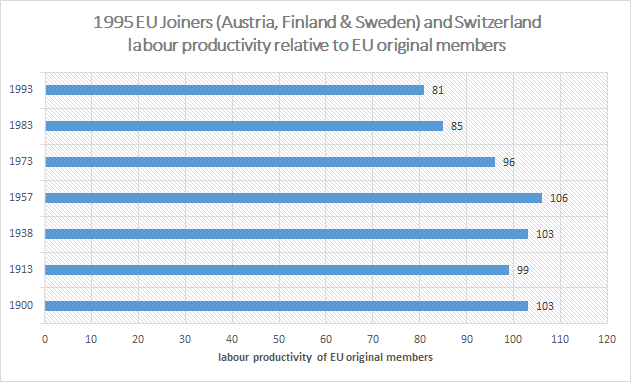
Source: Edward Prescott.
..
Celebrating humanity's flourishing through the spread of capitalism and the rule of law
17 Jan 2016 Leave a comment
in currency unions, economic growth, economic history, international economics, macroeconomics Tags: Common market, customs unions, European Union, trading blocs preferential trading agreements
17 Jan 2016 Leave a comment
in currency unions, economic growth, economic history, Euro crisis, international economics, macroeconomics Tags: Brexit, Common market, customs unions, European Union, free trade agreements, preferential trading agreements
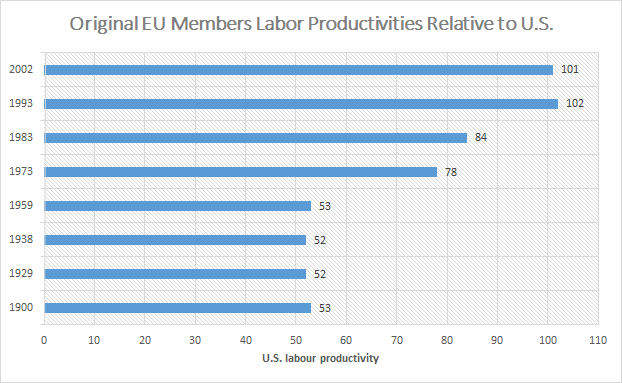
Source: Edward Prescott.
21 Oct 2015 Leave a comment
in international economics, politics - USA Tags: 2016 presidential election, customs unions, free trade agreements, preferential trading agreements, regional trade agreements, TPA, TPPA
Timeline of Hillary Clinton's positions on Pacific trade deal over time: on.wsj.com/1OA728c by @willmauldin http://t.co/iPN0p5VZhn—
WSJ Think Tank (@WSJThinkTank) October 18, 2015
08 Oct 2015 Leave a comment
in economic history, international economic law, international economics, Public Choice Tags: Cato Institute, customs unions, Douglas Irwin, preferential trade agreements, regional trade agreements, TPA, TPPA, trade policy
Good grief, the architect of "the pivot to Asia" opposes TPP? In her book she praised the deal! http://t.co/9XDiv0btzM—
Ryan Lizza (@RyanLizza) October 07, 2015
24 Sep 2015 Leave a comment
in economic history Tags: British disease, British economy, Common market, customs unions, Denmark, European Union, Margaret Thatcher, Sweden, Swedosclerosis
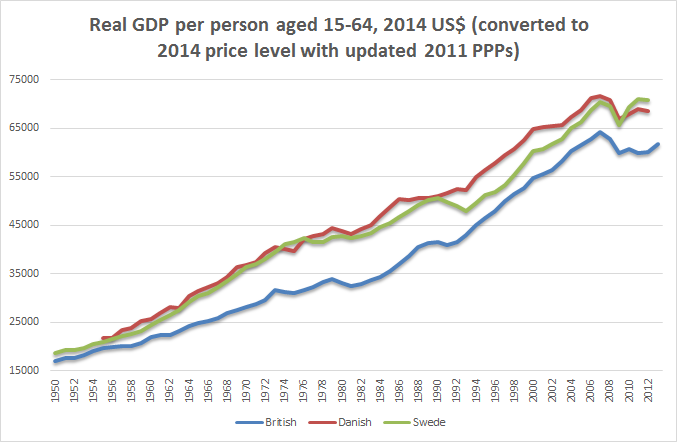
Source: Computed from OECD StatExtract and The Conference Board. 2015. The Conference Board Total Economy Database™, May 2015, http://www.conference-board.org/data/economydatabase/
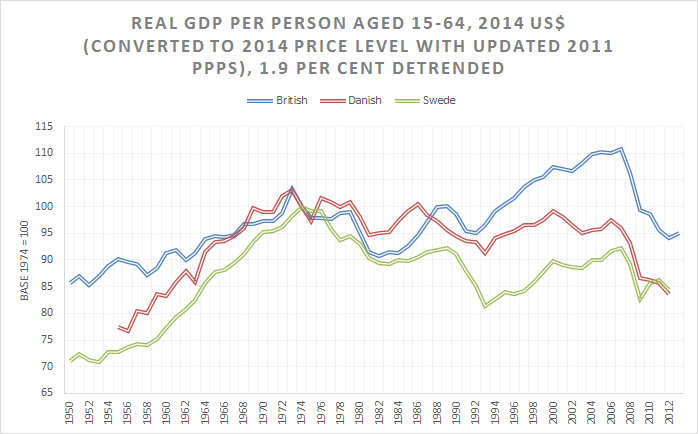
Source: Computed from OECD StatExtract and The Conference Board. 2015. The Conference Board Total Economy Database™, May 2015, http://www.conference-board.org/data/economydatabase/
The data is detrended at 1.9% per year – the trend rate of growth for the USA in the 20th century. A rising line means growth greater than 1.9% for that year, a falling line means growth of less than 1.9% for the year. A flat line is growth of 1.9% for that year.
Britain, Sweden and Denmark all grew quickly up until the 1970s in a period known as post-war catch up.In the 1970s and early 1980s, there was the British disease. The 1970s to the early 1990s was Swedosclerosis. There was a boom in the British economy subsequent to the economics of Mrs Thatcher.
31 Jul 2015 Leave a comment
in currency unions, economic growth, Euro crisis, international economics, macroeconomics Tags: British economy, customs unions, EU, EU membership, free trade areas, international economic integration, preferential trading agreements, regional integration
Ukip claims that there is a net saving from pulling out of EU are highly debatable: http://t.co/TemtNC9gnN—
C4 News FactCheck (@FactCheck) April 02, 2015
30 Jul 2015 6 Comments
in applied price theory, applied welfare economics, comparative institutional analysis, constitutional political economy, economics of regulation, environmental economics, health economics, industrial organisation, international economic law, international economics, International law, law and economics, property rights, Public Choice Tags: climate treaties, copyrights, customs unions, environmental standards, free trade agreements, free trade zones, intellectual property law, ISDS, Jane Kelsey, Labour standards, Left-wing hypocrisy, neocolonialism, patents, preferential trading agreeents, regional trade agreements, regulatory harmonisation, TPA, TPPA, WTO
Jane Kelsey in a television interview said she opposes the reductions in sovereignty in trade agreements that result from investor-state dispute settlement (ISDS) provisions because they limit the democratic choices of future governments.
If so, she must oppose environmental and labour standards in trade agreements and, more importantly, binding the hands of future governments with climate treaties. All international treaties are about restrictions on sovereignty.
Environmental and labour clauses in trade agreements and climate treaties all limit the powers of governments to legislate on environmental and employment law in accordance with the will of the people as expressed in the most recent election and change of government. Power to the people.
https://twitter.com/rorymccourt/status/625540621457960960
Jane Kelsey would do better focusing on those parts of the TPPA deal that lowers the net value of the deal such as those extending the term of patents over the drugs. All international treaties are about trade-offs.

The most important reason for focusing on intellectual property law in trade agreements is Kelsey is likely to actually win people over that are not on the far left, including many on the right of politics over to her cause. Kelsey is too busy rounding up the usual suspects.

Ranting about big corporate conspiracies and the investor state dispute settlement clauses puts people off.
As copyright duration's at play in #TPPA, a reminder of the costs when copyright's too long.
offsettingbehaviour.blogspot.co.nz/2014/03/orphan… http://t.co/tOtihpDmSU—
Eric Crampton (@EricCrampton) July 29, 2015
These gusts of paranoia lose support on issues where there is common ground to be suspicious about the growing scope of trade agreements and their reach behind borders.

Regulatory harmonisation is advisable only when there are compelling reasons such as the prevention of hazards or technical compatibility of products – do the plugs fit into each other? As Sykes argues:
as a normative matter, harmonization is inferior to a legal system that tolerates regulatory differences subject to legal constraints, and that relies on mutual recognition where appropriate (the exception to this claim being matters of technical compatibility between products).
Related, as a positive manner, harmonization will often lack any political constituency and thus instances of true harmonization will be rare.
29 Jul 2015 Leave a comment
in applied price theory, applied welfare economics, comparative institutional analysis, constitutional political economy, international economics, Public Choice, rentseeking Tags: customs unions, free trade agreements, free trade zones, game theory, Paul Krugman, preferential trading agreements, regional trade agreements, WTO
29 Jul 2015 2 Comments
25 Jul 2015 Leave a comment
in currency unions, Euro crisis, international economics, macroeconomics Tags: Common market, customs unions, economics of immigration, EU, Euro, Euroland, European free trade area, European Union, free trade agreements, free trade areas, open borders, preferential trading agreements
AMAZING chart on European integration. One to pin to your office wall. Nice job by @Nic_Koenig delorsinstitut.de/2015/wp-conten… http://t.co/zZbOA29mYP—
Maxime Sbaihi (@MxSba) July 24, 2015
17 Jul 2015 Leave a comment
in economics of regulation, industrial organisation, international economics, politics - USA Tags: border costs, British economy, Canada, Common market, Common markets, customs unions, EU, France, free trade areas, Germany, Italy, NAFTA, trade costs
Figure 1: World Bank Doing Business rankings and sub rankings for trading across the French, German, Italian, British, Canadian and US borders, 2014
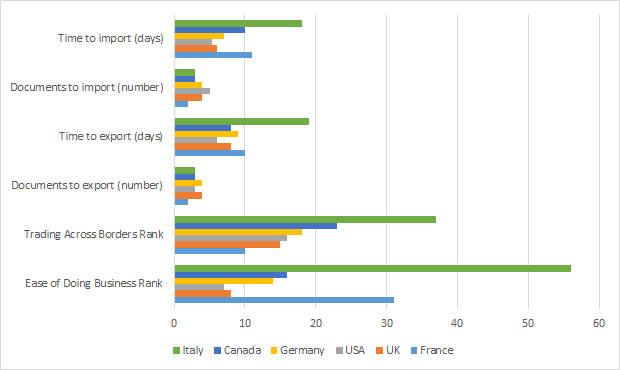
Source: World Bank Doing Business database; note: cost of importing and exporting not included.
Figure 2: World Bank Doing Business rankings – cost of importing and exporting across the French, German, Italian, British, Canadian and US borders, 2014
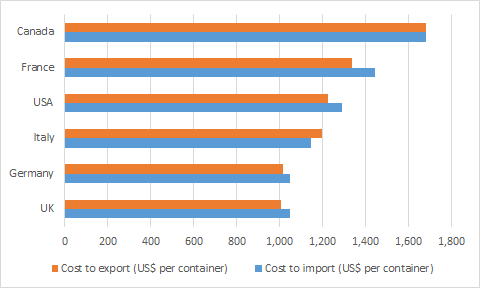
Source: World Bank Doing Business database; note: cost of importing and exporting not included.
Celebrating humanity's flourishing through the spread of capitalism and the rule of law
Scholarly commentary on law, economics, and more
Beatrice Cherrier's blog
Celebrating humanity's flourishing through the spread of capitalism and the rule of law
Celebrating humanity's flourishing through the spread of capitalism and the rule of law
Celebrating humanity's flourishing through the spread of capitalism and the rule of law
Why Evolution is True is a blog written by Jerry Coyne, centered on evolution and biology but also dealing with diverse topics like politics, culture, and cats.
Celebrating humanity's flourishing through the spread of capitalism and the rule of law
Celebrating humanity's flourishing through the spread of capitalism and the rule of law
A rural perspective with a blue tint by Ele Ludemann
DPF's Kiwiblog - Fomenting Happy Mischief since 2003
Celebrating humanity's flourishing through the spread of capitalism and the rule of law
The world's most viewed site on global warming and climate change
Tim Harding's writings on rationality, informal logic and skepticism
A window into Doc Freiberger's library
Let's examine hard decisions!
Commentary on monetary policy in the spirit of R. G. Hawtrey
Thoughts on public policy and the media
Celebrating humanity's flourishing through the spread of capitalism and the rule of law
Politics and the economy
A blog (primarily) on Canadian and Commonwealth political history and institutions
Reading between the lines, and underneath the hype.
Economics, and such stuff as dreams are made on
"The British constitution has always been puzzling, and always will be." --Queen Elizabeth II
Celebrating humanity's flourishing through the spread of capitalism and the rule of law
Celebrating humanity's flourishing through the spread of capitalism and the rule of law
WORLD WAR II, MUSIC, HISTORY, HOLOCAUST
Undisciplined scholar, recovering academic
Celebrating humanity's flourishing through the spread of capitalism and the rule of law
Res ipsa loquitur - The thing itself speaks
Celebrating humanity's flourishing through the spread of capitalism and the rule of law
Researching the House of Commons, 1832-1868
Articles and research from the History of Parliament Trust
Reflections on books and art
Posts on the History of Law, Crime, and Justice
Celebrating humanity's flourishing through the spread of capitalism and the rule of law
Exploring the Monarchs of Europe
Cutting edge science you can dice with
Small Steps Toward A Much Better World
“We do not believe any group of men adequate enough or wise enough to operate without scrutiny or without criticism. We know that the only way to avoid error is to detect it, that the only way to detect it is to be free to inquire. We know that in secrecy error undetected will flourish and subvert”. - J Robert Oppenheimer.
The truth about the great wind power fraud - we're not here to debate the wind industry, we're here to destroy it.
Celebrating humanity's flourishing through the spread of capitalism and the rule of law
Celebrating humanity's flourishing through the spread of capitalism and the rule of law
Economics, public policy, monetary policy, financial regulation, with a New Zealand perspective
Celebrating humanity's flourishing through the spread of capitalism and the rule of law
Restraining Government in America and Around the World


 Utopia, you are standing in it!
Recent Comments