Two different ways you could fit the population of the United States into Southeast Asia brilliantmaps.com/how-the-us-fit… http://t.co/k8ZBGdLYjT—
Brilliant Maps (@BrilliantMaps) April 18, 2015
The populations of Southeast Asia
10 May 2015 Leave a comment
in population economics Tags: demographics, Southeast Asia
Stay-at-home moms are poorer, less educated than working moms
18 Apr 2015 4 Comments
in gender, labour economics, labour supply, occupational choice, poverty and inequality, unemployment, welfare reform Tags: child poverty, demographics, family, single parents


It took Japan a long time to realize that the 1970s drop in fertility wasn’t temporary
06 Jan 2015 Leave a comment
in labour economics, labour supply, political change, technological progress Tags: demographic crisis, demographics, fertility crisis, forecasting errors, Japan
Japan’s demographic challenge
17 Dec 2014 Leave a comment
in labour economics, labour supply, population economics Tags: ageing society, demographics, Japan
As its new parliament comes in, here's a look at Japan's longer-term economic challenges pewrsr.ch/1pjgZx5 http://t.co/StGWEGdNfi—
PewResearch FactTank (@FactTank) December 16, 2014
New Zealand national labour force projections – the invasion of the 65+ worker
03 Dec 2014 Leave a comment
in labour economics, labour supply, population economics Tags: ageing workforce, demographics, labour economics, labour force projections, older workers, population ageing
Figure 1: National labour force projections by age group, 2006-2041
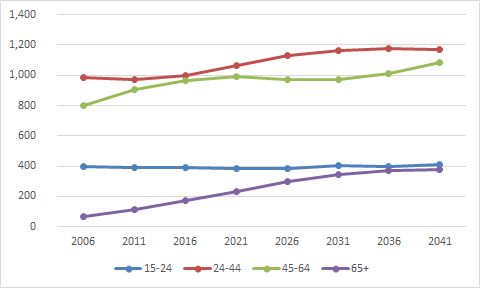
Source: Statistics New Zealand, cyclical migration scenario
Not that many years time, about 2035, there will be almost as many workers as there are young workers – those between 15 and 24. About 400,000 workers in each age bracket.
Not that long ago all, in the early 1990s, there were about 25,000 workers in New Zealand were over 65 – they could fit in a football stadium. Soon, they will equal the population of the national capital: Wellington.
Workers aged 65+ moved from accounting for 1.5 per cent of workers in 1991 to 5 per cent in 2011 and 9 per cent in 2021!
 Utopia, you are standing in it!
Recent Comments