Offsetting behaviour alert: school breakfast programmes

School lunches is back in the news again in New Zealand

Jim Rose's avatarUtopia, you are standing in it!

When children arrive at school without breakfast, being the dismal economist I am, the question I ask is not why they didn’t have breakfast – I ask whether their parents had breakfast.

If these children are getting a free breakfast because their parents are too poor to buy them breakfast food, why aren’t their parents invited to school to have a free breakfast as well. How do these parents eat at all? Any good parent would give up their breakfast for their children.

Diane Whitmore Schanzenbach and Mary Zaki in their just released Expanding the School Breakfast Program: Impacts on Children’s Consumption, Nutrition and Health look at the school lunch program is nearly universally available in U.S. public schools.

They use experimental data collected by the US Department of Agriculture to measure the impact of two policy innovations aimed at increasing access to the school breakfast program.

The first, universal…

View original post 242 more words

Benjamin Powell, In Defense of “Sweatshops”

via Benjamin Powell, In Defense of “Sweatshops” | Library of Economics and Liberty.

Some advice from a green consultant

Housing habitability laws

Minimum standards for rental housing is back in the news in New Zealand. After some deaths in some rather nasty fires in rental houses without fire alarms, there are demands that landlords must put fire alarms in place and maintain those fire alarms. About a dozen people or so die in fires in New Zealand every year.

The fact that in the proposed regulation, landlords are also required to maintain those fire alarms – ensure they have batteries in them – is a microcosm of the economics of rental housing habitability laws.

Even when landlords put in fire alarms, low income tenants prefer to spend their money on something other than replacement batteries for those alarms. These tenants are presumed to be competent to vote and drive cars, but not manage the risk of fires in the houses in which they live.

Maybe the reason for the lack of interest of low income tenants in putting batteries and fire alarms is domestic household fires are relatively rare these days. Fire is buried in the green area of the diagram below and is similar to drowning and falls.
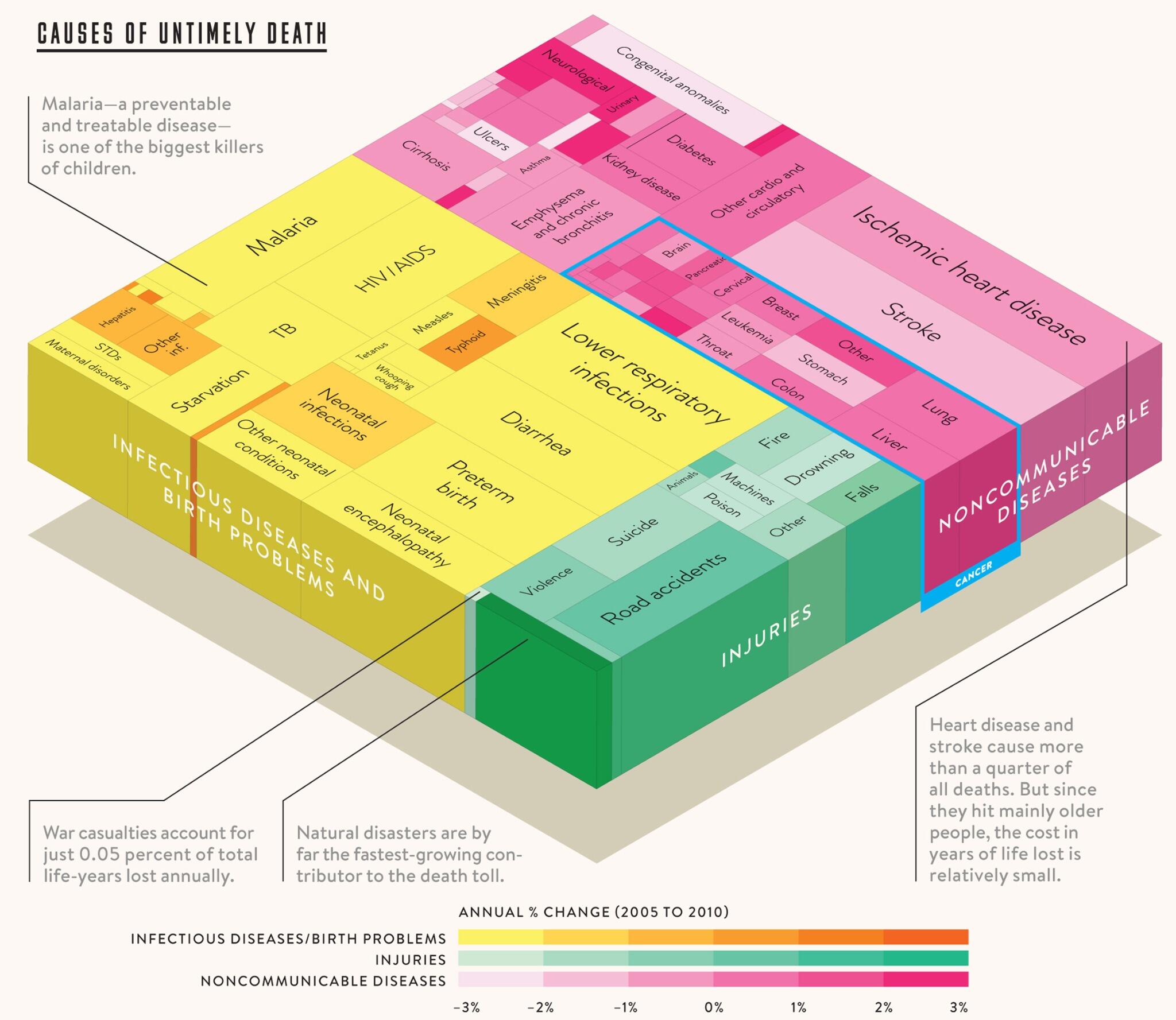
The American data below suggests that your chances of dying by fire are about the same as dying from choking and a little worse from dying from post surgery complications.

Rather than in need of nudging, your average low income tenants seems to have it pretty right regarding the risks of dying in a fire.

When I went looking for some economics of housing habitability laws, Google was a bit of a disappointment. There are some empirical work done in the 1970s and early 1980s and then it fell away.

My suspicion is there is not so much empirical work on the economics of housing habitability laws because proving the obvious is not a good investment in Ph.D. topics or tenure track economic research.

Walter Block wrote an excellent defence of slumlords in his 1971 book Defending the Undefendable:

The owner of ghetto housing differs little from any other purveyor of low-cost merchandise. In fact, he is no different from any purveyor of any kind of merchandise. They all charge as much as they can.

First consider the purveyors of cheap, inferior, and second-hand merchandise as a class. One thing above all else stands out about merchandise they buy and sell: it is cheaply built, inferior in quality, or second-hand.

A rational person would not expect high quality, exquisite workmanship, or superior new merchandise at bargain rate prices; he would not feel outraged and cheated if bargain rate merchandise proved to have only bargain rate qualities.

Our expectations from margarine are not those of butter. We are satisfied with lesser qualities from a used car than from a new car. However, when it comes to housing, especially in the urban setting, people expect, even insist upon, quality housing at bargain prices.

Richard Posner discussed housing habitability laws in his Economic Analysis of the Law. The subsection was titled wealth distribution through liability rules. Posner concluded that habitability laws will lead to abandonment of rental property by landlords and increased rents for poor tenants.
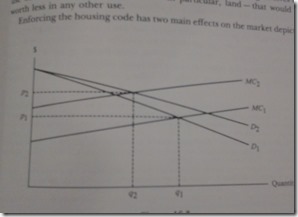
posner habitability

What do-gooder would want to know that a warranty of habitability for rental housing will lead to scarcer, more expensive housing for the poor! Surprisingly few interventions in the housing market work to the advantage of the poor.

Certainly, there will be less rental housing of a habitability standard below that demanded by do-gooders. In the Encyclopaedia of Law and Economics entry on renting, Werner Hirsch said:

It would be a mistake, however, to look upon a decline in substandard rental housing as an unmitigated gain. In fact, in the absence of substandard housing, options for indigent tenants are reduced. Some tenants are likely to end up in over-crowded standard units, or even homeless.

Here’s what’s not sustainable: organic farming » AEI

Organic farming might work well for certain local environments on a small scale, but its farms produce far less food per unit of land and water than conventional ones.

The low yields of organic agriculture—typically 20%-50% less than conventional agriculture—impose various stresses on farmland and especially on water consumption.

A British meta-analysis published in the Journal of Environmental Management (2012) found that “ammonia emissions, nitrogen leaching and nitrous oxide emissions per product unit were higher from organic systems” than conventional farming systems, as were “land use, eutrophication potential and acidification potential per product unit.”

via Here’s what’s not sustainable: organic farming » AEI.

Bryan Caplan on the pathologies of poverty

Bryan Caplan drew up a nice list of factors that contribute to poverty

  • alcoholism: Alcohol costs money, interferes with your ability to work, and leads to expensive reckless behaviour.
  • drug addiction: Like alcohol, but more expensive, and likely to eventually lead to legal troubles you’re too poor to buy your way out of.
  • single parenthood: Raising a child takes a lot of effort and a lot of money.  One poor person rarely has enough resources to comfortably provide this combination of effort and money.
  • unprotected sex: Unprotected sex quickly leads to single parenthood.  See above.
  • dropping out of high school: High school drop-outs earn much lower wages than graduates.  Kids from rich families may be able to afford this sacrifice, but kids from poor families can’t.
  • being single: Getting married lets couples avoid a lot of wasteful duplication of household expenses.  These savings may not mean much to the rich, but they make a huge difference for the poor.
  • non-remunerative crime: Drunk driving and bar fights don’t pay.  In fact, they have high expected medical and legal expenses.  The rich might be able to afford these costs.  The poor can’t.

Caplan argues that there is an undeserving poor if they fail to follow the following reasonable steps to avoid poverty and hardship:

  1. Work full-time, even if the best job you can get isn’t fun.
  2. Spend your money on food and shelter before getting cigarettes and cable t.v.
  3. Use contraception if you can’t afford a child

The reversing gender gap: why women choose not to be scientists, engineers and IT professionals

Concerns about the lack of women undertaking careers in science and engineering are based on one simple false premise: that science and engineering are the most prestigious choices available to women with great ability in maths and science at high school.

If relatively more prestigious career options are open to women who also happen to qualify for science and engineering, women will be underrepresented in science and engineering simply because they have better career options than the men who become scientists and engineers.

In New Zealand, just as many women as men qualify for science and engineering and the IT degrees. Not as many women who have qualified take up this option simply because they also qualify for medicine and law in greater numbers than the men who happen to qualify for science, engineering and IT degrees.

In the United States, the Association for Psychological Science found that:

Women may be less likely to pursue careers in science and math because they have more career choices, not because they have less ability, according to a new study published in Psychological Science.

Although the gender gap in mathematics has narrowed in recent decades, with more females enrolling and performing well in math classes, females are still less likely to pursue careers in science, technology, engineering, and mathematics (STEM) than their male peers.

Researchers tend to agree that differences in math ability can’t account for the underrepresentation of women in STEM fields. So what does?

Developmental psychologist Ming-Te Wang and his colleagues at the University of Pittsburgh and University of Michigan wondered whether differences in overall patterns of math and verbal ability might play a role.

The researchers examined data from 1490 college-bound US students drawn from a national longitudinal study. The students were surveyed in 12th grade and again when they were 33 years old. The survey included data on several factors, including participants’ SAT scores, various aspects of their motivational beliefs and values, and their occupations at age 33.

Looking at students who showed high math abilities, Wang and colleagues found that those students who also had high verbal abilities — a group that contained more women than men — were less likely to have chosen a STEM occupation than those who had moderate verbal abilities.

This outcome is no surprise for those familiar with the gap between men and women in verbal and reading abilities – a gap that is strongly in favour of women

The OECD PISA tests at the age of 15 find that teenage boys have a slight advantage in maths  – a few percentage points – teenage girls have a serious advantage in reading.

The OECD PISA tests at the age of 15 find that this superior verbal and reading abilities of teenage girls the equivalent of six months extra schooling. One half year’s education goes a long way towards explaining many wage gaps by gender,ethnicity in race. This six-month edge in schooling is a serious advantage when qualifying for university.

Young women choose to not pursue science, engineering and IT careers because there are other career options that allow them to use their superior verbal and reading abilities – other careers is that allow them to be more successful in life than being a scientist, an engineer or an IT geek. As the Association for Psychological Science explains in the same press release cited above:

Our study shows that it’s not lack of ability or differences in ability that orients females to pursue non-STEM careers, it’s the greater likelihood that females with high math ability also have high verbal ability,” notes Wang. “Because they’re good at both, they can consider a wide range of occupations.

To put it bluntly, science, engineering and IT degrees are for young people who lack the verbal and reading abilities to get into medicine and law. Science, engineering and IT good degrees are for those who can’t get into medicine and law. They could have been contenders if they were more articulate and well-read.

There is a gender disparity in science, engineering and IT because teenage girls find these degrees to be inferior choices – inferior choices given the set of abilities they have when considering their career options.

HT: Mark J. Perry

The real reason why behavioural economics is so popular among politicians and bureaucrats

\

HT: David-k-Levine

Anti-Science Left alert: Fight Ebola with homeopathy–NZ Green party MP – updated

NZ Green MP Steffan Browning says giving his support to a call for the World Health Organisation to deploy homeopathic remedies to combat the Ebola epidemic in West Africa.

Ebola

Mr Browning this week signed a petition started by Australian Fran Sheffield which calls on the World Health Organisation (WHO) to

End the suffering of the Ebola crisis. Test and distribute homeopathy as quickly as possible to contain the outbreaks.

Asked whether he thought homeopathy could cure Ebola, Mr Browning said:

It’s not for me to go down that track at all.

The World Health Organisation, world health authorities are doing that.

They will be considering I hope absolutely every possible options to this very concerning disease.

Green Party co-leader Russel Norman said the petition did not reflect the position of the party, and agreed it was unwise of Browning to have signed it.

Green party health spokesman Kevin Hague said he was "disappointed" Browning had signed the petition.

Browning is also on the record has been anti-GMOs, and is the green party spokesmen on genetic modification as well as the range of science-based portfolios such as agriculture and biosecurity.

To listen to most pundits, evolution, stem cells, and climate change are the only scientific issues worth mentioning—and the only people who are anti-science are on the right of politics.

Those on the left have numerous fallacies of their own. Aversion to clean energy programs, basic biological research, and even life-saving vaccines come naturally to many progressives. These are positions supported by little more than junk-science and paranoid thinking.

Concerns about vaccine safety and genetically modified organisms (GMOs) are often held up as evidence of anti-scientific beliefs among liberals. The anti-GMO movement is a product of the political left and has reached levels of delusion, paranoia and anti-intellectualism worthy of Michele Bachmann and young-earth creationists.

Though 70 percent of scientists support nuclear power, left-leaning organizations such as Greenpeace and the Sierra Club strongly oppose it.

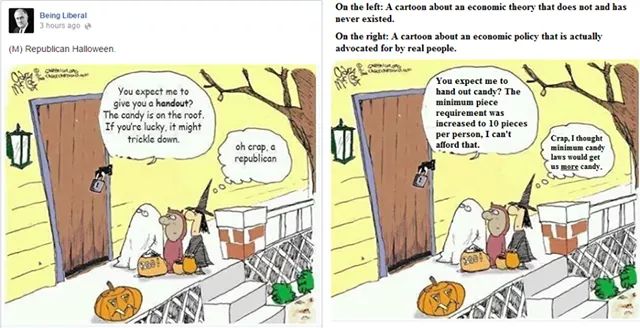
‘Being liberal’ logic on Halloween night

image

HT: Stephen Berry

The australian greens are confused about higher energy prices

image

Image

The proliferation of authoritarian personality types in the 21st century

The dangerous search for self importance by do-gooders

Image

Paul Krugman’s One Bad Idea – John Goodman

Image

Deirdre McCloskey on the axiom of goodwill in public policy making in left-wing circles

Image

Previous Older Entries Next Newer Entries

Bassett, Brash & Hide

Celebrating humanity's flourishing through the spread of capitalism and the rule of law

Truth on the Market

Scholarly commentary on law, economics, and more

The Undercover Historian

Beatrice Cherrier's blog

Matua Kahurangi

Celebrating humanity's flourishing through the spread of capitalism and the rule of law

Temple of Sociology

Celebrating humanity's flourishing through the spread of capitalism and the rule of law

Velvet Glove, Iron Fist

Celebrating humanity's flourishing through the spread of capitalism and the rule of law

Why Evolution Is True

Why Evolution is True is a blog written by Jerry Coyne, centered on evolution and biology but also dealing with diverse topics like politics, culture, and cats.

Down to Earth Kiwi

Celebrating humanity's flourishing through the spread of capitalism and the rule of law

NoTricksZone

Celebrating humanity's flourishing through the spread of capitalism and the rule of law

Homepaddock

A rural perspective with a blue tint by Ele Ludemann

Kiwiblog

DPF's Kiwiblog - Fomenting Happy Mischief since 2003

The Dangerous Economist

Celebrating humanity's flourishing through the spread of capitalism and the rule of law

Watts Up With That?

The world's most viewed site on global warming and climate change

The Logical Place

Tim Harding's writings on rationality, informal logic and skepticism

Doc's Books

A window into Doc Freiberger's library

The Risk-Monger

Let's examine hard decisions!

Uneasy Money

Commentary on monetary policy in the spirit of R. G. Hawtrey

Barrie Saunders

Thoughts on public policy and the media

Liberty Scott

Celebrating humanity's flourishing through the spread of capitalism and the rule of law

Point of Order

Politics and the economy

James Bowden's Blog

A blog (primarily) on Canadian and Commonwealth political history and institutions

Science Matters

Reading between the lines, and underneath the hype.

Peter Winsley

Economics, and such stuff as dreams are made on

A Venerable Puzzle

"The British constitution has always been puzzling, and always will be." --Queen Elizabeth II

The Antiplanner

Celebrating humanity's flourishing through the spread of capitalism and the rule of law

Bet On It

Celebrating humanity's flourishing through the spread of capitalism and the rule of law

History of Sorts

WORLD WAR II, MUSIC, HISTORY, HOLOCAUST

Roger Pielke Jr.

Undisciplined scholar, recovering academic

Offsetting Behaviour

Celebrating humanity's flourishing through the spread of capitalism and the rule of law

JONATHAN TURLEY

Res ipsa loquitur - The thing itself speaks

Conversable Economist

Celebrating humanity's flourishing through the spread of capitalism and the rule of law

The Victorian Commons

Researching the House of Commons, 1832-1868

The History of Parliament

Articles and research from the History of Parliament Trust

Books & Boots

Reflections on books and art

Legal History Miscellany

Posts on the History of Law, Crime, and Justice

Sex, Drugs and Economics

Celebrating humanity's flourishing through the spread of capitalism and the rule of law

European Royal History

Exploring the Monarchs of Europe

Tallbloke's Talkshop

Cutting edge science you can dice with

Marginal REVOLUTION

Small Steps Toward A Much Better World

NOT A LOT OF PEOPLE KNOW THAT

“We do not believe any group of men adequate enough or wise enough to operate without scrutiny or without criticism. We know that the only way to avoid error is to detect it, that the only way to detect it is to be free to inquire. We know that in secrecy error undetected will flourish and subvert”. - J Robert Oppenheimer.

STOP THESE THINGS

The truth about the great wind power fraud - we're not here to debate the wind industry, we're here to destroy it.

Lindsay Mitchell

Celebrating humanity's flourishing through the spread of capitalism and the rule of law

Alt-M

Celebrating humanity's flourishing through the spread of capitalism and the rule of law

croaking cassandra

Economics, public policy, monetary policy, financial regulation, with a New Zealand perspective

The Grumpy Economist

Celebrating humanity's flourishing through the spread of capitalism and the rule of law

International Liberty

Restraining Government in America and Around the World