DILBERT on EARTH DAY: "You can't save the Earth unless you're willing to make other people sacrifice." http://t.co/TvZjFqXXla—
Mark J. Perry (@Mark_J_Perry) April 22, 2015
#EarthDay explained
23 Apr 2016 Leave a comment
in environmental economics, environmentalism Tags: Earth Day
George Carlin on ‘saving the planet’ #earthday
22 Apr 2016 Leave a comment
in economics of media and culture, environmental economics Tags: Earth Day, George Carlin
Why environmentalists are adverse to real solutions #earthday
22 Apr 2016 Leave a comment
in applied price theory, applied welfare economics, comparative institutional analysis, constitutional political economy, economics of media and culture, economics of regulation, energy economics, entrepreneurship, environmental economics, environmentalism, global warming, politics - USA Tags: anti-market bias, Earth Day, expressive voting, rational ignorance, rational rationality

Source: Quotation of the day for Earth Day on the ‘science of economics versus the religion of environmentalism’ … – AEI | Carpe Diem Blog » AEIdeas from Steven E. Landsburg’s book “The Armchair Economist: Economics and Everyday Life,” in his chapter titled “Why I Am Not an Environmentalist: The Science of Economics versus the Religion of Ecology“.
Earth Day flashback
21 Apr 2016 Leave a comment
in environmental economics, environmentalism, labour economics, labour supply, population economics Tags: doomsday prophecies, Earth Day, Paul Ehrlich

As Earth Day closes, let’s appreciate the fossil fuel treasures from Mother Nature | Carpe Diem Blog
22 Apr 2015 Leave a comment
in energy economics, entrepreneurship, environmental economics Tags: Earth Day, Fossil Fuels, renewable energy

Earth Day activists are now victims of the mass kidnappings
22 Apr 2015 Leave a comment
in environmental economics, politics - Australia, politics - New Zealand, politics - USA Tags: Earth Day
Mass kidnappings is the only charitable explanation for their failure to be dancing in the streets by Eart Day activists over the greening of the planet courtesy of capitalism since Earth Day 1970?

The first Earth Day was celebrated 45 years ago today. nyti.ms/1IDVPyC http://t.co/Zpg7zJc8V6—
NYT Archives (@NYTArchives) April 22, 2015

No One Cares How Many Predictions Earth Day Founders Got Wrong
13 Jun 2014 Leave a comment
in climate change, development economics, environmentalism Tags: Earth Day, pessimism bias
“Air pollution… is certainly going to take hundreds of thousands of lives in the next few years alone.”
Paul Ehrlich, Stanford University biologist
“The world has been chilling sharply for about twenty years. If present trends continue, the world will be about four degrees colder for the global mean temperature in 1990, but eleven degrees colder in the year 2000. This is about twice what it would take to put us into an ice age.”
Kenneth Watt, Ecologist
“Population will inevitably and completely outstrip whatever small increases in food supplies we make. The death rate will increase until at least 100-200 million people per year will be starving to death during the next ten years.”
Paul Ehrlich
“By… [1975] some experts feel that food shortages will have escalated the present level of world hunger and starvation into famines of unbelievable proportions. Other experts, more optimistic, think the ultimate food-population collision will not occur until the decade of the 1980s.”
Paul Ehrlich
“It is already too late to avoid mass starvation.”
Denis Hayes, chief organizer for Earth Day
“Demographers agree almost unanimously on the following grim timetable: by 1975 widespread famines will begin in India; these will spread by 1990 to include all of India, Pakistan, China and the Near East, Africa.
By the year 2000, or conceivably sooner, South and Central America will exist under famine conditions…
By the year 2000, thirty years from now, the entire world, with the exception of Western Europe, North America, and Australia, will be in famine.”
Peter Gunter, professor, North Texas State University
“Scientists have solid experimental and theoretical evidence to support… the following predictions: In a decade, urban dwellers will have to wear gas masks to survive air pollution…by 1985 air pollution will have reduced the amount of sunlight reaching earth by one half.”
Life magazine, January 1970
via No One Cares How Many Predictions Earth Day Founders Got Wrong.
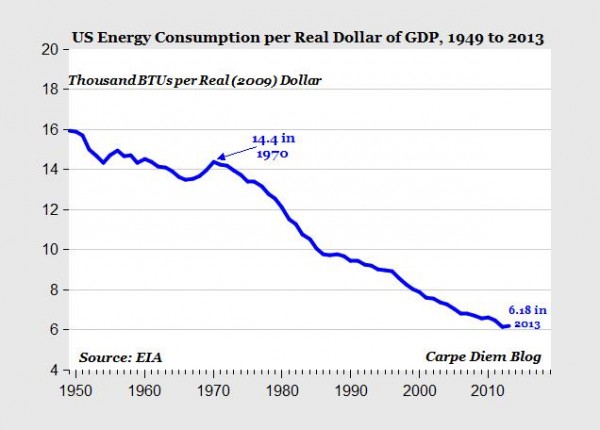
Chart of the day: In 2013, America was more than twice as energy efficient compared to 1970 when Earth Day started | AEIdeas
23 Apr 2014 Leave a comment
in entrepreneurship, environmental economics, environmentalism, liberalism, technological progress Tags: Earth Day, energy conservation
EARTH DAY: SPIRITUALLY UPLIFTING, INTELLECTUALLY DEBASED by Julian L. Simon
23 Apr 2014 Leave a comment
in applied welfare economics, entrepreneurship, environmental economics, environmentalism, liberalism, market efficiency Tags: Earth Day, Julian Simon, Paul Ehrlich
During the first great Earth Week in 1970 there was panic.
The public’s outlook for the planet was unrelievedly gloomy.
The doom saying environmentalists – of whom the dominant figure was Paul Ehrlich – raised the alarm: The oceans and the Great Lakes were dying; impending great famines would be seen on television starting in 1975; the death rate would quickly increase due to pollution; and rising prices of increasingly-scarce raw materials would lead to a reversal in the past centuries’ progress in the standard of living.
… On average, people throughout the world have been living longer and eating better than ever before.
Fewer people die of famine nowadays than in earlier centuries.
The real prices of food and of every other raw material are lower now than in earlier decades and centuries, indicating a trend of increased natural-resource availability rather than increased scarcity.
The major air and water pollutions in the advanced countries have been lessening rather than worsening.

Via Julian Simon memorial site
 Utopia, you are standing in it!
Recent Comments