Matthias Doepke on Why He Studies Family Economics
22 Aug 2018 Leave a comment
in applied price theory, business cycles, economics of love and marriage, human capital, labour economics, labour supply, macroeconomics Tags: economics of families
Thomas Sowell – Black Lives and Social Policy
08 Dec 2016 Leave a comment
in applied price theory, discrimination, economics of education, human capital, labour economics, minimum wage, occupational choice, poverty and inequality, unemployment Tags: economics of families, racial discrimination, Thomas Sowell
The Heckman equation explained
26 Nov 2015 Leave a comment
in applied welfare economics, economics of education, human capital Tags: early childhood education, economics of families, James Heckman
The Moynihan Report revisited
22 Sep 2015 Leave a comment
in economic history, labour economics, politics - USA Tags: economics of families, marriage and divorce, Moynihan report, single mothers, single parents
James Heckman on improving schools @greencatherine @dbseymour @ThomasHaig @PPTAWeb
17 Sep 2015 Leave a comment
in economics of crime, economics of education, human capital, labour supply, occupational choice, poverty and inequality Tags: behavioural genetics, crime and punishment, criminal deterrence, economics of early childhood education, economics of families, economics of fertility, economics of personality traits, marriage and divorce, single parents


Another aspect of helicopter parenting
15 Aug 2015 Leave a comment
in economics of love and marriage, human capital, labour economics, law and economics, welfare reform Tags: child rearing, economics of families, marital division of labour, marriage and divorce
More time with mom has little to no effect on children's well-being: thesocietypages.org/socimages/2015… http://t.co/zyirz1QvQs—
(@SocImages) April 08, 2015
Motherhood explains 80% of the gender wage gap, up from 30% 30 years ago
16 Jul 2015 Leave a comment
in discrimination, gender, human capital, labour economics, labour supply, occupational choice Tags: asymmetric marriage premium, economics of families, gender wage gap, motherhood penalty
#Women's earnings drop 20% after 1st child & gap remains the same even 20 years later @LSEEcon bit.ly/1M60KfJ http://t.co/UpoqLkhbl2—
STICERD (@STICERD_LSE) July 15, 2015
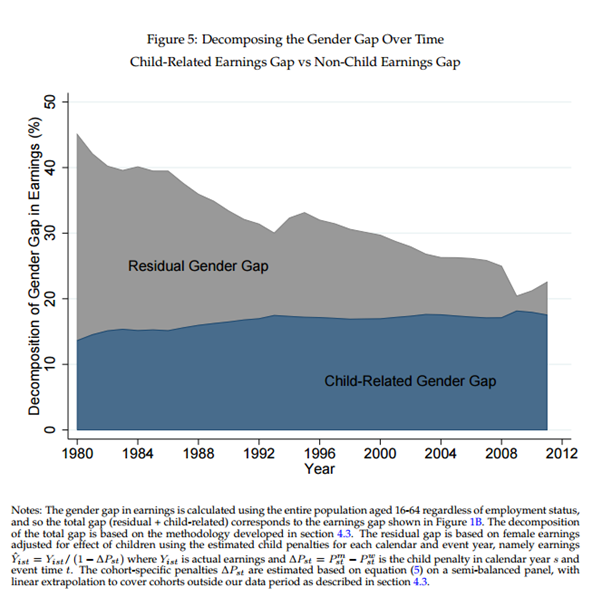
Source: Parenthood and the Gender Gap: Evidence from Denmark by Henrik Jacobsen Kleven, Camille Landais and Jakob Egholt Søgaard, University of Copenhagen January 2015 at http://eml.berkeley.edu/~webfac/auerbach/Landais2015.pdf
Average age of marriage by gender since 1890 in the USA
05 Jul 2015 Leave a comment
in economic history, economics of love and marriage, economics of media and culture, law and economics, politics - USA Tags: economics of families, family demographics, marriage and divorce
Mawwiage. Mawwiage is wut bwings togetha… men who are about 2.5yrs older than their female counterparts. http://t.co/KQqKmNJn7P—
Tyler Vigen (@TylerVigen) May 25, 2015
Dual income nation
05 Jul 2015 Leave a comment
in economics of love and marriage, labour economics, labour supply, politics - USA, poverty and inequality Tags: asymmetric marriage premium, dual income couples, economics of families, reversing gender gap
Many American families face negative affected income taxes rates
23 Jun 2015 Leave a comment
in economics of love and marriage, labour economics, politics - USA, public economics Tags: earned income tax credit, economics of families, family tax credits
The impact of parental employment on child poverty in couple families, Anglo-Saxon countries
21 Jun 2015 Leave a comment
in economics of love and marriage, labour economics, labour supply, law and economics, politics - Australia, politics - New Zealand, politics - USA, population economics, poverty and inequality, welfare reform Tags: Australia, British economy, Canada, child poverty, economics of families, family poverty, Ireland, labour force participation, single parents
Figure 1: child poverty rates in couple families by employment status, Anglo-Saxon countries, 2010
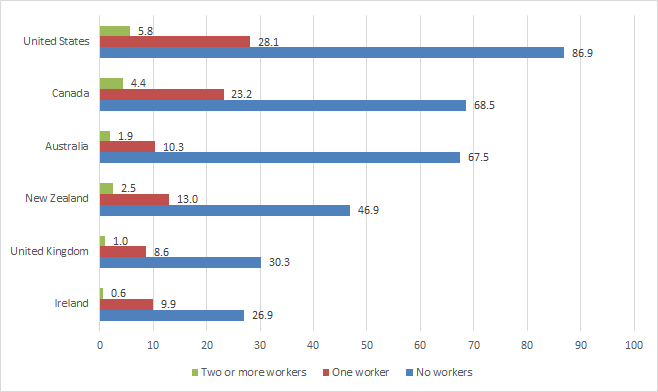
Source: OECD Family Database; Poverty thresholds are set at 50% of the median income of the entire population.
The employment rates of sole parents with kindergarten age children, OECD, 2011
24 May 2015 Leave a comment
in gender, labour economics, labour supply, welfare reform Tags: child poverty, economics of families, female labour force participation, paternal labour force participation, single parents
Figure 1: percentage of sole parents not working with youngest child aged 3-5, OECD, 2011

Source: OECD family database
Figure 2: percentage of sole parents part-time with youngest child aged 3-5, OECD, 2011

Source: OECD family database
The employment rates of sole parents with school age children, OECD, 2011
23 May 2015 Leave a comment
in gender, labour economics, labour supply, welfare reform Tags: child poverty, economics of families, female labour force participation, paternal labour force participation, single parents
Figure 1: percentage of sole parents working with youngest child aged 6-14, 2011

Source: OECD family database
Figure 2: percentage of sole parents working part0time with youngest child aged 6-14, 2011
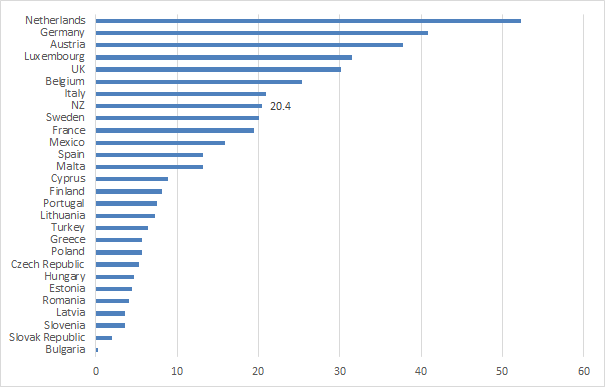
Source: OECD family database
The employment rates of sole parents with toddlers, OECD, 2011
22 May 2015 Leave a comment
in gender, labour economics, labour supply, welfare reform Tags: child poverty, economics of families, female labour force participation, paternal labour force participation, single parents
Figure 1: percentage of sole parents with youngest child aged under two not working, 2011

Source: OECD family database
Figure 2: percentage of sole parents with youngest child aged under two working part-time, 2011
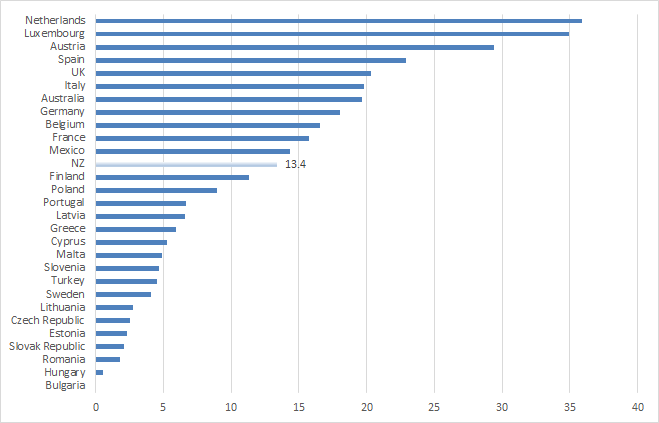
Source: OECD family database
Why is the gender gap so large and the glass ceiling so thick in Sweden?
14 May 2015 1 Comment
in discrimination, economics of love and marriage, gender, human capital, labour economics, occupational choice, politics - USA Tags: asymmetric marriage premium, do gooders, economics of families, gender wage gap, maternity leave, Sweden, The fatal conceit, unintended consequences
The gender wage gap is no better than the OECD average, despite generous maternity and paternity leave. What gives?
America: one day a year celebrating mothers, fathers.
Sweden: 480 days paid leave per child. vox.com/2014/5/12/5708… http://t.co/weFDrTj7Jb—
Ezra Klein (@ezraklein) May 11, 2015
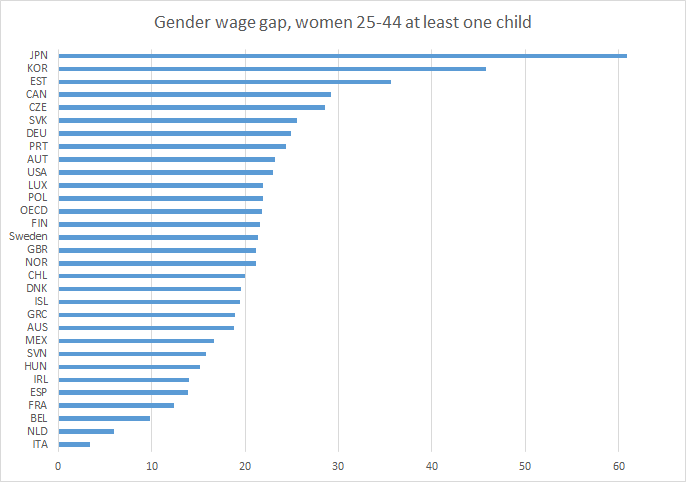
Source: Closing the gender gap: Act now – http://dx.doi.org/10.1787/9789264179370-en
How big is the wage gap in your country? bit.ly/18o8icV #IWD2015 http://t.co/XTdntCRfDQ—
(@OECD) March 08, 2015
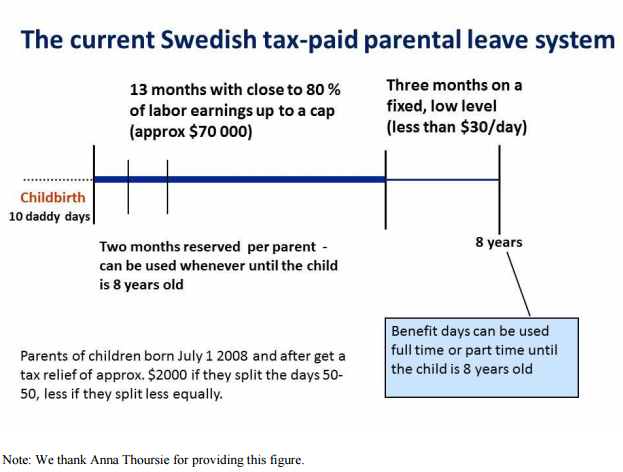
One important question is whether government policies are effective in reducing the gap. One such policy is family leave legislation designed to subsidize parents to stay home with new-born or newly adopted children.
One of the RLE articles shows that for high earners in Sweden there is a large difference between the wages earned by men and women (the so-called “glass ceiling”), which is present even before the first child is born. It increases after having children, even more so if parental leave taking is spread out.
These findings suggest that the availability of very long parental leave in Sweden may be responsible for the glass ceiling because of lower levels of human capital investment among women and employers’ responses by placing relatively few women in fast-track career positions. Thus, while this policy makes holding a job easier and more family-friendly, it may not be as effective as some might think in eradicating the gender gap.
via New volume on gender convergence in the labour market | IZA Newsroom.
 Utopia, you are standing in it!

Recent Comments