The 35 year old American woman, 1970-2010. A fascinating chart. Change in family status, by decade pic.twitter.com/6ZLejC2ePL
— Paul Kirby (@paul1kirby) December 3, 2015
The 35 year old American woman, 1970-2010
16 Dec 2015 Leave a comment
in economics of love and marriage, gender, labour economics, population economics Tags: economics of fertility, economics of the family, family demographics, female labour force participation, labour demographics
The decline of the traditional British family
26 Sep 2015 Leave a comment
in economic history, economics of love and marriage Tags: British economy, British history, British politics, economics of fertility, economics of the family, family demographics, marriage and divorce, single families, single mothers
https://twitter.com/ONS/status/624500831023407104/photo/1
Almost half of all babies (47.5%) are now born outside marriage/civil partnership ow.ly/PDqCi http://t.co/aVqG1GAqMA—
(@ONS) July 15, 2015
Mises on feminism
12 Sep 2015 Leave a comment
in constitutional political economy, discrimination, economics of education, gender, labour economics, labour supply, liberalism, occupational choice, Public Choice, rentseeking Tags: economics of fertility, economics of the family, engines of liberation, female labour force participation, feminism, women's liberation
The trouble with boys
31 Aug 2015 1 Comment
in applied welfare economics, labour economics, politics - Australia, politics - New Zealand, politics - USA, welfare reform Tags: economics of the family, lost boys, reversing gender gap, single mothers, single parents
The Trouble w Boys: U Chicago study: boys fr non-intact homes esp likely to struggle in school nber.org/papers/w17541 http://t.co/31xyA4BVQH—
W Bradford Wilcox (@WilcoxNMP) June 18, 2015
Did Mass Incarceration Destroy the Black Family?
28 Aug 2015 Leave a comment
in discrimination, economics of crime, economics of love and marriage, labour economics, law and economics, politics - New Zealand, population economics, poverty and inequality, unemployment, urban economics, welfare reform Tags: crime and punishment, criminal deterrence, economics of the family, racial discrimination, single mothers, single parents, teen pregnancies
Did Mass Incarceration Destroy the Black Family? Not exactly. bit.ly/1f8jgXm http://t.co/1q2nKJnU9W—
City Journal (@CityJournal) August 13, 2015
US Illegitimacy Rates
24 Jul 2015 Leave a comment
in politics - USA, population economics Tags: child poverty, economics of the family, family poverty, single mothers, single parents
CHART of the DAY: US Illegitimacy Rates http://t.co/TcbPo1Yhf9—
Mark J. Perry (@Mark_J_Perry) May 12, 2015
Unwanted pregnancy rates and education
20 Jul 2015 Leave a comment
in applied price theory, applied welfare economics, labour economics, labour supply, occupational choice, politics - USA Tags: economics of fertility, economics of the family, single parents
Who are the top 10 in foreign remittances?
13 Jul 2015 Leave a comment
in development economics, growth disasters, growth miracles, labour economics, labour supply Tags: economics of the family, remittances
Kids today: Watching TV is a punishment for iPad generation of children
13 Jul 2015 Leave a comment
in entrepreneurship, technological progress Tags: child rearing, economics of the family

% of children living with 2 parents
23 Jun 2015 Leave a comment
% of children living with 2 parents
Israel 92%
Egypt 89
Turkey 88
Brazil 72
US 69
S Africa 36worldfamilymap.org/2014/e-ppendix… http://t.co/GveypeU6tK—
Conrad Hackett (@conradhackett) June 22, 2014
Child poverty rates in single parent and couple families, Anglo-Saxon countries
22 Jun 2015 Leave a comment
in labour economics, politics - Australia, politics - New Zealand, politics - USA, population economics, poverty and inequality, welfare reform Tags: Australia, British economy, Canada, child poverty, economics of the family, family poverty, Ireland, single mothers, single parents
Figure 1: Child poverty rates by family type, Anglo-Saxon countries, 2010
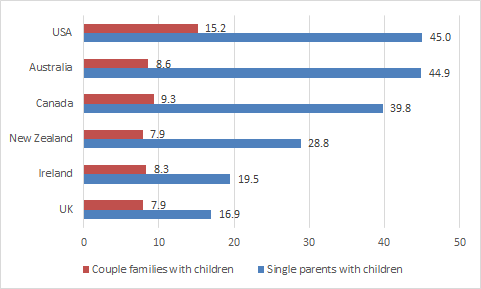
Source: OECD Family Database; Poverty thresholds are set at 50% of the median income of the entire population.
What happened to black family formation in the 1970s?
22 Jun 2015 Leave a comment
in economics of love and marriage, labour economics, labour supply, law and economics, occupational choice Tags: child poverty, economics of the family, family poverty, single mothers, single parents
The War On Poverty has been a disaster for black kids. 2x kids living with unmarried mom. bit.ly/1alPWKB http://t.co/Cwi4C5NtHz—
Old Whig (@aClassicLiberal) April 12, 2015
Proportion of births out of wedlock, 2011, Anglo-Saxon countries
20 Jun 2015 Leave a comment
in gender, labour economics, labour supply, occupational choice, politics - Australia, politics - New Zealand, politics - USA, population economics Tags: economics of fertility, economics of the family, single mothers, single parents
Figure 1: Proportion of births out of wedlock, 2011, Anglo-Saxon countries
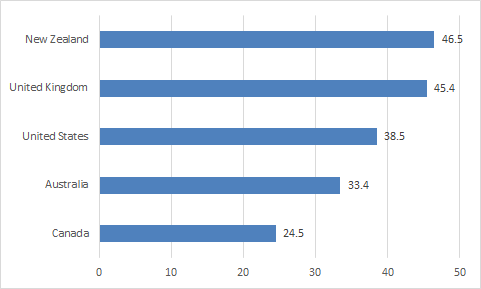
Source: OECD family database; no data for Ireland.
The impact of single parent employment on child poverty rates, Anglo-Saxon countries
20 Jun 2015 Leave a comment
in labour economics, politics - Australia, politics - New Zealand, politics - USA, poverty and inequality, welfare reform Tags: Australia, British economy, Canada, child poverty, economics of the family, family poverty, female labour force participation rates, Ireland, maternal labour supply, single mothers, single parents
Figure 1: Child poverty rate by employment status of single parent, Anglo-Saxon countries, 2010
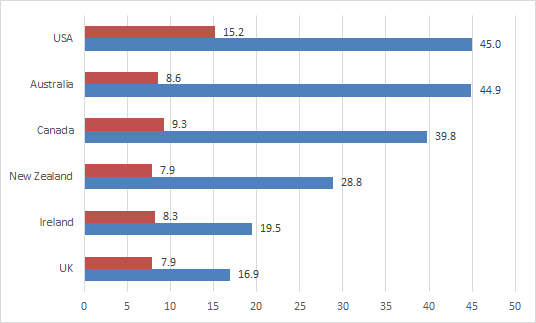
Source: OECD Family Database; Poverty thresholds are set at 50% of the median income of the entire population.
How the average day of American mums and dads has changed since 1965
12 Jun 2015 Leave a comment
in discrimination, economics of love and marriage, gender, labour economics, labour supply, law and economics, occupational choice Tags: economics of the family, home production, household division of labour, marriage and divorce
#Dailychart: How the average day of American mums and dads has changed since 1965 econ.st/1Hi43yt http://t.co/tY5DSpdVKN—
The Economist (@EconBizFin) June 08, 2015
 Utopia, you are standing in it!
Recent Comments