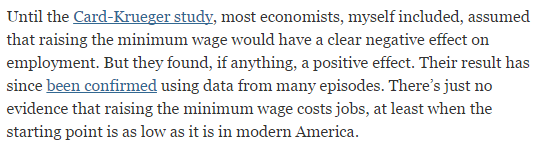
From wisdom to conviction – Paul Krugman on the Card–Kruger study of minimum wages (1998 and now)

This first screenshot is from the New York Times today of Paul Krugman’s current recollection of his interpretation of the Card – Kruger study of minimum wages in restaurants when that study was published all those years ago.
image

Paul Krugman in his review of Living Wage: What It Is and Why We Need It By Robert Pollin and Stephanie Luce in 1998 was far wiser.

So what are the effects of increasing minimum wages? Any Econ 101 student can tell you the answer: The higher wage reduces the quantity of labour demanded, and hence leads to unemployment. This theoretical prediction has, however, been hard to confirm with actual data.

Indeed, much-cited studies by two well-regarded labour economists, David Card and Alan Krueger, find that where there have been more or less controlled experiments, for example when New Jersey raised minimum wages but Pennsylvania did not, the effects of the increase on employment have been negligible or even positive.

Exactly what to make of this result is a source of great dispute. Card and Krueger offered some complex theoretical rationales, but most of their colleagues are unconvinced; the centrist view is probably that minimum wages “do,” in fact, reduce employment, but that the effects are small and swamped by other forces.

What is remarkable, however, is how this rather iffy result has been seized upon by some liberals as a rationale for making large minimum wage increases a core component of the liberal agenda–for arguing that living wages “can play an important role in reversing the 25-year decline in wages experienced by most working people in America” (as this book’s back cover has it).

Clearly these advocates very much want to believe that the price of labour–unlike that of gasoline, or Manhattan apartments–can be set based on considerations of justice, not supply and demand, without unpleasant side effects.

This will to believe is obvious in this book: The authors not only take the Card-Krueger results as gospel, but advance a number of other arguments that just do not hold up under examination.

The Card– Kruger results have gone from rather iffy in the mind of Paul Krugman to the basis of public policy that, if wrong, costs a lot of low paid workers their jobs. Krugman was well aware in 1998 what a risky path minimum wage increases were:

Now to me, at least, the obvious question is, why take this route? Why increase the cost of labour to employers so sharply, which–Card/Krueger notwithstanding–must pose a significant risk of pricing some workers out of the market, in order to give those workers so little extra income?

Why not give them the money directly, say, via an increase in the tax credit?

Studies of tiny increases in the minimum wage are being used to justify far larger increases in the minimum wage. Krugman was right to be suspect of that in 1998.

Krugman’s statements today in the New York Times about the low starting point in modern America for any minimum wage increases is still keeping that slightly cautious tone in his analysis. Few who read his analysis will carry that passing nuance into their own policy advocacy.

Paul Krugman in 1998 was quite astute as to why people want to believe the minimum wage can be increased without any cost to jobs:

One answer is political: What a shift from income supports to living wage legislation does is to move the costs of income redistribution off-budget. And this may be a smart move if you believe that America should do more for its working poor, but that if it comes down to spending money on-budget it won’t.

Indeed, this is a popular view among economists who favour national minimum-wage increases: They will admit to their colleagues that such increases are not the best way to help the poor, but argue that it is the only politically feasible option.

Nor in 1998 was Krugman blind to the expressive politics, the ideological blindness of those who advocate minimum wage increases and living wages:

But I suspect there is another, deeper issue here–namely, that even without political constraints, advocates of a living wage would not be satisfied with any plan that relies on after-market redistribution.

They don’t want people to “have” a decent income, they want them to “earn” it, not be dependent on demeaning hand-outs…

In short, what the living wage is really about is not living standards, or even economics, but morality. Its advocates are basically opposed to the idea that wages are a market price–determined by supply and demand, the same as the price of apples or coal.

It is most unwise to say there is no evidence of minimum wage increases causing unemployment. That sets a low bar of having to find only one or two studies to refute the claim:

1. Taking his claims as true, why do small businesses lobby against raising the minimum wage?
2.  Why did Tom Holmes find in his seminal 1999 JPE paper that manufacturing clusters on the Right to Work Side of state borders and avoids the union side of the border?
3.  Why did Erin Mansur and I find the same result in our 2013 paper where we build on Holmes’ paper and show that labour intensive manufacturing industries are even more likely to avoid the union side of the border as they are more likely to locate in the adjacent county in the Right to Work State?
4.  The Card-Krueger study is certainly important but the variation they used to estimate their effect is tiny relative to the upcoming doubling of the minimum wage up to $15 in cities such as LA and San Fran. How is Dr. Krugman so sure that he can “extrapolate out of sample” to a policy that has never been tried before?  Does he have a valid structural model that he can use to conduct such extreme policy counter-factuals?

Karl Popper would be proud of Krugman’s bold and risky prediction that strictly forbids the existence of any studies showing adverse unemployment effects of minimum wage increases.

The thing to remember is, if there is not doubt in the literature, if there are not some mixed results, the econometricians are simply not trying hard enough to win tenure, secure promotion and be published on the top journals.
Naomi Klein versus The Great Fact

via Winning the War on World Poverty – Bloomberg View.

Real and Pseudo-Financial Crises, the Chinese share market crash and Anna Schwartz

If we could take time out from the breathless journalism about the Chinese stock market, which some people may have heard of before this week, it’s crash should be seen through the lens that Anna Schwartz developed in 1987 of a pseudo financial crisis and a financial crisis.

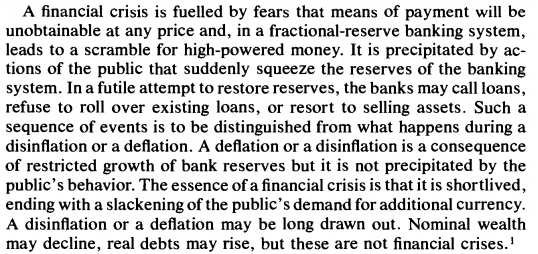
Her paper is written at the same time as the 1987 stock market crash. On financial crises, Anna Schwartz said:

image

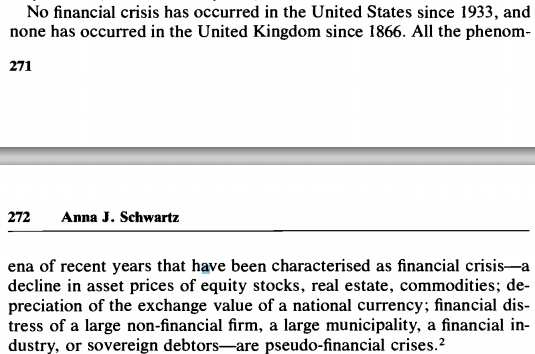
As for those pseudo financial crises, she said:

image

Schwartz’s principal concern with regard to pseudo financial crisis was:

proposals to deal with pseudo-financial crises is the perpetuation of policies that promote inflation and waste of economic resources

As we are talking about the Chinese stock market, Anna Schwartz also wrote about the concepts of real systemic international risk and and pseudo international systemic risk.

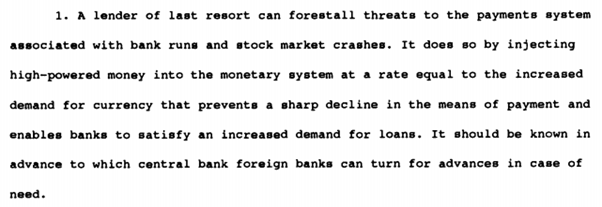
Once again, and as with pseudo financial crises and real financial crises, what distinguishes real systemic international risk and pseudo international systemic risk is a threat to the payment system. The threat of bank runs, which can easily be eliminated through lender of last resort facilities:

image

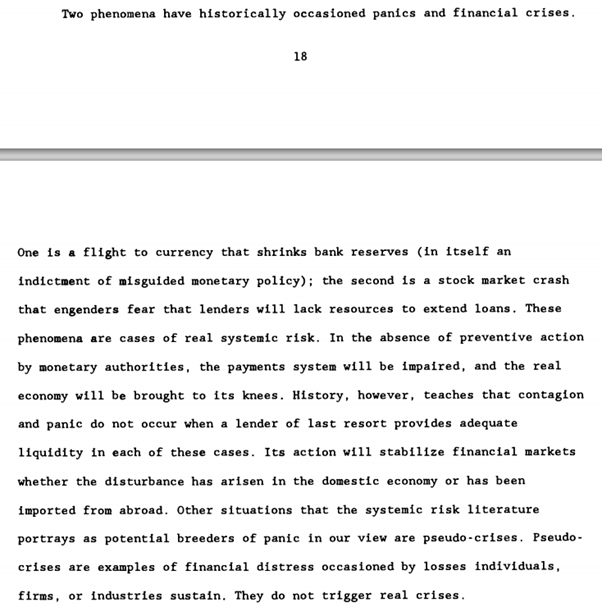
As always it is about the security of the payments system – of avoiding bank runs, not private losses:

image

The lesson for the day is that when people start panicking about the economy or the stock market or international markets, don’t go to a macroeconomist for advice, go to a monetary historian. They have seen it all before.

The opportunity cost of renewable energy subsidies

The different advisory roles of science and the humanities

Housing affordability breakthrough! The capital gains tax has been given its chance to fail

This week, the New Zealand government announced a special capital gains tax for investments in housing. Specifically, if a buyer sells the house within two years of buying it, and this house is not their home, the investor will be liable to income tax on any profit.

This solution also has been put forward by the left-wing political parties in New Zealand as their solution to the problem of restricted land supply in Auckland and other cities in New Zealand.

The introduction of a capital gains tax is a breakthrough for housing affordability. This solution of using a capital gains tax to dampen demand has been given its chance and it will fail.

Once a capital gains tax fails to make housing more affordable, political parties on the left and on the right can no longer put off confronting real solutions such as major reforms to the Resource Management Act (RMA) to loosen restrictions on the supply of land in the big cities in New Zealand and in particular in Auckland.

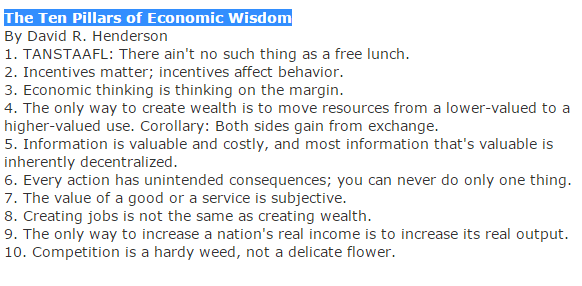
The Ten Pillars of Economic Wisdom

image

via The Ten Pillars of Economic Wisdom, David Henderson | EconLog | Library of Economics and Liberty.

FA Hayek on piecemeal analysis such as cost benefit analysis and evidence-based policy

Persuasive power of quoting a number

Milton Friedman on evidence-based policy

Murphy’s Law of Economic Policy

The merits of different options to combat global warming

No one says this about economists

Scientists dream about what could be.

Economists remind you of price tags and unintended consequences

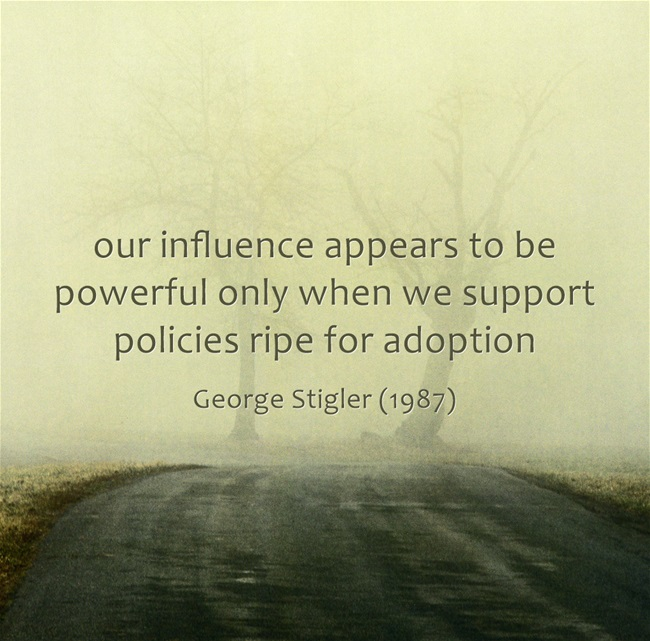
George Stigler on the extensive influence of economists on public policy

George Stigler influence economists adoption

.

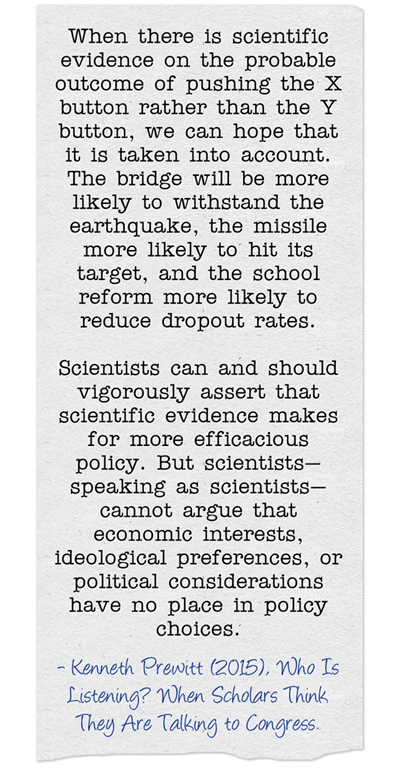
The weight of science in contentious social issues

who is listening. When science is talked of Congress

via via Roger Pielke Jr.’s Blog: Kenneth Prewitt on Science and Congress.

Previous Older Entries Next Newer Entries

Bassett, Brash & Hide

Celebrating humanity's flourishing through the spread of capitalism and the rule of law

Truth on the Market

Scholarly commentary on law, economics, and more

The Undercover Historian

Beatrice Cherrier's blog

Matua Kahurangi

Celebrating humanity's flourishing through the spread of capitalism and the rule of law

Temple of Sociology

Celebrating humanity's flourishing through the spread of capitalism and the rule of law

Velvet Glove, Iron Fist

Celebrating humanity's flourishing through the spread of capitalism and the rule of law

Why Evolution Is True

Why Evolution is True is a blog written by Jerry Coyne, centered on evolution and biology but also dealing with diverse topics like politics, culture, and cats.

Down to Earth Kiwi

Celebrating humanity's flourishing through the spread of capitalism and the rule of law

NoTricksZone

Celebrating humanity's flourishing through the spread of capitalism and the rule of law

Homepaddock

A rural perspective with a blue tint by Ele Ludemann

Kiwiblog

DPF's Kiwiblog - Fomenting Happy Mischief since 2003

The Dangerous Economist

Celebrating humanity's flourishing through the spread of capitalism and the rule of law

Watts Up With That?

The world's most viewed site on global warming and climate change

The Logical Place

Tim Harding's writings on rationality, informal logic and skepticism

Doc's Books

A window into Doc Freiberger's library

The Risk-Monger

Let's examine hard decisions!

Uneasy Money

Commentary on monetary policy in the spirit of R. G. Hawtrey

Barrie Saunders

Thoughts on public policy and the media

Liberty Scott

Celebrating humanity's flourishing through the spread of capitalism and the rule of law

Point of Order

Politics and the economy

James Bowden's Blog

A blog (primarily) on Canadian and Commonwealth political history and institutions

Science Matters

Reading between the lines, and underneath the hype.

Peter Winsley

Economics, and such stuff as dreams are made on

A Venerable Puzzle

"The British constitution has always been puzzling, and always will be." --Queen Elizabeth II

The Antiplanner

Celebrating humanity's flourishing through the spread of capitalism and the rule of law

Bet On It

Celebrating humanity's flourishing through the spread of capitalism and the rule of law

History of Sorts

WORLD WAR II, MUSIC, HISTORY, HOLOCAUST

Roger Pielke Jr.

Undisciplined scholar, recovering academic

Offsetting Behaviour

Celebrating humanity's flourishing through the spread of capitalism and the rule of law

JONATHAN TURLEY

Res ipsa loquitur - The thing itself speaks

Conversable Economist

Celebrating humanity's flourishing through the spread of capitalism and the rule of law

The Victorian Commons

Researching the House of Commons, 1832-1868

The History of Parliament

Articles and research from the History of Parliament Trust

Books & Boots

Reflections on books and art

Legal History Miscellany

Posts on the History of Law, Crime, and Justice

Sex, Drugs and Economics

Celebrating humanity's flourishing through the spread of capitalism and the rule of law

European Royal History

Exploring the Monarchs of Europe

Tallbloke's Talkshop

Cutting edge science you can dice with

Marginal REVOLUTION

Small Steps Toward A Much Better World

NOT A LOT OF PEOPLE KNOW THAT

“We do not believe any group of men adequate enough or wise enough to operate without scrutiny or without criticism. We know that the only way to avoid error is to detect it, that the only way to detect it is to be free to inquire. We know that in secrecy error undetected will flourish and subvert”. - J Robert Oppenheimer.

STOP THESE THINGS

The truth about the great wind power fraud - we're not here to debate the wind industry, we're here to destroy it.

Lindsay Mitchell

Celebrating humanity's flourishing through the spread of capitalism and the rule of law

Alt-M

Celebrating humanity's flourishing through the spread of capitalism and the rule of law

croaking cassandra

Economics, public policy, monetary policy, financial regulation, with a New Zealand perspective

The Grumpy Economist

Celebrating humanity's flourishing through the spread of capitalism and the rule of law

International Liberty

Restraining Government in America and Around the World