
6 charts that show why UN climate talks keep breaking down – Vox
15 Dec 2014 Leave a comment
in economics of climate change, environmental economics, environmentalism, global warming Tags: climate alarmism, expressive voting, global warming
/assets.sbnation.com/uploads/chorus_asset/file/1374708/failing_at_two-degree_goal.0.png)
/assets.sbnation.com/uploads/chorus_asset/file/1374424/cumulative_historical_emissions.0.png)
/assets.sbnation.com/uploads/chorus_asset/file/1374568/China_s_per_capita_emissions.0.png)
/assets.sbnation.com/uploads/chorus_asset/file/1395414/outsourcing_emissions_2.0.png)
/assets.sbnation.com/uploads/chorus_asset/file/1374984/divvying_up_to_meet_the_budget.0.png)
/assets.sbnation.com/uploads/chorus_asset/file/1374504/Annex_B_vs_non_Annex_B.0.png)
Lima climate deal: Every single country now plans to tackle emissions. Sort of. – Vox
15 Dec 2014 Leave a comment
in climate change, energy economics, environmental economics, global warming Tags: climate alarmism, expressive voting, global warming
Global warming – where there is and is not a consensus to deny | Ordinary Times
14 Dec 2014 Leave a comment
in applied welfare economics, climate change, environmental economics, environmentalism, global warming, Karl Popper, politics - Australia, politics - New Zealand, politics - USA, Public Choice Tags: climate alarmism, expressive voting, global warming

The motte for climate change activists are the following:
- Global temperatures are rising.
- Greenhouse gases lead to increased temperatures.
- Greenhouse gases emitted by humans have led to measurable increases in temperature beyond what would have occurred without any humans.
The above points are highly defensible because Science. I believe they are true (though I do so only via trust in others rather than having evaluated any of the research involved personally).
Activists, however, do not sit in this motte for long. They often go on to make a lot of other claims in the bailey:
- Long-term projections of the Earth’s climate are accurate.
- Catastrophe will result in a few decades due to human carbon emissions.
- Nuclear energy is not a viable alternative to fossil fuels.
- Carbon capture is not viable.
- Geoengineering is not viable.
- Unilateral subsidization of renewables by Western industrialized nations is an effective way to reduce global emissions of greenhouse gases.
- Subsidies of energy-efficient products are a better use of resources rather than research and development.
- Subsidizing vehicles that pollute less than other vehicles will provide a net reduction in greenhouse emissions.
- LEED-certified buildings are more energy-efficient than old buildings.
- Building new LEED-certified buildings reduces net greenhouse emissions relative to not building them.
- Sending oil by railcar will result in less net emissions than sending oil through a pipeline (e.g. the Keystone pipeline).
Not all activists make all of these claims, but I think most make at least some claims that are less defensible than those in the motte.
The end result is that anyone who opposes any of the views, even questionable ones sitting in the bailey, can be branded an anti-science denialist. Strictly speaking, this is unfair since there certainly isn’t a scientific consensus on questions like whether it makes sense to spend thousands of dollars subsidizing Chevy Volts while taxing bicycles and safety helmets at 8%.
via An Example of the Motte and Bailey Doctrine | Ordinary Times.
EU’s rate of decarbonisation is identical before and after the ETS was introduced in 2000
13 Dec 2014 Leave a comment
in climate change, economics of climate change, environmental economics, global warming Tags: carbon tax, carbon trading, climate alarmism, European Union, expressive voting, global warming
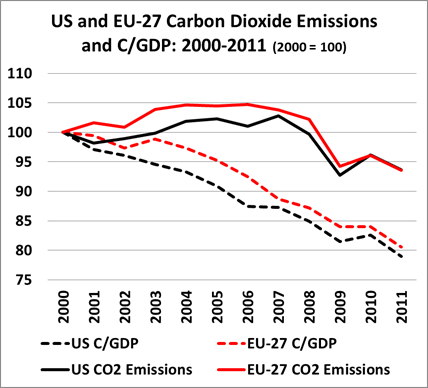 Whatever impact the EU ETS has had, the US achieved similar results with no carbon market (and some might argue, with no climate policy at all. Both the US and EU reduced aggregate emissions by 6.4 percent from 2000.

The torture report’s one glaring weakness – The Washington Post
11 Dec 2014 Leave a comment
in laws of war, politics - USA, war and peace Tags: congressional accountability, expressive voting, interrogation techniques, Left-wing hypocrisy, wawar against terror
A more honest report would have squarely faced the arguments made by former CIA officials that key members of Congress were informed about interrogation practices and, far from objecting, condoned the very CIA activities we now judge to have been wrong.
“There’s great hypocrisy in politicians’ criticism of the CIA’s interrogation program,” wrote Jose Rodriguez, the CIA deputy director who oversaw it, in last weekend’s Washington Post.
That allegation deserves a serious response, rather than the stonewall it got from Feinstein.
“The CIA briefed Congress approximately 30 times” on interrogation,according to six former CIA directors or deputy directors in an article Tuesday in the Wall Street Journal. “The briefings were detailed and graphic and drew reactions that ranged from approval to no objection.”
…History (including the latest dark chapter on interrogation) suggests that members are for questionable activities when they’re politically popular, and against them when public opinion shifts.
Anti-prohibition demonstrators were in-your-face about what they wanted
07 Dec 2014 Leave a comment
in applied welfare economics, economics of regulation, law and economics, liberalism Tags: drug decriminalisation, expressive voting, marijuana decriminalisation, prohibition
Too Many Battery Factories, Too Few Electric Cars | MIT Technology Review
29 Nov 2014 Leave a comment
in energy economics, environmental economics Tags: electric cars, expressive voting


A Mini adventure: London to Edinburgh in an electric car
28 Nov 2014 2 Comments
in energy economics, environmental economics, global warming Tags: climate alarmism, electric cars, expressive voting, global warming

The intrepid adventurer from the BBC drove the 778 kilometers from London to Edinburgh in an electric Mini, and had to stop eight times to recharge – often waiting six hours or more.
In total, he spent 80 hours waiting or driving, averaging just ten kilometers per hour – an unenviable pace even before the advent of the steam engine.
via BBC News – Mini adventure: how far can an electric car go?.
On the relative cost effectiveness of electric cars
28 Nov 2014 Leave a comment
in energy economics, environmental economics, global warming Tags: climate alarmism, expressive voting, global warming
Behind on my food snob blogging
24 Nov 2014 Leave a comment
in health economics, liberalism Tags: expressive voting, food snobs organic food
Breaking Analysis: US-China Climate Deal to Avoid 640 Billion Tons of Carbon Pollution, if fully implemented!?
15 Nov 2014 Leave a comment
in energy economics, environmental economics, global warming Tags: climate alarmism, expressive voting, global warming


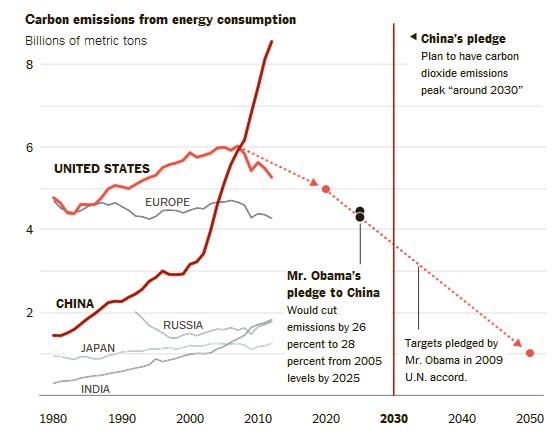
What Obama and China intend to do by around 2030
14 Nov 2014 Leave a comment
in environmental economics, global warming, politics - USA Tags: climate alarmism, expressive voting, global warming
HT: Catallaxyfiles
U.S. and China Reach Climate Deal After Secret Negotiations – where are the protesters? Where is the hypocrisy?!
12 Nov 2014 1 Comment
in environmental economics, global warming, politics - New Zealand, politics - USA Tags: climate alarmism, expressive voting, global warming, international environmental law, international law, international trade law, Leftover Left, preferential trading agreements
The United States and China have unveiled a secretly negotiated deal to reduce their greenhouse gas output, with China agreeing to cap emissions for the first time and the US committing to deep reductions by 2025. Jointly announced in Beijing by President Obama and President Xi Jinping, includes new targets for carbon emissions reductions by the United States and a first-ever commitment by China to stop its emissions from growing by 2030.
https://twitter.com/CearaProut/status/531251207033982977
Will protestors take to streets about the secrecy that proceeded the negotiation of this international agreement?
- 10,000 protesters took to the streets of New Zealand at the weekend against the secrecy surrounding the Trans-Pacific partnership trade and investment talks. The air was thick with conspiracy theories and the demand for transparency in international diplomacy.
- Why were these treaty negotiations with China over carbon emissions kept from the watchful eye of the American public before the recent congressional elections?
The Left over Left picks and chooses the international law that it champion:
- International law on both human rights and the environment are both an addendum to the 10 Commandments and must be followed, come hell or high water. Even better if the UN is somehow involved – moral status is then beyond question.
- International trade and investment laws are the spawn of Satan. The fact that these trade and investment treaties are freely negotiated between sovereign states adds nothing to their moral standing and much to their conspiratorial origins.
- International criminal courts, the European Court of Justice and the World Court are all superior to national courts. International trade and investment dispute tribunals are the lackeys of multinationals.
 Utopia, you are standing in it!
Recent Comments