The universal basic income is a rare bird for the left. It is the only time the usual suspects on the left are happy to cut government bureaucracy.
Furthermore, the left makes no inquiries as to how these redundant bureaucrats who administered the welfare state will find jobs. The market is left to work its magic for once. How convenient.
When a tariff cut is proposed, a trade deal signed, or job reduction in a bureaucracy suggested perhaps as the result of a privatisation, left-wing activists chain themselves to factory gates or government offices in solidarity. The social upheaval from the job losses among existing workers and their dim prospects of reemployment are paramount in their minds.
The universal basic income is the only time the left welcomes a reduction in bureaucracy and the role in the state. This switch from welfare payments to a universal basic income does not make those on the benefit any better off. Normally they are worse off under a universal basic income.
None of the the less well groups which of the concern of the left gain from a universal basic income. Despite this, they sell the jobs of their comrades in the public sector down the river.
I cannot believe the explanation is job losses are OK as long as they are the result of left-wing policies. Unless the labour market is liberalised, its ability to find new jobs for workers, for example, made redundant in the public sector after the introduction of a universal basic income is not any under greater than under a right-wing policy that costs jobs.
Any decent political movement makes an ambit claim in expectation of being beaten back to its real position. That is basic negotiation tactics in politics.
Such is the volatility of expressive politics that the fight for 15 campaign has taken on a life of its own and is actually delivering on a $15 living wage as the minimum wage in the USA in a growing number of states and cities as well is in Democratic party presidential campaign pledges.
If there is any degree of economic sanity and practicality among living wage advocates, they know that such a high living wage increase will cost jobs.
Venn diagram of the day: Do higher tariffs/wages reduce quantity demanded or not? – AEI https://t.co/33369UkpX2
After all, if a large wage increase for low-paid workers cost no jobs, why not increase everyone’s wage by a similar percentage, which is about 100% in the USA?
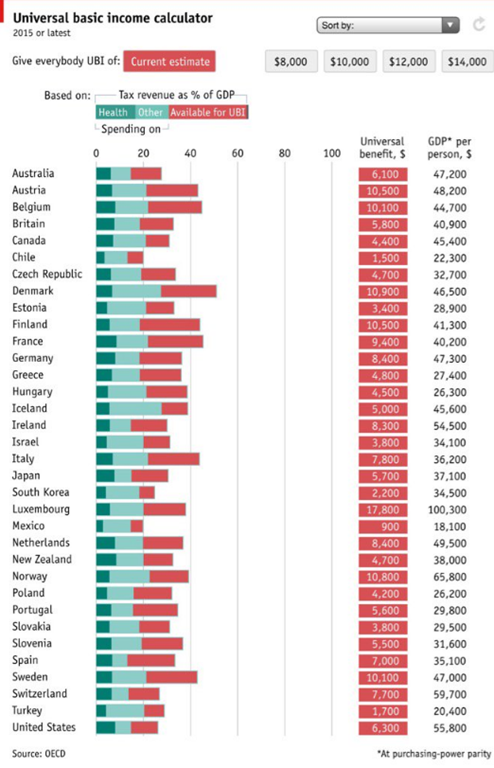
A universal basic income in New Zealand will have to be financed by a great big new tax because the existing ones are not enough according to the Economist calculations below.
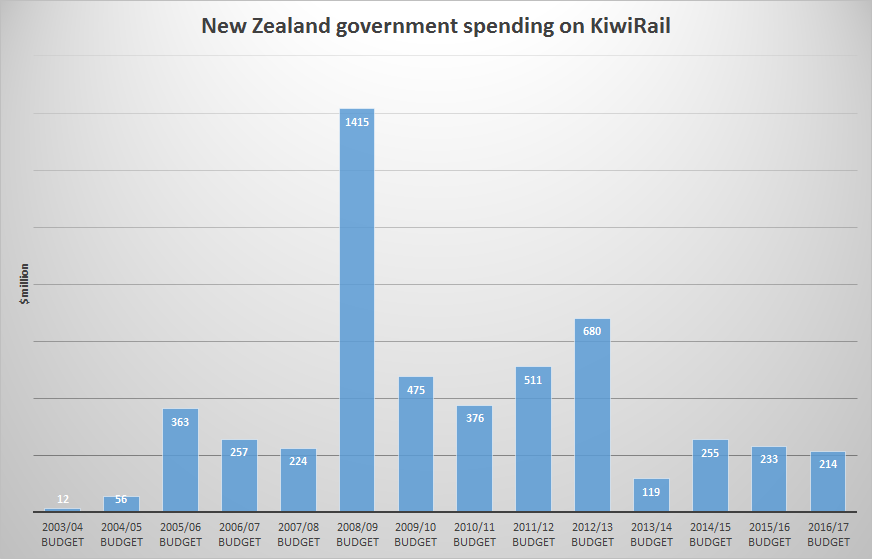
$5.2 billion in rail spending since the 2003 budget! This $5.2 billion does not include any spending on urban rail, commuter train networks or their electrification. The $5.2 billion since the 2003 budget is for the passenger and freight network, not the urban metro contracts
Source: New Zealand Budget Papers, various years.
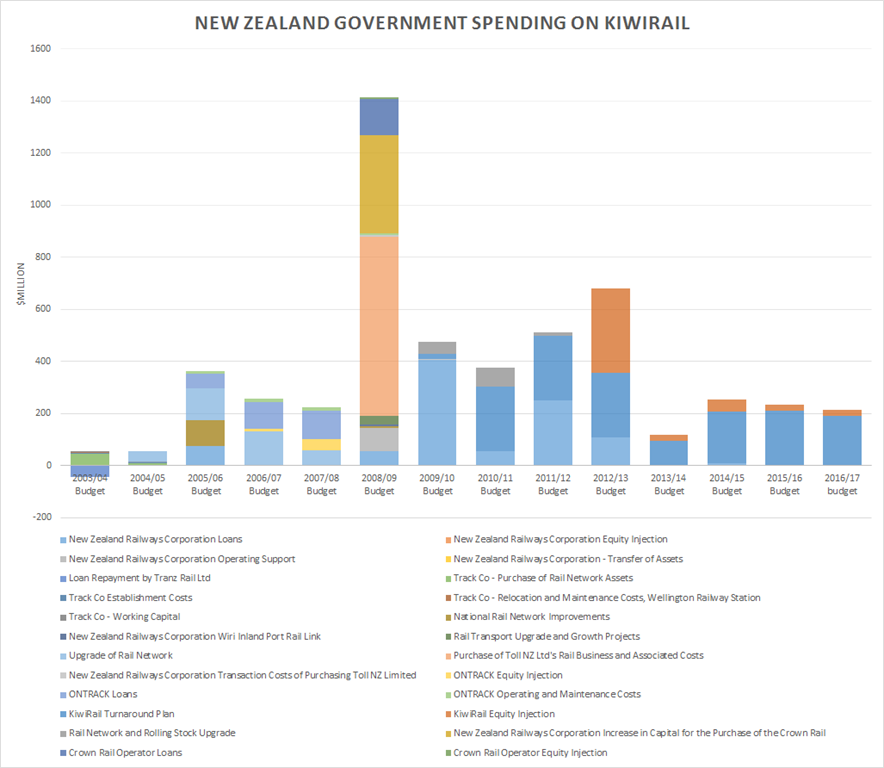
Desperately waiting for that dividend the taxpayers lose if any of these assets are privatised. The spending listed below in the two charts includes loans, capital injections and the purchase of the track and of the train operator itself. The latter was purchased for $690 million which was soon written down to zero.
Source: New Zealand Budget Papers, various years.
There is no table because the table format breaks down when blogged.
At various times, OnTrack and KiwiRail was subsidiaries of the New Zealand Railways Corporation, which was the holding company. Now OnTrack is a division of KiwiRail.
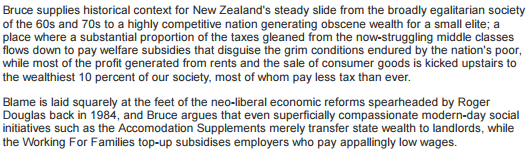
You really are still fighting the 1990 New Zealand general election if Max Rashbrooke makes more sense than you on the good old days before the virus of neoliberalism beset New Zealand from 1984 onwards.
Maybe 65% of the population of those good old days before the virus of neoliberalism. were missing out on that broadly egalitarian society championed by Bryan Bruce.
As is typical for the embittered left, the reactionary left, gender analysis and the sociology of race is not for their memories of their good old days. New Zealand has the smallest gender wage gap of any of the industrialised countries.
The 20 years of wage stagnation that proceeded the passage of the Employment Contracts Act and the wages boom also goes down the reactionary left memory hole.
That wage stagnation in New Zealand in the 1970s and early 80s coincided with a decline in the incomes of the top 10%. When their income share started growing again, so did the wages of everybody after 20 years of stagnation. The top 10% in New Zealand managed to restore their income share of the early 1970s and indeed the 1960s. That it is hardly the rich getting richer.
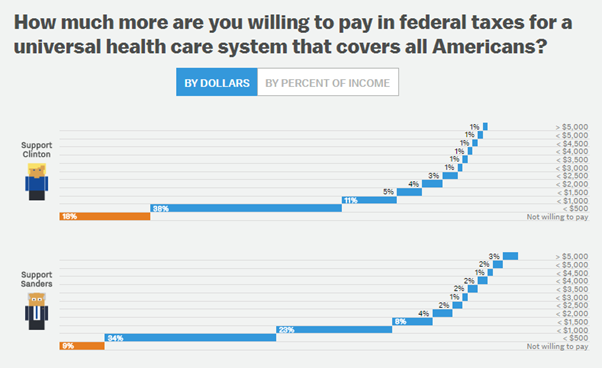
66 percent of Sanders supporters are unwilling to pay more than $1,000 in higher taxes for universal health care. This includes the 8 percent of Sanders supporters who aren’t willing to pay anything more!
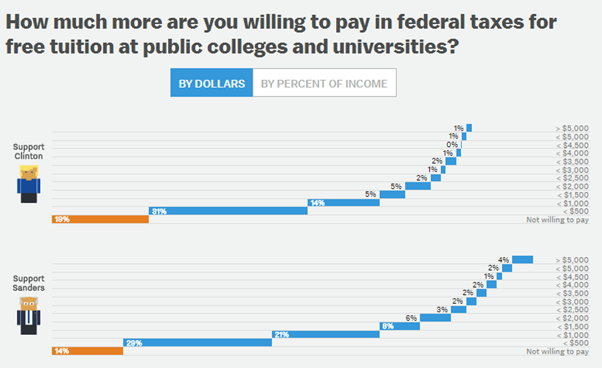
Sanders supporters want free public college tuition but 14 percent said they don’t want to pay additional taxes for it; another half said they would only pay up to $1,000 a year!
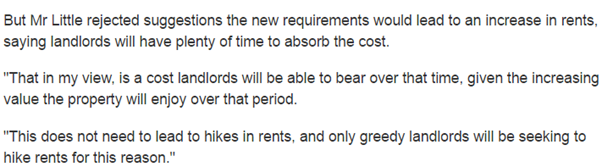
Opposition Leader Andrew Little accepts that mandating insulation and heat pumps into rental properties will increase their value. But he denies that this will affect rents!
An upgrade increases the value of a rental property if the improvements that increase its rental value. You cannot have the increase in the value of the asset without the increase in rent.
For an application of economics to a different part of the law, consider the nonwaivable warranty of habitability, a legal doctrine under which some courts hold that apartments must meet court-defined standards with regard to features such as heating, hot water, sometimes even air conditioning, whether or not such terms are provided in the lease—indeed, even if the lease specifically denies that it includes them.
The immediate effect is that certain tenants get services that their landlords might not otherwise have provided. Some landlords are worse off as a result; some tenants are better off. It seems as though supporting or opposing the rule should depend mainly on whose side you are on.
In the longer run, the effect is quite different. Every lease now automatically includes a quality guarantee. This makes rentals more attractive to tenants and more costly to landlords. The supply curve, the demand curve, and the price, the rent on an apartment, all shift up. The question, from the standpoint of a tenant, is not whether the features mandated by the court are worth anything but whether they are worth what they will cost.
The answer may well be no. If those features were worth more to the tenants than they cost landlords to provide, landlords should already be including them in their leases—and charging for them. If they cost the landlord more than they are worth to the tenant, then requiring them and letting rents adjust accordingly is likely to make both landlord and tenant worse off. It is particularly likely to make poorer tenants worse off, since they are the ones least likely to value the additional features at more than their cost.
A cynical observer might conclude that the real function of the doctrine is to squeeze poor people out of jurisdictions that adopt it by making it illegal, in those jurisdictions, to provide housing of the quality they can afford to rent.
If my analysis of the effect of this legal doctrine seems implausible, consider the analogous case of a law requiring that all cars be equipped with sunroofs and CD changers. Some customers—those who would have purchased those features anyway—are unaffected. Others find that they are getting features worth less to them than they cost and paying for them in the increased price of the car.
Why Evolution is True is a blog written by Jerry Coyne, centered on evolution and biology but also dealing with diverse topics like politics, culture, and cats.
“We do not believe any group of men adequate enough or wise enough to operate without scrutiny or without criticism. We know that the only way to avoid error is to detect it, that the only way to detect it is to be free to inquire. We know that in secrecy error undetected will flourish and subvert”. - J Robert Oppenheimer.



 Utopia, you are standing in it!
Recent Comments