By almost any metric, belief in climate change is on the rise among GOP Voters pic.twitter.com/pPyt5Cn7Kt
— Adrian Gray (@adrian_gray) November 30, 2015
Are Republican voters becoming climate alarmists?
03 Dec 2015 Leave a comment
in energy economics, environmental economics, global warming, politics - USA Tags: climate alarmism, expressive voting, rational ignorance, rational rationality, voter demographics
Share of world poverty has halved in last 20 years
29 Nov 2015 1 Comment
in development economics, economic history, growth disasters, growth miracles Tags: capitalism and freedom, expressive voting, extreme poverty The Great Fact, global poverty, rational ignorance, rational rationality, voter demographics
https://twitter.com/MaxCRoser/status/630066216158261248/photo/1
Since 1820 the world's population increased 7x while extreme poverty fell from 94% to 14%. buff.ly/1hgHIrb http://t.co/0dx4GE4Uqc—
Jeremiah Dillon (@jeremiahdillon) August 07, 2015
Political outlooks and risk perception
29 Nov 2015 1 Comment
in applied welfare economics, economics of regulation, health economics Tags: anti-vaccination movement, expressive voting, GMOs, gun control, political psychology, risk risk trade-offs
The incentive effects of the living wage and a carbon tax @BernieSanders
25 Nov 2015 Leave a comment
in applied price theory, energy economics, labour economics, minimum wage, politics - USA Tags: 2016 presidential election, carbon tax, climate alarmism, expressive voting, Leftover Left, living wage, rational irrationality, Twitter left
Why propaganda?
21 Nov 2015 Leave a comment
in constitutional political economy, economics of media and culture, income redistribution, Marxist economics, Public Choice, rentseeking Tags: economics of advertising, expressive voting, rational ignorance, rational irrationality
The inconvenient truths of @AlGore
20 Nov 2015 Leave a comment
in environmental economics, global warming Tags: climate alarmism, expressive voting, political propaganda, rational ignorance, rational irrationality
JFK assassination conspiracy theories are still going strong, unfortunately
19 Nov 2015 Leave a comment
in economic history, health economics, politics - USA, Public Choice Tags: conspiracy theories, cranks, expressive voting, JFK conspiracy theorists, political psychology, Quacks, rational ignorance, rational irrationality, social psychology

..
One in five support a military coup to stop Boris Johnson becoming prime minister
16 Nov 2015 Leave a comment
in constitutional political economy, Public Choice Tags: British politics, expressive voting, military coups, rational ignorance, rational rationality, voter demographics
Trust in media by ideology
15 Nov 2015 Leave a comment
in economics of information, economics of media and culture, industrial organisation, politics - USA, Public Choice, survivor principle Tags: expressive voting, media bias, rational ignorance, rational irrationality, The meaning of competition
The costs of solar energy to the environment are underestimated
13 Nov 2015 Leave a comment
in energy economics, environmental economics, global warming Tags: Big Solar, expressive voting, renewable energy, solar energy, unintended consequences
https://twitter.com/roomfordebate/status/662290426083328000

Source: The Costs of Solar Energy to the Environment – Room for Debate – NYTimes.com.
Virtue signaling
13 Nov 2015 Leave a comment
in Public Choice Tags: expressive voting, political psychology, signaling
@jeremycorbyn @BernieSanders oppose the one path to peace
04 Nov 2015 Leave a comment
in international economics, liberalism, politics - USA, war and peace Tags: British politics, capitalism and freedom, China, expressive voting, free trade, game theory, populists, rational ignorance, rational irrationality, Richard Cobden, World War I

Jeremy Corbyn is in trouble again, this time for describing World War I as pointless.
Corbyn has, for all his life, opposed the only means of securing peace either in Europe or anywhere else. He is against trade agreements, the European Union and NATO. Bernie Sanders is equally as misguided.
Corbyn and Sanders thinks you can make peace just by talking with people. Peace is made by trading with hostile countries to make them depend on you for their prosperity as well as yours. By growing rich through free trade, it’s in no ones interest to go to war or have poor relations with each other or each other’s friends.
Is the living wage a form of indirect sex discrimination?
03 Nov 2015 Leave a comment
in applied price theory, discrimination, gender, labour economics, Marxist economics, minimum wage, politics - New Zealand Tags: expressive voting, living wage, offsetting behaviour, rational irrationality, The fatal conceit, unintended consequences
The living wage will certainly be to the profit of incumbent workers at the time of the wage increase but that is provided that their employer stays in business. The introduction of a living wage will result in indirect sex discrimination because of the higher job turnover rates of women. Women also have shorter average job tenures than men in any particular job.
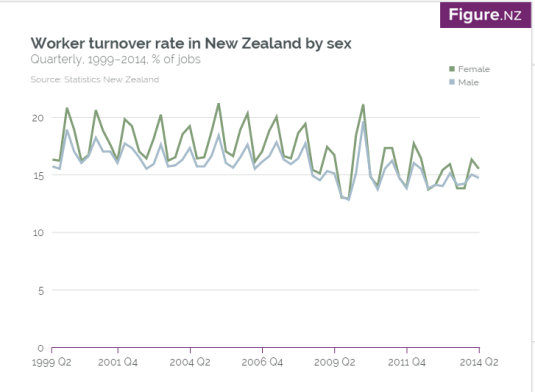
Source: Worker turnover rate in New Zealand by sex – Figure.NZ.
Any benefit premised on not quitting jobs discriminates against women because of their higher job quit rates. More women than men will have to quit living wage jobs because of motherhood and other changes in their personal circumstances. Isn’t that discrimination?
One in six workers change their jobs every year. That job turnover rate is higher among the workers with less human capital simply because both sides of the job match have less reasons to continue. A job quit or job layoff for a less skilled worker does not result as much of a loss of job specific and firm specific human capital than would be the case if the worker was more skilled with more firm-specific human capital.
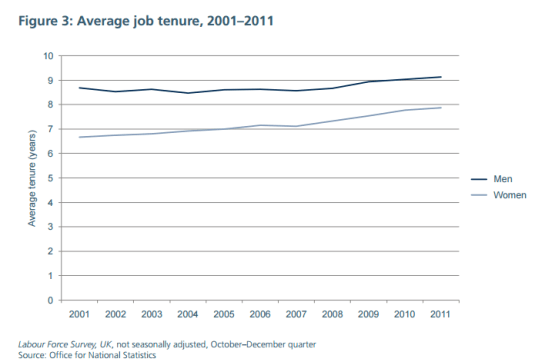
One of the iconic empirical facts of the labour market is job turnover rates are higher and job layoff rates are higher for less skilled workers. As workers acquire more job specific human capital, they are more reluctant to quit and their employer hesitate before laying them off. This is because of the firm specific human capital which both invested would have to be written off.
Women quit jobs more often than men, work part-time or switch between part-time and full-time work more often than men and enter and re-enter to the workforce because of motherhood and maternity leave. Women also tend to invest in more generalised, more mobile human capital. Women anticipate a more intermittent labour force participation and more spells of part-time work. As such, women have less reasons to invest in specific human capital if they anticipate leaving because of motherhood and either changing jobs more often are working part-time. If you are changing jobs more often, such as women do, investing in more general human capital and less in specific capital increases options when searching for vacancies.
Any benefit of the living wage will erode faster for women because they quit jobs at a higher rate than men. Is this indirect sex discrimination? This higher job turnover rate is driven by human capital investment strategies and career plans. The living wage, which privileges the incumbent workers at the time the living wage increases implemented, discriminates against female workers because they change jobs more often or are likely to quit sooner after the living wage was initially implemented.

The particular form of indirect sex discrimination at hand arises from the Golden Handcuffs effect of the living wage. Closer Together Whakatata Mai – reducing inequalities explain the Golden Handcuffs effect this way:
You may have noticed in the article it is actually the SAME people being paid the living wage (“all of them have stayed on as staff”). This is how labour markets can work if employers make different choices. If you look at the Living Wage employers – they haven’t hired a whole new set of people – they have invested in the people they already have. The world has not ended and many more people are happy and businesses and organisations are doing just fine.
Even the proponents of the living wage admit that a living wage increase will segment the labour market and create insiders and outsiders with the insiders paid more than what used to be called the reserve army in the unemployed by the same crowd of activists. A reduction in job turnover will increase unemployment durations because there are fewer vacancies posted every period.
Hopefully all the existing employees of the living wage employer are capable of the requisite up skilling they need to match their new productivity targets. Not everyone did well at school. One of the reasons workers on low wages are on those low wages because they perhaps didn’t do as well at school as activists who appointed themselves to speak for them. A harsh reality of life is 50% of the population have below-average IQs.
This up skilling answer to the cost to employers of a living wage increase is a variation of the standard policy response in a labour market crisis. That standard labour market policy response in crisis is send them on a course. Sending them on a course as a response to a crisis makes you look like you care and by the time they graduate the problem will probably have fixed itself. Most problems do. I found this bureaucratic response to labour market crises to repeat itself over and over again while working in the bureaucracy.
The reason was sending them on a course was so popular with geeks as yourself sitting at your desk as a policy analysis, minister or political activist all did well at university. You assume others will do well through further education and training including those who have neither the ability or aptitude to succeed in education. People don’t go on from high school to higher education for a range of reasons that include a lack of motivation to study or a simple lack of ability no matter how hard they try.

The living wage hypothesis about reduced turnover, up-skilling and greater motivation is a small example of the American company that decided to pay a minimum wage of $70,000 a year. Those workers who cannot earn as much of this elsewhere would never quit. Some of his better employers quit because they resented being paid the same as less productive employees. Hopefully, the minority shareholder suing his brother who is the CEO for offering that above market wage doesn’t end up bankrupting the company. As such, the incumbent workers’ fortunes are unusually closely tied to their existing employer if they are paying above the going rate in their industry and occupation.
I suppose you could hold on like grim death but women tend to have more reasons to move on than men if only because of pregnancy and motherhood. These golden handcuffs are of less value to them than to men. Younger workers are also less advantaged because many young New Zealanders take a overseas working holiday of several years, if not more. If they have a living wage job now that have to give up that advantage.
Workers who lack the labour productivity to earn a wage equivalent of the living wage elsewhere will never quit a living wage job, and will have a much reduced incentive to up-skill or seek promotion. There will be less internal reward for undertaking additional training or job responsibilities among low skilled is because the living wage will mean they will not get a wage rise. That wage rise is gobbled up by the living wage increase if you’re already a low-paid worker.
Naturally, as vacancies arise, recruits will be drawn from a much higher quality recruitment attracted by the higher wage at the living wage employer. The less skilled workers who don’t currently work for the living wage employer will miss out completely.
 Utopia, you are standing in it!
Recent Comments