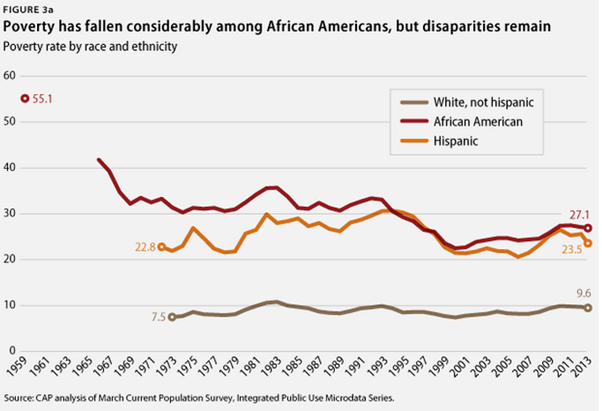
Black and Hispanic poverty dropped by a third after the 1996 US welfare reforms
13 May 2015 Leave a comment
in labour economics, labour supply, politics - USA, poverty and inequality, welfare reform Tags: 1996 welfare reforms, child poverty, family poverty, welfare state
Child poverty and single parenthood
13 May 2015 Leave a comment
in economics of love and marriage, gender, labour economics, labour supply, occupational choice, poverty and inequality, welfare reform Tags: child poverty, economics of marriage, family poverty, marriage and divorce, single mothers, single parents, welfare reform
Over half of all births to young adults in the U.S. now occur outside of marriage. bit.ly/1qONO10 http://t.co/KXl4sFd122—
Isabel Sawhill (@isawhill) September 17, 2014
Despite forgoing #marriage, young Americans are not forgoing parenthood. bit.ly/1sMG2bJ http://t.co/1aSELaJlfg—
Isabel Sawhill (@isawhill) October 31, 2014
Despite forgoing #marriage, young Americans are not forgoing #parenthood. bit.ly/1xLa1AJ http://t.co/fetnPAiCPG—
Isabel Sawhill (@isawhill) October 13, 2014
Almost 60% of births to women with only a high school degree occur out of wedlock. bit.ly/1sMG2bJ http://t.co/zomTFjZwA2—
Isabel Sawhill (@isawhill) October 14, 2014
Employment and the risk of deep poverty in the USA
12 May 2015 Leave a comment
in labour economics, labour supply, poverty and inequality Tags: child poverty, family poverty, labour force participation
The best defense against deep poverty is a paycheck: brook.gs/1IVXiTo http://t.co/BsermWSDZk—
Brookings (@BrookingsInst) May 10, 2015
Despite being a wealthy nation, extreme & deep poverty has become more prevalent in the U.S.: brook.gs/1IVVI3O http://t.co/cfnlkrXuw6—
Brookings (@BrookingsInst) May 09, 2015
More than 7.1 million U.S. children live in deep poverty. Get the facts on America's poor: brook.gs/1IWlK74 http://t.co/K4Uwrl5TOg—
Brookings (@BrookingsInst) May 08, 2015
What’s left of the welfare state after dastardly neoliberalism still lifts most out of poverty
12 May 2015 Leave a comment
in labour economics, labour supply, politics - USA, poverty and inequality Tags: child poverty, family poverty, Leftover Left, neoliberalism, welfare reform, welfare state
How government reduces child poverty (SPM-measured) in the U.S. bit.ly/1D7eXjZ From: @aecfkidscount http://t.co/80m2jjXxvY—
Richard V. Reeves (@RichardvReeves) April 16, 2015
To tackle poverty, the Left says welfare, the Right says work. Guess what? They're both right: brook.gs/1zSabJI http://t.co/E4AZR05CQJ—
Richard V. Reeves (@RichardvReeves) February 13, 2015
The magic of (increasing) redistribution in one @EugeneSteuerle graph blog.metrotrends.org/2015/02/addres… http://t.co/lbtlM3zT5L—
Richard V. Reeves (@RichardvReeves) February 18, 2015
Full-time work on the minimum wage is enough to keep a NZ family out of poverty!
10 May 2015 Leave a comment
in labour economics, minimum wage, politics - Australia, politics - New Zealand, politics - USA, poverty and inequality Tags: capitalism and freedom, child poverty, family poverty, Left-wing hypocrisy, living wage, New Zealand Greens, New Zealand Labour Party, Simon Chapple
Where a 40-hour workweek doesn't lift families from poverty: bloom.bg/1AFOD0q http://t.co/eBoJSz1TkX—
Bloomberg VisualData (@BBGVisualData) May 23, 2015
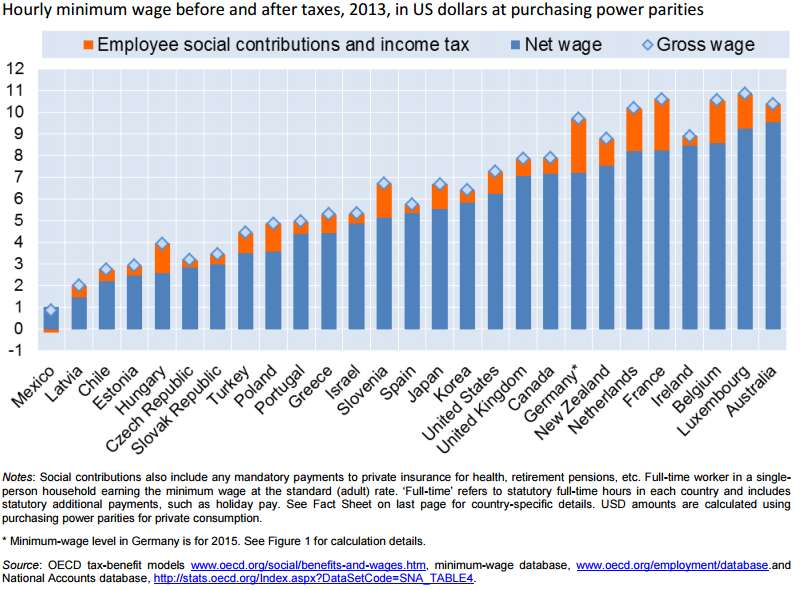
An OECD chart that shows New Zealand parents only need to work a little over 40 hours a week on the minimum wage to lift a family out of poverty in New Zealand.

The figure above shows that a lone parent with two children needs to work about 25 hours a week stay out of poverty in 2013 in New Zealand Once taxes are taken into account as well as additional family benefits such as in-work tax credits. New Zealand is one of the easiest places in the world to get out of poverty by working part-time for a sole mother.
The figure above from the OECD shows that New Zealand couple with two children needs to work about 40 hours a week to stay out of poverty. Of course, what is poverty depends on the definition of the poverty line and in this case by the OECD, it is defined as 50% of the median wage after taxes and family benefits. Another common definition of poverty is earning less than 60% of the median wage
The minimum wage is $14.75 per hour in New Zealand while proposals for a living wage in New Zealand are now $19.25 an hour. The Labour Party wants to increase the minimum wage to $15 per hour.The Greens want to increase the minimum wage to the living wage.
Simon Chapple and Jonathan Boston pointed out in their excellent book last year on child poverty in New Zealand that full-time work by one parent and part-time work by the other in the same household is enough to lift families out of most definitions of poverty:
Sustained full-time employment of sole parents and the fulltime and part-time employment of two parents, even at low wages, are sufficient to pull the majority of children above most poverty lines, given the various existing tax credits and family supports.
The best available analysis, the most credible analysis, the most independent analysis in New Zealand or anywhere else in the world that having a job and marrying the father of your child is the secret to the leaving poverty is recently by the Living Wage movement in New Zealand.
According to the calculations of the Living Wage movement, earning only $19.25 per hour with a second earner working only 20 hours affords their two children, including a teenager, Sky TV, pets, international travel, video games and 10 hours childcare. This analysis of the Living Wage movement shows that finishing school so your job pays something reasonable and marrying the father of your child affords a comfortable family life.
The OECD’s analysis also showed that incentives for New Zealanders to work more and earn more is better than in most countries in terms of what happens if they earn a wage increase.
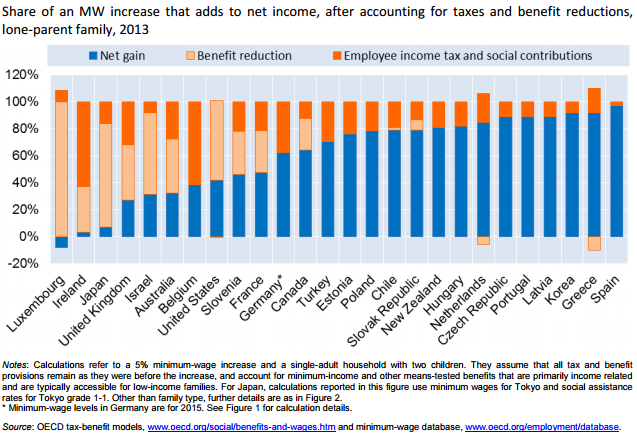
In New Zealand, when there is a 5% minimum wage increase, four percentage points of that wage increase actually stays in the hands of the worker.
In some countries such as Australia, the USA and UK, 60 to 80%of the minimum wage increase is gobbled up in reductions in benefits and taxes. At the same time, the minimum wage increase makes it less profitable for your employer to retain you so your job is more at risk.
The only explanation I have for why the Labour Party, NZ Greens and the living wage movement don’t highlight the success of the existing minimum wage in reducing family poverty in New Zealand is mass kidnappings.
But for these abductions most fowl, I’m sure the Labour Party, NZ Greens and the living wage movement would be dancing in the street celebrating successes of capitalism and freedom in New Zealand in keeping families out of poverty through the minimum wage.
 Utopia, you are standing in it!
Recent Comments