International Women's Day: Part-time work boosts female employment rate #Eurostat #IWD2015 http://t.co/R8Wjt1DIYw pic.twitter.com/lCcOZWgwOX
— EU_Eurostat (@EU_Eurostat) March 5, 2015
There are surprisingly large differences in female part-time employment rates
11 Mar 2015 Leave a comment
Another boy’s own analysis by the IMF of the decline of unions and inequality in recent decades
06 Mar 2015 Leave a comment
in discrimination, gender, human capital, labour economics, labour supply Tags: decline of unions, female labour force participation, gender analysis, gender wage gap, IMF, reversing gender wage gap, union power
we find strong evidence that lower unionization is associated with an increase in top income shares in advanced economies during the period 1980–2010

Gender analysis! Gender analysis! Where is the gender analysis, which is central to any analysis of inequality in and outside of the labour market!
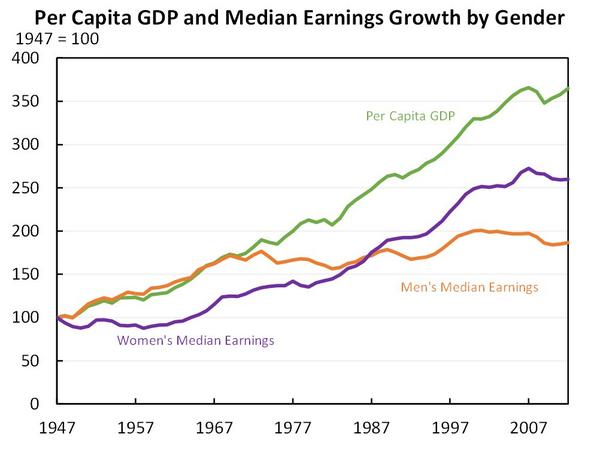
Women have done swimmingly over the last few decades in terms of closing the gender wage gap, increasing labour force participation and overtaking men in investment in higher education.
Who's the weaker sex? Women now make up the majority of university students around the world econ.st/1x1cUli http://t.co/6YWv6SuQc4—
The Economist (@TheEconomist) March 13, 2015
As for unions and women, their record of discrimination against women as threat to the union wage premium was so appalling that even Hollywood was willing to take a swipe at unions and the hostility with which mining unions, for example, greeted the first female miners.
In spite of women’s early involvement in labour struggles, deeply ingrained prejudices against women taking a full role in the workplace were often reinforced by labour unions themselves. Women were seen as mere auxiliaries to the movement, or worse, as threats to men’s jobs.
HT: whitehouse.gov
The division of labour between modern parents
10 Feb 2015 Leave a comment
in labour economics, labour supply Tags: engines of liberation, female labour force participation, household production, motherhood penalty
Notice that mothers spent about 30 hours per week on housework in the 1960s. The engines of liberation were smaller families and the availability of a large number of labour saving household white goods, and preprepared and takeaway food.


The labour force participation of mothers in the 20th century
30 Jan 2015 Leave a comment
in gender, labour economics, labour supply Tags: engines of liberation, female labour force participation, gender wage gap, sex discrimination

First, work changed to offer more jobs to women. Farming declined sharply; industrial jobs peaked and then declined. Brawn became less important; precise skills, learning, and personal service became more important.
The new economy generated millions of white-collar and “pink-collar” jobs that seemed “suited” to women. That cannot be the full story, of course; women also took over many jobs that had once been men’s, such as teaching and secretarial work.
Second, mothers responded to those job opportunities. Some took jobs because the extra income could help families buy cars, homes, furnishings, and so on. Some took jobs because the family needed their income to make up for husbands’ stagnating wages (a noteworthy trend after the 1970s). And some took jobs because they sought personal fulfilment in the world of work.
via Why Did Married Mothers Go To Work? » Sociological Images.
 Utopia, you are standing in it!
Recent Comments