More on the reversing gender pay gap or men getting their comeuppances?
10 Jan 2016 Leave a comment
in discrimination, economic history, gender, human capital, labour economics, labour supply, occupational choice, politics - USA Tags: gender wage gap, middle class stagnation, reversing gender gap, wage stagnation
Why aren’t female wages stagnating?
30 Dec 2015 Leave a comment
in discrimination, economic history, gender, labour economics Tags: gender wage gap, middle-class wage stagnation
@geoffsimmonz The family wage gap or why are the Swiss implicitly biased in favour of single women but heavily against married women?
22 Dec 2015 Leave a comment
in discrimination, gender, labour economics, labour supply Tags: family wage gap, gender wage gap, implicit bias
The gender wage gap from married women is 3 to 30 times that of single women. This was actually have a positive gender wage gap.
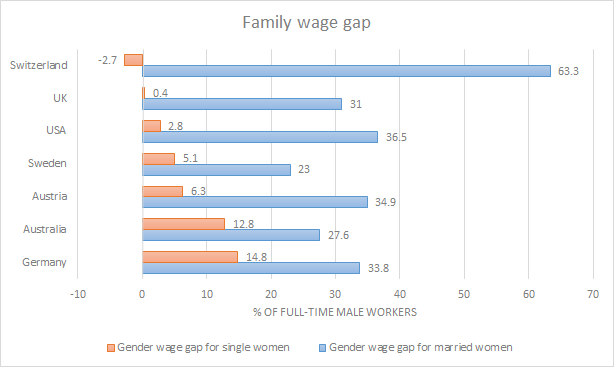
Source: IZA World of Labor – Equal pay legislation and the gender wage gap.
The smallest of the gender wage gap for single women, which has been well known for a long time, does not bode well for those such as Geoff Simmons who argue that implicit bias is an important driver of the gender pay gap.
Why are there vast differences in this implicit bias against women between countries. Why is this implicit bias so much stronger against married women? Having an implicit bias against married women but not single women is a very odd implicit bias.
These puzzles are before considering the information extraction problem facing employers who are implicitly bias against married women. Employers do not know whether an applicant is married or single and pay less accordingly. As Polachek observed:
Corporate discrimination cannot explain these wage patterns. Were corporate discrimination the reason, one would need an explanation why corporations hardly discriminate against single women, but discriminate enormously against married women, especially married women with children spaced widely apart, given that they often cannot legally ask questions about marital status in employment applications.
Even if they could get this marital status information, they wouldn’t have information on the number and spacing of one’s children. But even if supervisors knew number of children, they are far less knowledgeable about children’s ages, and hence less likely to know much about child spacing.
Employers who are slightly less implicitly biased against married women would have a far higher quality recruitment pool which gives them a competitive advantage. Employers who are implicitly biased against women and married women are less likely to survive in competition.
The gender gap among the top 1%
19 Dec 2015 Leave a comment
in discrimination, gender, human capital, labour economics, occupational choice Tags: gender wage gap, superstar wages, superstars, top 1%
Are women just too smart to be computer scientists?
08 Dec 2015 Leave a comment
in applied price theory, discrimination, economics of education, gender, human capital, labour economics, managerial economics, occupational choice, organisational economics, personnel economics, politics - Australia, politics - New Zealand, politics - USA Tags: economics of personality traits, gender wage gap, reversing gender gap


Women started drifting away from computer science in the mid-1980s. The interpretation put forward by the professional grievance industry, that is, by National Public Radio in the USA is:
The share of women in computer science started falling at roughly the same moment when personal computers started showing up in U.S. homes in significant numbers.
These early personal computers weren’t much more than toys. You could play pong or simple shooting games, maybe do some word processing.
And these toys were marketed almost entirely to men and boys. This idea that computers are for boys became a narrative. It became the story we told ourselves about the computing revolution. It helped define who geeks were, and it created techie culture.
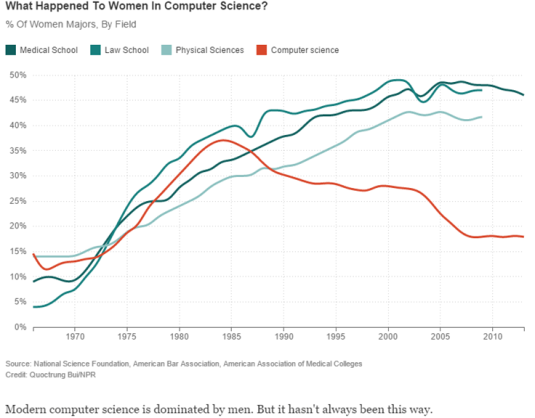 Source: NPR
Another interpretation is there are systematic differences between teenage boys and teenage girls in verbal and written skills. Young women moved away from enrolling in computer…
View original post 224 more words
Rejoinder to @geoffsimmonz and Jess Berentson-Shaw on are we all sexists – Part 1
07 Dec 2015 1 Comment
in applied price theory, discrimination, econometerics, gender, job search and matching, labour economics Tags: Armen Alchian, Gary Becker, gender wage gap, unconscious bias
Morgan Foundation researchers Jess Berentson-Shaw and Geoff Simmons were good enough to write a long reply to my recent post on the role of unconscious bias in the gender wage gap. My post was in reply to a Friday whiteboard session by Geoff Simmons.
I thought the best way to start is to summarise their reply in terms of how my rejoinder will be structured:
- There is a persistent, known but unexploited entrepreneurial opportunity for pure profit arising from employers not hiring women on merit because of an unconscious bias against them. This unconscious bias among employers against women explains 20-30% of the gender wage gap. Most of the rest of that gap is due to factors such as differences in occupation and education.
- The gender wage gap is smaller at the bottom of the labour market because of the minimum wage.
- The gender wage is smaller in the middle than at the top of the labour because of “far more standard contracts in the middle”. I take this to mean recruiting firms set a hiring standard and make a wage offer. This does not mean they have a free hand in their wage posting. A higher wage offer attracts better qualified applicants. Posting a low wage attracts fewer candidates that meet their hiring standard from other jobs and from the ranks of the unemployed. The available evidence suggests that one-third of job matches are based on wage bargaining and two-thirds through wage posting. Wage posting is more common in larger firms, the public sector and where there is collective bargaining. Wage bargaining is more profitable for occupations and jobs with a high dispersion in workers’ skills and productivity and in tighter labour markets.
- The gender pay gap is largest for the top 10% of female wage earners because “… what scientific evidence supports the argument that better paid women have the ability to negotiate pay & conditions better? The very fact that there is a consistent and large gap between highly paid men and women suggests that where MORE negotiation, discretion, more complex selection processes are involved the more women are discriminated against”. The available evidence is wage posting is less common the more skilled is the worker. It pays to invest more in scrutinising recruits against hiring standards and to consider offer matching when the wage is higher for applicants and for employees threatening to quit. The payoff from a longer job search is greater the higher is the wage. There is a greater chance of higher skilled jobseeker of finding a better paid match between their more idiosyncratic skills and backgrounds in vacancies elsewhere or which might appear later. Low skilled jobseekers invest less in job search because one vacancy is frequently as good as another in their occupational and industry labour markets. The higher skilled are also more geographically mobile than the low skilled and more likely to live in cities and earn the urban wage premium.
- “Better paid professional women may have more options than lower paid women but they still have fewer than their male equivalents.” I take this to mean the greater the ability of workers to move from employer to employer, the better are they paid. Women have a weaker average attachment to the labour market. The human capital interpretation of this is woman and mothers in particular have lower productivity because they have spent less time accumulating on-the-job human capital. In the search and matching interpretation, women have less search capital. Workers start out as job shoppers: the longer a worker shops around, the more likely after a succession of job matches that they chance upon better paying job and occupational matches. Women through career interruptions for motherhood spend less time in the labour market, accumulate less search capital and are therefore are paid less. Women find it harder to work their way into the better-paying job matches.
- “Removing unconscious bias requires cultural change and will take time to resolve but it is possible to do with concerted effort.” This as example of what Adam Smith called the overweening conceit of youth.
My reply to the original Friday whiteboard session by Geoff Simmons relied on invisible hand explanations. Nozick argued that invisible hand explanations of social phenomena must have a filter and an equilibrating mechanism.
Geoff Simmons’ hypothesis about the gender wage gap is an invisible hand explanation: 20-30% of the gender wage gap is driven by unconscious bias. There could be no greater an invisible hand than an unconscious one.
There must be a mechanism in Geoff Simmons’ hypothesis that guides market participants to not hire and not promote women on merit. Not hiring on merit forfeits profit. There must be a filter that penalise hiring on merit.
The market has a filter and an equilibrating mechanism that constitute its invisible hand. The equilibrating mechanism – the mechanism that prompts people to hire on merit – is price signals. Prices are a signal wrapped in an incentive. If prices go up, buy less and look for other options, if they go down, buying more is profitable. The filter, which is more of an invisible punch than an invisible hand, is profits and losses. Higher costs, lower profits, loss of market share, insolvency and bankruptcy drive out the entrepreneurs who fail to hire on merit.
Entrepreneurs that hire on merit are more likely to survive in market competition than those that do not. Entrepreneurs must adapt or die.
There is no similar institutional filter in Geoff Simmons hypothesis to ensure that not hiring on merit is the unintended outcome from the decentralised behaviour of countless employers and job seekers trying to improve their own circumstances. Self-interested employers are not prompted by price signals to not hire on merit. More importantly, their chances are surviving in market competition are increased rather than are reduced if employers resist the temptations arising from their unconscious biases against women.
This institutional context is the reverse of what should be for unconscious bias against women to survive in market competition as suggested by Geoff Simmons. Firms that hire on merit should have a lower probability of survival, not a higher chance of staying in business if the unconscious bias hypothesis is to prevail in the face of market competition.
Geoff Simmons and Jess Berentson-Shaw is they didn’t address my extensive comments about the market as an evolutionary process. They did not explain how market competition would not penalise employers who fail to hire on merit for any reason including unconscious bias. That is the fundamental flaw, a fatal flaw in their reply to my comment on their Friday whiteboard session.
Most of all, Geoff Simmons and Jess Berentson-Shaw succumb to what Robert Nozick christened normative sociology. This is the study of what the causes of social problems ought to be.

For Geoff Simmons and Jess Berentson-Shaw, the gender wage gap ought not be the result of the conscious choices of women making the best they can do what they have. The gender wage gap must be the result of the bad motivations of employers and other external forces. The bad motivations must be unconscious because conscious prejudice is rare these days.
The unconscious bias hypothesis suffers from the same floors as the occupational crowding and occupational segregation hypotheses. Neither the unintentional bias hypothesis nor the occupational crowding and segregation hypotheses have a filter and an equilibrating mechanism that guides employers into make unprofitable choices about hiring. These hypotheses must explain how unconsciously biased employers survive in competition with less unconsciously biased employers.
Central to Gary Becker’s theory of prejudice based discrimination is competition in the market will slowly wear down prejudice-based discrimination in the same way that it drives out any other practices inconsistent with profit maximisation and cost minimisation. Profit maximisation gets no respect in the theory of unconscious bias and the gender wage gap put forward by Geoff Simmons and Jess Berentson-Shaw.
If there are sufficient number of less unconsciously biased employers, there will be segregation. Some employers will hire a large number of women because they have the pick of the crop and will be more profitable to boot at least in the short run.
The more unconsciously biased employers will have a large number of men working for them and will be less profitable and more likely to fail. At worst, men and women will be paid to same but most women will work for these less unconsciously biased employers. The possibility of labour market segregation rather than gender wage gap was not considered in the unconscious bias hypothesis.
Unconscious bias is a preference-based explanation of the gender wage gap. The young are the last to notice the rapid social change that came before them. Cultural and preference based explanations underrate the rapid social change in the 20th century. As Gary Becker explains:
… major economic and technological changes frequently trump culture in the sense that they induce enormous changes not only in behaviour but also in beliefs. A clear illustration of this is the huge effects of technological change and economic development on behaviour and beliefs regarding many aspects of the family.
Attitudes and behaviour regarding family size, marriage and divorce, care of elderly parents, premarital sex, men and women living together and having children without being married, and gays and lesbians have all undergone profound changes during the past 50 years. Invariably, when countries with very different cultures experienced significant economic growth, women’s education increased greatly, and the number of children in a typical family plummeted from three or more to often much less than two.
Goldin (2006) showed that women adapted rapidly over the 20th century to changing returns to working and education as compared to options outside the market. Their labour force participation and occupational choices changed rapidly into long duration professional educations and more specialised training in the 1960s and 1970s as many more women worked and pursued careers. The large increase in tertiary education by New Zealand after 1990 and their move into many traditionally male occupations is another example.
The main drivers of the gender wage gap are unknown to recruiting employers such as whether a would-be recruit is married, how many children they have, whether their partner is present to share childcare, how many of children are under 12, and how many years between the births of children. Spacing out the births is a major driver of the gender pay gap but this information is unknown to employers when hiring. As Polachek explains:
The gender wage gap for never marrieds is a mere 2.8%, compared with over 20% for marrieds. The gender wage gap for young workers is less than 5%, but about 25% for 55–64-year-old men and women. If gender discrimination were the issue, one would need to explain why businesses pay single men and single women comparable salaries. The same applies to young men and young women.
One would need to explain why businesses discriminate against older women, but not against younger women. If corporations discriminate by gender, why are these employers paying any groups of men and women roughly equal pay? Why is there no discrimination against young single women, but large amounts of discrimination against older married women?
… Each type of possible discrimination is inconsistent with negligible wage differences among single and younger employees compared with the large gap among married men and women (especially those with children, and even more so for those who space children widely apart).
The main drivers of the gender wage gap are of no relevance to entrepreneurs making a profit. These findings are devastating to the notion that there is some sort of discrimination against women on the demand side of the labour market.
Employers lack the necessary information to implement any unconscious bias they might have against women in fact is mainly a bias against older women and mothers and mothers in particular the space out the births of their children. The emergence of the gender wage gap is through the supply-side choices of women because employers lack the necessary information to drive the emergence of a gender pay gap.
The career cost of a family is central to the emergence and size of the gender pay gap because it leads to self-selection on the supply-side in terms of human capital to mitigate the cost of careers breaks.
The gender gap is fairly minor before the age of 30. The female full-time employment rate drops by 10 percentage points after women enter their 30s before recovering by the time women reach the age of 50 (Johnston 2005). The gender wage gap also widens between the ages 35 to 64 when women are raising children; the biggest gap is for the ages of 44 to 44; a wage gap of 22 per cent (MWA 2010). The first child is estimated to reduce New Zealand female earnings by 7 per cent and second child reduces earnings by 10 per cent (Dixon 2000, 2001).
This self-selection of females into occupations with more durable human capital, and into more general educations and more mobile training that allows women to change jobs more often and move in and out of the workforce at less cost to earning power and skills sets. Chiswick (2006) and Becker (1985, 1993) then suggest that these supply side choices about education and careers are made against a background of a gendered division of labour and effort in the home, and in particular, in housework and the raising of children. These choices in turn reflect how individual preferences and social roles are formed and evolve in society.
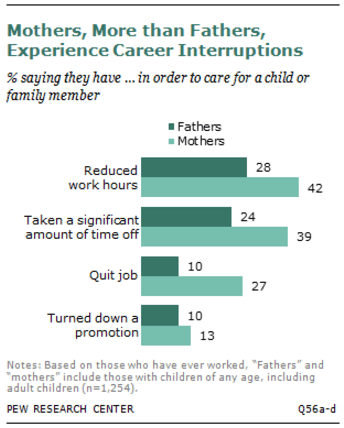
Source: On Equal Pay Day, key facts about the gender pay gap | Pew Research Center.
Tiny differences in comparative advantage such as in child rearing immediately after birth can lead to large differences in specialisation in the market work and in market-related human capital and home production related work and household human capital (Becker 1985, 1993). These specialisations are reinforced by learning by doing where large differences in market and household human capital emerge despite tiny differences at the outset (Becker 1985, 1993).
Many women choose educational and occupational paths that give them more control over their hours worked, and lowers the cost of time spent on maternity leave and the associated depreciation of skills during career breaks and reduced hours (Polachek 1978, 1981; Bertrand, Goldin and Katz 2010; Katz 2006; Sasser 2005). Women over the entire run of the 20th century often end up in jobs that reduced the career cost of a family and rapidly changed their plans when new opportunities emerge (Katz 2006).
The prospect of children drives the early choices of women on education and occupations. Careers requiring continuous commitment, long hours and great sacrifices do not attract and retain as many women (Bertrand, Goldin and Katz 2010; Goldin 2006). Goldin and Katz (2011) found that differences in the reductions on the cost of career breaks was a major driver in the influx of women into previously male dominated occupations.
The key is what drives the rapid changes in the labour force participation and occupational choices of women. Some of the factors are global technology trends such rising wages and the emergence of household technologies and safe contraception and antidiscrimination laws. All of these increased the returns to working and investing in specialised education and training.
Up until the mid-20th century, women invested in becoming a teacher, nurse, librarian or secretary because these skills were general and did not deprecate as much during breaks. When expectations among women of still working at the age of 35 doubled, there were massive increases in female labour force participation and female investments in higher education and specialised skills (Goldin and Katz 2006).
In summary, Geoff Simmons and Jess Berentson-Shaw put forward an invisible hand explanation of the residual in the gender wage gap that lacks that all-important invisible punch. There is no market mechanism which penalises employers who rise above their unconscious bias against women to hire on merit. The invisible hand rewards employers that hire on merit with higher profits and penalises those that indulge a bias of whatever origin. The invisible hand consists of an invisible finger and an invisible punch. The invisible finger points the way forward through price signals; the invisible punch slaps down those entrepreneurs whose attentions wander from their bottom line when deciding who to hire and promote.
Part two of this reply will address the particulars of the reply of Geoff Simmons and Jess Berentson-Shaw. In particular, the search and matching aspects of their explanation and whether we are all sexists.
@suemoroney more generous maternity leave increases the gender wage gap @JanLogie
07 Dec 2015 Leave a comment
in applied price theory, discrimination, economics of love and marriage, gender, labour economics, labour supply, law and economics, occupational choice, politics - New Zealand Tags: do gooders, expressive voting, female labour force participation, gender wage gap, maternal labour supply, maternity leave, The fatal conceit, unintended consequences

Source: Why Are Women Paid Less? – The Atlantic.
Source: AEAweb: AER (103,3) p. 251 – Female Labor Supply: Why Is the United States Falling Behind?
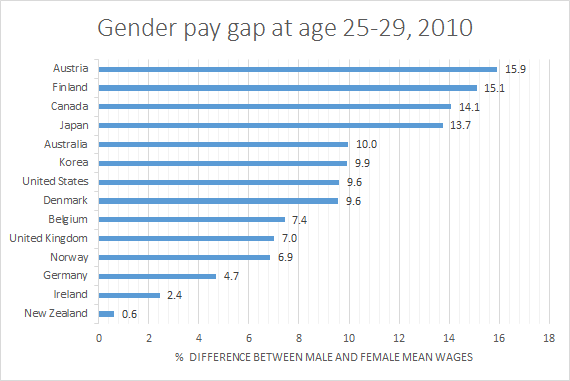
Gender pay gap at age 25-29, OECD countries @GreenCatherine
03 Dec 2015 Leave a comment
in discrimination, gender, human capital, labour economics, labour supply, politics - Australia, politics - New Zealand, politics - USA Tags: compensating differentials, gender wage gap, labour demographics
The gender pay gap in New Zealand rounds down to zero for women in their mid-20s!
The role of the six-day working week in Japanese sexism and the gender wage gap
02 Dec 2015 Leave a comment
in applied price theory, discrimination, economic history, economics, economics of love and marriage, gender, human capital, labour economics, occupational choice, personnel economics Tags: asymmetric marriage premium, compensating differentials, entrepreneurial alertness, gender wage gap, marital division of labour
When I was studying in Japan, they were at the end of phasing out working on Saturdays. The staff at my university work on Saturday mornings for four hours and then went home.
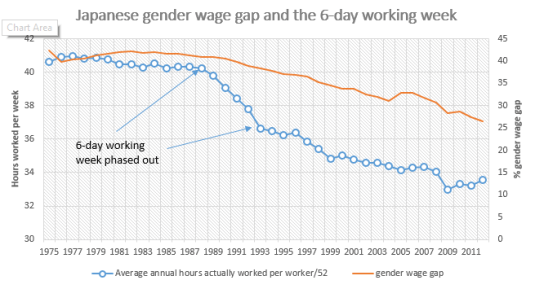
The Japanese working week was reduced by law from 48 to 44 hours per week in 1988 and to 40 hours per week from 1993 (Prescott 1999; Hayashi and Prescott 2002). The Japanese stopped routinely working on Saturdays over the 1990s. The number of national holidays was increased by three and an extra day of annual leave was also prescribed by law.
While feuding with strangers on an unrelated matter about the gender wage gap, it somehow occurred to me that the six-day working week might have something to do with what is on the face of a large amount of sexism in Japan and a large gender wage gap.
That feud with strangers was about unconscious bias as a driver of the gender wage gap in New Zealand. The gender wage gap Japan is attributed to conscious prejudice.
Source: OECD Stat.
In the above chart I have plotted the average weekly hours worked of Japanese workers and the Japanese gender wage gap. Two things can be noticed from the above chart:
- there is a sharp reduction in the number of hours worked per week by Japanese workers when they stopped working on Saturdays; and
- the gender wage gap started declining after the introduction of a five-day working week in Japan.
In a country where it is standard to work six days a week, the price of motherhood would be much higher than in other countries industrialised countries that phased out the 48-hour week decades previous. The asymmetric marriage premium would also be much higher if one partner to the marriage worked a six-day week while the other looked after the children.
Other drivers of the gender wage gap that arise from human capital specialisation and depreciation and from the differences of a few years in the marrying ages of men and women would be intensified if people worked another day per week. The payoff from a marital division of labour and human capital specialisation where one worked long hours and the other focused on investing in human capital that allow them to care for the children and move in and out of the workforce with less human capital depreciation would be much larger.
Much is made of the distinctiveness of Japanese culture and its sexism. In my time in Japan, the thing I notice most distinctively about Japanese culture was its extraordinary pragmatism and willingness to change rapidly. The Japanese economic miracle was founded on rapid industrialisation, innovation and repeated renewal of human capital. That requires an entrepreneurial spirit and open-mindedness.
Cultural and preference based explanations of the gender wage Including that in Japan underrate the rapid social change in the role of women in the 20th century in all countries in all cultures. As Gary Becker explains:
… major economic and technological changes frequently trump culture in the sense that they induce enormous changes not only in behaviour but also in beliefs. A clear illustration of this is the huge effects of technological change and economic development on behaviour and beliefs regarding many aspects of the family.
Attitudes and behaviour regarding family size, marriage and divorce, care of elderly parents, premarital sex, men and women living together and having children without being married, and gays and lesbians have all undergone profound changes during the past 50 years. Invariably, when countries with very different cultures experienced significant economic growth, women’s education increased greatly, and the number of children in a typical family plummeted from three or more to often much less than two.
A good explanation of this rapid social change is in Timur Kuran’s “Sparks and Prairie Fires: A Theory of Unanticipated Political Revolutions” and “Now Out of Never: The Element of Surprise in the East European Revolution of 1989“.
Kuran suggests that political revolutions and large shifts in political opinion will catch us by surprise again and again because of people’s readiness to conceal their true political preferences under perceived social pressure:
People who come to dislike their government are apt to hide their desire for change as long as the opposition seems weak. Because of the preference falsification, a government that appears unshakeable might see its support crumble following a slight surge in the opposition’s apparent size, caused by events insignificant in and of themselves.
Kuran argues that everyone has a different revolutionary threshold where they reveal their true beliefs, but even one individual shift to opposition leads to many others to come forward and defy the existing order. Small concessions embolden the ground-swell of revolution.
Those ready to oppose social intolerance or who are lukewarm in their intolerance keep their views private until a coincidence of factors gives them the courage to bring their views into the open. They find others share their views and there is a revolutionary bandwagon effect.
Plenty of people have had personal experiences of this in the 1980s and the 1990s when there were rapid changes in social and political attitudes about racism, sexism and gay rights. This includes Japan.
In the case of the Japanese gender wage gap, the move from a six-day to a five-day working week radically changed the asymmetric marriage premium and the payoff from investing in both specialised human capital and in human capital that depreciates quickly when away from work.
This large shift in incentives to work and invest in human capital would embolden a change in social attitudes. This is because the previous views were no longer profitable and many would gain from the change. Others who prefer just to go along with crowd would quickly follow them in to stay in tune with whatever is now popular.
Much of Japanese sexism may be the preference falsification that was low-cost when there was a six-day working week. The move to a five-day working week greatly increased the cost of that sexism and the profits from finding new ways of organising the workplace that better matched motherhood and career in Japan.
Undervalued workers are an untapped business opportunity for more alert entrepreneurs to hire these undervalued workers. In the case of Japan, with a five-day working week, hiring women for jobs that involved considerable investment in firm-specific human capital became more profitable. Previously under a six-day working week it was more profitable to invest in men because they undertook few childcare responsibilities. Under a five-day working week, that payoff matrix favours women more than in the past.
Gender pay gap for 30 to 34-year-olds, selected OECD countries
02 Dec 2015 Leave a comment
in discrimination, gender, labour economics Tags: compensating differentials, gender wage gap
New Zealand is top of the world, as usual, in closing the gender wage gap.

Unconscious bias and the gender wage gap
30 Nov 2015 Leave a comment
in applied price theory, discrimination, gender, labour economics, managerial economics, occupational choice, organisational economics, personnel economics Tags: gender wage gap, preference formation, unconscious bias
Gender wage gaps and the role of unconscious bias
28 Nov 2015 9 Comments
in discrimination, entrepreneurship, gender, labour economics, occupational choice, politics - New Zealand, survivor principle Tags: compensating differentials, employer discrimination, entrepreneurial alertness, gender wage gap, market selection, The meaning of competition
Geoff Simmons’ Friday Whiteboard podcast last night on the 12% gender wage gap was a good summary of the proximate drivers such as occupational segregation and part-time work. I have a few quibbles with his stress on unconscious bias as the driver of the gender wage gap.
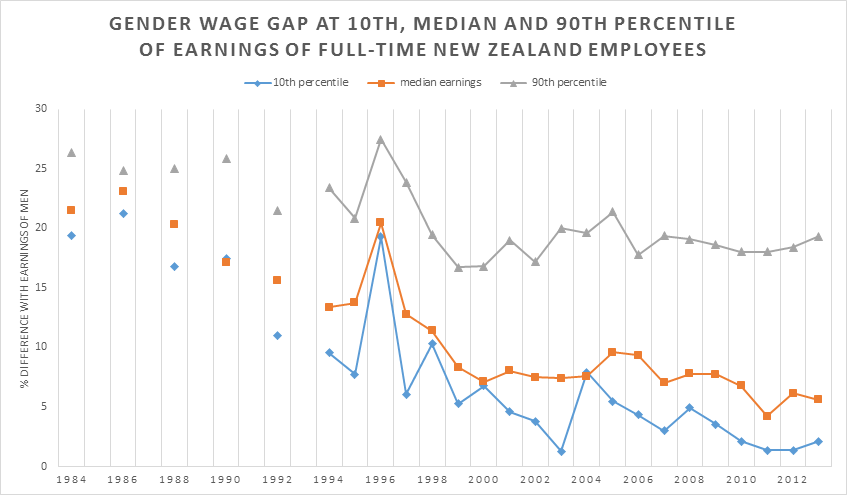
The first of these quibbles is the gender wage gap is tiny at the bottom and even the middle of the labour market but is so high and so stable for so long at the top-end. Why does unconscious bias increase with the wages on offer? Better paid professional women have far more options to look around for the best paid job and turned down inferior officers.
Source: OECD Employment Database.
My second quibble is the New Zealand gender wage gap is trivial for women under the age of 45 but suddenly there is a burst of unconscious bias until they retire. This is odd because mature age workers have had plenty of time to accumulate human capital, search around for the best job offer and will have a job and therefore can turn down inferior offers. These women are not new starters on the unemployment benefit desperate for employment.
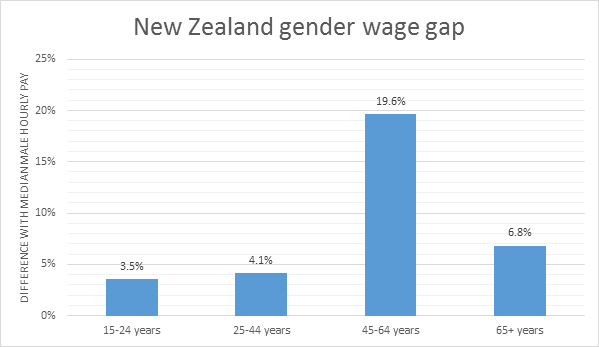
Source: New Zealand Income Survey 2014 via Human Rights Commission: Tracking Equality at Work.
My final quibble is the gender wage gap for part-time workers is reversed. No one takes this higher pay per hour as evidence that there is no unconscious bias against women who work part-time. If the gender pay gap was in the opposite direction, of course, that pay gap would be conclusive evidence of unconscious bias against women in part-time jobs. But as the gap is as it is in favour of women not against them, the usual adjustments for skills, age and experience become convenient truths.
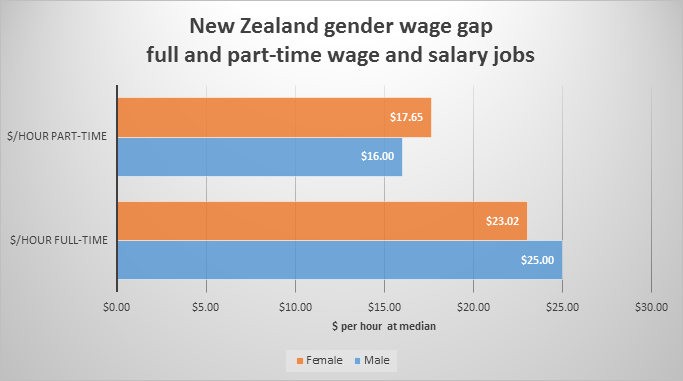
Source: Statistics New Zealand, New Zealand Income Survey, June quarter 2015.
Is what’s left of the unconscious bias hypothesis that we chauvinistic men, bastards all, have an unconscious bias against women who work full-time, who are over the age of 45 or earn a lot of money making us jealous?
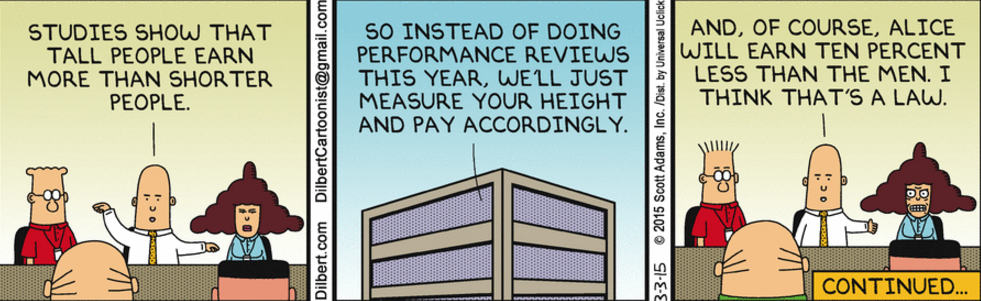
The unconscious bias hypothesis for the residual in the gender wage gap has come to the fore because earlier hypotheses of deliberate discrimination against women fell by the wayside as explanations for the gender wage gap.
Complicating things is the unconscious bias hypothesis must explain why the unconscious bias is so much stronger at the top end of the labour market against women who have plenty of options to fight back including found in their own companies to hire women underpaid elsewhere.
As is well known, sex and race discrimination by employers as a profit opportunity for other less prejudiced employers including unconsciously prejudiced employers to hire the undervalued workers.
The process whereby the market bids up the wages of women undervalued by unconsciously biased employers can be itself be thoroughly unconscious as Armen Alchian explained in 1950. Alchian pointed out the evolutionary struggle for survival in the face of market competition ensured that only the profit maximising firms survived:
- Realised profits, not maximum profits, are the marks of success and viability in any market. It does not matter through what process of reasoning or motivation that business success is achieved.
- Realised profit is the criterion by which the market process selects survivors.
- Positive profits accrue to those who are better than their competitors, even if the participants are ignorant, intelligent, skilful, etc. These lesser rivals will exhaust their retained earnings and fail to attract further investor support.
- As in a race, the prize goes to the relatively fastest ‘even if all the competitors loaf.’
- The firms which quickly imitate more successful firms increase their chances of survival. The firms that fail to adapt, or do so slowly, risk a greater likelihood of failure.
- The relatively fastest in this evolutionary process of learning, adaptation and imitation will, in fact, be the profit maximisers and market selection will lead to the survival only of these profit maximising firms.
These surviving firms may not know why they are successful, but they have survived and will keep surviving until overtaken by a better rival. All business needs to know is a practice is successful. The reason for its success is less important.
In the case of unconscious bias against women, those employers who are less unconsciously biased than the rest will grow at the expense of less enlightened albeit unconsciously less enlightened rivals. Undervaluing workers for any reason is a business opportunity. The market processes will reduce this undervaluation. All that is required is that some employers be less unconsciously biased than others.

One method of organising production will supplant another when it can supply at a lower price (Marshall 1920, Stigler 1958). Gary Becker (1962) argued that firms cannot survive for long in the market with inferior product and production methods regardless of what their motives are. They will not cover their costs.
The more efficient sized firms are the firm sizes that are currently expanding their market shares in the face of competition; the less efficient sized firms are those that are currently losing market share (Stigler 1958; Alchian 1950; Demsetz 1973, 1976). Business vitality and capacity for growth and innovation are only weakly related to cost conditions and often depends on many factors that are subtle and difficult to observe (Stigler 1958, 1987). In the case of unconsciously biased employers, they are less likely to survive.

What is even more peculiar is this unconscious bias exists at the end of the market where there is the greatest incentive to invest in ascertaining the quality of recruits if Edward Lazear’s pioneering work on the personnel economics of hiring standards is to believed:
Screening is more profitable when the stakes are higher: The purpose of screening is to avoid the unprofitable candidates. Therefore, the greater the downside risk from hiring the wrong person, the more value there is to screening. Similarly, the longer that a new candidate can be expected to stay with the employer, the more valuable will be the screen. Firms that intend to hire employees for the long term thus tend to invest more in careful screening before committing to a new hire.
The higher the wage of recruit, the more important they are to the success of the firm. That gives the entrepreneur more reasons to sort and screen from better quality recruits. The higher paid is the recruit, the greater the returns to the applicant from signalling their quality:
Signalling is helpful when employers do not have enough information about job applicants to assess their potential accurately enough. It is useful when differences in talent among potential employees matter a lot to productivity. When differences in talent do not make much difference to productivity, signalling will not be very useful.
These ideas suggest when we should expect to see employment practices consistent with signalling. First, signalling should be more important in jobs where skills are most important. Such jobs tend to be those that are at high levels of the hierarchy, in research and development, and in knowledge work. They also correspond well to professional service firms, such as consulting, accounting, law firms, and investment banks. In such professions, even small differences in talent can lead to large differences in effectiveness on the job, so sorting for talent is very important. For this reason, such firms tend to screen very carefully at recruiting, and usually have promotion systems that correspond well to our probation story above, at least in the first few years on the job.
The presence of more unconscious bias at the top of the labour market than at the middle and the bottom doesn’t have as many legs as suggested by Geoff Simmons in his Friday podcast. The higher is the wage, the greater is investment by both sides to the recruitment equation in an unbiased consideration of the job application. This runs against the notion that the gender gap at the top end of the labour market is due to unconscious bias.

A far better explanation is compensating differentials. Women at the top are trading off wages from work-life balance and more time with their children. They can do so because they are well-paid.
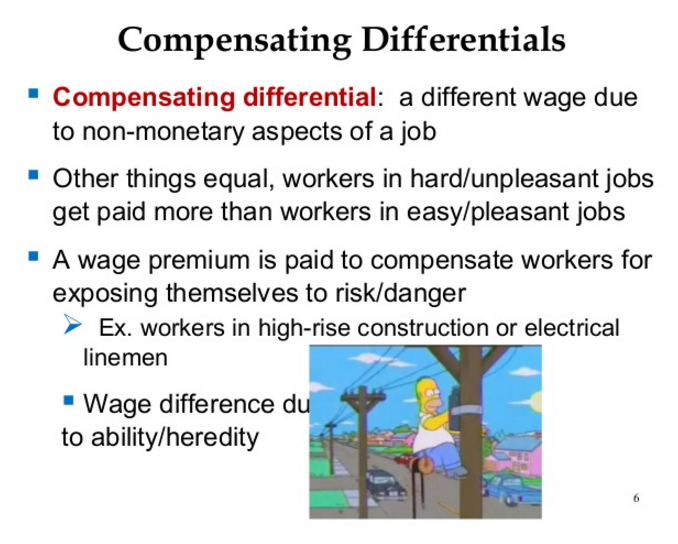
Whatever the hypothesis about compensating differentials is, that hypothesis has nothing to do with unconscious bias by employers. Alison Booth and Jan van Ours were almost annoyed to find that British women are actually quite satisfied with part-time work:
Women present a puzzle. Hours satisfaction and job satisfaction indicate that women prefer part-time jobs irrespective of whether these are small or large but their life satisfaction is virtually unaffected by hours of work.
I will close with a quote from Amy Wax on the impractical nature of doing anything about unconscious bias:
Demonstrating racial bias is no easy matter because there is often no straightforward way to detect discrimination of any kind, let alone discrimination that is hidden from those doing the deciding. As anyone who has ever tried a job-discrimination case knows, showing that an organization is systematically skewed against members of one group requires a benchmark for how each worker would be treated if race or sex never entered the equation. This in turn depends on defining the standards actually used to judge performance, a task that often requires meticulous data collection and abstruse statistical analysis.
Assuming everyone is biased makes the job easy: The problem of demonstrating actual discrimination goes away and claims of discrimination become irrefutable. Anything short of straight group representation — equal outcomes rather than equal opportunity — is “proof” that the process is unfair.
Advocates want to have it both ways. On the one hand, any steps taken against discrimination are by definition insufficient, because good intentions and traditional checks on workplace prejudice can never eliminate unconscious bias. On the other, researchers and “diversity experts” purport to know what’s needed and do not hesitate to recommend more expensive and strenuous measures to purge pervasive racism. There is no more evidence that such efforts dispel supposed unconscious racism than that such racism affects decisions in the first place.
@economicpolicy gathers more evidence of a waning gender pay gap @joshbivens_DC @eliselgould
22 Nov 2015 Leave a comment
in applied price theory, discrimination, economic history, gender, human capital, labour economics, labour supply, minimum wage, occupational choice, poverty and inequality Tags: asymmetric marriage premium, Claudia Goldin, compensating differentials, economics of fertility, gender wage gap, marriage and divorce, power couples
As part of a large paper calling for massive government intervention, the Economic Policy Institute, impeccably left-wing, massed a considerable amount of evidence about the withering away of the gender wage gap and anomalies in what is left of that gap. None of these anomalies bolster the case for more regulation of the labour market.
The first of their charts showed the large reduction in the gender wage gap in the USA. Women’s wages have been increasing consistently over the last 40 years or so. The second of their tweeted charts shows that women of all races consistently outperformed men in wages growth, often by a large margin.
Their most interesting chart is about how the gender gap is not only highest among top earners, their pay gap has not fallen at all in the last 40 years. If anything, that gender wage gap is rising at the top end of the labour market albeit slowly. Progress in closing the gender gap been pretty consistent at the lower pay levels. That progress is certainly better than no progress at all.
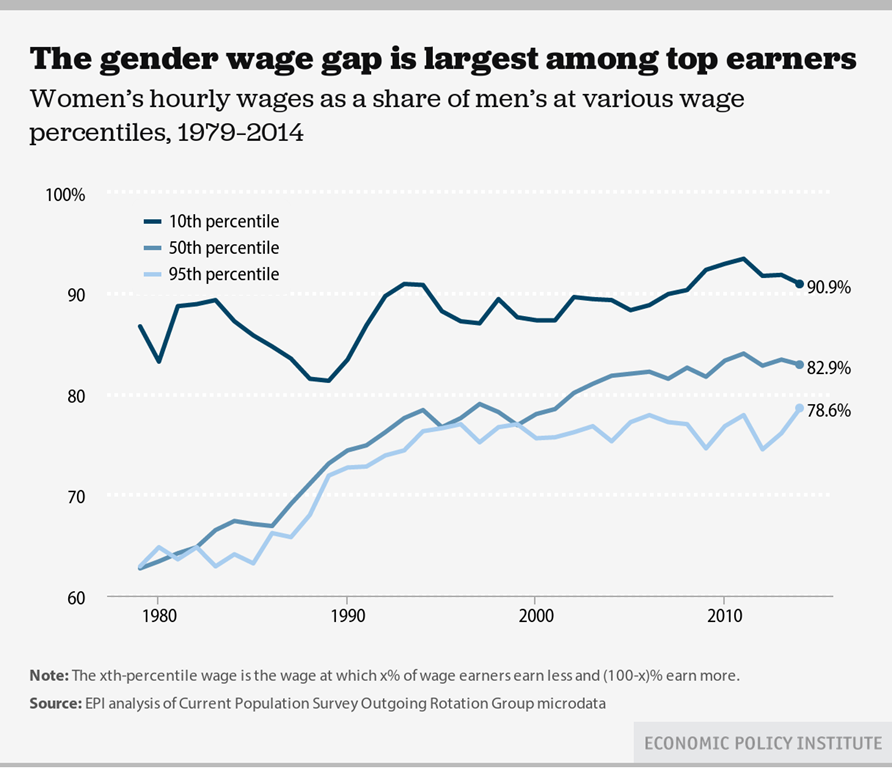
The Economic Policy Institute didn’t enquire in any detail into why women with the most options in the labour market had made the least progress in closing the gender wage gap.
None of their solutions such as more collective-bargaining and a higher minimum wage will help the top end of the job market.
There is an anomaly in the Economic Policy Institute’s reasoning. The women who would suffer least from a purported inequality of bargaining power inherent in the capitalist system and have plenty of human capital have had least success in closing the gender pay gap. These women can shop around for better job offers and start their own businesses. Many do because they are professionals where self-employment and professional partnerships are common.
The better discussions of the gender wage gap emphasise choice. Women choosing at the top end of the labour market to balance career and family and choosing the occupation and education where the net advantages of doing that are the greatest. As the Economic Policy Institute itself notes:
In 2014, the gap was smallest at the 10th percentile, where women earned 90.9 percent of men’s wages. The minimum wage is partially responsible for this greater equality among the lowest earners, as it results in greater wage uniformity at the bottom of the distribution.
The gap is highest at the top of the distribution, with 95th percentile women earning 78.6 percent as much as their male counterparts. Economist Claudia Goldin (2014) postulates that the gap is larger for women in high-wage professions because they are penalized for not working long, inflexible hours that often come with many professional jobs, due in large part to the arrival of children and long-standing social expectations about the division of household labour between men and women.
What the Economic Policy Institute does not explain is why these long-standing social expectations about the division of household labour should be strongest among well-paid women with plenty of options.
Among these options of high-powered women in well-paid jobs is the ability to buy every labour-saving appliance, hire a nanny and ample childcare and acquire everything else on the list of demands of the Economic Policy Institute on closing the gender pay gap. Something doesn’t add up?
Of course, the Economic Policy Institute discusses the unadjusted gender wage rather than the adjusted gender wage. When you study the gender wage gap after making adjustments for demographic and other obvious factors, it is clear that this pay gap is driven by the choices women make between career and family.
Claudia Goldin did a great study of Harvard MBAs using online surveys of their careers. This is the very group that according to the Economic Policy Institute have made the least progress in bringing down patriarchy in the labour market. Specifically, the overturning of traditional expectations about the marital division of labour in childcare and parenthood.
https://twitter.com/alyssalynn7/status/669219008747610113
Goldin found that three proximate factors accounted for the large and rising gender gap in earnings among MBA graduates as their careers unfold:
- differences in training prior to MBA graduation,
- differences in career interruptions, and
- differences in weekly hours.
The greater career discontinuity and shorter work hours for female MBAs are largely associated with motherhood. There are some careers that severely penalise any time at all out of the workforce or working less than punishingly long and rigid hours.
A 2014 Harvard Business School study found that 28 percent of recent female alumni took off more than six months to care for children; only 2 percent of men did.

Claudia Goldin found one counterfactual that cancels out the gender wage gap amongst MBA professionals: hubby earns less! Female MBAs who have a partner who earn less than them earn as much as the average MBA professional on an hourly basis but work a few less hours per week.
The gender wage gap is persisted in high-paying jobs because career women have so many options. Studies of top earning professionals show that they make quite deliberate choices between family and career. The better explanation of why so many women are in a particular occupation is job sorting: that particular job has flexible hours and the skills do not depreciate as fast for workers who take time off, working part-time or returning from time out of the workforce.
Low job turnover workers will be employed by firms that invest more in training and job specific human capital:
- Higher job turnover workers, such as women with children, will tend to move into jobs that have less investment in specialised human capital, and where their human capital depreciates at a slower pace.
- Women, including low paid women, select careers in jobs that match best in terms of work life balance and allows them to enter and leave the workforce with minimum penalty and loss of skills through depreciation and obsolescence.
This is the choice hypothesis of the gender wage gap. Women choose to educate for occupations where human capital depreciates at a slower pace.
The gender wage gap for professionals can be explained by the marriage market combined with assortative mating:
- Graduates are likely to marry each other and form power couples; and
- There tends to be an age gap between men and women in long-term relationships and marriages of two years.
This two-year age gap means that the husband has two additional years of work experience and career advancement. This is likely to translate into higher pay and more immediate promotional prospects.
An interesting and informed look at the pay gap between men and women economist.com/blogs/freeexch… https://t.co/0nxtC9ILWo—
Charles Read (@EconCharlesRead) November 06, 2015
Maximising household income would imply that the member of the household with a higher income, and greater immediate promotional prospects stay in the workforce. This is entirely consistent with the choice hypothesis and equalising differentials as the explanation for the gender wage gap. As Solomon Polachek explains:
At least in the past, getting married and having children meant one thing for men and another thing for women. Because women typically bear the brunt of child-rearing, married men with children work more over their lives than married women. This division of labour is exacerbated by the extent to which married women are, on average, younger and less educated than their husbands.
This pattern of earnings behaviour and human capital and career investment will persist until women start pairing off with men who are the same age or younger than them. That is, more women will have to start marrying down in both income and social maturity.

New Zealand gender wage gap for full-time workers and for part-time workers, 2015
10 Nov 2015 Leave a comment
in discrimination, gender, labour economics, labour supply, occupational choice, politics - New Zealand Tags: gender wage gap, part-time work, reversing gender gap
The unadjusted gender wage gap is regarded as a reliable measure of sex discrimination in these day, apparently, because the adjusted wage gap is too small to maintain the rage. In the data below, the gender wage gap is in favour of women. That is an unreliable unadjusted gender wage because many part-time male workers are teenagers. Many part-time female workers are professionals.
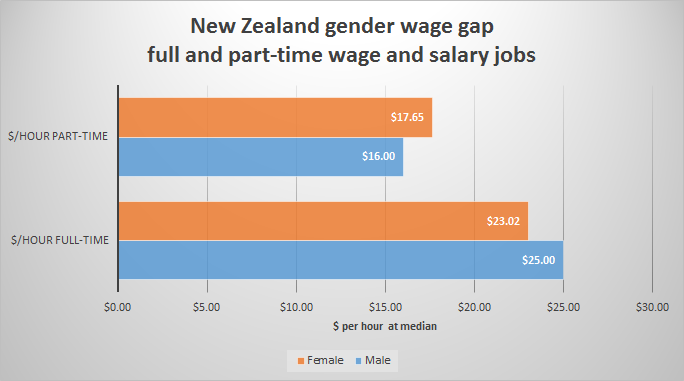
Source: Statistics New Zealand, New Zealand Income Survey, June quarter 2015
@NZGreens is the gender pay gap 6.6%, 11.8% or 14%?
10 Nov 2015 Leave a comment
in discrimination, gender, human capital, labour economics, occupational choice, politics - New Zealand Tags: compensating differentials, gender wage gap, Leftover Left, New Zealand Greens, Twitter left
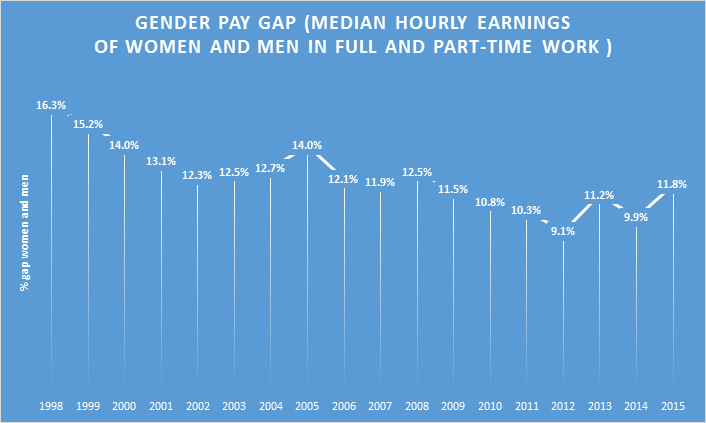
Source: Statistics New Zealand: New Zealand Income Survey.
@greencatherine Unadjusted NZ gender pay gap is 6%, the best in world. http://t.co/2fYuVbJg9E—
Jim Rose (@JimRose69872629) March 19, 2015

Source: Gender pay gap | Ministry for Women.
The unadjusted gender pay gap has been in a long-term decline for generations. The unadjusted gender wage gap in 2015 is 11.8% as shown in the above chart and in the second New Zealand Green’s Facebook link above but not first of their Facebook links above where it is claimed to be 14%.
To sex-up their numbers, the Labour Party and Greens used the gap between the average wages of men and women. This was rather than the median wage to make their gender wage gap comparisons despite the pious commitment of the Greens to use median wage in their gender wage gap calculations in the recent past.
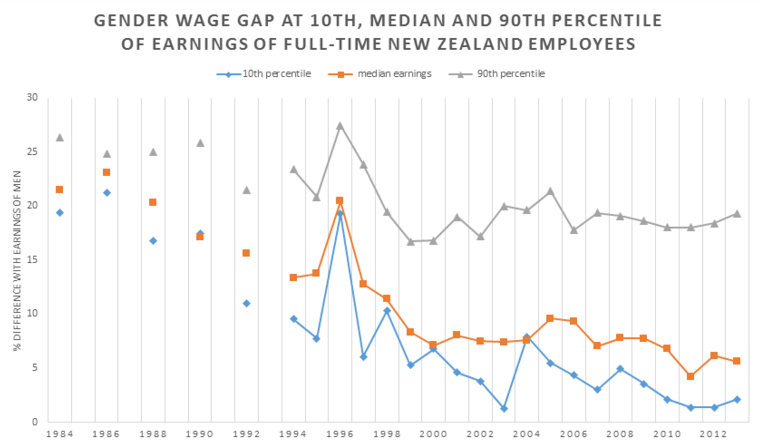
The unadjusted gender pay gap has all but disappeared at the bottom of the labour market as the chart below shows. The gender wage gap remains stubbornly high at the high end of the wage market at 20% because of compensating differentials. Professional women are balancing families and careers in choosing the occupations that best suits each individual woman.
 Utopia, you are standing in it!
Recent Comments