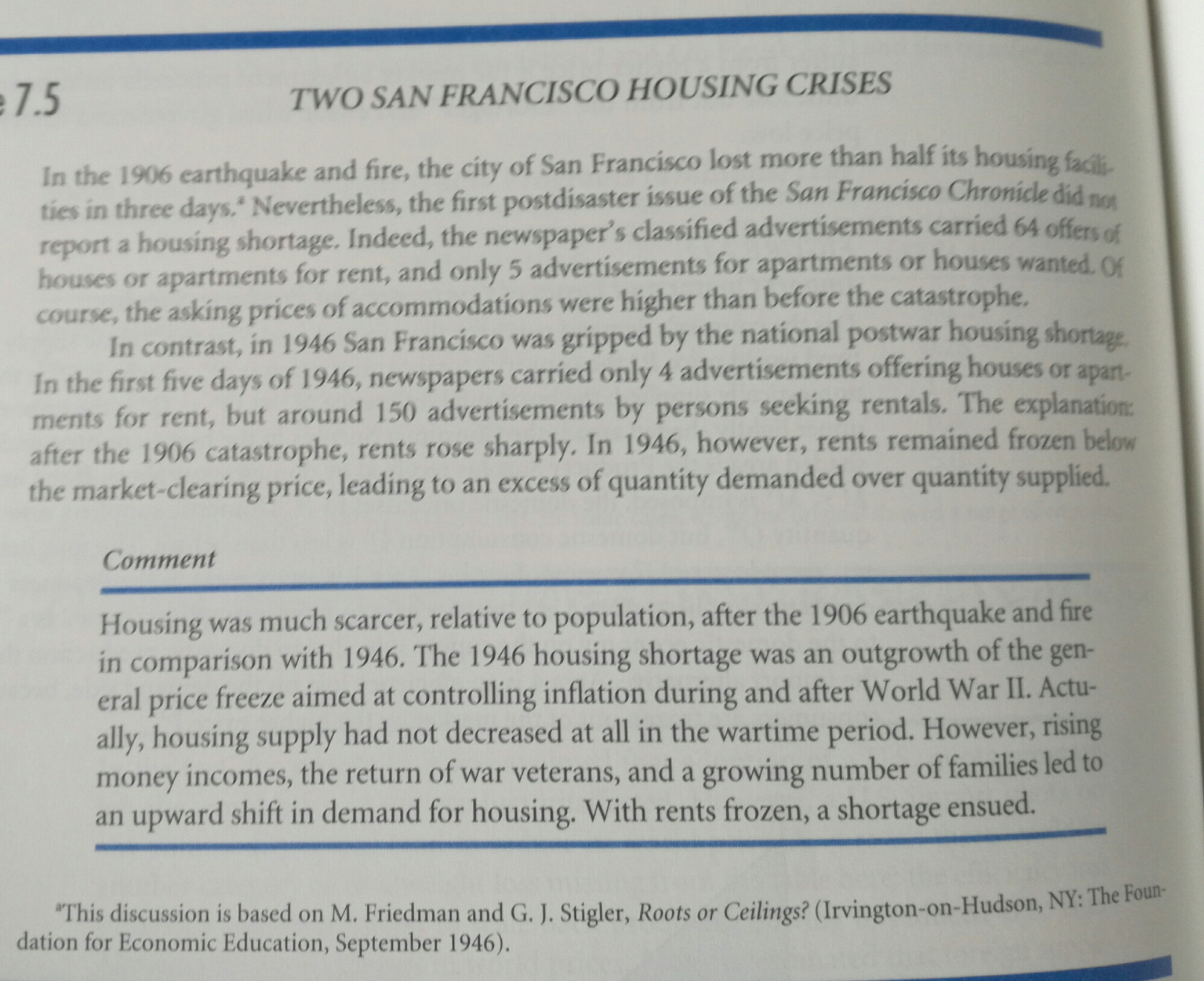
Thinking of rent control?
10 Jan 2017 Leave a comment
in applied price theory, economic history, economics of natural disasters, economics of regulation, Milton Friedman Tags: george stigler, rent control

The marvel of the market: the remarkable foresight of young adults in choosing what to study
16 Jan 2015 1 Comment
in Alfred Marshall, Armen Alchian, economics of education, George Stigler, human capital, job search and matching, labour economics, occupational choice, politics - New Zealand, rentseeking Tags: 2nd laws of supply and demand, Alfred Marshall, Armen Alchian, george stigler, search and matching, skills shortgaes
Known but yet to be exploited opportunities for profit do not last long in competitive markets, including hitherto unnoticed opportunities for the greater utilisation and development of skills and experience (Hakes and Sauer 2006, 2007; Ryoo and Rosen 2004; and Kirzner 1992). Moneyball is the classic example of entrepreneurial alertness to hitherto unexploited job skills which were quickly adopted by competing firms (Hakes and Sauer 2006, 2007).
There is considerable evidence that the demand and supply of human capital responds to wage changes. For example, over- or under-supplied human capital moves either in or out in response to changes in wages until the returns from education and training even out with time (Ryoo and Rosen 2004; Arcidiacono, Hotz and Kang 2012; Ehrenberg 2004).
As evidence of this equalisation of returns on human capital investments across labour markets, the returns to post-school investments in human capital are similar – 9 to 10 percent – across alternative occupations, and in occupations requiring low and high levels of training, low and high aptitude and for workers with more and less education (Freeman and Hirsch 2001, 2008). There is evidence that workers with similar skills in similarly attractive jobs, occupation and locations earn similar pay (Hirsch 2008; Vermeulen and Ommeren 2009; Rupert and Wasmer 2012; Roback 1982, 1988).
Ryoo and Rosen (2004) found that the labour supply and university enrolment decisions of engineers is “remarkably sensitive” to career earnings prospects. Graduates are the main source of new engineers. Engineers who moved out into other occupations such as management did not often moved back to work again as professional engineers. Ryoo and Rosen (2004) observed when summarising their work that:
Both the wage elasticity of demand for engineers and the elasticity of supply of engineering students to economic prospects are large. The concordance of entry into engineering schools with relative lifetime earnings in the profession is astonishing.
Ryoo and Rosen (2004) found several periods of surplus in the market for engineers. These periods of shortage or surplus corresponded to unexpected demand shocks in the market for engineers such as the end of the Cold War.
Figure 1: New entry flow of engineers: a, actual vs. imputed from changes in stock of engineers; b, time-varying coefficients.
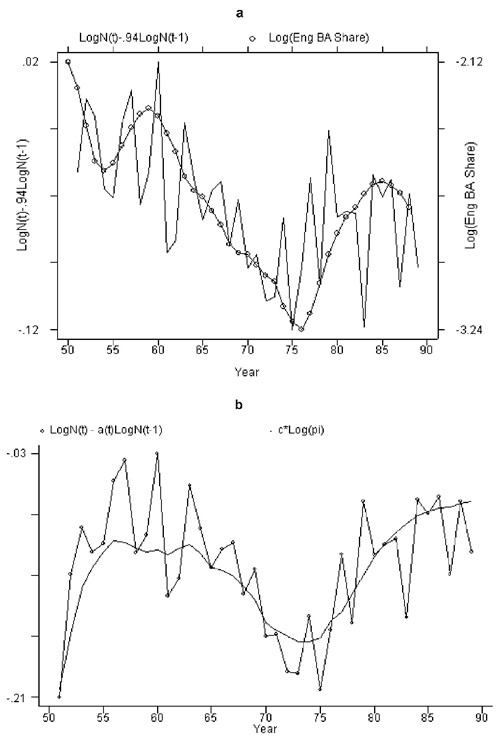
Source: Ryoo and Rosen (2004)
Ryoo and Rosen (2004) noted that importance of permanent versus transitory changes in earnings. Transitory rises and falls in earnings prospects have much less influence on occupational choices and the educational investments of students.
In light of these findings that the supply of engineers rapidly adapted to changing market conditions, Ryoo and Rosen (2004) questioned whether public policy makers have better information on future labour market conditions than labour market participants do. When politicians get worked up about skill shortages, the markets for scientists and engineers often where they make extravagant claims about the ability of the market to adapt to changing conditions because of the long training pipeline involved in university study, including at the graduate level.
There can be unexpected shifts in the supply or demand for particular skills, training or qualifications. These imbalances even themselves out once people have time to learn, update their expectations and adapt to the new market conditions (Rosen 1992; Ryoo and Rosen 2004; Bettinger 2010; Zafar 2011; Arcidiacono, Hotz and Kang 2012; Webbink and Hartog 2004).
For example, Arcidiacono, Hotz and Kang (2012) found that both expected earnings and students’ abilities in the different majors are important determinants of student’s choice of a college major, and 7.5% of students would switch majors if they made no forecast errors.
The wage premium for a tertiary degree was low and stable in New Zealand in the 1990s (Hylsop and Maré 2009) and 2000s (OECD 2013). This stability in the returns to education suggests that supply has tended to kept up with the demand for skills at least over the longer term at the national level. There were no spikes and crafts that would be the evidence of a lack of foresight among teenagers in choosing what to study.
All in all, the remarkable sensitivity of engineers to a career earnings prospects, the frequent changes of college majors by university students in response to changing economic opportunities, and the stability of the returns on human capital over time suggest that the market for human capital is well functioning.
The argument that the market was not working well was assumed rather than proven. Likewise, the case for additional subsidies for science, technology, engineering and mathematics because of perceived skill shortages has not been made out. There is a large literature showing that the market for professional education works well.
The onus is on those who advocate intervention to come up with hard evidence, rather than innate pessimism about markets that are poorly understood because of a lack of attempts to understand it. Studies dating back to the 1950s by George Stigler and by Armen Alchian found that the market for scientists and engineers works well and the evidence of shortages were more presumed than real.


George Stigler vindicated: Learning the Wealth of Nations
14 Nov 2014 Leave a comment
in constitutional political economy, political change, politics - Australia, politics - New Zealand, politics - USA, Public Choice Tags: george stigler, Leftover Left, Milton Friedman, neoliberal conspiracies, public choice, Twitter left, Tyler Cowen

Tyler Cowen has drawn attention to a 2011 paper on policy learning in the 1970s and 80s by Francisco J. Buera, Alexander Monge-Narajo, and Giorgio E. Primiceri was published in Econometrica in 2011. Their paper found that:
1. Policymakers have priors about how good the market economy is, and they revise those views — and thus revise policy — as they observe their own growth results and those of their neighbors.
2. A simple learning model predicts about 97% of the policy choices observed in the data. The model accounts for more than 77% of the observed policy switches over a three-year time window.
3. Evolving beliefs — and not just the fixed demographic characteristics of countries — are critical for understanding policy decisions.
4. It was probably the growth collapse of the late 1970s for interventionist countries which led to a greater reliance on markets.
5. Adjustment toward better-performing policies is often quite slow. In part this is because policymakers attribute the superior performance of other countries to heterogeneity rather than policy per se.
This record of politicians learning from failure and success at home and abroad is a vindication of George Stigler’s views of the relative unimportance of economists in influencing public policy.
There was no neoliberal conspiracy that captured the hearts and minds of politicians through mass hypnosis in the 1970s and 1980s as both the Left over Left and the Twitter Left like to suggest
The policies of Friedman had to wait, as George Stigler predicted, for a market to develop among interest groups and the voting public. Once that market developed, Milton Friedman, FA Hayek and others looked like leaders of an opinion.
A few years earlier, Friedman and Hayek were just angry men in the wilderness.
The reason for this sudden change in their public profile and purported influence on the shape the course of public policy in th 1970s and 1980s onwards was political parties were yet to conclude that the existing policy regime had failed irretrievably, and that the successes of neighbours on economic reform might be worth imitating locally.
Once politicians, the voting public and interest groups concluded that new solutions are needed, just as Stigler predicted, the ideas for reform been around for a long time came to the front.
via http://marginalrevolution.com/marginalrevolution/2014/11/learning-the-wealth-of-nations.html

George Stigler on the empirical success of the 1st law of demand and why demand curves will never slope upwards
03 Nov 2014 Leave a comment


In the 1950s, George Stigler wanted to break up US steel because it had too much market power
15 Oct 2014 Leave a comment
in applied price theory, comparative institutional analysis, George Stigler, industrial organisation, political change Tags: george stigler, The pretence to knowledge

HT: David Henderson

George Stigler (1982) on why the working class did not vote for the Green Party in the 2014 NZ election–part 4
04 Oct 2014 Leave a comment


 Utopia, you are standing in it!
Recent Comments