Figure 1: French, German, Italian and British trade union densities, 1960 – 2013
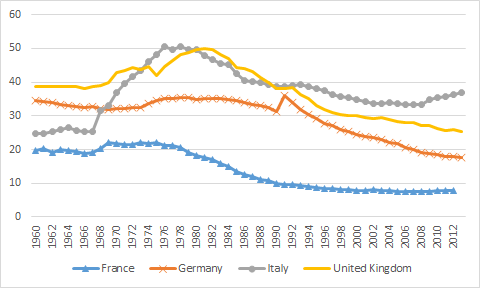
Source: OECD Stat Extract
Celebrating humanity's flourishing through the spread of capitalism and the rule of law
04 Jun 2015 Leave a comment
in economic history, labour economics, unions Tags: British economy, France, Germany, Italy, trade union density, union power
Figure 1: French, German, Italian and British trade union densities, 1960 – 2013
Source: OECD Stat Extract
03 Jun 2015 Leave a comment
in economic growth, economic history, job search and matching, labour economics, labour supply, macroeconomics, unemployment Tags: Eurosclerosis, France, Germany, Italy
Figure 1: French, German and Italian unemployment rates, 1956 – 2013

Source: OECD StatExtract.
28 May 2015 Leave a comment
in economic history, politics - USA, public economics, taxation Tags: British economy, France, Germany, growth of government
Figure 1: Tax revenue as percentage of French, German, British and US GDP, 1965–2013
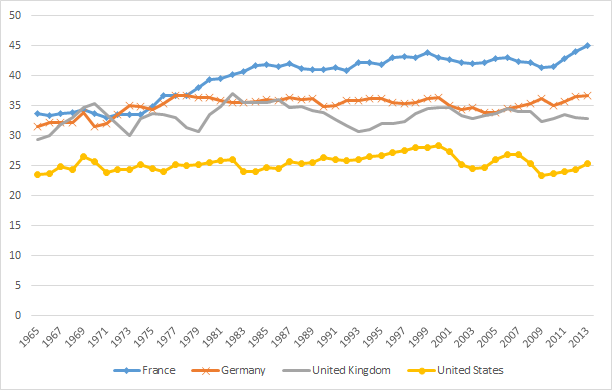
Source: OECD StatExtract.
24 May 2015 Leave a comment
in economics of love and marriage, labour economics, labour supply, occupational choice, population economics Tags: economics of family, Germany, household production, marital division of labour, marriage and divorce
The gender gap in housework narrows as men in Germany approach and enter retirement family-studies.org/how-mens-retir… http://t.co/5Q8IaHkSC4—
Inst. Family Studies (@FamStudies) May 04, 2015
21 May 2015 Leave a comment
in economic history Tags: British economy, France, Germany
Figure 1: French and German real GDP per capita are as percentage of British GDP per capita (1990 Int. GK$PPP), 1820 – 2010
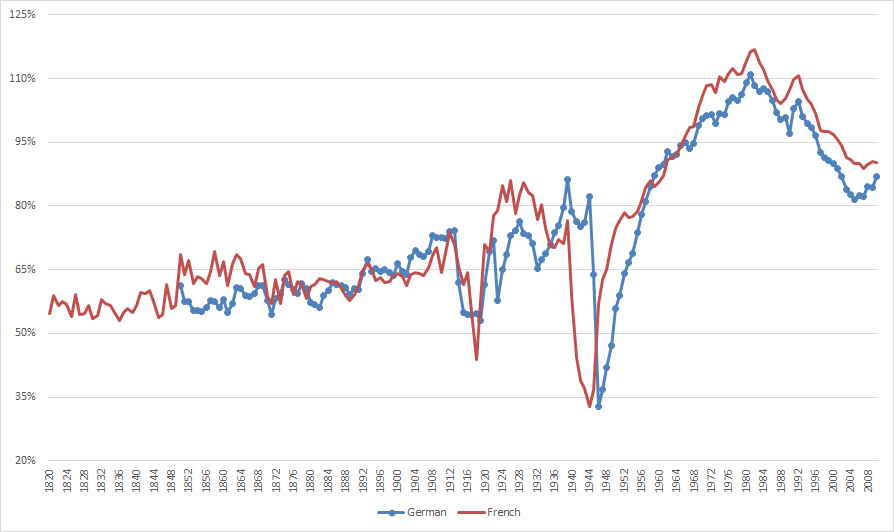
Source: The Maddison-Project, http://www.ggdc.net/maddison/maddison-project/home.htm 2013 version.
18 May 2015 Leave a comment
in transport economics Tags: bicycle, Germany
Own a bike
Jordan 5%
Egypt 18%
Turkey 26%
Russia 42%
UK 50%
US 53%
India 62%
Germany 80%pewresearch.org/fact-tank/2015… http://t.co/XRd5V8lY2o—
Conrad Hackett (@conradhackett) May 15, 2015
12 May 2015 Leave a comment
in applied price theory, economic growth, economic history, great depression, labour economics, labour supply, macroeconomics, politics - USA, Public Choice, public economics, taxation Tags: Edward Prescott, Euroclerosis, France, Germany, labour supply, Robert Lucas, taxation and labour supply
Figure 1 shows that Americans work the same hours per year pretty much the entire post-war period. By contrast, there is been a long decline in hours worked in Germany and France. The large drop in 1992 was German unification.
Figure 1: annual hours worked per working age American, German and French, 1950 – 2013

Source: OECD StatExtract and The Conference Board Total Economy Database™,January 2014, http://www.conference-board.org/data/economydatabase/
The long decline seemed to tally with the disproportionately sharp rise in the average tax rate on labour income, including social security contributions in France and Germany. When tax rates on labour income, including social security contributions stabilised in about 1980, hours worked stabilised in all countries.
Figure 2: average tax rate on labour income,USA, Germany and France, 1950 – 2013
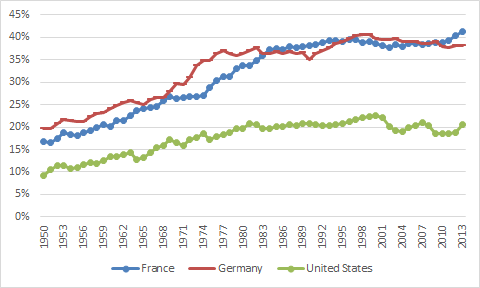
Source: Source: Cara McDaniel.
Some pander to the great vacation theory of European labour supply. This is the hypothesis of a large increase in the preference for leisure in the European Union member states. That is, mass voluntary unemployment and mass voluntary reductions and labour supply by choice by Europeans. They just decided to work less.
This is not the first outing for the great vacation theory of labour supply. In the late 1970s, Modigliani dismissed the new classical explanation of Lucas and Rapping (1969) of the U.S. great depression in which the 1930s unemployment was voluntary unemployment – the great depression was just a great vacation – with the following remarks:
Sargent (1976) has attempted to remedy this fatal flaw by hypothesizing that the persistent and large fluctuations in unemployment reflect merely corresponding swings in the natural rate itself.
In other words, what happened to the U.S. in the 1930’s was a severe attack of contagious laziness!
I can only say that, despite Sargent’s ingenuity, neither I nor, I expect most others at least of the non-Monetarist persuasion, are quite ready yet. to turn over the field of economic fluctuations to the social psychologist!
As Prescott has pointed out, the USA in the Great Depression and France since the 1970s both had 30% drops in hours worked per adult. That is why Prescott refers to France’s economy as depressed. The reason for the depressed state of the French (and German) economies is taxes, according to Prescott:
Virtually all of the large differences between U.S. labour supply and those of Germany and France are due to differences in tax systems.
Europeans face higher tax rates than Americans, and European tax rates have risen significantly over the past several decades.
Countries with high tax rates devote less time to market work, but more time to home activities, such as cooking and cleaning. The European services sector is much smaller than in the USA.
Time use studies find that lower hours of market work in Europe is entirely offset by higher hours of home production, implying that Europeans do not enjoy more leisure than Americans despite the widespread impression that they do. Europeans did not work less. They worked more on activities that were not taxed.
04 May 2015 Leave a comment
in currency unions, economic growth, economic history, Euro crisis, macroeconomics Tags: Eurosclerosis, France, Germany, Italy, post-war reconstruction
Figure 1: Real GDP per German, Italian and French aged 15-64, converted to 2013 price level with updated 2005 EKS purchasing power parities, 1950-2013
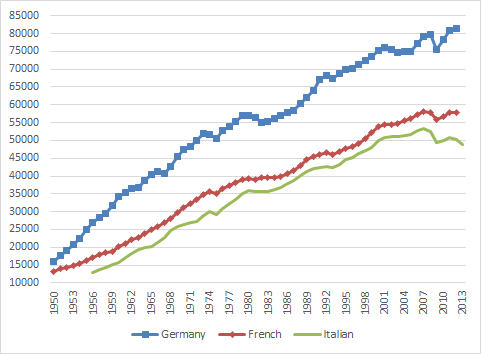
Source: Computed from OECD Stat Extract and The Conference Board, Total Database, January 2014, http://www.conference-board.org/economics
Figure 2: Real GDP per German, Italian and French aged 15-64, converted to 2013 price level with updated 2005 EKS purchasing power parities, 1.9 per cent detrended, 1950-2013
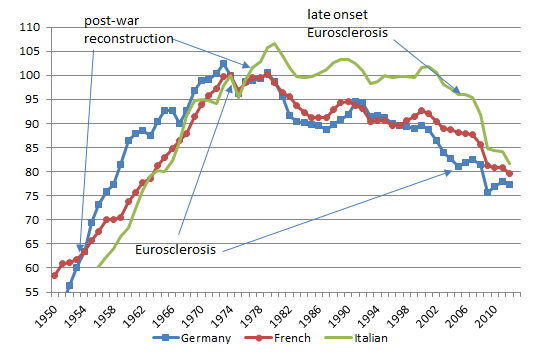
Source: Computed from OECD Stat Extract and The Conference Board, Total Database, January 2014, http://www.conference-board.org/economics
A flat line in figure 2 means real GDP growth of 1.9% per year, which is trend growth. A rising line means growth that is higher than trend rate; a falling line means growth at below the trend rate of 1.9%. 1.9% is the trend rate of growth of the USA in the 20th century. Figure 2 shows that:
28 Apr 2015 Leave a comment
in business cycles, economic growth, Euro crisis, global financial crisis (GFC), great recession, macroeconomics, politics - USA Tags: British economy, Canada, Eurosclerosis, France, Germany, Italy, Japan, recoveries from recessions
UK recovery: stronger than Italy, weaker than US & Canada. http://t.co/C0TEsbzMm3—
Jonathan Portes (@jdportes) April 28, 2015
22 Apr 2015 Leave a comment
in Euro crisis, macroeconomics, population economics Tags: ageing society, European Union, Eurosclerosis, France, Germany, labour demographics
BofA-ML: Working age population projections, a serious problem for Germany http://t.co/eStgQePoVP—
Fabrizio Goria (@FGoria) March 30, 2015
17 Apr 2015 Leave a comment
in economics of regulation, Euro crisis, global financial crisis (GFC), great recession, job search and matching, labour economics, macroeconomics, unemployment Tags: employment law reform, employment protections laws, Eurosclerosis, Germany
#Unemployment rate in #OECD area fell to 7.0% in Feb, w/42.9mn people jobless bit.ly/1FNK0W5 #stats http://t.co/RPUqvlR3mQ—
(@OECD) April 13, 2015
The countries with the more liberal labour markets are recovering fastest from the Great Recession and the Global Financial Crisis.
EZ unemployment rates http://t.co/vnfti1hhqe—
(@cigolo) March 31, 2015
This includes Germany where there were major labour market reforms a couple of years before the onset of the Global Financial Crisis. For that reason, German unemployment rates didn’t rise much in 2008 and after and are now falling quite rapidly because of their labour market liberalisations. Germany has the lowest unemployment rate in Europe.
UK youth unemployment high but lower than 20 other EU member states. #Budget2015 http://t.co/eBa8W9rr6C—
RBS Economics (@RBS_Economics) March 18, 2015

31 Jan 2015 Leave a comment
14 Jan 2015 1 Comment
in economic history, macroeconomics, politics - Australia, politics - New Zealand Tags: East Germany, Germany, immigration, Trans-Tasman income gap
When I pointed to Jennifer Hunt’s so titled paper freshly released in 2000 on why does anyone still live in East Germany, none of my New Zealand colleagues understood the parallel with their own country.
The wage gap between East and West Germany is about the same as the wage gap between Australia and New Zealand.
There are in fact bigger language, or more correctly dialect differences between Germany than there are across the Tasman Sea between New Zealanders and Australians. Educational standards are similar between New Zealanders and Australians.
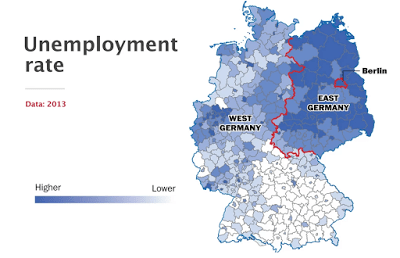
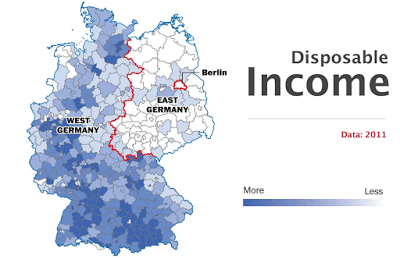
In 1997 GDP per capita in East Germany was 57% of that of West Germany, wages were 75% of western levels, and the unemployment rate was at least double the western rate of 7.8%.
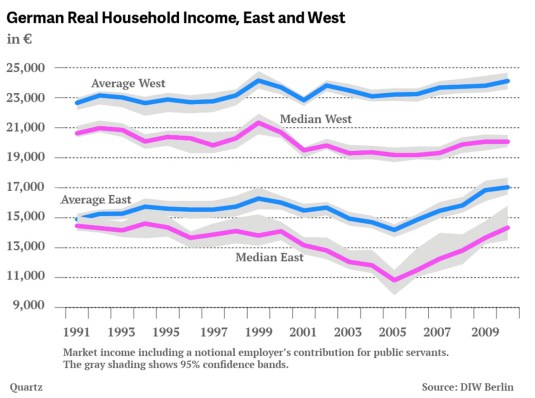
The wage gap across the Tasman between New Zealand and Australia is about one third. Wage gaps between East and West Germany and between Australia and New Zealand are about the same.
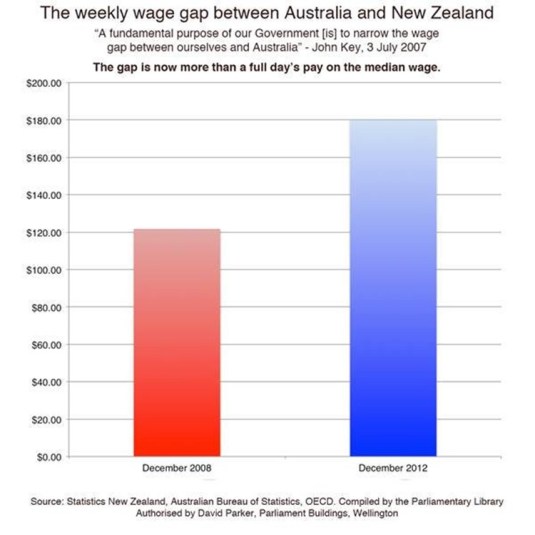
Australia and New Zealand have a single integrated labour market. Any New Zealander Australian is free to work in the other country.
New Zealanders are not eligible for social security benefits if they first arrived in Australia after mid-2001. Prior to 2001, New Zealanders have the same rights as Australians for social security benefits.
One would expect that if capital flows and trade in goods failed to bring convergence between East and West Germany, labour flows should respond, enhancing overall efficiency.
Same goes between Australia and New Zealand. About 35,000 New Zealanders used to move to Australia each year, but that’s recently dried up to about zero. Funnily enough, by the late 1990s net emigration from East Germany has fallen from high levels in 1989-1990 to close to zero.
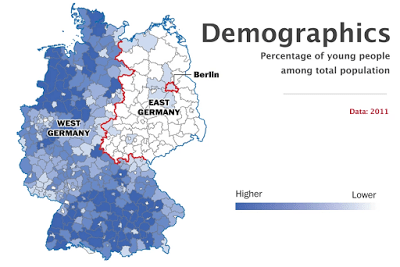
Jennifer Hunt found through her analysis of the eastern sample of the German Socio-Economic Panel for 1990-1997 that commuting is unlikely to substitute substantially for emigration.
Wage convergence between the East and the West was a main factor that stemmed immigration. The individual-level data further indicate that emigrants are disproportionately young and skilled, and that individuals suffering a layoff or non-employment spell are also much more likely to emigrate. This is all as predicted by the Roy model of immigration self-selection.
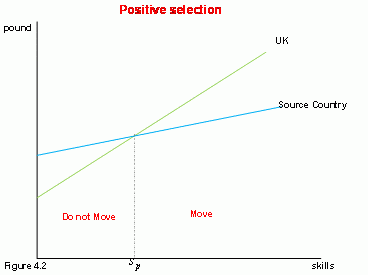
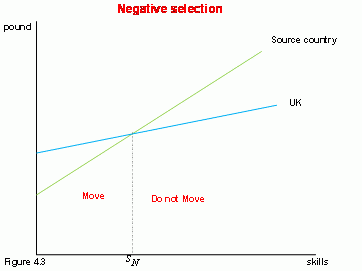
Like all human capital investments, both international and within country migration is based on the comparison of the present value of lifetime earnings in all available employment opportunities. Individuals compare the potential incomes and the destination country with the income in the home countries, and make the migration decision based on these income differentials (net of mobility costs).
02 Aug 2014 Leave a comment
in applied price theory, entrepreneurship, macroeconomics Tags: barriers to riches, Britain, France, Germany, Japan, relative labour productivity, USA
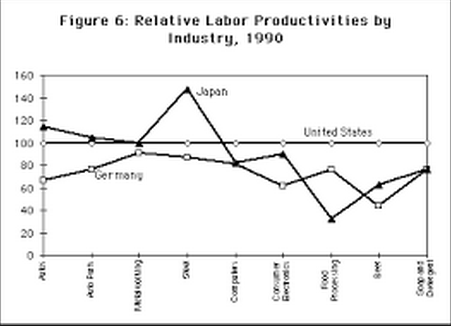
There are large productivity differences between the global industrial leaders at the industry level. In a 1993 McKinsey’s study, large differences were uncovered in value added per worker between the USA, Japan, France, the UK and Germany across individual industries, by a factor of three in some cases (Prescott and Parente 2000, 2005).
| Industry | Japan | Germany |
| Automobiles | 116 | 66 |
| Automobile Parts | 124 | 76 |
| Metal Working | 119 | 100 |
| Steel | 145 | 100 |
| Computer | 95 | 89 |
| Consumer Electronics | 115 | 62 |
| Food | 33 | 76 |
| Beer | 69 | 44 |
| Soap and Detergent | 94 | 76 |
Differences in the access to the global pool of useful knowledge cannot explain such large productivity differences at the sector and the individual industry levels between the USA, Japan, France, the UK and Germany and between these three European neighbours. The stock of useful technological knowledge does not vary that much across these countries (Prescott and Parente 2000, 2005). These countries produce and are the markets for the majority of that knowledge.
| Industry | Japan | Germany | U.K. | France |
| Retailing | 44 | 96 | 82 | 69 |
| Telecommunications | 66 | 50 | 38 | 56 |
| Banking | – | 68 | 64 | – |
Lags in technology diffusion cannot be important. The USA, Japan, France, the UK, and Germany define the global technological frontier.
Differences in the skills of the individual worker or in the total stock of human capital of all workers in a country cannot explain these differences in value added per worker. The USA, Japan, France, the UK and Germany all have relatively well-educated, experienced and tested labour forces. For example, the 1993 McKinsey’s study inquired into the education and skills levels of Japanese and German steel workers. Comparably skilled German steel workers were half as productive as their Japanese counterparts (Prescott and Parente 2000, 2005).
What differ between these countries at the glob technological frontier is the amount of the global pool of useful productive of knowledge that is used and as work practices. Ford Europe failed to adopt Japanese just-in-time production, but Ford U.S.A. has adopted it. In the beer industry, much of the high technology machinery in Japan and U.S. is manufactured in Germany but German breweries fail to use these more productive technologies. The less productive airline sector in Europe vis-à-vis the United States is the result of over-staffing.
Celebrating humanity's flourishing through the spread of capitalism and the rule of law
Scholarly commentary on law, economics, and more
Beatrice Cherrier's blog
Celebrating humanity's flourishing through the spread of capitalism and the rule of law
Celebrating humanity's flourishing through the spread of capitalism and the rule of law
Celebrating humanity's flourishing through the spread of capitalism and the rule of law
Why Evolution is True is a blog written by Jerry Coyne, centered on evolution and biology but also dealing with diverse topics like politics, culture, and cats.
Celebrating humanity's flourishing through the spread of capitalism and the rule of law
Celebrating humanity's flourishing through the spread of capitalism and the rule of law
A rural perspective with a blue tint by Ele Ludemann
DPF's Kiwiblog - Fomenting Happy Mischief since 2003
Celebrating humanity's flourishing through the spread of capitalism and the rule of law
The world's most viewed site on global warming and climate change
Tim Harding's writings on rationality, informal logic and skepticism
A window into Doc Freiberger's library
Let's examine hard decisions!
Commentary on monetary policy in the spirit of R. G. Hawtrey
Thoughts on public policy and the media
Celebrating humanity's flourishing through the spread of capitalism and the rule of law
Politics and the economy
A blog (primarily) on Canadian and Commonwealth political history and institutions
Reading between the lines, and underneath the hype.
Economics, and such stuff as dreams are made on
"The British constitution has always been puzzling, and always will be." --Queen Elizabeth II
Celebrating humanity's flourishing through the spread of capitalism and the rule of law
Celebrating humanity's flourishing through the spread of capitalism and the rule of law
WORLD WAR II, MUSIC, HISTORY, HOLOCAUST
Undisciplined scholar, recovering academic
Celebrating humanity's flourishing through the spread of capitalism and the rule of law
Res ipsa loquitur - The thing itself speaks
Celebrating humanity's flourishing through the spread of capitalism and the rule of law
Researching the House of Commons, 1832-1868
Articles and research from the History of Parliament Trust
Reflections on books and art
Posts on the History of Law, Crime, and Justice
Celebrating humanity's flourishing through the spread of capitalism and the rule of law
Exploring the Monarchs of Europe
Cutting edge science you can dice with
Small Steps Toward A Much Better World
“We do not believe any group of men adequate enough or wise enough to operate without scrutiny or without criticism. We know that the only way to avoid error is to detect it, that the only way to detect it is to be free to inquire. We know that in secrecy error undetected will flourish and subvert”. - J Robert Oppenheimer.
The truth about the great wind power fraud - we're not here to debate the wind industry, we're here to destroy it.
Celebrating humanity's flourishing through the spread of capitalism and the rule of law
Celebrating humanity's flourishing through the spread of capitalism and the rule of law
Economics, public policy, monetary policy, financial regulation, with a New Zealand perspective
Celebrating humanity's flourishing through the spread of capitalism and the rule of law
Restraining Government in America and Around the World
 Utopia, you are standing in it!
Recent Comments