It’s time to end wind welfare
05 Dec 2014 Leave a comment
in energy economics, rentseeking Tags: corporate welfare, green rent seeking, wind welfare
The U.S. has built its first new oil refinery in 40 years
04 Dec 2014 Leave a comment
in economics of regulation, energy economics, environmental economics, resource economics Tags: green rent seeking, NIMBYs
Three days to save the world from climate change, if Australia’s chief scientist is to believed?!
01 Dec 2014 Leave a comment
in environmental economics, global warming, politics - Australia Tags: climate alarmism, global warming, green rent seeking
“It is entirely possible to rapidly switch our energy systems to 100 percent renewables” – Naomi Klein
09 Nov 2014 Leave a comment
in energy economics, environmental economics, environmentalism, global warming Tags: carbon free economy, energy economics, expressive voting, green rent seeking, Leftover Left, Naomi Klein, Quacks, renewable energy
Jacobson and Delucchi think we can replace all coal, oil, natural gas, and nuclear power by 2030 with wind, solar, and hydropower while fueling a fleet of electric cars.
How? By deploying 3.8 million 5-megawatt wind turbines, 5,350 100-megawatt geothermal plants, 500,000 1-megawatt tidal turbines, 720,000 0.75-megawatt wave power generators, 1.7 billion 3-kilowatt rooftop solar panels, 40,000 300-megawatt solar panel farms, and 49,000 300-megawatt concentrated solar power plants.
| Annual global investment target | Current global stock |
| 250,000 wind turbines | 225,000 wind turbines |
| 113 million rooftop solar panel systems | 11.3 million |
Delucchi and Jacobson estimate a price tag of about $100 trillion for their program.
That entails spending about $6.6 trillion per year from now until 2030, more than 11 percent of the entire world’s 2013 output of $75 trillion.
Naomi Klein cited Jacobson and Delucchi to support her proposition that 100% renewable energy systems is possible.
Bjørn Lomborg says that the UN climate panel’s latest report tells a story that politicians prefer to ignore
09 Nov 2014 Leave a comment
in climate change, energy economics, environmental economics, global warming Tags: Bjørn Lomborg, climate alarmism, global warming, green rent seeking, IPCC
The second IPCC installment showed that the temperature rise that we are expected to see sometime around 2055-2080 will create a net cost of 0.2-2% of GDP – the equivalent of less than one year of recession…
Again, not surprisingly, politicians tried to have this finding deleted. British officials found the peer-reviewed estimate “completely meaningless,” and, along with Belgium, Norway, Japan, and the US, wanted it rewritten or stricken. One academic speculated that governments possibly felt “a little embarrassed” that their previous exaggerated claims would be undercut by the UN.
The third installment of the IPCC report showed that strong climate policies would be more expensive than claimed as well – costing upwards of 4% of GDP in 2030, 6% in 2050, and 11% by 2100.
And the real cost will likely be much higher, because these numbers assume smart policies, instantly enacted, with key technologies magically available.
Why Middle-Class Americans Can’t Afford to Live in Liberal Cities – The Atlantic
07 Nov 2014 Leave a comment
in applied welfare economics, economics of regulation, environmental economics, income redistribution, Public Choice, rentseeking, urban economics Tags: Director's Law, green rent seeking, land use regulation, zoning


Heritage trumps safety
03 Nov 2014 Leave a comment
in applied welfare economics, economics of regulation, urban economics Tags: Christchurch earthquake, green rent seeking, health and safety, Heritage regulation

Quote of the day:
. . . Deaths in earthquakes are somewhat unavoidable. But deaths caused by regulatory structures that force that little value is placed on human life, or that prevent a building owner from tearing down a building very likely to kill a pile of people in a quake, are worse than tragic – they’restupid. Offsetting Behaviour.
It’s in a post on heritage rules which make some buildings untouchable and how the burden of providing the heritage amenity falls on the owner of the building.
He has a better idea:
I’ve suggested an alternative structure where we run heritage protection as an on-budget Council expenditure. Have each Council decide how much money they’re willing to put into heritage preservation, perhaps have Central provide a matching grant, and open it up to further voluntary contributions from the public. Then, have the heritage boards decide how and…
View original post 176 more words
Solutions should reflect the problem definition and analysis: Duncan Garner on child poverty
02 Nov 2014 Leave a comment
in economics of religion, labour economics, politics - New Zealand, urban economics, welfare reform Tags: child poverty, Duncan Garner, expressive voting, green rent seeking, land use zoning, regulation of land supply, Resource Management Act
Duncan Garner wrote a passionate column yesterday in the local paper calling for gutsy action on child poverty.
His analysis of the causes of child poverty in New Zealand was good. Garner’s solutions had nothing to do with what he had identified as the causes of child poverty. As Garner himself wrote:
… in order to tackle poverty it’s important to attempt to define what it means today.
Poverty is children living in crowded, damp homes who don’t get three square meals a day.
They may not have their own bed, they won’t see a doctor when they’re sick and many of them will be admitted to hospital with serious poverty-related illnesses such as respiratory problems and skin infections.
They may live in households where paying the rent accounts for 60 per cent of the family’s income every week.
Garner then discussed the plight of one particular family in Auckland:
The parents are nice people, with seven children.
They shared a tiny home with three other adults and another child.
Dad works full-time at a meat factory and they had been waiting 10 months for a state house. They had beds in the dining room and lounge.
They couldn’t afford the cost of a private rental home. One son, aged 11, had a serious lung problem. I saw poverty in action that day and it was deeply disturbing. I highlighted their plight on my radio show and within weeks a shamed Housing NZ had found them a home.
The family Garner discussed is in a tiny house because they lacked the income to rent a better one. They must rely on social housing provided by government with income related rents.
Recurring through his problem definition is the impact that rising housing costs is having on the poor.
Nonetheless, Garner then advocates cash payments to low income families, a tax credit system seen as more generous and inclusive, and a back to school bonus without addressing the supply of housing.
The evidence is overwhelming in New Zealand that the main driver of the increases in the child poverty since the 1980s is rising housing costs.
In the longer run after housing costs child poverty rates in 2013 were close to double what they were in the late 1980s mainly because housing costs in 2013 were much higher relative to income than they were in the late 1980s.
– Bryan Perry, 2014 Household Incomes Report – Key Findings. Ministry of Social Development (July 2014).
Any policy to reduce child poverty must increase the supply of houses by reducing regulatory restrictions on the supply of land.
The Metropolitan Limit confines the expansion of Auckland beyond the existing built-up area. This regulatory constraint explains the exceptionally high housing price-income ratio of Auckland.

The limit imposed on the horizontal expansion of the city in green fields encourages increases in residential prices. As demand for new housing increases, no new land supply can enter the market and stem price rises in response to this increased demand.

If you serious about child poverty, you have to criticise government regulation: the dead hand of the Resource Management Act (RMA) on the poor and the vulnerable.
Mainstream media is finally catching up with the sceptics
01 Nov 2014 Leave a comment
in applied welfare economics, energy economics, environmental economics, environmentalism Tags: global warming, green rent seeking

 A hard hitting article appears in the Mail which slams the climate change act.
Six years ago today, an ambitious Labour politician, newly appointed climate change secretary, set Britain on a ruinous path that threatens our energy-dependent civilisation with collapse.
Such is the devastating conclusion of Owen Paterson, the Tory former Environment Secretary, who yesterday joined Lord Lawson among the highest-profile critics of the political consensus on energy policy.
For it was on October 16, 2008, that the new secretary of state – Ed Miliband, by name – set us the legally binding goal of meeting the EU’s wildly ambitious target to cut carbon emissions by 80 per cent before 2050 (and how significant that no other country has followed his lead).
View original post 89 more words
The Greens are the heirs of the 19th century Tory squires
01 Nov 2014 Leave a comment
in environmentalism, politics - Australia, politics - New Zealand, politics - USA Tags: expressive voting, green rent seeking, green voters

The Greens are no more than a reincarnation of the 19th century British Tory Radicals with their aristocratic sensibilities that combined strong support for centralised power with a paternalistic concern for the plight of the poor:
- 19th century Tory radicals opposed the middle classes and the aesthetic ugliness they associated with an industrial economy; and
- Like the 19th century Tory Radicals, today’s green gentry see the untamed middle classes as the true enemy.
Environmentalists have an aristocratic vision of a stratified, terraced society in which the knowing ones would order society for the rest of us.
Environmentalism offered the extraordinary opportunity to combine the qualities of virtue and selfishness
Many left-wingers thought they were expressing an entirely new and progressive philosophy as they mouthed the same prejudices as Trollope’s 19th century Tory squires: attacking any further expansion of industry and commerce as impossibly vulgar, because it was:
View original post 346 more words
Anti-Science Left alert: food labelling and natural food
01 Nov 2014 Leave a comment
in health economics Tags: Anti-Science left, food labelling, green rent seeking, Quacks
The fire of truth: the relationship between inequality and economic prosperity in New Zealand since the 1970s
29 Oct 2014 Leave a comment
in economic growth, economics of regulation, income redistribution, politics - New Zealand, rentseeking Tags: Auckland urban limit, economic growth, Gini coefficient, green rent seeking, poverty and inequality, Resource Management Act
Figure 1: Before Housing Costs Gini coefficient, New Zealand, 1982 – 2013

closertogether.org.nz/nzs-income-inequality-problem claims that NZ income inequality increased very rapidly in the late 1980s and 1990s — faster than in any other wealthy country.
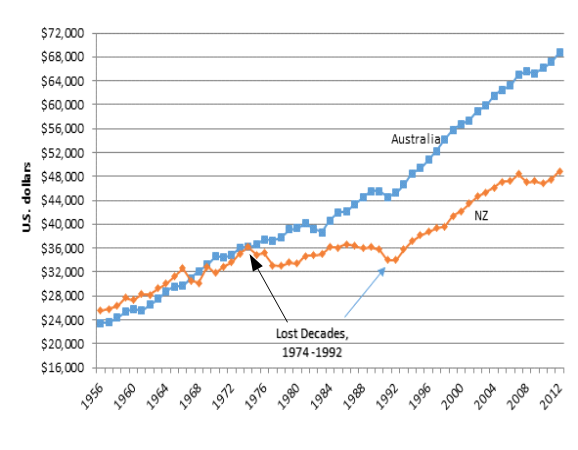
Figure 2 shows that this rapid rise in inequality coincided with the resumption of economic growth after two lost decades: next to no increase in real GDP per working age New Zealander from 1974 to 1992.
Figure 2: Real GDP per New Zealander and Australian aged 15-64, converted to 2013 price level with updated 2005 EKS purchasing power parities, 1956-2012
Source: Source: Computed from OECD Stat Extract and The Conference Board, Total Database, January 2014, http://www.conference-board.org/economics
Perry (2014) found that:
- Income inequality in New Zealand is at a similar level to Australia, Canada, Italy and Japan (Ginis of 32-33) and a little lower than the UK (34). Countries such as Denmark, Norway, Finland and Belgium have lower than average inequality (Ginis of 25-26). The US and Israel have higher scores of 39.
- The top 1% in New Zealand received around 8% of all taxable income in 2010 and 2011 (before tax), similar to Norway, Finland and Australia, lower than Ireland and Switzerland (11%) and much lower than the UK and Canada (13%) and the US (18%).
- The trend for the New Zealand share has been steady at around 8-9% since the mid 1990s, with perhaps a slight fall in the last few years. Many OECD countries saw small rises in the period, and in the USA the top 1% share continued to rise strongly, from 13% to 19%.
Perry (2014) concluded that:
Overall, there is no evidence of any sustained rise or fall in inequality in the last two decades. The level of household disposable income inequality in New Zealand is a little above the OECD median. The share of total income received by the top 1% of individuals is at the low end of the OECD rankings.
This remark by Parry that there is no evidence of any sustained rise or fall in inequality in New Zealand in the last 20 years is very much at odds with the claim of Closer Together New Zealand that income inequality inequality increased rapidly in the late 1980s and 1990s.
The increase in inequality in New Zealand was in the late 1980s and early 1990s. In the early 1990s, a long economic boom started that lasted until the global financial crisis.
Figure 3 : Income Inequality in New Zealand as Assessed by the Gini Coefficient

Source: Perry 2014 derived from Statistics NZ Household Economic Survey (HES) 1982–2012.
Figure 4: Income Inequality in New Zealand as Assessed by the P80/P20 Ratio

Source: Perry 2014 derived from Statistics NZ Household Economic Survey (HES) 1982–2012.
Figures 3 and 4 both show that after housing costs inequality in New Zealand is higher, but has been pretty stable for 20 years as measured by the Gini coefficient and by the P80/P20 ratio. (When individuals are ranked by equivalised household income and then divided into 100 equal groups, each group is called a percentile. If the ranking starts with the lowest income, then the income at the top of the 20th percentile is denoted P20; the income at the top of the 80th percentile is called P80. The ratio of the value at the top of the 80th percentile to the value at the top of the 20th percentile is called the P80/20 ratio and is often used as a measure of income inequality).
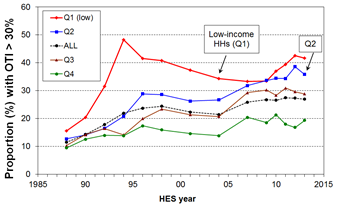
Figure 5: Proportion of HHs with housing cost outgoings to income of greater than 30%, by income quintile
Source: Perry (2014); OTI = outgoings to income
Figure 5 shows that
- for the bottom quintile (Q1), the proportion with high outgoings to income (OTI) steadily reduced from 48% in 1994 to 34% in 2004, as unemployment fell, employment and income rose, and income-related rental policies were introduced in 2000 for those in HNZC houses. From HES 2009 to HES 2013 the proportion rose strongly from 33% to 42%, the highest it has been in the last 25 years except for the peak of 48% in 1994.
- For households with incomes in the second quintile (Q2) there was a strong rise from the 1980s through to the mid 1990s, followed by a relatively flat trend to 2004. Since 2004, the proportion with high OTIs has risen strongly from 27% to 36%.
- For the third quintile (Q3) the proportion with high OTIs settled at around 30% for 2007 to 2013, up from 21% in 2004 and 10% in 1988.
Rising housing costs in New Zealand have one explanation, which is restrictions on the supply of land under the Resource Management Act.
HT: nzchildren.co.nz/income_inequality for figures 3 and 4.


 Utopia, you are standing in it!
Recent Comments