Cara McDaniel went to the mammoth task of constructing average tax rates for 15 OECD countries over the period 1950-2003 for consumption, investment, labour and capital:
Total tax revenue is divided into revenue generated from four different sources: consumption expenditures, investment expenditures, labour income and capital income.
To find the average tax rate, tax revenue from each source is then divided by the appropriate income or expenditure base.
She used that data to examine the role of taxes and productivity growth as forces influencing market hours. She used a calibrated growth model extended to include home production and subsistence consumption, both of which were key features influencing market hours. Her model was simulated for 15 OECD countries. She found the primary force driving changes in market hours is found to be changing labour income tax rates and productivity catch-up relative to the United States is found to be an important secondary force.
I thought I would summarise the tax rate data computed by Cara McDaniel for Australia and New Zealand.
Source: Cara McDaniel.
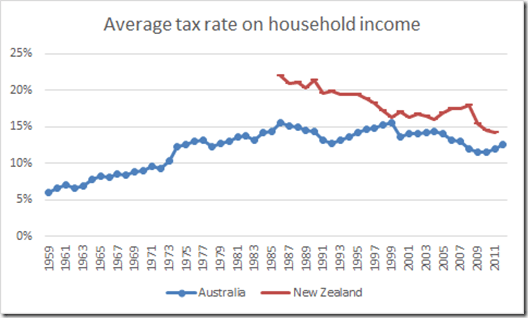
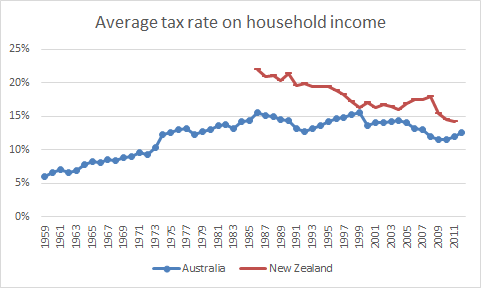
McDaniel’s data on average tax rates on household incomes in Australia and New Zealand suggests that the average tax rate New Zealand household incomes fell by a third since 1986. No estimates were calculated for earlier years for New Zealand.
As for Australia, taxes steadily increased between 1959 and 1987 stabilised until 2005 and then fell a bit.
Source: Cara McDaniel.
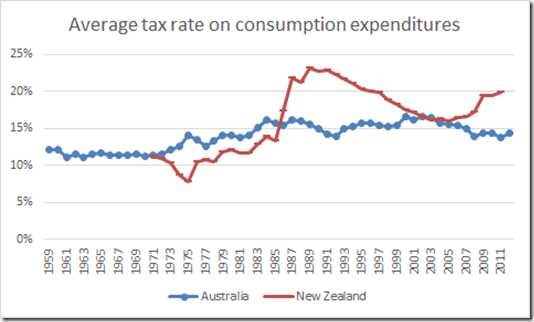
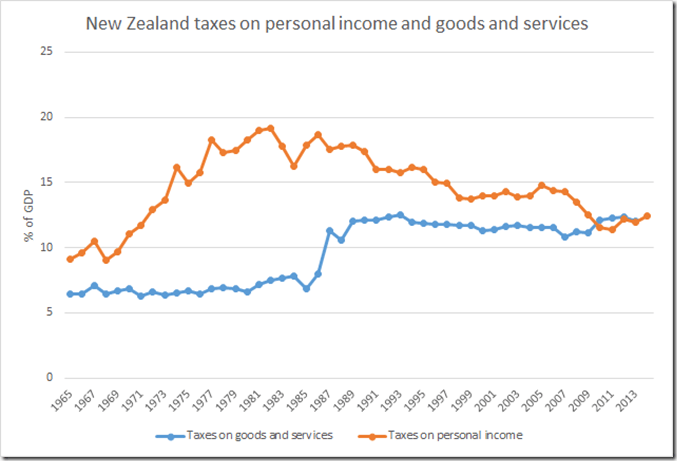
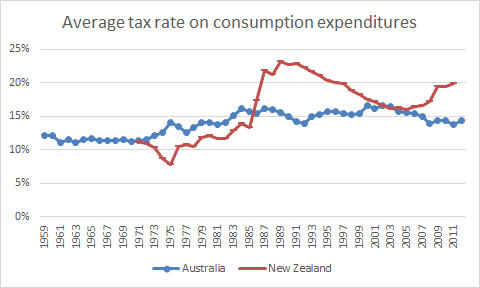
There is a big spike in the average tax rate on consumption expenditure in New Zealand in 1986 when a GST replaced the pre-existing sales taxes. The average tax rate on New Zealand consumption expenditures and tapered away until the end of2009 and started to increase again.
Not much happened in Australia regarding the average tax rate in consumption expenditures since about 1983 despite the introduction of a GST in 1998.
Source: Cara McDaniel.
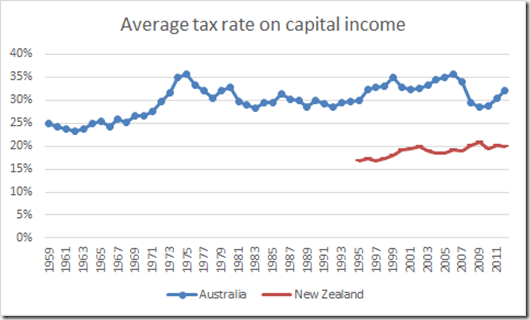
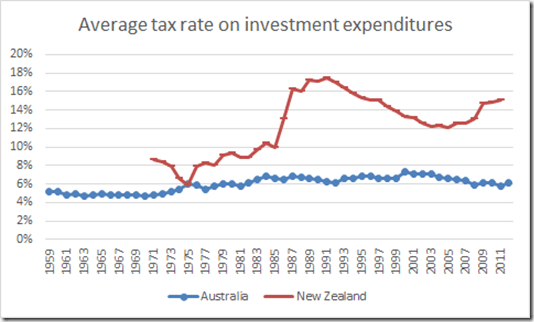
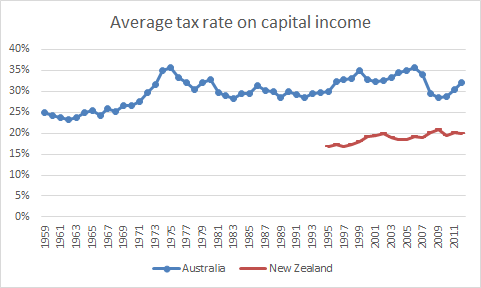
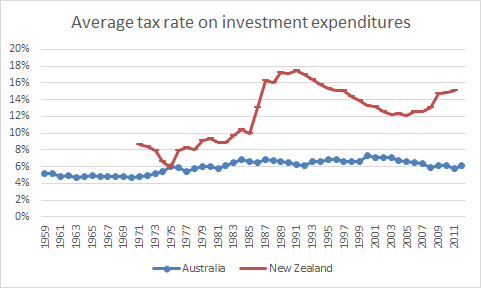
The average tax rate in capital income in Australia is much higher than in New Zealand. On the other hand, the average tax rate on investment expenditure is much higher New Zealand as compared to Australia.
Source : Cara McDaniel.
Taxes on investment expenditures increased quite significantly at the same time that a GST was introduced in New Zealand.
All in all, New Zealand cut taxes on personal income but that tax cut seemed to be pretty much offset by higher taxes on personal consumption through the introduction of a 10% and then 12.5% GST.
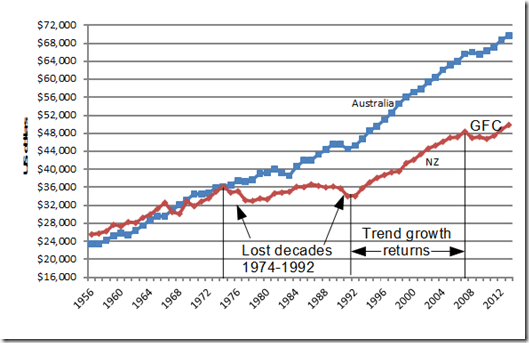
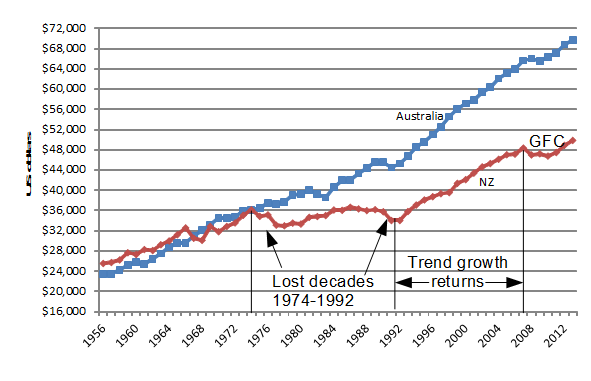
The most interesting finding in this database is the sharp increase in the average tax on investment expenditures in the mid-1980s. This prolonged New Zealand’s lost decades – the two decades of next to no GDP growth per working age New Zealander.
Real GDP per New Zealander and Australian aged 15-64, converted to 2013 price level with updated 2005 EKS purchasing power parities, 1956-2013
Source: Computed from OECD Stat Extract and The Conference Board, Total Database, January 2014.
New Zealand’s lost decades ended when the average tax rate on investment expenditures started to fall.
 Utopia, you are standing in it!
Recent Comments