The 30 Mile Zone That Explains Why Hollywood Exists
13 Feb 2018 Leave a comment
in industrial organisation, labour economics, unions, urban economics Tags: Hollywood economics
Half of Hollywood now claims to not have understood this joke
17 Dec 2017 Leave a comment
in discrimination, economics of crime, gender, labour economics, law and economics Tags: Hollywood economics
I did not know about Harvey Weinstein is not a wise thing to say in an industry that lives on gossip.
https://twitter.com/rosemcgowan/status/942142777747496960
https://twitter.com/rosemcgowan/status/939118902809837569
Wellywood is in an expensive global subsidy market
24 May 2017 Leave a comment
in applied price theory, industrial organisation, politics - New Zealand, Public Choice, rentseeking, survivor principle Tags: film subsidies, Hollywood economics, wars of attrition
The $300 million in film subsidies in the coming budget is riding off the back of Sir Peter Jackson’s phenomenal success. Our politicians will not consider pulling out of this global subsidy market until they have backed a few box office bombs.
The first law of Hollywood economics illustrates how fickle moviemaking is: “Nobody knows anything … Not one person in the entire motion picture field knows for a certainty what’s going to work. Every time out it’s a guess and, if you’re lucky, an educated one (Goldwin 1989).”
Big budgets, star power and large marketing budgets do not reduce ‘the terror of the box office’. Industry profits depend on the rare blockbuster; 78 percent of films are unprofitable (Walls 2005). Taxpayers cannot afford to pick winners in an industry of flops and the occasional blockbuster.
You do not have to be much of a film buff to remember box office flops with big names in them. Every Robert De Niro fan has been asking for a fair time now why did he agree to his latest film? Bruce Willis spent the middle part of his career recovering from a few box office bombs.
Many famous films and TV shows succeeded because the producers made something that audiences did not know they wanted to see until they saw it. Their success surprised everyone, including their producers. Star Wars, Rocky, The Rocky Horror Picture Show, One Flew over the Cuckoo’s Nest, My Big Fat Greek Wedding, The Godfather, Fawlty Towers and Seinfeld are all examples.
We watched the Seinfeld pilot last week. How did it ever get picked up (and initially only for four episodes)? George Clooney appeared in 23 failed pilots before hitting it big. These are the freaky odds taxpayers are playing when selecting which films to subsidise.
The most profitable movies of all time such as National Lampoon’s Animal House often had tiny budgets. Donald Sutherland is still kicking himself for insisting on a $50,000 cash rather than $35,000 plus 15% of the eventual $500 million gross (in present-day dollars). He thought he had made a nifty deal for one day’s work in a $2.5 million film, signing on only as a favour to his old baby sitter John Landis. You just never know when the biggest break in your life is passing you by in show business.
Sir Alec Guinness hated every day on the Star Wars set but made most of the money he ever made in his life from his 2 ¼%. It was supposed to be 2 ½% but did not think it important to get the increase from 2% in writing before the film’s first release in a mere 32 theatres.
George Lucas planned to be out of town to escape some of the backwash of failure at the box office. He was in LA through a mix-up in dates and only realised he was rich when he went out for a hamburger to be caught up in massive traffic jams around a theatre playing Star Wars.
Think of any successful film in the first half of the 1970s, Steve McQueen turn down it down; any successful film in the second half of the 70s including Star Wars, James Caan turned it down. Sean Connery turned down Lord of the Rings.
On Academy Awards night, the audience is full of stars showing surprising grace under pressure in an emotional profession. They show their true acting chops by jumping up, applauding and faking genuine smiles despite their having turned down the Oscar-winning role.
Many classics have modest initial reviews or weak box offices such as Blade Runner and Get Carter. Radical uncertainty about whether you will like what you see is part of the experience sought when going to the movies. My favourite movie is Casablanca the second time I saw it at Uni for $1.
Studios and investors cope with this extreme uncertainty through a portfolio approach. They invest in many films and in both established and new talent and hope to get lucky.
New Zealand taxpayers cannot diversify the risk of frequent flops with a global portfolio approach. We have only enough cash to spare to subsidise a few films. Many of these are now sequels or franchises that sooner or later will tire with their inherently fickle audiences.
Any industry which survives on the grace and favour of the subsidy granter is inherently vulnerable; doubly so when consumer tastes are so unpredictable. With 6000 or so employed in the NZ film industry, the danger is politicians will never turn the subsidy tap off because of job losses.
New Zealand is a bit player in a global subsidy market where national, state and city governments are all pitching big to attract a bit of glamour their way.

The poor returns on film subsidies are well-known. The Treasury estimated taxpayers spent $472 billion in seven years for net economic benefits of just $13.6 million from 2004 to 2011; an annual rate of return of less than one percent. Treasury found only limited evidence of spill-overs to tourism.
The infant industry argument for subsidies does not stand up if only because they never grow up. Perpetually subsidising the film industry as the basic business model makes no sense at all.
Looking past the tinsel town glamour, film subsidies are a race to the bottom for the taxpayer. That does not count for much when there are photo opportunities for politicians with movie stars.
Is it merchandising that drives gender bias in Hollywood casting?
17 May 2016 Leave a comment
in discrimination, economics of media and culture, gender, industrial organisation, labour economics, labour supply, occupational choice, survivor principle Tags: entrepreneurial alertness, gender gap, gender wage gap, Hollywood economics

Iron Man 3 changed the gender of the film’s villain from female to male after pressure from the production company Marvel, which feared toy merchandise would not sell as well.
This is a rather frank admission of what drives gender bias in Hollywood casting decisions. Its customer preferences – customer discrimination. It was not nasty producers and directors choosing not to hire women.
It was producers and directors casting a movie that might sell at the box office given what the box office wants. The great majority of box office sales is outside of the USA and US cultural values, interests and concepts of humour.

Hollywood is a cutthroat market where producers and directors do do whatever it takes to make their movie sell at the box office. But would not last very long if they indulge their personal preferences at the expense of the box office.
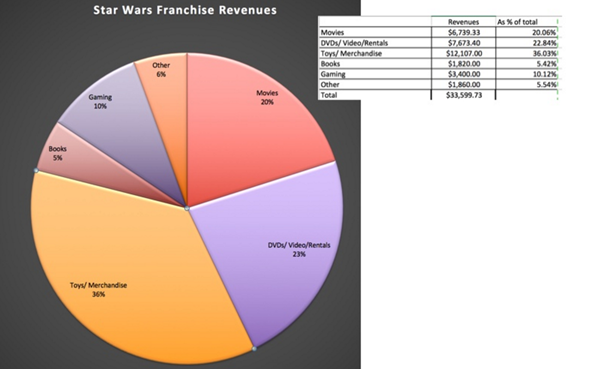
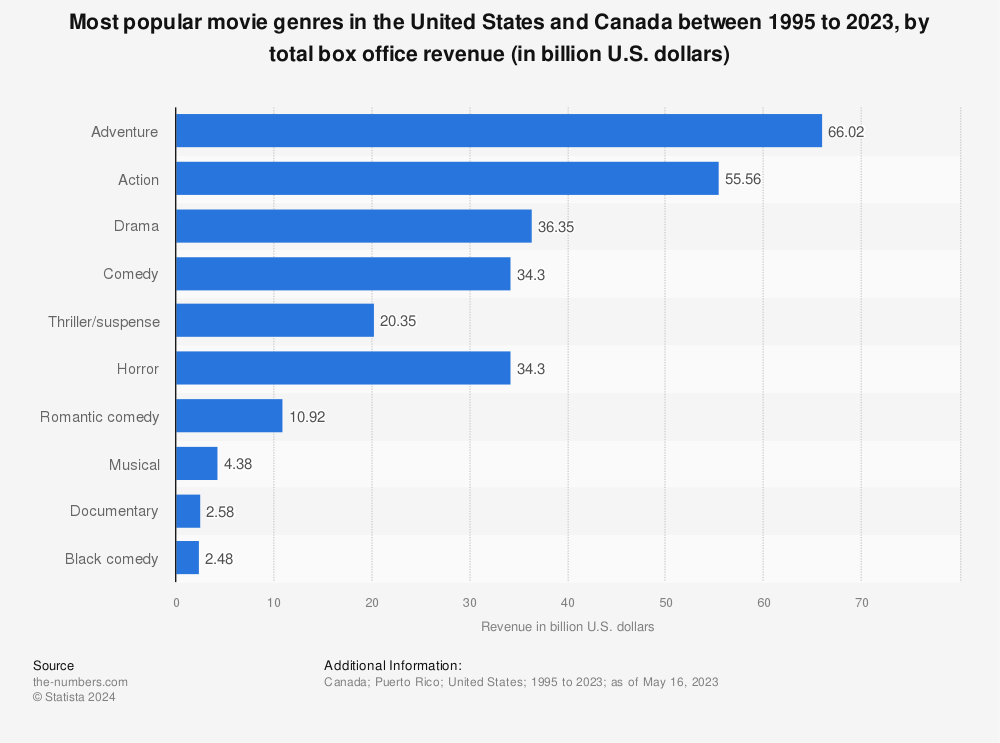
Not every movie has the merchandising potential of action films but they still have to pay careful attention to what audiences want to avoid having produced a run of flops and never get financing again.
That is not made any easier by the first law of Hollywood economics, which is nobody knows nothing. Audiences have a constant demand for novelty but they do not know what they want delay see it.
25 biggest grossing adjusted for inflation movies of all time in the USA
15 May 2016 Leave a comment
in economics of media and culture Tags: Hollywood economics
Good to see more than a few classics on this list including the epics of the early 1960s.
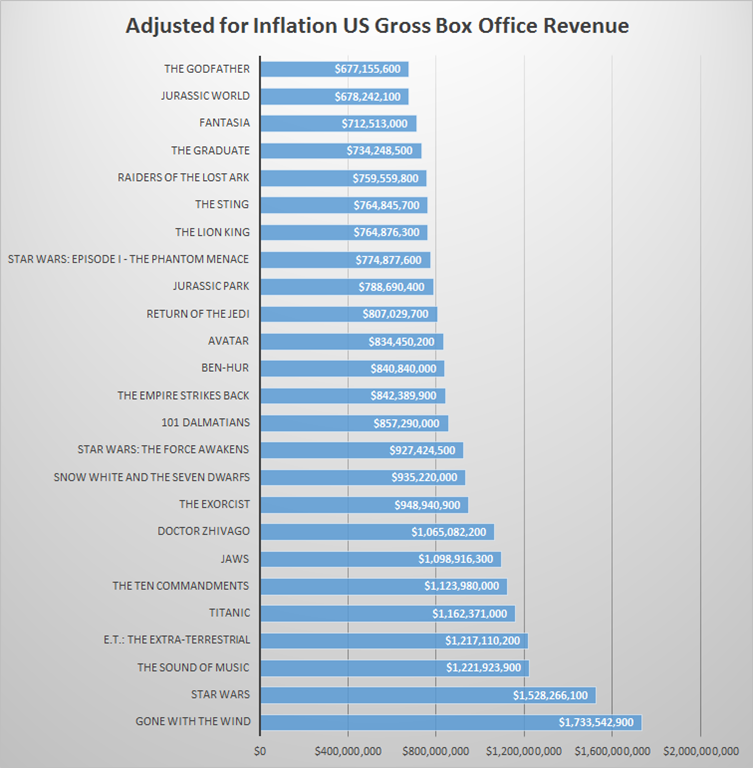
Source: Box Office Mojo, All Time Box Office Adjusted for Ticket Price Inflation.
The economics of Bollywood
10 May 2016 Leave a comment
in economics of media and culture, industrial organisation, survivor principle Tags: Hollywood economics
Picking winners and @stevenljoyce’s repayable grants to 11 more tech start-ups @JordNZ
13 Apr 2016 Leave a comment
in applied price theory, entrepreneurship, industrial organisation, politics - New Zealand, Public Choice, rentseeking, survivor principle Tags: corporate welfare, creative destruction, entrepreneurial alertness, Hollywood economics, industry policy, picking losers, picking winners
 Minister for Science and Innovation Steven Joyce picked a few more winners today. Eleven more start-up technology companies are to be funded $450,000 each in repayable loans to commercialise their technology. The loans are from Callaghan Innovation’s incubator network.
To cut a long diatribe short, I find these sums of money rather piddling. I have encountered this corporate welfare program before at a presentation.
My reaction then as is now: by handing out such small grants, some will succeed, some will fail. Importantly, there will never be one big disaster to bring the whole show down. There is political safety in diversification.

This is not the case with, for example, film subsidies. If Sir Peter Jackson and others finally produce a box office bomb, it will be all too glaring that the taxpayers backed a Hollywood loser with hundreds of millions of dollars. $500 million in subsidies in the case of Avatar.

By peppering small sums of money across the economy, there is no similar risk from this repayable grant scheme for the commercialisation of products.

Colour films were initially thought to be uncompetitive on cost grounds
12 Feb 2016 Leave a comment
in economic history, entrepreneurship, industrial organisation Tags: creative destruction, Hollywood economics
Screen actor demographics
07 Feb 2016 Leave a comment
in discrimination, gender, labour economics Tags: customer discrimination, employer discrimination, Hollywood economics, racial discrimination, sex discrimination
@TrevorMallard what next for #TPPANoWay? Repeal CER?
31 Jan 2016 Leave a comment
in economic history, international economics, International law, law and economics, politics - Australia, politics - New Zealand, Public Choice, television, TV shows Tags: CER, closer economic relations, Hollywood economics, ISDS, preferential trading agreements, rational irrationality, single market, TPPA, Twitter left

New Zealand filmmakers have used trade treaties to pry open access to foreign markets by challenging failures to honour promises of nondiscrimination in trade and investment in the Federal Court of Australia.
This should please the Twitter Left because they are also a film going left as are most members of the educated middle class as a point of identity and snobbery.
Back in the day, New Zealand television programming was sold cheaply into the Australian market. Many cultural and other products are exported into foreign markets and sold for whatever they can get above the price of shipping or digital transmission. What else explains all that rubbish on cable TV?
Under the Closer Economic Relations agreement that creates a single market between Australia and New Zealand, New Zealand made television programming content must be treated the same way as Australian content so it was included in their 50% local content rules for commercial television back from whenever I remember this story from.
There was a Federal Court of Australia case that ruled that New Zealand television programming was Australian content programming for the purposes of the relevant media regulations because of Closer Economic Relations.
From the late 1990s, with revival of the New Zealand film and television industry, New Zealand content was starting to flood the Australian market, especially in the off-season in the summer when stations were looking for cheap content to fill a low ratings period.
Naturally, this Kiwi invasion did not please the rent seeking Australian television programme production industry and many a mendicant actor, writer and producer
Where there is a will, where there is a way: minimum quality standards are introduced into the Australian content rules defined by price – a price that happen to be above what the television stations used to pay for New Zealand made programming in the off-season.
This court victory in favour of various New Zealand film industry in enforcing a trade and investment treaty puts the Twitter left in a bit of a conundrum. Which is more important? The New Zealand film industry or their hatred of globalisation and the rule of law.
Some films I mostly did not see
15 Jan 2016 Leave a comment
in economic history, economics of media and culture, movies Tags: blockbusters, Hollywood economics
What are movie tickets as expensive as in 1920?
19 Nov 2015 Leave a comment
in economic history, economics of media and culture Tags: creative destruction, Hollywood economics
Martin Scorsese Creates a List of 39 Essential Foreign Films for a Young Filmmaker
07 Nov 2015 Leave a comment
in movies Tags: Hollywood economics
Did the New Zealand film industry just eat our lunch? By Jason Potts
01 Nov 2015 Leave a comment
in applied price theory, economics of media and culture, fiscal policy, industrial organisation, job search and matching, labour economics, labour supply, macroeconomics, politics - Australia, politics - New Zealand, Public Choice, rentseeking, survivor principle Tags: film subsidies, Hollywood economics, industry policy, offsetting behaviour, The fatal conceit, The pretense to knowledge, unintended consequences

James Cameron is going to film the next three instalments of the Avatar franchise in New Zealand. He promises to spend at least NZ$500 million, employ thousands of Kiwis, host at least one red-carpet event, include a NZ promotional featurette in the Avatar DVDs, and will personally serve on a bunch of Film NZ committees, and probably even bring scones, all in return for a 25% rebate on any spending he and his team do in the country (up from a 20% baseline to international film-makers) that is being offered by the New Zealand Government.
The implication that many media reports are running with is that this is a loss to the Australian film industry, that we should be fighting angry, and that we should hit back at this brilliantly cunning move by the Kiwi’s by increasing our film industry rebates, which currently are about 16.5% (these include the producer and location offsets, and the post, digital and visual effects offset) to at very least 30%. These rebates cost tax-payers A$204 million in 2012, which hardly even buys you a car industry these days.
So what are the economics of this sort of industry assistance? Is this something we should be doing a whole lot more of? Was the NZ move to up the rebate especially brilliant? First, note that James Cameron has substantial property interests in New Zealand already, so this probably wasn’t as up for grabs as we might think. But if that’s how the New Zealand taxpayers want to spend their money, that’s up to them. The issue is should we follow suit?
The basic economics of this sort of give-away is the concept of a multiplier “”), which is the theory that an initial amount of exogenous spending becomes someone else’s income, which then gets spent again, creating more income, and so on, creating jobs and exports and all sorts of “economic benefits” along the way.
People who believe in the efficacy of Keynesian fiscal stimulus also believe in the existence of (>1) multipliers. Consultancy-based “economic impact” reports do their magic by assuming greater-than-one multipliers (or equivalently, a high marginal propensity to consume coupled with lots of dense sectoral linkages). With a multiplier greater than one, all government spending is magically transformed into “investment in Australian jobs”.
So the real question is: are multipliers actually greater-than-one? That’s an empirical question, and the answer is mostly no. (And if you don’t believe my neoliberal bluster, the progressive stylings of Ben Eltham over at Crikey more or less make the same point.)
But to get this you have to do the economics properly, and not just count the positive multipliers, but also account for the loss of investment in other sectors that didn’t take place because it was artificially re-directed into the film sector, which no commissioned impact study ever does.
This is why economists have a very low opinion of economic impact studies, which are to economics what astrology is to physics.
What does make for a good domestic film industry then? Look again at New Zealand, and look beyond the great Weta Studios in Wellington, for Australia and Canada both have world-class production studios and post-production facilities. Look beyond New Zealand’s natural scenery, for Vancouver is an easy match for New Zealand and Australia pretty much defines spectacular.
No, the simple comparison is that New Zealand is about 20% cheaper than Australia and 30% cheaper than Canada. New Zealand has lower taxes, easy employment conditions and relatively light regulations (particularly around insurance and health and safety). It’s just easier to get things done there.
If Australia really wants to boost its film industry, it might look more closely at labour market restrictions (including minimum wages) and regulatory burden and worry less about picking taxpayer pockets and bribing foreigners.
This article was originally published on The Conversation in December 2013. Read the original article. Republished under the a Creative Commons Attribution No Derivatives licence.
Creative destruction in cable TV
01 Oct 2015 Leave a comment
in economics of media and culture, entrepreneurship, industrial organisation, survivor principle Tags: cable TV, creative destruction, economics of television, Hollywood economics
Google wants to break the grip cable and satellite-TV companies have over the set-top box bloom.bg/1GbGDqz http://t.co/zGj4OBTzq3—
Bloomberg Business (@business) September 29, 2015
 Utopia, you are standing in it!
Recent Comments