Ideological segregation in the media
16 Mar 2018 Leave a comment
in applied price theory, economics of media and culture, industrial organisation, survivor principle Tags: information cocoons, infotopia, media bias
Are we all living in ideologically walled-off media gardens
29 Mar 2016 Leave a comment
in economics, economics of media and culture Tags: infotopia
@NZGreens are so polite on Twitter @MaramaDavidson @RusselNorman @greencatherine
12 Sep 2015 1 Comment
in comparative institutional analysis, constitutional political economy, economics of media and culture, liberalism, managerial economics, organisational economics Tags: Cass Sunstein, Daily Me, information cocoons, infotopia, John Stuart Mill, Karl Popper, New Zealand Greens, Twitter, Twitter left
One of the first things I noticed when feuding on Twitter with Green MPs was how polite they were. Twitter is not normally known for that characteristic and that is before considering the limitations of 144 characters. People who are good friends and work together will go to war over email without any space limitations for the making an email polite and friendly. Imagine how easy it is to misconstrue the meaning and motivations of tweets that can only be 144 characters.

The New Zealand Green MPs in their replies on Twitter make good points and ask penetrating questions that explain their position well and makes you think more deeply about your own. Knowledge grows through critical discussion, not by consensus and agreement.

Cass Sunstein made some astute observations in Republic.com 2.0 about how the blogosphere forms into information cocoons and echo chambers. People can avoid the news and opinions they don’t want to hear.
Sunstein has argued that there are limitless news and information options and, more significantly, there are limitless options for avoiding what you do not want to hear:
- Those in search of affirmation will find it in abundance on the Internet in those newspapers, blogs, podcasts and other media that reinforce their views.
- People can filter out opposing or alternative viewpoints to create a “Daily Me.”
- The sense of personal empowerment that consumers gain from filtering out news to create their Daily Me creates an echo chamber effect and accelerates political polarisation.
A common risk of debate is group polarisation. Members of the deliberating group move toward a more extreme position relative to their initial tendencies! How many blogs are populated by those that denounce those who disagree? This is the role of the mind guard in group-think.
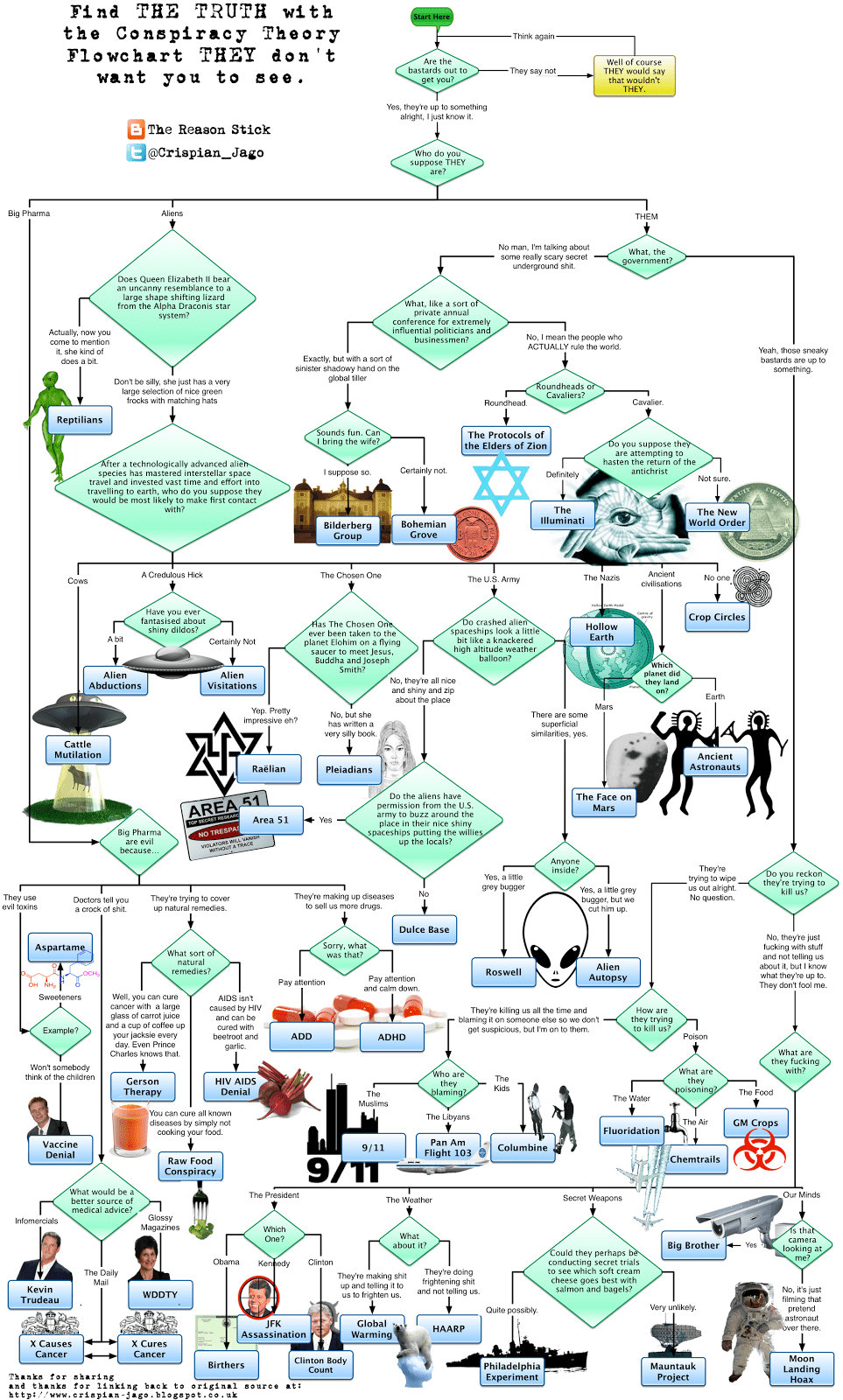
Sunstein in Infotopia wrote about how people use the Internet to spend too much time talking to those that agree with them and not enough time looking to be challenged:
In an age of information overload, it is easy to fall back on our own prejudices and insulate ourselves with comforting opinions that reaffirm our core beliefs. Crowds quickly become mobs.
The justification for the Iraq war, the collapse of Enron, the explosion of the space shuttle Columbia–all of these resulted from decisions made by leaders and groups trapped in “information cocoons,” shielded from information at odds with their preconceptions. How can leaders and ordinary people challenge insular decision making and gain access to the sum of human knowledge?
Conspiracy theories had enough momentum of their own before the information cocoons and echo chambers of the blogosphere gained ground.

J.S. Mill pointed out that critics who are totally wrong still add value because they keep you on your toes and sharpened both your argument and the communication of your message. If the righteous majority silences or ignores its opponents, it will never have to defend its belief and over time will forget the arguments for it.
As well as losing its grasp of the arguments for its belief, J.S. Mill adds that the majority will in due course even lose a sense of the real meaning and substance of its belief. What earlier may have been a vital belief will be reduced in time to a series of phrases retained by rote. The belief will be held as a dead dogma rather than as a living truth.
Beliefs held like this are extremely vulnerable to serious opposition when it is eventually encountered. They are more likely to collapse because their supporters do not know how to defend them or even what they really mean.

J.S. Mill’s scenarios involves both parties of opinion, majority and minority, having a portion of the truth but not the whole of it. He regards this as the most common of the three scenarios, and his argument here is very simple. To enlarge its grasp of the truth, the majority must encourage the minority to express its partially truthful view. Three scenarios – the majority is wrong, partly wrong, or totally right – exhaust for Mill the possible permutations on the distribution of truth, and he holds that in each case the search for truth is best served by allowing free discussion.

Mill thinks history repeatedly demonstrates this process at work and offered Christianity as an illustrative example. By suppressing opposition to it over the centuries Christians ironically weakened rather than strengthened Christian belief. Mill thinks this explains the decline of Christianity in the modern world. They forgot why they were Christians.
The Antiscience Left and GMOs
05 Sep 2015 Leave a comment
in health economics, politics - Australia, politics - New Zealand, politics - USA Tags: agricultural economics, antiscience left, conjecture and refutation, conspiracy theories, conspiracy theorists, creative destruction, GMOs, infotopia, risk risk trade-offs
Rather common on the University of the Internet
13 Jul 2015 Leave a comment
in economics of media and culture Tags: information cocoons, infotopia
The revised Maslow’s hierarchy of needs
04 Jul 2015 Leave a comment
in economics of media and culture Tags: infotopia
HL Mencken on the Harmful Digital Communication Bill
26 Jun 2015 Leave a comment
in applied price theory, applied welfare economics, comparative institutional analysis, constitutional political economy, economics of crime, economics of media and culture, economics of regulation, law and economics, liberalism, politics - New Zealand, Public Choice Tags: chilling effect, disorderly conduct, free speech, infotopia, Internet trolls, meddlesome preferences, nanny state, offsetting behaviour, The fatal conceit, The pretence to knowledge, unintended consequences
Political discussions on Facebook
25 Jun 2015 Leave a comment
in economics of media and culture Tags: conjecture and refutation, echoed chambers, Facebook, infotopia
Irrational nonsense mapped
12 Jun 2015 Leave a comment
in health economics, liberalism, politics - Australia, politics - New Zealand, politics - USA Tags: anti-vaccination movement, antifluoridation movement, antiscience left, BlackBerry, conjecture and refutation, conspiracy theories, conspiracy theorists, expressive voting, infotopia, rational ignorance, rational irrationality
The University of the Internet summed up
03 May 2015 Leave a comment
in economics of information, economics of media and culture, environmental economics Tags: conjecture and refutation, information overload, infotopia
The science news cycle
02 May 2015 Leave a comment
in economics of information, economics of media and culture Tags: conjecture and refutation, conspiracy theories, infotainment, infotopia, media buyers
People do lots of different things when online
01 May 2015 Leave a comment
in economics of media and culture Tags: infotopia

 Utopia, you are standing in it!
Recent Comments