Inside North Korea’s bubble in Japan
02 Nov 2017 Leave a comment
in international economics, International law Tags: Japan, North Korea
Why Japan has so many vending machines
28 Sep 2017 Leave a comment
in economics of media and culture Tags: Japan
The Weirdest JAPANESE OBSESSIONS (You Won’t Believe)
05 Sep 2017 Leave a comment
in economics of media and culture Tags: Japan
I didn’t bring business cards to Japan. Big mistake.
02 Jun 2017 Leave a comment
in managerial economics Tags: Japan
Most Streets in Japan Don’t Have Names
27 May 2017 Leave a comment
in economics, economics of media and culture Tags: Japan

Japanese spa offers the option of a back massage from a cat
13 Feb 2017 Leave a comment
in cats, entrepreneurship Tags: Japan
Most Streets in Japan Don’t Have Names
12 Jan 2017 Leave a comment
in economics of media and culture Tags: Japan
How did Germany and Japan achieve record economic growth following World War II?
08 Nov 2016 Leave a comment
in applied price theory, development economics, economic growth, economics of natural disasters, growth miracles, macroeconomics Tags: convergence, Germany, Japan
Top 10 Strange Things About Japan That Baffle Foreigners
06 Oct 2016 Leave a comment
in economics of media and culture Tags: Japan
Gap in GDP per Australian, Canadian, French, German, Japanese, New Zealander and British hour worked with the USA
28 May 2016 Leave a comment
in economic growth, economic history, labour economics, labour supply, macroeconomics, politics - Australia, politics - New Zealand, politics - USA, public economics Tags: Australia, British economy, Canada, Eurosclerosis, France, Germany, Japan, labour productivity, measurement error, taxation and labour supply
This data tells more of a story than I expected. Firstly, New Zealand has not been catching up with the USA. Japan stopped catching up with the USA in 1990. Canada has been drifting away from the USA for a good 30 years now in labour productivity.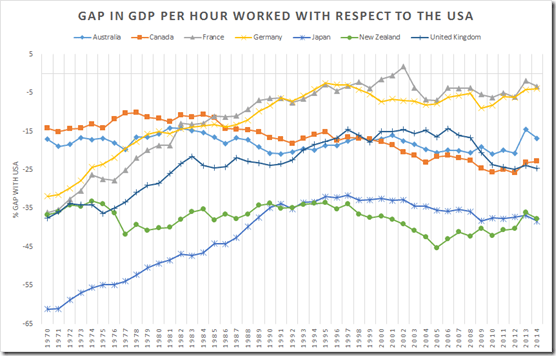
Data extracted on 28 May 2016 05:15 UTC (GMT) from OECD.Stat from OECD Compendium of Productivity Indicators 2016 – en – OECD.
Australia has not been catching up with the USA much at all since 1970. It has maintained a pretty consistent gap with New Zealand despite all the talk of a resource boom in the Australia; you cannot spot it in this date are here.
Germany and France caught up pretty much with the USA by 1990. Oddly, Eurosclerosis applied from then on terms of growth in income per capita.
European labour productivity data is hard to assess because their high taxes lead to a smaller services sector where the services can be do-it-yourself. This pumps up European labour productivity because of smaller sectors with low productivity growth.


Recent Comments