
My letter to @ DomPost on trolly buses
03 Nov 2017 Leave a comment
in economics of natural disasters, health and safety, labour economics, television Tags: killer green technologies
Killer green technologies alert: downed trolley bus wires
29 Apr 2017 Leave a comment
in energy economics, environmental economics, global warming, politics - New Zealand, transport economics Tags: buses, expressive voting, killer green technologies, New Zealand Greens, precautionary principle, rational rationality
A car would not swerved towards us and we would not have driven under downed trolley bus wires if it were not for this green fetish. The swerving car distracted me from noticing that the trolley bus wires were hanging low above it on a dull Wellington Day

This enormously expensive way of running public transport in Wellington is already killed bus drivers when they are out on the road putting in the polls back up to the wires. Today, we were put at risk of electrocution.
New Zealand’s 16 flightless birds should count themselves lucky
13 May 2016 Leave a comment
in energy economics, environmental economics Tags: endangered specie, expressive voting, green hypocrisy, killer green technologies, Left-wing hypocrisy, rational irrationality, wind power
Foodborne Illness and Plastic Bag Bans
18 Jul 2015 Leave a comment
in economics of regulation, health economics Tags: antimarket bias, expressive voting, killer green technologies, meddlesome preferences, nanny state, plastic bag bans, plastic bags, rational ignorance, rational irrationality
Electric cars are a killer green technology
14 May 2015 Leave a comment
in energy economics, environmental economics, global warming Tags: electric cars, killer green technologies
Wind power is bad for the environment
07 Apr 2015 Leave a comment
in environmental economics, global warming Tags: climate alarmism, endangered species, green hypocrisy, killer green technologies
Many more birds to be incinerated as solar energy becomes cost competitive; climate alarmists face mass layoffs
13 Mar 2015 Leave a comment
in energy economics, environmental economics, global warming Tags: climate alarmism, creative destruction, global warming, killer green technologies, solar power

Unsubsidized rooftop solar electricity costs anywhere between $0.13 and $0.23/kWh today, well below retail price of electricity in many markets globally.
The economics of solar have improved significantly due to the reduction in solar panel costs, financing costs and balance of system costs. We expect solar system costs to decrease 5-15% annually over the next 3+ years which could result in grid parity within ~50% of the target markets.
If global electricity prices were to increase at 3% per year and cost reduction occurred at 5-15% CAGR, solar would achieve grid parity in an additional ~30% of target markets globally. We believe the cumulative incremental total available market for solar is currently around ~140GW/year and could potentially increase to ~260GW/year over the next 5 years as solar achieves grid parity in more markets globally and electric capacity needs increase…
solar system costs have declined at ~15% CAGR over the past 8 years and we expect 40% cost reduction over the next 4-5 years as a solar module costs continue to decline, panel efficiencies gradually improve, balance of system costs decline due to scale and competition, global financing costs decline due to development of new business models and customer acquisition costs decline as a result of increasing customer awareness and more seamless technology adoption enabled by storage solutions…
oil represents only about 5% of global electricity production and in some of the important solar markets such as US, China, oil based electricity generation is less than 5% of the total. Moreover, the cost of oil based electricity generation even at $50 oil prices is the 7-9c/kWh range and as shown in the note, the marginal cost is higher than solar in many regions worldwide. Bottom line is that oil prices do not have a material impact on solar demand.

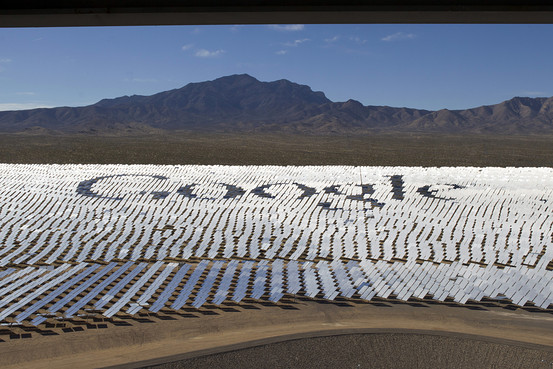
About the only losers from this creative destruction in energy production, aside from the tens of thousands of public officials, academics and NGO employees who jobs and research grants depend up climate alarmism, are the birds that happen to fly past these solar power stations and are incinerated.

via Deutsche Bank’s 2015 solar outlook: accelerating investment and cost competitiveness – Deutsche Bank Responsibility and Deutsche Bank report: Solar grid parity in a low oil price era – Deutsche Bank Responsibility.
Killer green technologies alert – electric cars
25 Feb 2015 Leave a comment
in environmental economics, global warming, health economics Tags: electric cars, killer green technologies
Killer green technologies alert: wind farms kill protected endangered species
23 Jan 2015 Leave a comment
in energy economics, environmental economics Tags: activists, endangered species, expressive voting, green hypocrisy, killer green technologies, Leftover Left, rational ignorance, rational irrationality, windfarms


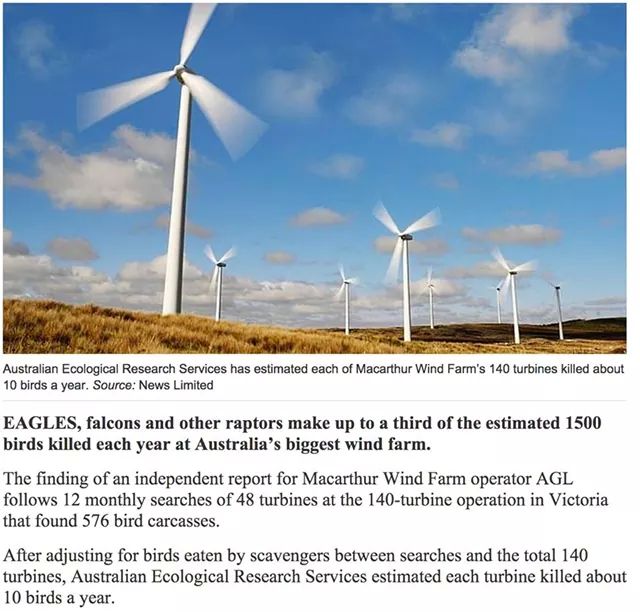
Killer green technologies alert: wind farms ‘kill confused bats’:
02 Oct 2014 Leave a comment
in environmental economics, global warming Tags: endangered species, global warming, green hypocrisy, killer green technologies

Over 600,000 bats were killed by wind turbines in the United States in 2012 including endangered species.
via Wind farms ‘kill confused bats’: Turbines are deadly to the animals as they create same air currents as trees, so they fly too close | Daily Mail Online.
I knew it: killer green technologies alert – reusable grocery bags can kill (unless washed)
20 Sep 2014 1 Comment
in environmentalism, health economics Tags: do gooders, environmental movement, killer green technologies, offsetting behaviour, recycling, reusable grocery bags, unintended consequences
Reusable grocery bags often carry raw meat and are stored for convenience in the trunk of cars that sit outside in the sun. Reusable grocery bags are friendly breeding environment for E. coli bacteria, which can cause severe illness and death.
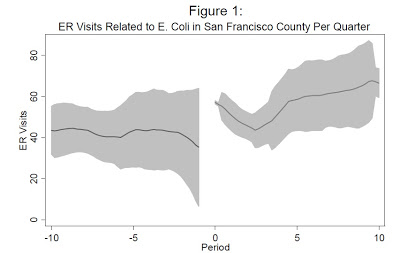
The above figure shows the number of emergency room visits in San Francisco County related to E. coli for the 10 quarters before and after the reusable grocery bags enactment of the ordinance: zero on the horizontal axis is the date the ordinance went into effect. The shaded area around the line is a 95% statistical confidence interval. There is a discontinuous jump in the number of emergency room visits immediately after the reusable grocery bags ordinance was enacted.
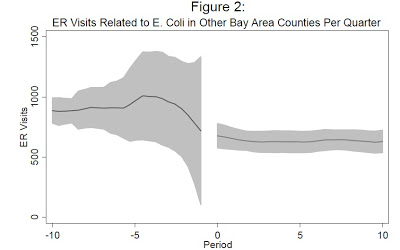
San Francisco experiences about 12 deaths per year from intestinal infections, and that the restrictions on plastic bags probably let to another 5-6 deaths per year in that city and several dozen additional hospitalisations.
 Utopia, you are standing in it!
Recent Comments