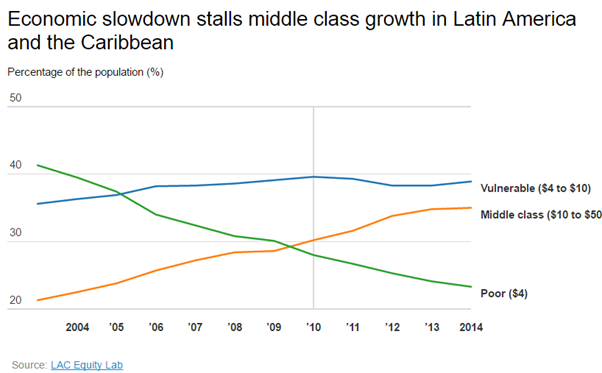
Source: World Bank Economic slowdown puts the brakes on middle class growth in Latin America | The Data Blog
Celebrating humanity's flourishing through the spread of capitalism and the rule of law
30 May 2016 Leave a comment
in development economics, economic history, growth disasters, growth miracles Tags: Latin America, The Great Escape, Withering away of the proletariat
Source: World Bank Economic slowdown puts the brakes on middle class growth in Latin America | The Data Blog
08 Apr 2016 Leave a comment
in development economics, economic history, growth disasters, growth miracles Tags: extreme poverty, global poverty, Latin America
07 Mar 2016 Leave a comment
in development economics, economic history, growth disasters, growth miracles Tags: Latin America
19 Dec 2015 1 Comment
in applied welfare economics, development economics, economic history, growth disasters, growth miracles Tags: Latin America, The Great Enrichment, The Great Fact
In early 2000s more than 40% of Latin Americans lived on less than $4 a day. What about now? wrld.bg/OK6J6 http://t.co/iEZm030rj6—
World Bank Poverty (@WBG_Poverty) June 25, 2015
29 May 2015 1 Comment
in international economics Tags: Argentina, Greece, international economic law, Latin America, sovereign defaults
#Dailychart: Nine of the top ten sovereign debt defaulters are from Latin America econ.st/UDi8B1 http://t.co/s0jb2yh5PN—
The Economist (@ECONdailycharts) July 31, 2014
13 May 2014 Leave a comment
in development economics, Gary Becker, politics, Public Choice Tags: crony capitalism, Latin America
One legitimate reason for the opposition to capitalism in Latin America is that it frequently has been "crony capitalism" as opposed to the competitive capitalism that produces desirable social outcomes.
Crony capitalism is a system where companies with close connections to the government gain economic power not by competing better, but by using the government to get favoured and protected positions.
These favours include monopolies over telecommunications, exclusive licenses to import different goods, and other sizeable economic advantages. Some cronyism is found in all countries, but Mexico and other Latin countries have often taken the influence of political connections to extremes.
…The excesses of cronyism have provided ammunition to parties of the left that are openly hostile to capitalism and neo-liberal policies. Yet when these parties come to power they usually do not reduce the importance of political influence but shift power to groups that support them.
…Leftist ideologies take advantage of the discontent this causes among intellectuals and the poor, and promise a redistribution of assets and better education opportunities for the poor.
Promises of redistribution have figured prominently in the speeches of Chavez, Lula, Morales, Peronists in Argentina, and Andres Manuel Lopez Obrador, former mayor of Mexico City and a leading candidate to be Mexico’s next president.
When it is discovered that left wing governments usually do not end up helping the poor very much, they tend to be voted out of office.
… The overall trend during the past several decades in practically all countries of this region has been toward more open economies with greater competition within industries, with much more reliance on private enterprise, and with a reduced role for government mandates, government-run enterprises, and cronyism.
Since these policies have provided greater benefits to all classes than the socialist policies of a Fidel Castro or a Hugo Chavez, the vast majority of people that live under such leaders will be, or in Cuba have been, disappointed by the unfulfilled promises. They are likely to come back to parties that support more market policies as long as free elections are preserved.
Gary Becker 2006
Celebrating humanity's flourishing through the spread of capitalism and the rule of law
Scholarly commentary on law, economics, and more
Beatrice Cherrier's blog
Celebrating humanity's flourishing through the spread of capitalism and the rule of law
Celebrating humanity's flourishing through the spread of capitalism and the rule of law
Celebrating humanity's flourishing through the spread of capitalism and the rule of law
Why Evolution is True is a blog written by Jerry Coyne, centered on evolution and biology but also dealing with diverse topics like politics, culture, and cats.
Celebrating humanity's flourishing through the spread of capitalism and the rule of law
Celebrating humanity's flourishing through the spread of capitalism and the rule of law
A rural perspective with a blue tint by Ele Ludemann
DPF's Kiwiblog - Fomenting Happy Mischief since 2003
Celebrating humanity's flourishing through the spread of capitalism and the rule of law
The world's most viewed site on global warming and climate change
Tim Harding's writings on rationality, informal logic and skepticism
A window into Doc Freiberger's library
Let's examine hard decisions!
Commentary on monetary policy in the spirit of R. G. Hawtrey
Thoughts on public policy and the media
Celebrating humanity's flourishing through the spread of capitalism and the rule of law
Politics and the economy
A blog (primarily) on Canadian and Commonwealth political history and institutions
Reading between the lines, and underneath the hype.
Economics, and such stuff as dreams are made on
"The British constitution has always been puzzling, and always will be." --Queen Elizabeth II
Celebrating humanity's flourishing through the spread of capitalism and the rule of law
Celebrating humanity's flourishing through the spread of capitalism and the rule of law
WORLD WAR II, MUSIC, HISTORY, HOLOCAUST
Undisciplined scholar, recovering academic
Celebrating humanity's flourishing through the spread of capitalism and the rule of law
Res ipsa loquitur - The thing itself speaks
Celebrating humanity's flourishing through the spread of capitalism and the rule of law
Researching the House of Commons, 1832-1868
Articles and research from the History of Parliament Trust
Reflections on books and art
Posts on the History of Law, Crime, and Justice
Celebrating humanity's flourishing through the spread of capitalism and the rule of law
Exploring the Monarchs of Europe
Cutting edge science you can dice with
Small Steps Toward A Much Better World
“We do not believe any group of men adequate enough or wise enough to operate without scrutiny or without criticism. We know that the only way to avoid error is to detect it, that the only way to detect it is to be free to inquire. We know that in secrecy error undetected will flourish and subvert”. - J Robert Oppenheimer.
The truth about the great wind power fraud - we're not here to debate the wind industry, we're here to destroy it.
Celebrating humanity's flourishing through the spread of capitalism and the rule of law
Celebrating humanity's flourishing through the spread of capitalism and the rule of law
Economics, public policy, monetary policy, financial regulation, with a New Zealand perspective
Celebrating humanity's flourishing through the spread of capitalism and the rule of law
Restraining Government in America and Around the World

 Utopia, you are standing in it!
Recent Comments