CHART: US average airfares 1979 to 2014 measured in number of hours work at the average wage. @chartoftheday http://t.co/q7Phz3VkU0—
Mark J. Perry (@Mark_J_Perry) August 02, 2015
The Left opposed airline deregulation
05 Aug 2015 Leave a comment
in applied price theory, applied welfare economics, comparative institutional analysis, economic history, economics of regulation, entrepreneurship, income redistribution, industrial organisation, politics - Australia, politics - New Zealand, politics - USA, Public Choice, rentseeking, survivor principle Tags: airline deregulation, antimarket bias, bootleggers and baptists, expressive voting, Leftover Left, rational ignorance, rational irrationality
Feuding with the Left over Left again @gtiso @helenkellyCTU
03 Aug 2015 Leave a comment
in economic history, politics - New Zealand Tags: antimarket bias, expressive voting, Leftover Left, lost decades, rational ignorance, rational irrationality, Twitter left
Is the Left liberal?
03 Aug 2015 Leave a comment
in liberalism, Marxist economics Tags: Left-wing hypocrisy, Leftover Left, meddlesome preferences, nanny state, progressive left
The fates of two islands under constant threat from a neighbouring military colossus
01 Aug 2015 Leave a comment
in applied price theory, applied welfare economics, Austrian economics, comparative institutional analysis, constitutional political economy, development economics, economics of media and culture, economics of regulation, growth disasters, growth miracles, income redistribution, industrial organisation, law and economics, liberalism, Marxist economics, property rights, Public Choice, rentseeking, survivor principle Tags: anticapitalist mentality, antimarket bias, capitalism and freedom, China, Cuba, expressive voting, Hong Kong, Leftover Left, public intellectuals, rational ignorance, rational irrationality, Twitter left
Trigger warning for the Twitter Left
31 Jul 2015 Leave a comment
in applied price theory, applied welfare economics, constitutional political economy, income redistribution, politics - Australia, politics - New Zealand, politics - USA, Public Choice, public economics, rentseeking Tags: antimarket bias, endogenous growth theory, expressive voting, laffer curve, Leftover Left, taxation and entrepreneurship, taxation and human capital, taxation and investment, taxation and the labour supply, top 1%, Twitter left
I thought America’s poor never had health insurance cover!? I’ve watched too much American TV?
26 Jul 2015 1 Comment
in applied welfare economics, economic history, economics of media and culture, health economics, industrial organisation, politics - USA, Public Choice, rentseeking, survivor principle Tags: adverse selection, expressive voting, health insurance, Leftover Left, media bias, medicaid, Medicare, moral hazard, Obamacare, rational ignorance, rational irrationality
#Medicaid expands access to health coverage and supports work: bit.ly/1RKHQ2x #Medicaidat50 http://t.co/mydZMggcXg—
Center on Budget (@CenterOnBudget) July 20, 2015
6.4 million seniors get the vital support & care they need thanks to Medicaid: bit.ly/1HqYvNG #Medicaidat50 http://t.co/onWMiYj301—
Center on Budget (@CenterOnBudget) July 23, 2015
Reminder: #Medicaid helps millions of babies: bit.ly/1RS7ME5 #Medicaidat50 http://t.co/SeJ7MFPGWE—
Center on Budget (@CenterOnBudget) July 20, 2015
#Medicaid help millions of children across the country live healthier lives. #Medicaidat50: bit.ly/1RS7ME5 http://t.co/LT6rXhNzUg—
Center on Budget (@CenterOnBudget) July 16, 2015
50 years of coverage that every American deserves. #Medicare http://t.co/uRtERV2k9K—
American Progress (@amprog) July 30, 2015
Mann: Celebrating historic gains in coverage for kids CCF#2015 http://t.co/g7CYQ7DuwN—
Georgetown CCF (@GeorgetownCCF) July 22, 2015
#Medicare has been keeping seniors insured and healthy for 50 years. http://t.co/mXW4x12Rhi—
American Progress (@amprog) July 30, 2015
The majority of Americans of all ages don't recognize that gov subsidizes their health care: vox.com/2015/3/1/81257… http://t.co/ivq5eLThsi—
(@SocImages) April 22, 2015
When I worked at Marxism Today, my desire to earn a living proved to be somewhat déclassé.
26 Jul 2015 Leave a comment
in economics of crime, labour economics, law and economics, Marxist economics, minimum wage, poverty and inequality Tags: far left, Labour standards, Left-wing hypocrisy, Leftover Left, living wage, progressive left

The essence of the antiscience Left
26 Jul 2015 Leave a comment
in economics of regulation, energy economics, environmental economics, health economics Tags: anti-GMOs movement, anti-vaccination movement, antimarket bias, antiscience left, cranks, GMOs, Leftover Left, precautionary principle, quackery
@patcondell on how to insult a progressive
26 Jul 2015 Leave a comment
in liberalism Tags: Leftover Left, Pat Condell, progessive left
why Labour members think they lost and why voters think they did
25 Jul 2015 Leave a comment
Fascinating. Yawning chasm between why Labour members think they lost and why voters think they did. From @thetimes http://t.co/MvhZYI2CTr—
Joe Watts (@JoeWatts_) July 23, 2015
@Income_Equality there’s an Internet you know – was there next to no unemployment prior to the mid-1980s in New Zealand?
24 Jul 2015 Leave a comment
in business cycles, econometerics, economic growth, economic history, job search and matching, labour economics, labour supply, macroeconomics, politics - New Zealand, Public Choice, unemployment, unions, welfare reform Tags: antimarket bias, Don Brash, economic reform, expressive voting, Homer Simpson, Leftover Left, lost decades, makework bias, neoliberalism, rational ignorance, rational irrationality, Sir Roger Douglas, Twitter left
Today, Closing The Gap – The Income Inequality Project boldly claimed today that there was next to no unemployment in New Zealand prior to the onset of the curse of neoliberalism.

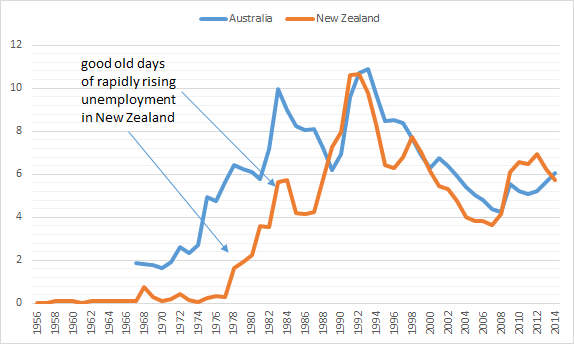
There is an Internet on computers now where it is easy to find data showing that the unemployment rate was rising rapidly in New Zealand in the 1970s and in double digits by the end of the 1980s – see figure 1.
Figure 1: harmonised unemployment rates, Australia and New Zealand, 1956-2014
Source: OECD StatExtract.
Figure 1 shows unemployment was rising rapidly in the 1970s and wasn’t much different by the end of the 1970s to the unemployment rates recorded after about 2000 in New Zealand.

One of the reasons that Sir Roger Douglas wrote There’s Got To Be A Better Way was the rapidly rising unemployment in New Zealand and the stagnant economic growth in the late 1970s and early 1980s.

New Zealand was one of the most regulated economies, so much so that Prime Minister David Lange said:
We ended up being run very similarly to a Polish shipyard.
As for those jobs on the railways, the then Reserve Bank Governor Don Brash said in 1996:
Railways cut its freight rates by 50 percent in real terms between 1983 and 1990, reduced its staff by 60 percent, and made an operating profit in 1989/90, the first for six years.
More on unemployment: In 1955 the New Zealand’s prime minister knew all unemployed personally.
– Atkinson’s new book http://t.co/x37Vxya97C—
Max Roser (@MaxCRoser) July 24, 2015
Some of the kidnapped ODA activists have been freed and can speak out at last!
23 Jul 2015 Leave a comment
in development economics, economic history, growth disasters, growth miracles, Marxist economics Tags: activists, anticapitalist mentality, antiforeign bias, antimarket bias, do gooders, expressive voting, Left-wing hypocrisy, Leftover Left, mass kidnappings, ODA, overseas aid, rational ignorance, rational irrationality, The Guardian
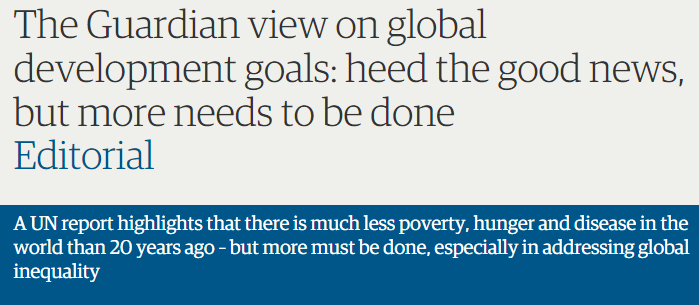
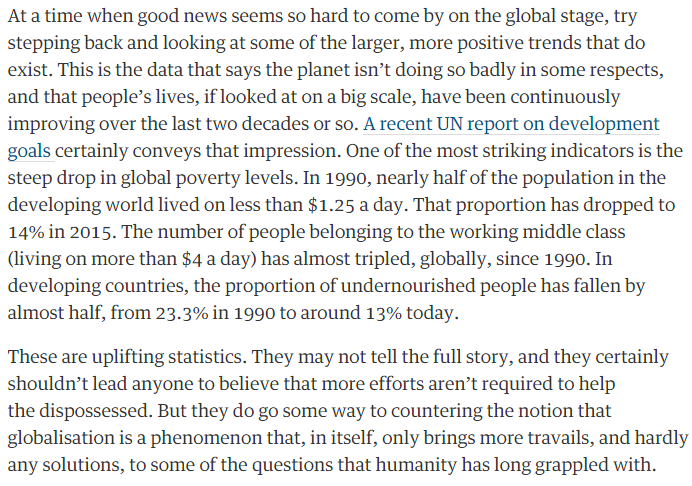
The role of the spread of capitalism and globalisation in massively reducing extreme poverty just gets a mention, begrudgingly, but it’s better than nothing From a newspaper of record of the Left over Left.
@jeremycorbyn should welcome #toriesforcorbyn as shy Labour voters coming home to the long-awaited hard left policies
23 Jul 2015 1 Comment
in constitutional political economy, Marxist economics, Public Choice Tags: British Labour Party, British politics, expressive voting, Leftover Left, rational irrationality, shy Labour voters

Jeremy Corbyn has done it. The working hypothesis of the far left everywhere is if the Labour Party were to adopt hard left policies, they would win many more votes.

The new votes include shy Labour voters parking their vote with the Tory party pending the call home to a true Labour Party.

They are parking their votes with other parties because they are fed up with a middle of the road Labour Party, such as the Blairite Labour Party. They are withholding their vote as punishment until the Labour Party returns to its roots and adopts hard left policies.
Our vision is of an economy that works for all, provides opportunity for all and invests in all. #jeremy4leader http://t.co/59Gk9AN7Xf—
JeremyCorbyn4Leader (@Corbyn4Leader) July 22, 2015
Rather than accept that their day has come, the left of the Labour Party is deeply suspicious of Tory party supporters wanting to join the Labour Party in anticipation of voting in hard left leadership in their current leadership election. What’s going on?

What seems to terrify the Labour Party is its old dream coming true: a large number of Tory party voters switching their support to Labour and joining the Labour Party because it might adopt hard left policies and a hard left leader who makes Michael Foot look like a pussycat.
Labour party members, please think before you vote for Jeremy Corbyn gu.com/p/4aqvd/stw http://t.co/U5hz02ahgd—
Comment is free (@commentisfree) July 22, 2015
What is more jarring than the fear of the Labour Left having its dreams come true is the Left of the British Labour is not showing against any insight into the genuine enthusiasm that the Tory party has for Jeremy Corbyn winning the election as leader of the Labour Party
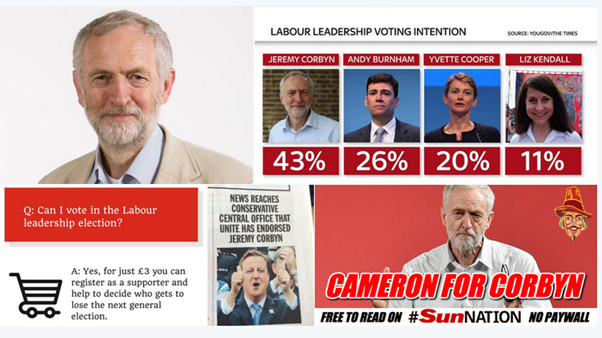
There is no misdirection here or double play. The Tory party wants Jeremy Corbyn to be elected leader of the Labour Party.
Time for a re-run of this classic? http://t.co/Pwqyn00cQo—
James Bartholomew (@JGBartholomew) April 14, 2015
The Liberal Democratic party must see their resurrection coming in the form of Jeremy Corbyn as do UKIP in terms of making inroads into working-class labour electorates.

There are left-wing and fairly left-wing people who do vote for the Tory party and the LDP, but there’s not that many of them, and overall they only make up about 15% of the British electorate, and a small part of the left-wing vote not voting for left-wing parties.
It would seem more reasonable to follow the median voter theorem and go for those in the centre because there are plenty of them and only minor modifications of your platform are required to win their votes.
Anti-establishment candidate with fringe views draws huge crowds in sure-fire guarantee of electoral success http://t.co/P7waxqUXrR—
Alex Wickham (@WikiGuido) August 03, 2015
Why is the far left chasing with these shy Labour voters when there are plenty more middle of the road voters willing to vote for them in 2015 in the right circumstance?
…while the average UKIP or Tory voter is well to the right of Labour there are many Conservative and UKIP supporters who are in the centre ground and whose votes Miliband cannot afford to write off. For example, nearly four in ten UKIP supporters and 16% of Conservative voters place themselves on the centre point or to the left of centre.
The 35 heroes of #toriesforcorbyn
23 Jul 2015 Leave a comment
in constitutional political economy, Marxist economics, Public Choice Tags: British Labour Party, British politics, Leftover Left
MPs nominations for Leader of the Labour Party – 35 MPs required
| Burnham – 68 |
Cooper – 56 |
Corbyn – 35 |
Kendall – 40 |
|
Ian Lavery |
Jess Phillips |
Jon Trickett |
Tristram Hunt |
|
Steve Rotheram |
Diana Johnson |
Clive Lewis |
Phil Wilson |
|
Rachel Reeves |
Khalid Mahmood |
John McDonnell |
Stephen Timms |
|
Dan Jarvis |
Sharon Hodgson |
Michael Meacher |
John Woodcock |
|
Michael Dugher |
David Hanson |
Ronnie Campbell |
Mike Gapes |
|
Debbie Abrahams |
Shabana Mahmood |
Diane Abbott |
Wes Streeting |
|
Owen Smith |
Steve Pound |
Kelvin Hopkins |
Margaret Hodge |
|
Karl Turner |
Helen Goodman |
Richard Burgon |
Toby Perkins |
|
Emma Lewell-Buck |
Helen Jones |
Dennis Skinner |
Alison McGovern |
|
Yvonne Fovargue |
Kevan Jones |
Grahame Morris |
Stephen Doughty |
|
Kevin Brennan |
Chris Bryant |
Frank Field |
Siobhain McDonagh |
|
Luciana Berger |
Seema Malhotra |
Kate Osamor |
Ann Coffey |
|
Barbara Keeley |
Kate Green |
Cat Smith |
Gavin Shuker |
|
David Crausby |
Vernon Coaker |
Dawn Butler |
Pat McFadden |
|
Yasmin Qureshi |
John Spellar |
Jeremy Corbyn |
Ivan Lewis |
|
Lisa Nandy |
Paula Sherriff |
Chi Onwurah |
Simon Danczuk |
|
Andrew Gwynne |
John Healey |
Sarah Champion |
Chuka Umunna |
|
Lucy Powell |
Daniel Zeichner |
Emily Thornberry |
Stephen Twigg |
|
Graham Jones |
Ian Austin |
Sadiq Khan |
Emma Reynolds |
|
David Anderson |
Jim Cunningham |
Huw Irranca-Davies |
Jonathan Reynolds |
|
Conor McGinn |
Karen Buck |
Louise Haigh |
Gisela Stuart |
|
Anna Turley |
Lyn Brown |
Jo Cox |
Paul Flynn |
|
Keir Starmer |
Steve McCabe |
Imran Hussein |
Nick Smith |
|
Pat Glass |
Liam Byrne |
David Lammy |
Chris Evans |
|
Stephen Hepburn |
Virendra Sharma |
Rebecca Long-Bailey |
Kevin Barron |
|
Paul Farrelly |
Judith Cummins |
Margaret Beckett |
Jenny Chapman |
|
Bill Esterson |
Ruth Cadbury |
Jon Cruddas |
Jim Dowd |
|
Peter Dowd |
Marie Rimmer |
Gareth Thomas |
Fiona MacTaggart |
|
Harry Harpham |
Andy Slaughter |
Tulip Siddiq |
Steve Reed |
|
Rob Flello |
Geraint Davies |
Rushanara Ali |
Joan Ryan |
|
Rachael Maskell |
Fabian Hamilton |
Rupa Huq |
Barry Sheerman |
|
Justin Madders… |
Geoffrey Robinson… |
Andrew Smith |
Angela Smith… |
Source: Who’s backing whom and who did endorsers vote to be leader in 2010? | LabourList.
Fact checking @StaceyKirkNZ & @armchair_critic @Income_Equality: How NZ is one of the worst in the world – updated
23 Jul 2015 1 Comment
in discrimination, gender, labour economics, labour supply, politics - New Zealand, poverty and inequality, public economics, Rawls and Nozick, urban economics Tags: child poverty, difference principle, distributive justice, family poverty, green rent seeking, housing prices, land prices, land supply, Leftover Left, NIMBYs, top 1%
Last May, the Dominion Post had a feature on how New Zealand inequality was amongst the worst in the world:
Rising inequality has been the norm in most developed countries, but few have seen it increase by as much as New Zealand.
Since the 1980s, New Zealand’s inequality – which had been low by OECD standards – drew closer to levels seen in more unequal countries like the United States.
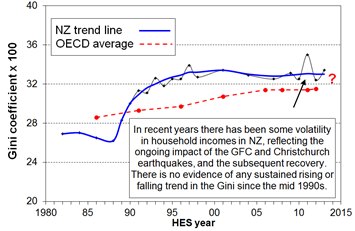
They support this claim with a Gini Coefficient chart that I’ve been unable to source at the OECD. I therefore use another that is freely available in New Zealand and which I have used in the past. My data source on the Gini coefficient has the advantage of been a complete series back to the early 1980s rather than five yearly observations in the OECD data sourced by the Dominion Post.
Figure 1: Inequality in New Zealand and the OECD trend: the Gini coefficient
Source: Bryan Perry, Household incomes in New Zealand: Trends in indicators of inequality and hardship 1982 to 2013. Ministry of Social Development (July 2014), Figure J5.
Figure 1 shows there is no evidence of a substantive rise or fall in inequality in New Zealand since the mid 1990s. Nearly all of the increase in inequality was in the late 1980s and early 1990s. Not mentioning that nearly all of the increase was in a short period leads to a poor understanding of the data before their readers. Rising inequality is not an on-going problem in New Zealand. There was a large rise in inequality in the late 1980s and early 1990s.
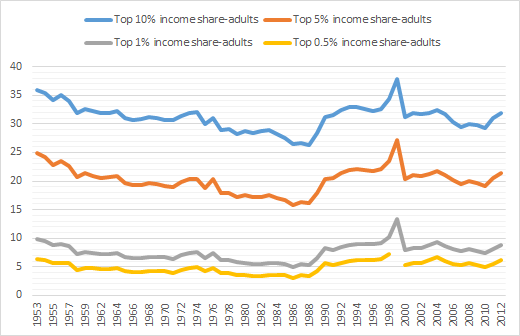
The next figure that I’ve been able to reproduce is the income shares of the top 10%, top 5%, top 1% on top 0.5% income earners in New Zealand – see figure 2.
Figure 2: Top Income Shares, New Zealand
Source: top incomes-parisschoolofeconomics.
Our intrepid reporters in the Dominion Post claim that figure 2 shows that:
In 1986, the top 10 per cent took home 26.5 per cent of New Zealand’s income. In 1999, it was 37.8 per cent and in 2004, it was 33.2 per cent.
Oddly enough, our intrepid reporters decided to stop at 2004 for no particular reason. They also chose to truncate their chart at 1986 for no particular reason other than to lead the coincidence that the top 10% income shares were higher in the 1960s and 1970s that now– see figure 2 . That is, the top 10% in New Zealand earned more in the days before the scourge of neoliberalism came upon the New Zealand then after it – see figure 2. This detail was worth disclosing. Did neoliberalism reduce the income divide in New Zealand between the top 10% and the rest? Figure 2 suggests that it did.
The best that veteran grumbler Max Rashbrooke could spin to make these good old days of higher inequality than now to look like good old days before the scourge of neoliberalism beset New Zealand was to ignore the fortunes of the majority of the population in his dewy eyed view of his childhood:
New Zealand up until the 1980s was fairly egalitarian, apart from Māori and women, our increasing income gap started in the late 1980s and early 1990s
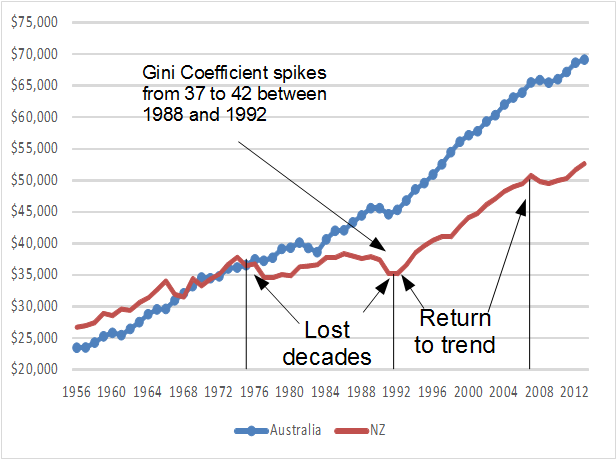
A more worthy analysis of figure 2 is to note that top income shares in New Zealand haven’t changed that much except for a bit of a spike in the late 1980s. This increase in inequality in New Zealand in the late 1980s and early 1990s – see figures 1 and 2 – was quickly followed by a long economic boom – see figure 3.
Figure 3: Real GDP per New Zealander and Australian aged 15-64, 2014 US$ (converted to 2014 price level with updated 2011 PPPs), 1.9 per cent detrended, 1956-2013
Source: Computed from OECD Stat Extract and The Conference Board. 2015. The Conference Board Total Economy Database™, May 2015, http://www.conference-board.org/data/economydatabase/
This boom after next to two decades of minimal real economic growth per working age New Zealander benefited everyone and, for example, the unemployment rate fell to a record low of 3.5% about 2005. The supposedly more egalitarian 1970s and 1980s were lost decades of growth – see figure 3.
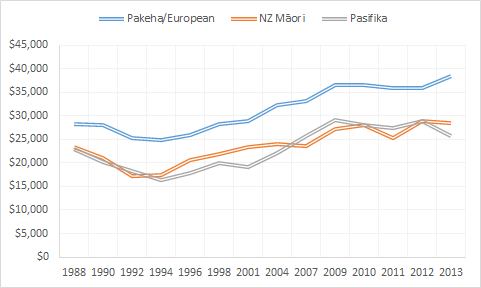
Figure 4: Real equivalised median household income (before housing costs) by ethnicity, 1988 to 2013 ($2013)
Source: Bryan Perry, Household incomes in New Zealand: Trends in indicators of inequality and hardship 1982 to 2013. Ministry of Social Development (July 2014).
As shown in figure 4, between 1994 and 2010, real equivalised median New Zealand Pakeha household income rose by 47%; for Māori, this rise was 68%; for Pasifika, the rise in real equivalised median household income was 77%. These trends pass the difference principle developed by John Rawls.
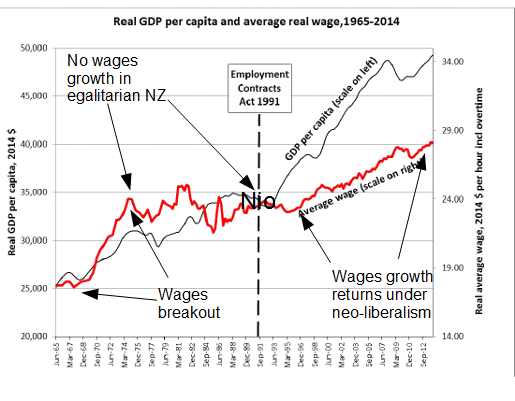
The large improvements in Māori incomes since 1992 were based on rising Māori employment rates, fewer Māori on benefits or zero incomes, more Māori moving into higher paying jobs, and greater Māori educational attainment (Dixon and Maré 2007). Labour force participation rates of Māori increased from 45% in the late 1980s to about 62% in the last few years. Māori unemployment reached a 20-year low of 8 per cent from 2005 to 2008. That and the return of wages growth after years of stagnation as shown in figure 5 is something to celebrate.
Figure 5: real GDP per capita an average real wage, 1965 – 2014, New Zealand
Source: Council of Trade Unions.
The reporters in the Dominion Post also fell for the recent OECD analysis suggesting a connection between economic growth and inequality:
One study by the OECD suggests rising inequality was responsible for wiping a third off New Zealand’s economic growth in the past 30 years
It estimated the rate of New Zealand’s GDP growth was stunted by as much as 15.5 percentage points between 1990 and 2010 – more than any other OECD economy.
The analysis of the OECD depended crucially upon how greater inequality reduces the ability of the lower income families to invest in human capital:
The evidence strongly suggests that high inequality hinders the ability of individuals from low economic background to invest in their human capital, both in terms of the level of education but even more importantly in terms of the quality of education.
The OECD theory of inequality and lower growth is there is a financing constraint because of inequality that reduces economic growth because of less human capital accumulation by lower income families.

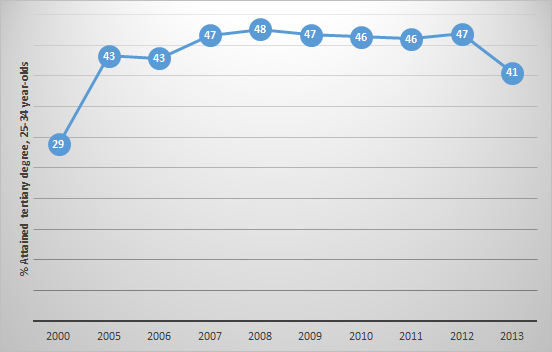
The OECD put a lot of their growth inequality nexus eggs in one basket. The OECD was implying that student loans and other government interventions are not closing credit constraints on financing higher education despite decades of rapidly rising tertiary education attainment, which is partially illustrated in figure 6.
Figure 6: tertiary educational degree attainment (%), New Zealanders aged 25–34, 2000-2013
Source: OECD StatExtract.
This is interesting because in 2002, with Pedro Carneiro, James Heckman showed that lack of credit is not a major constraint on the ability of young Americans to attend college. They found that credit constraints prevent, at most, 4% of the U.S. population from attending. Credit constraints is weakening as a rationale for a lack of an accumulation of human capital, and can be easily solved.
Another difficulty for the OECD is the increase in inequality in New Zealand was, as noted before in figures 1 and 2, in the late 1980s and 1990s. To blame low economic growth to the tune of 15 percentage points on events of some 25 or 30 years ago is a long bow.
Higher education has been free for the low income families for several generations. Student loans are readily available. It is hard to believe that such a readily solvable problem is a major source of inequality and lower growth. Moreover, as Aghion said:
Economists and others have proposed many channels through which education may affect growth–not merely the private returns to individuals’ greater human capital but also a variety of externalities.
For highly developed countries, the most frequently discussed externality is education investments’ fostering technological innovation, thereby making capital and labour more productive, generating income growth.
Despite the enormous interest in the relationship between education and growth, the evidence is fragile at best.
The 15 percentage point reduction in New Zealand economic growth since the late 1980s because of inequality is so large over a 30 year period that this half a percentage point reduction on average per annum qualifies as an independent source of business cycle shocks and an equally implausible driver of real business cycles.
Our intrepid reporters closed by claiming large increases in child poverty:
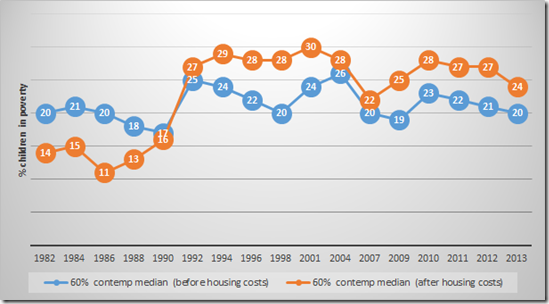
In December last year, the second annual Child Poverty Monitor showed a slight decrease in the number of Kiwi children living in income poverty, from 27 per cent to 24 per cent. But 30 years ago, it was 14 per cent.
Figure 7 below shows their numbers, which is child poverty in New Zealand for poverty thresholds of 60% relative to a contemporary median measured both before and after housing costs.
Figure 7: % child poverty in New Zealand (before and after housing costs), 60% relative to contemporary median, 1982 – 2013
Source: Bryan Perry, Household incomes in New Zealand: Trends in indicators of inequality and hardship 1982 to 2013. Ministry of Social Development (July 2014), Tables F.6 and F.7.
The first thing to notice in figure 7 is before housing costs child poverty has been pretty stable for 30 years the New Zealand. Few celebrate this.
Figure 7 does show a large increase in after housing costs child poverty in the late 1980s. Since the early 1990s, after housing costs child poverty has slowly tapered down from the high 30% in the mid-1990s to 24% now – see figure 7.
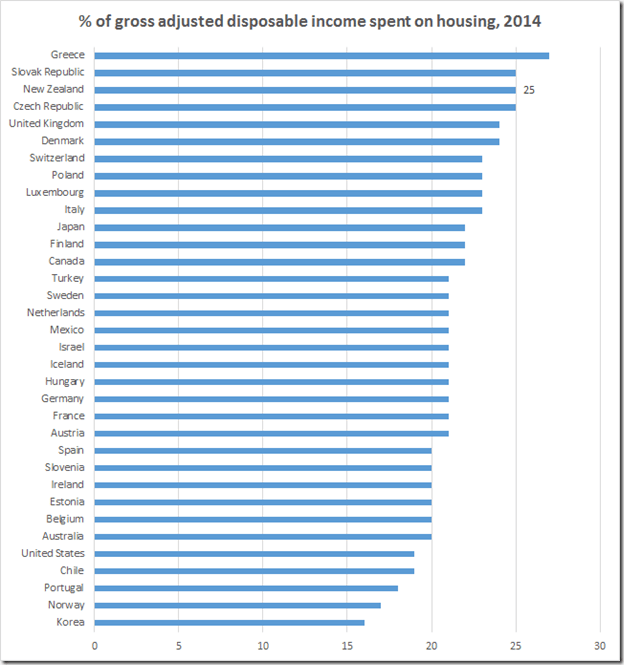
In the longer run after housing costs child poverty rates in 2013 were close to double what they were in the late 1980s mainly because housing costs in 2013 were much higher relative to income than they were in the late 1980s.
– Bryan Perry, 2014 Household Incomes Report – Key Findings. Ministry of Social Development (July 2014).
Before housing costs child poverty in recent years as been the same as it was in 1982 – see figure 7. Although there were large cuts in the social security benefits in the 1991 mother of all budgets in New Zealand, before housing child poverty increased to 25% but was back to 20% by the mid 1990s.
As figure 7 shows, the problem was not income, but the rising costs of housing that had to be paid out of benefits and wages. The Left over Left will not let go of the 1991 benefit cuts even 25 years later despite the fact that the issue was rising housing costs rather than perpetually higher before housing costs child poverty.

The problem is not income, it is rising costs of housing. Increasing wages and benefits will not solve that if more money is simply chasing the same limited stock of land and urban housing.

A proper comparison of the diverging trends in figure 7 between before housing costs child poverty and after housing costs child poverty rates since 1982 gives a much clearer picture of what is increasing child poverty. It is rising housing costs as a result of regulation on the supply of new urban land.
Source: OECD Better Life Index.
The driver of inequality in New Zealand is government regulation of the land supply – policies supported by the middle-class and the left-wing parties. Rising inequality is not inequality between high and low income earners as suggested by the Dominion Post.
 Utopia, you are standing in it!
Recent Comments