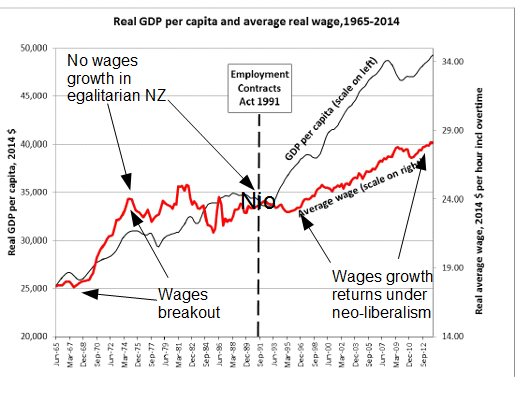
Source: Low Wage Economy | New Zealand Council of Trade Unions – Te Kauae Kaimahi, with extra annotations by this blogger.
Celebrating humanity's flourishing through the spread of capitalism and the rule of law
24 Jul 2016 1 Comment
in economic growth, economic history, labour economics, macroeconomics, politics - New Zealand, unions Tags: economic reform, Employment Contracts Act, employment protection laws, employment regulation, Leftover Left, neoliberalism, pessimism bias
Source: Low Wage Economy | New Zealand Council of Trade Unions – Te Kauae Kaimahi, with extra annotations by this blogger.
23 Jul 2016 Leave a comment
in economic history, liberalism, politics - New Zealand Tags: Leftover Left, pessimism bias, Twitter left
David Aislabie yesterday in the Wanganui Chronicle went beyond Max Rashbrooke’s boy’s own view of the 1970s New Zealand is an egalitarian paradise. Aislabie said
The post-war New Zealand I grew up in was the envy of the world — an egalitarian paradise and a great place to bring up children.
It is a sad irony that the baby boomers who benefited from the welfare state they inherited from their parents’ generation should be responsible for snatching those benefits away from subsequent generations.
At least last year, Max Rashbrooke was good enough to qualify his pre-economic reform egalitarian paradise to not include women and Maori
New Zealand up until the 1980s was fairly egalitarian, apart from Maori and women, our increasing income gap started in the late 1980s and early 1990s,” says Rashbrooke. “These young club members are the first generation to grow up in a New Zealand really starkly divided by income.
Leaving out a good 60% of the population from the pre-1984 New Zealand egalitarian paradise is a bit of a stretch on any paradise.
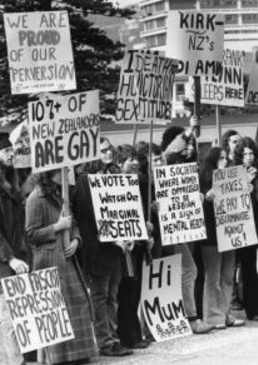 Pre-1984 was no paradise to sing that you were glad to be gay; you could have been thrown in jail and many were.
17 Jul 2016 Leave a comment
in economic history, human capital, labour economics, occupational choice, politics - New Zealand, poverty and inequality Tags: Leftover Left, pessimism bias, top 1%, top incomes, Twitter left
Max Rashbrooke was good enough to remind us that the 2013 update of New Zealand top income shares came online a few days ago.
As is well known to everyone except those obsessed with top income shares, New Zealand top income shares have not changed much since the late 1980s. They are now no higher than in the good old days when New Zealand was an egalitarian paradise in their eyes.

Source: The World Wealth and Income Database.
06 Jul 2016 Leave a comment
in income redistribution, Public Choice Tags: British economy, British politics, Leftover Left, Margaret Thatcher
Thatcher was able to implement her policies because the Labour Party of the 1980s failed to offer a credible alternative government. In the 1983 general election, Labour ran on policy such as
After barely upholding the social democratic alliance in 1983, British labour did slightly better after four more years of Maggie Thatcher. Labour won 30% of the vote in 1987, up from 27%. in 1983 The social democratic alliance drop down from 25% to 22%

One reason was clever responses are national security in the 1987 election such as this
On 24 May, Kinnock was interviewed by David Frost and claimed that Labour’s alternative defence strategy in the event of a Soviet attack would be “using the resources you’ve got to make any occupation totally untenable”.
In a speech two days later Mrs. Thatcher attacked Labour’s defence policy as a programme for “defeat, surrender, occupation, and finally, prolonged guerrilla fighting… I do not understand how anyone who aspires to Government can treat the defence of our country so lightly.”
In 1992, Labour still lost the election by a landslide despite 13 years of Thatcher good and ended its commitment to unilateral nuclear disarmament, high taxes and old-style nationalisation. Go left, go left so damaged the labour brand that a new generation of leaders was required.
The British electorate had every chance to vote for a hard left Labour in the 1980s. It rejected it resoundingly and almost voted in the social democratic alliance as the main opposition party.
05 Jul 2016 Leave a comment
in economics, Public Choice Tags: British politics, Leftover Left
Corbyn does not explain how he will win back lost votes, much less the confidence of those that work closely every day and who are not impressed.
Corbyn’s new politics is deeply unpopular with swinging voters.
Worst of all, Corbyn chatted with a man immediately after he yelled anti-Semitic abuse at a fellow Labour MP at the public release of the report on the internal investigation into anti-Semitism in the Labour Party. That was his chance to be brave rather than just stubborn.
01 Jul 2016 Leave a comment
in constitutional political economy, Public Choice Tags: British Labour Party, British politics, Leftover Left
Ed Miliband managed to do what 30 years of militant tendency entryism failed to do. He delivered the British Labour Party to the far left.
By allowing anyone to join the Labour Party for £3 to vote for its leader, far left activists were able to join online and vote in a leader and certainly re-elect him in the forthcoming challenge.
Far left control of the National Executive and National Conference means the Left will never have to agree to a less favourable form of electing the leadership. Corbyn plans to remove the parliamentary party from approving developing policy and nominating leadership candidates.
A Labour Party led by Jeremy Corbyn and then John McDonnell and other grumpy old socialists will never win a British general election. They will be massacred in 2020.
John McDonnell is good at saying there is much agreement on domestic policy but some want to go faster. That agreement is to be a more radical government than the Attlee government.
Labour was elected in a landslide in 1945 in the hope of a Better Britain. It was re-elected by 5 seats in 1950 in a time far more forgiving of socialism and the growth of government. Labour lost the 1951 general election and stayed out of office for the next 13 years.
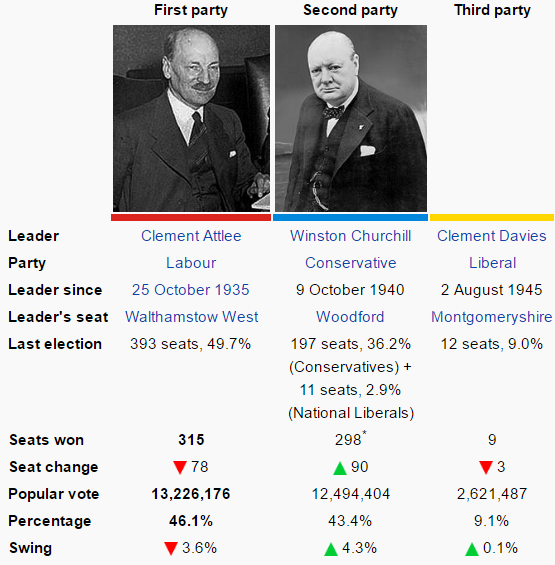
If Labour wants to win a 2020 election in the United Kingdom of England, Wales and Northern Ireland, it must win 6% more of the vote and win England for one of the few times in its history. There will be no Scottish MPs to join in coalition in 2020.
If Labour is ever to be an effective opposition, an opposition that might actually win the next election by winning England outside of London, the party must split, discard the far left and become a social democratic party under a firm control of its MPs.
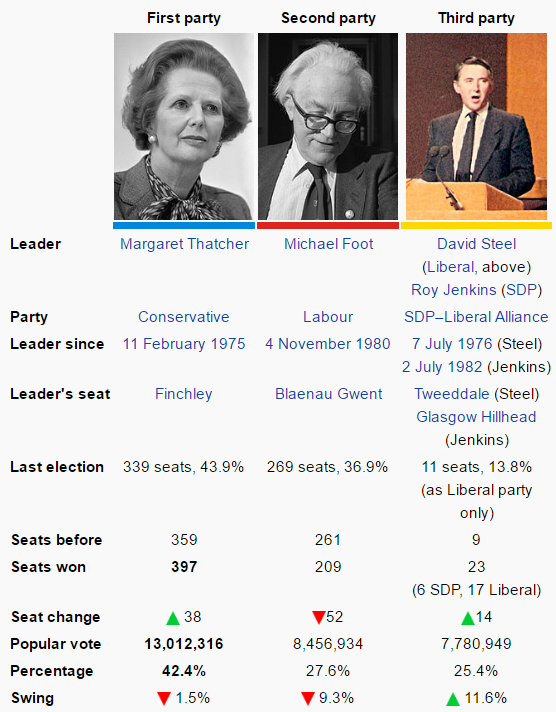
When four leading MPs left in 1981, they were able to cobble together 25% of the popular vote in the 1982 British general election in an alliance with the Liberal Party.
Imagine if 100-150 MPs left to form a new party big enough to be the official opposition now. They would have a real chance of killing off the left-wing rump in 2020 and winning in 2025.
That is better chances that they have now assuming there is no mandatory reselections and mass de-selections of MPs who do not support Corbyn. If Corbyn carries out his plan for mandatory re-selections, they have nothing to lose from forming another party and everything to gain.
05 Jun 2016 Leave a comment
in applied price theory, applied welfare economics, comparative institutional analysis, constitutional political economy, development economics, economic history, economics, economics of regulation, entrepreneurship, growth disasters, growth miracles, income redistribution, industrial organisation, labour economics, macroeconomics, Milton Friedman, minimum wage, occupational choice, politics - USA, Public Choice, public economics Tags: 2016 presidential election, Leftover Left
30 May 2016 Leave a comment
in Economics of international refugee law, international economic law, International law, labour economics, politics - Australia Tags: Australian Greens, avoiding difficult choices, economics of immigration, Leftover Left, rational irrationality
People who enter illegally by boat do not increase the number of refugees of Australia admits in any one year. They change who was granted asylum within the same fixed quota. Increasing the quota will not change incentives for illegal entry if illegal entry allows for settlement in Australia.
28 May 2016 Leave a comment
in economic history, financial economics, politics - USA, public economics Tags: company tax, Leftover Left, pension fund socialism, Peter Drucker, tax havens, taxation and entrepreneurship, taxation and investment, Twitter left
Peter Drucker first pointed out in the 70s that the retirement savings of ordinary workers will end up opening the majority of public listed companies. That day has come much to the disappointment of the Leftover Left ranging from Thomas Piketty to Max Rashbrooke.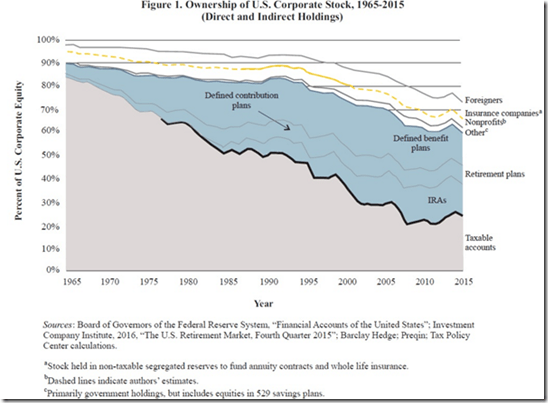
Source: CONVERSABLE ECONOMIST: US Corporate Stock: The Transition in Who Owns It.
Any call for higher taxes on investment incomes and capital and even tax havens is an attack on the retirement savings of ordinary workers.
28 May 2016 Leave a comment
in constitutional political economy, politics - USA Tags: 2016 presidential election, Leftover Left, reactionary left, taxation and entrepreneurship, taxation and investment, taxation and labour supply, Twitter left
Why have no Democrats formed the equivalent of #NeverTrump?
Bernie Sanders is not even a member of their party. Have they no principles?
Many of their republican opponents do in rejecting Trump and planning to vote for either Clinton or Gary Johnson.
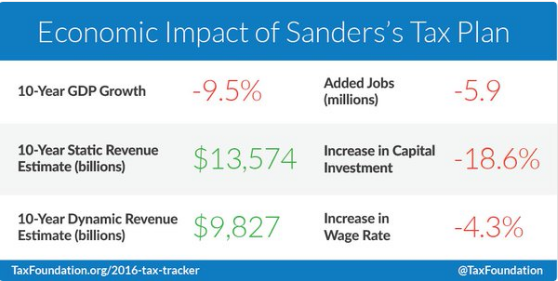
Sanders is an old socialist throwback whose economic policies would plunge the American economy into a deep recession harming most of all those that Democrats claim to represent.
Sander’s mind is just as inflexible as that of Trump as is his unwillingness to learn from events.
23 May 2016 Leave a comment
in applied welfare economics, comparative institutional analysis, economic history, economics of regulation, income redistribution, industrial organisation, politics - New Zealand, poverty and inequality, Public Choice, rentseeking Tags: child poverty, conspiracy theories, expressive voting, family poverty, Leftover Left, living standards, neoliberalism, Old Left, pessimism bias, rational irrationality, reactionary left, top 1%
New work by Chris Ball and John Creedy shows substantial *declines* in NZ inequality.
initiativeblog.com/2015/06/24/ine… http://t.co/f94fw4Bhae—
Eric Crampton (@EricCrampton) June 24, 2015
You really are still fighting the 1990 New Zealand general election if Max Rashbrooke makes more sense than you on the good old days before the virus of neoliberalism beset New Zealand from 1984 onwards.
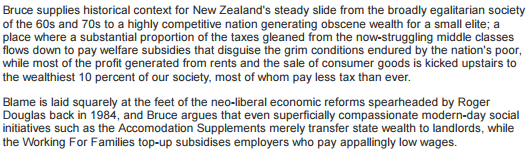
Source: Mind the Gap: Why most of us are poor | Stuff.co.nz.
Bryan Bruce in the caption looks upon the New Zealand of the 1960s and 70s as “broadly egalitarian”. Even Max Rashbrooke had to admit that was not so if you were Maori or female.
The present rate of technology adoption is nearly a vertical line —@blackrock https://t.co/3oS3YAI4ld—
Vala Afshar (@ValaAfshar) January 22, 2016
Maybe 65% of the population of those good old days before the virus of neoliberalism. were missing out on that broadly egalitarian society championed by Bryan Bruce.
As is typical for the embittered left, the reactionary left, gender analysis and the sociology of race is not for their memories of their good old days. New Zealand has the smallest gender wage gap of any of the industrialised countries.
The 20 years of wage stagnation that proceeded the passage of the Employment Contracts Act and the wages boom also goes down the reactionary left memory hole.
That wage stagnation in New Zealand in the 1970s and early 80s coincided with a decline in the incomes of the top 10%. When their income share started growing again, so did the wages of everybody after 20 years of stagnation. The top 10% in New Zealand managed to restore their income share of the early 1970s and indeed the 1960s. That it is hardly the rich getting richer.
07 May 2016 Leave a comment
in politics - New Zealand, public economics Tags: entrepreneurial alertness, Leftover Left, reactionary left, superstar wagers, superstars, top 1%
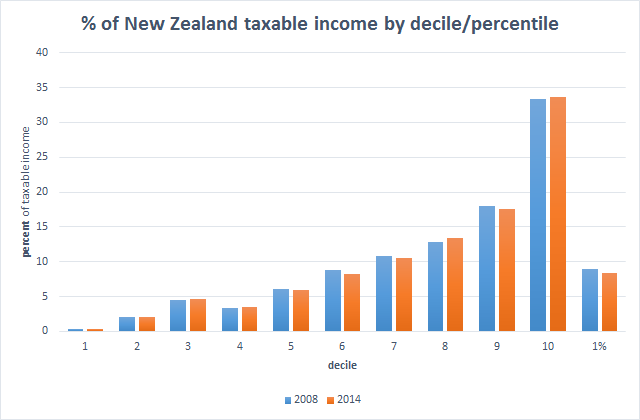
The share of incomes of the top 1% in New Zealand has not increased since the 1950s – they are just bone lazy at extracting labour surplus.
Veteran left-wing grumbler Max Rashbrooke was good enough to collect Inland Revenue Data data that show that getting even lazier under right-wing government elected in 2008. Their share of taxable income has dropped from 9% when labour lost power to 8.4% now. These figures exclude capital gains.
28 Apr 2016 Leave a comment

25 Apr 2016 Leave a comment
13 Apr 2016 Leave a comment
in international economics, labour economics, minimum wage, politics - New Zealand, politics - USA Tags: antiforeign bias, antimarket bias, expressive voting, Leftover Left, living wage, makework bias, rational irrationality
Celebrating humanity's flourishing through the spread of capitalism and the rule of law
Scholarly commentary on law, economics, and more
Beatrice Cherrier's blog
Celebrating humanity's flourishing through the spread of capitalism and the rule of law
Celebrating humanity's flourishing through the spread of capitalism and the rule of law
Celebrating humanity's flourishing through the spread of capitalism and the rule of law
Why Evolution is True is a blog written by Jerry Coyne, centered on evolution and biology but also dealing with diverse topics like politics, culture, and cats.
Celebrating humanity's flourishing through the spread of capitalism and the rule of law
Celebrating humanity's flourishing through the spread of capitalism and the rule of law
A rural perspective with a blue tint by Ele Ludemann
DPF's Kiwiblog - Fomenting Happy Mischief since 2003
Celebrating humanity's flourishing through the spread of capitalism and the rule of law
The world's most viewed site on global warming and climate change
Tim Harding's writings on rationality, informal logic and skepticism
A window into Doc Freiberger's library
Let's examine hard decisions!
Commentary on monetary policy in the spirit of R. G. Hawtrey
Thoughts on public policy and the media
Celebrating humanity's flourishing through the spread of capitalism and the rule of law
Politics and the economy
A blog (primarily) on Canadian and Commonwealth political history and institutions
Reading between the lines, and underneath the hype.
Economics, and such stuff as dreams are made on
"The British constitution has always been puzzling, and always will be." --Queen Elizabeth II
Celebrating humanity's flourishing through the spread of capitalism and the rule of law
Celebrating humanity's flourishing through the spread of capitalism and the rule of law
WORLD WAR II, MUSIC, HISTORY, HOLOCAUST
Undisciplined scholar, recovering academic
Celebrating humanity's flourishing through the spread of capitalism and the rule of law
Res ipsa loquitur - The thing itself speaks
Celebrating humanity's flourishing through the spread of capitalism and the rule of law
Researching the House of Commons, 1832-1868
Articles and research from the History of Parliament Trust
Reflections on books and art
Posts on the History of Law, Crime, and Justice
Celebrating humanity's flourishing through the spread of capitalism and the rule of law
Exploring the Monarchs of Europe
Cutting edge science you can dice with
Small Steps Toward A Much Better World
“We do not believe any group of men adequate enough or wise enough to operate without scrutiny or without criticism. We know that the only way to avoid error is to detect it, that the only way to detect it is to be free to inquire. We know that in secrecy error undetected will flourish and subvert”. - J Robert Oppenheimer.
The truth about the great wind power fraud - we're not here to debate the wind industry, we're here to destroy it.
Celebrating humanity's flourishing through the spread of capitalism and the rule of law
Celebrating humanity's flourishing through the spread of capitalism and the rule of law
Economics, public policy, monetary policy, financial regulation, with a New Zealand perspective
Celebrating humanity's flourishing through the spread of capitalism and the rule of law
Restraining Government in America and Around the World

 Utopia, you are standing in it!
Recent Comments