Tsipiras remains Greece’s PM, following the country’s third national vote this year econ.st/1Wd3POq http://t.co/F3x08Gyrab—
The Economist (@ECONdailycharts) September 21, 2015
The Left is back in power in Greece
21 Sep 2015 Leave a comment
in currency unions, Euro crisis, macroeconomics, Marxist economics Tags: Euroland, Greece, Leftover Left
Nick Cohen on why he resigned from the Left
18 Sep 2015 Leave a comment
in Marxist economics, Public Choice Tags: Left-wing hypocrisy, Leftover Left, Nick Cohen, Twitter left
Powerful by @NickCohen4: his Christopher Hitchens moment spectator.co.uk/features/96374… http://t.co/pjJrXb7Czn—
John Rentoul (@JohnRentoul) September 17, 2015
George Orwell via @NickCohen4 spectator.co.uk/features/96374… http://t.co/9x7svhACRm—
John Rentoul (@JohnRentoul) September 17, 2015
More fun to be rude about Corbyn than say what centre-left shd do about him @DAaronovitch £ thetimes.co.uk/tto/opinion/co… http://t.co/GEYUhhexrx—
John Rentoul (@JohnRentoul) September 17, 2015
@anneapplebaum on @jeremycorbyn
17 Sep 2015 Leave a comment
in Marxist economics, Public Choice Tags: British politics, echo chambers, information cocoons, Leftover Left, Twitter left
https://twitter.com/JeremyCliffe/status/630393902843985920/photo/1
John McDonnell, the new shadow chancellor, set out his (and Corbyn's) economic stall here: john-mcdonnell.net/jeremy_corbyn_… http://t.co/nrmqJcOJWU—
Jeremy Cliffe (@JeremyCliffe) September 13, 2015
@jeremycorbyn incomes of the poorest increased most under Blairism @UKLabour
13 Sep 2015 2 Comments
in economic history, labour economics, Marxist economics, poverty and inequality Tags: British economy, Leftover Left, Tony Blair, Trish Labor Party, welfare state
Under Tony Blair the incomes of the UK's poorest families increased by more than under any other Prime Minister. http://t.co/8Uh8GBqbRB—
Tom Forth (@thomasforth) September 12, 2015
@jeremycorbyn @UKLabour has a long history of picking losers as leaders
13 Sep 2015 Leave a comment
in economic history, Public Choice Tags: British Labour Party, British politics, Leftover Left, Twitter left
Great chart. Labour not keen on choosing on leaders who can win elections, 1906-2015. Contrast the Tories http://t.co/VBlT7k5ONB—
paulkirby (@paul1kirby) September 12, 2015
What do #McDonalds & @GreenpeaceNZ no longer have in common? @NZGreens @RusselNorman
12 Sep 2015 Leave a comment
in economics of regulation, environmental economics, environmentalism, global warming, health economics, politics - New Zealand Tags: anti-science left eye global warming, climate alarmism, GMOs, Greenpeace, Leftover Left, New Zealand Greens, Russell Norman, The Great Escape, The Great Fact, Twitter left
Like McDonalds, Greenpeace globally is a brand. I read the papers every day in detail but are utterly clueless as to who its leaders are. That is a deliberate branding decision so people cannot conflate the inevitably dodgy and far left backgrounds of its leaders and activist support base with self appointed environmental do-gooders brand.

That is no longer so in New Zealand where a middle-age political junkie retiring as co-leader of the New Zealand Greens will now be their CEO in New Zealand.
.@RusselNorman to lead @GreenpeaceNZ bit.ly/1K08JJj http://t.co/M4QNmeGQjr—
Greenpeace NZ (@GreenpeaceNZ) September 10, 2015
If Russell Norman wants to do his job properly, you should never give an interview, never appear in public.
Incoming @GreenpeaceNZ leader @RusselNorman says Greenpeace critical for humanity's future stuff.co.nz/national/polit… http://t.co/XqpxYjYmf4—
Greenpeace NZ (@GreenpeaceNZ) September 12, 2015
What is worse is the carrying on by the Greens about the retirement of Russell Norman to lead the Greenpeace in New Zealand.
If they wanted to maintain the political effectiveness of Greenpeace, they should have made a short press release congratulating him on his retirement and wishing him well in his new job and saying little more. The Greens should stop carrying on as though you have taken over Greenpeace New Zealand.
I do not wish Greenpeace well with its anti-growth, anti-science, anti-human agenda, so I hope this was a mistake and I hope I am not interrupting them in making that mistake.
Being classically liberal
12 Sep 2015 Leave a comment
in constitutional political economy, liberalism, Public Choice Tags: Leftover Left, meddlesome preferences, nanny state, progressive left, The fatal conceit, The pretence to knowledge
@radleybalko @thecounted How did the 169 unarmed people killed by police in 2015 die? @Mark_J_Perry updated
11 Sep 2015 2 Comments
in economics of crime, law and economics, politics - USA Tags: body cameras, crime and punishment, criminal deterrence, law and economics of evidence, law and order, Leftover Left, police, police shootings, presumption of innocence, William Blackstone
The Guardian is so anti-police that they included in their interactive database a drunk that drove into a police car and some poor bastard run over by the police cruiser searching for him at night.
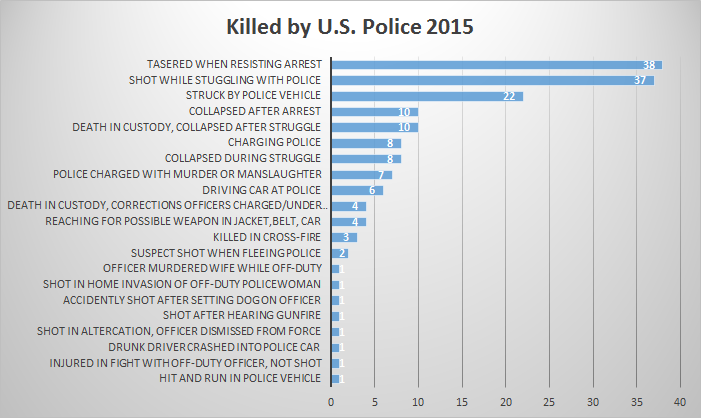
Another handy hint for an unarmed suspect is do not flee police by stealing a police cruiser with the officer dragging behind you. He may well shoot you. Police will certainly shoot an unarmed suspect if they flee arrest in a police cruiser, kidnapping the two children who happened to be in the back – their parents expect no less.

Most of the police killings of the unarmed in circumstances where better evidence would resolve doubts.

The Guardian would do a lot better by arguing that all Tasers should have cameras on them, all police cruisers should have cameras in them, and all police officers should have cameras on their lapels. These cameras are excellent for collecting evidence against criminals. There should also be plenty of cameras in police stations.

The first randomized controlled trial of police body cameras in the USA showed that cameras sharply reduce the use of force by police and the number of citizen complaints. In Seattle, the police department has set up its own YouTube channel, broadcasting a stream of blurred images to protect privacy.
Update: I recoded charging police and reaching for a possible weapon on your person or in a car into separate categories
$100 million for the few that cycle to work in #Wellington @dpfdpf @NZGreens
10 Sep 2015 Leave a comment
in politics - New Zealand, population economics, transport economics Tags: expressive voting, Leftover Left, urban transport
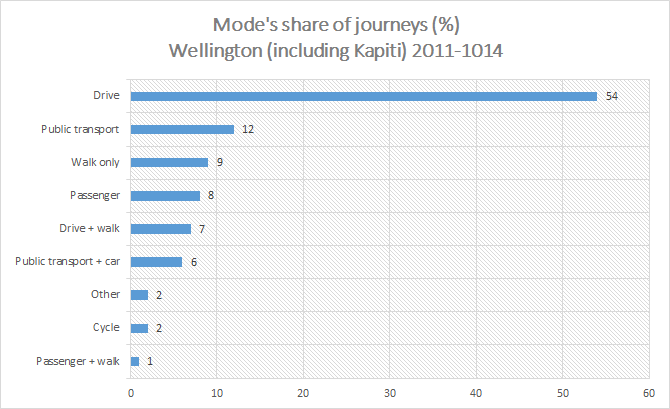
Source: Statistics New Zealand, New Zealand Travel Survey.
#JFK on @jeremycorbyn #toriesforcorbyn
10 Sep 2015 Leave a comment
in comparative institutional analysis, constitutional political economy, Marxist economics, Public Choice Tags: British politics, JFK, Leftover Left

How did the 19 unarmed people killed by police since 1 August 2015 die? @radleybalko @thecounted
10 Sep 2015 Leave a comment
in economics of crime, law and economics, politics - USA Tags: crime and punishment, deaths in custody, expressive voting, law and order, Leftover Left, police, police shootings
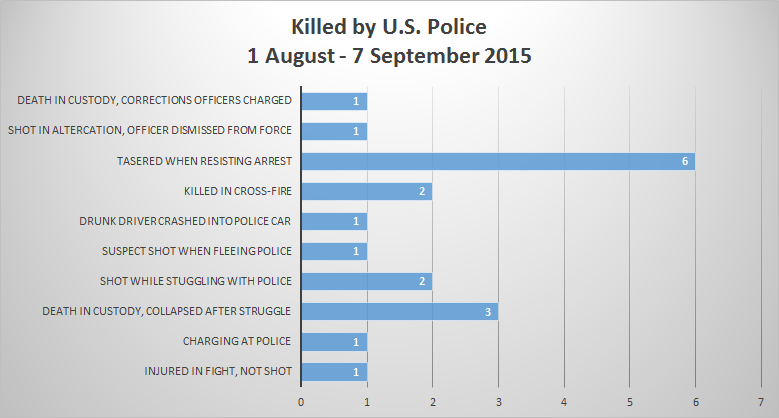
In coding the data from The Guardian interactive website, I included all 19 people they classified as unarmed and killed by police including
- a death in custody involving corrections officers,
- a drunk driver drove into the police car while turning left, and
- an off duty police officer getting into a fatal fight with a neighbour.
Unarmed people should not charge at armed police, struggle for their guns, or refuse to comply when threatened with a Taser, especially if poor of health or have a weak heart.
In the only two cases of police malfeasance – three corrections officer beating a prisoner to death or a trigger-happy police officer – charges have been laid or the officer dismissed pending further investigation. The man shot while fleeing police was a murder suspect.
War on Police? Or one of the safest years in law enforcement since 1887? @Mark_J_Perry goo.gl/qNQ2lO http://t.co/2zPjZmG2fQ—
AEIdeas Blog (@AEIdeas) September 09, 2015
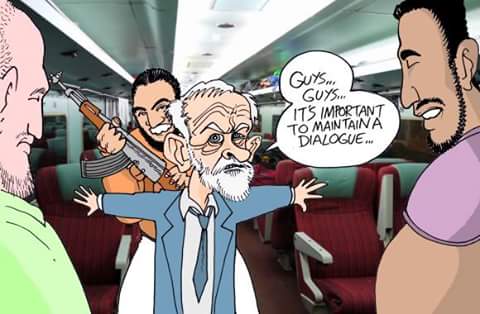
@jeremycorbyn in a nutshell #torysforcorbyn
24 Aug 2015 1 Comment
in Marxist economics, Public Choice, war and peace Tags: British politics, Leftover Left
@nzlabour @NZGreens There just isn’t no missing million out there hanging out for that hard-left clarion call @rsalmond
22 Aug 2015 1 Comment
in applied price theory, constitutional political economy, economics of information, politics - New Zealand, Public Choice Tags: British Labour Party, British politics, economics of advertising, Eric Crampton, expressive voting, false consciousness, Leftover Left, median voter theorem, New Zealand Greens, New Zealand Labour Party, rational ignorance, rational rationality
Rob Salmond has written a great blog this week on the ideological spectrum of New Zealand voters based on the New Zealand Election Study.

In the course of his blog he drove a tremendously big stake through the heart of the old left fantasy that if Labour or Greens goes left, a large block of voters not voting for them now or not voting at all (the missing million voters) will shake lose its false consciousness and follow you:
But “pulling the centre back towards the left” is massively, massively hard.
You win those people over by being relevant to them as they are, not by telling them they’re worldview needs a rethink. It is just basic psychology. Tell people they were right all along; they like you. Tell people they were wrong all along; they don’t.
And if you win a majority of centrists, you win. The New Zealand Election Study series records six MMP elections in New Zealand – the three where Labour did best among centrists were the three Labour won.
That’s another message from the academic study I quoted above – in Germany, Sweden, and the UK, the elections where the left did best among centrists were the elections where they took power. As their popularity among centrists declined, so did their seat share.
What is more disturbing for the old left fantasy of the missing million is voting for the Labour Party or Greens is correlated with ignorance rather than knowledge.
Furthermore, the more people know about economics, the less likely they are to vote for the left as Eric Crampton explains:
When they get to the polls, the ignorant are significantly more likely to support the Labour Party (4% increase in predicted probability for a standard deviation increase in ignorance) and significantly less likely to support the Green party (1% decrease in predicted probability) and United Future (0.5% decrease in predicted probability).
Understanding economics strongly predicted supporting National in 2005, which comes as little surprise: the National Party leader was former Governor of the Reserve Bank of New Zealand. A standard deviation increase in our “economic thinking” index correlates with a 5.7% increased probability of voting National, a 1.5% decreased probability of voting NZ First, and a slight decrease in the probability of voting United Future and Maori.
To make matters worse, Crampton found that joining political organisations does little to cure ignorance of politics or otherwise lead to a political awakening. Sometimes active political affiliation reduces ignorance, other times such organisational membership intensifies ignorance.
via Salmond on the centre | Kiwiblog and StephenFranks.co.nz » Blog Archive » Why the left wants everyone to vote.
When do rising incomes increase child poverty?
22 Aug 2015 2 Comments
in economic history, labour economics, politics - New Zealand, poverty and inequality, welfare reform Tags: child poverty, family poverty, Leftover Left, measurement error, New Zealand Greens
Summary of the 222 pages of MSD's Household Incomes report: kids are still missing out BIG time. #itsnotchoice http://t.co/4x7dm1O0Wg—
Child Poverty NZ (@povertymonitor) August 13, 2015
AHC = after deducting housing costs
BHC = before deducting housing costs
‘anchored line’:
- this is the line set at a chosen level in a reference year (now 2007), and held fixed in real terms (CPI adjusted)
- the concept of ‘poverty’ here is – have the incomes of low-income households gone up or down in real terms compared with what they were previously?
‘moving line’:
- this is the fully relative line that moves when the median moves (e.g. if median rises, the poverty line rises and reported poverty rates increase even if low incomes stay the same)
- the concept of ‘poverty’ here is – have the incomes of low-income households moved closer or further away from the median?
Bryan Perry, Household Incomes in New Zealand: trends in indicators of inequality and hardship 1982 to 2014 – Ministry of Social Development, Wellington (August 2015), p. 133.
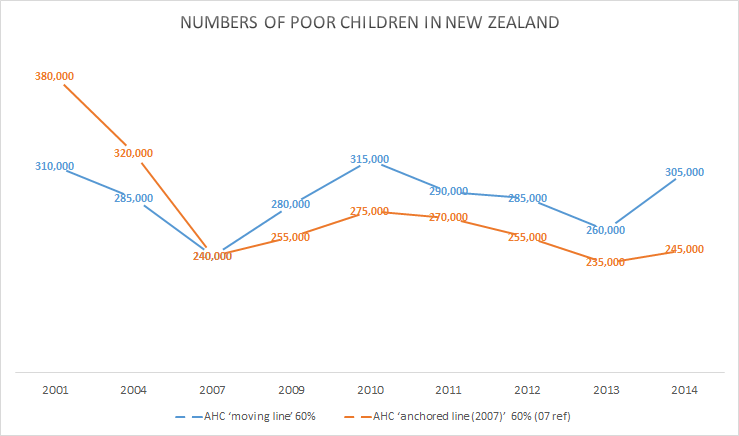
Source: Bryan Perry, Household Incomes in New Zealand: trends in indicators of inequality and hardship 1982 to 2014 – Ministry of Social Development, Wellington (August 2015), p. 133.
Is child poverty in New Zealand 245,000 children or 305,000 children?
260,000 kids in income poverty, 180,000 in material hardship, 10% in severe poverty, 3in5 in poverty for a long time http://t.co/Oy5cWftvwU—
Child Poverty NZ (@povertymonitor) May 21, 2015
If you base your estimate of child poverty on the 60% of median income after housing costs moving line, which is the number of low income households who moved further away from 60% of median income, a median which increased by 5% last year, the figure is 305,000 children after housing costs. 45,000 children are in households that is not as close to the median as last year but are not necessarily any poorer than last year in terms of money coming into the house.
45k more children in #poverty this year than last, that’s 305k Kiwi kids without life's basics. C'mon @johnkeypm! http://t.co/K8zeQpgA79—
UNICEF New Zealand (@UNICEFNZ) August 13, 2015
If you base your estimate on the anchored line, which is the number of low income households whose income has gone up on down compared to what they were on previously,the number of children in poverty has increased from 235,000 to 245,000 after housing costs. About 10,000 children are poorer than last year – poorer enough than last year to be classified as in poverty.

 Utopia, you are standing in it!
Recent Comments