Millennium Development Goal 4: Reduce by two-thirds, between 1990 and 2015, the under-five mortality rate
17 Jul 2015 Leave a comment
in development economics, growth disasters, growth miracles, health economics Tags: capitalism and freedom, child mortality, child poverty, extreme poverty, infant mortality rates, life expectancies, millennium development goals, The Great Escape

Although there has been a dramatic decline in deaths, most children still die from causes that are readily preventable or curable with existing interventions. Pneumonia, diarrhea, and malaria are the leading causes, accounting for 30 percent under-five deaths

via MDG4: A dramatic decline in child mortality over the last 20 years | Open Data.
Equality lacks relevance if the poor are growing richer
17 Jul 2015 Leave a comment
in development economics, economic history, growth disasters, growth miracles, liberalism Tags: capitalism and freedom, Deirdre McCloskey, life expectancies, The Great Enrichment, The Great Escape, The Great Fact, top 1%

Evidence grows of mass kidnappings of Oxfam activists – how else could they have been silenced?
15 Jul 2015 Leave a comment
in development economics, growth disasters, growth miracles, health economics, technological progress Tags: activists, do gooders, extreme poverty, global poverty, infant mortality, Left-wing hypocrisy, life expectancies, mass kidnappings, ODA, overseas aid, Oxfam, The Great Escape, The Great Fact
https://twitter.com/MaxCRoser/status/621132860657897472/photo/1
The biggest success of our time: Child mortality is decreasing rapidly. Everywhere!
More at: OurWorldInData.org/data/populatio… http://t.co/FhdbQeheUd—
Max Roser (@MaxCRoser) July 13, 2015
Staggering #inequality: top 1% will own 50% of world's wealth by 2016. Help #EvenitUp! act.oxfam.org/new-zealand/ev… http://t.co/KX9GR2VSo5—
Oxfam New Zealand (@oxfamnz) January 19, 2015
Fossil fuel companies get more subsidies than all the public health spending globally. It's time to #GoCoalFree http://t.co/gsDIocxAq9—
Oxfam New Zealand (@oxfamnz) June 08, 2015
The Great Escape in Chinese life expectancies by age bracket
14 Jul 2015 Leave a comment
in applied welfare economics, development economics, economic history, growth disasters, growth miracles, health economics Tags: capitalism and freedom, China, life expectancies, The Great Escape
Life Expectancy by Age – for all countries in the world: bit.ly/1Ba1R8G
The chart shows progress in #China. http://t.co/z5IpbMkeFW—
Max Roser (@MaxCRoser) March 30, 2015
A stunning aspect of The Great Escape since my parents were born
13 Jul 2015 Leave a comment
in applied welfare economics, development economics, economic history, growth disasters, growth miracles, health economics Tags: Africa, British economy, British history, child mortality, child poverty, infant mortality, life expectancies, The Great Enrichment, The Great Escape, The Great Fact
"Today, children in sub-Saharan Africa are more likely…"—Prof. Angus Deaton, @Princeton
Data: buff.ly/1K2tELk http://t.co/lrTdiLi3F7—
HumanProgress.org (@humanprogress) July 12, 2015
The Great Escape in China, India and Indonesia
12 Jul 2015 Leave a comment
in applied welfare economics, development economics, economic history, growth disasters, growth miracles, health economics Tags: China, India, Indonesia, life expectancies, The Great Escape, The Great Fact
These 4 nations are 50% of mankind. That's 3.5 billion people who are living longer. buff.ly/1Kle6mU #health http://t.co/949oqisMsL—
HumanProgress.org (@humanprogress) June 30, 2015
The Great Escape: infant mortality since 1990
10 Jul 2015 Leave a comment
in development economics, growth disasters, growth miracles, health economics Tags: child poverty, extreme poverty, global poverty, infant mortality, life expectancies, The Great Enrichment, The Great Escape, The Great Fact
Child mortality declined in all world regions.
Here is by how much: http://t.co/06lS3ZELKr—
Max Roser (@MaxCRoser) June 26, 2015
The Great Escape in disease mortality across the industrialised countries
08 Jul 2015 Leave a comment
in health economics Tags: life expectancies, mortality rates, The Great Escape
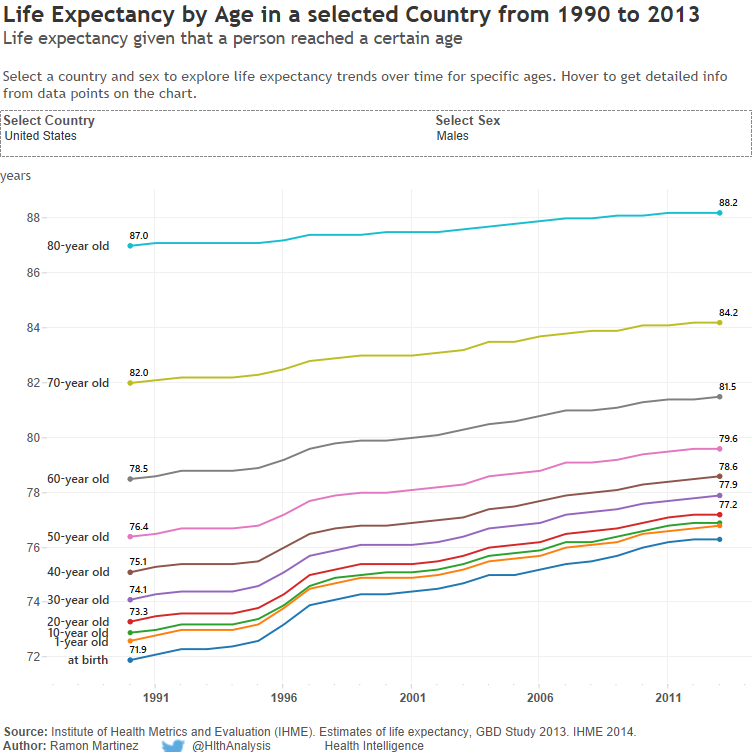
American life expectancy increases by age cohort from 1990
08 Jul 2015 Leave a comment
in economic history, health economics, politics - USA Tags: life expectancies

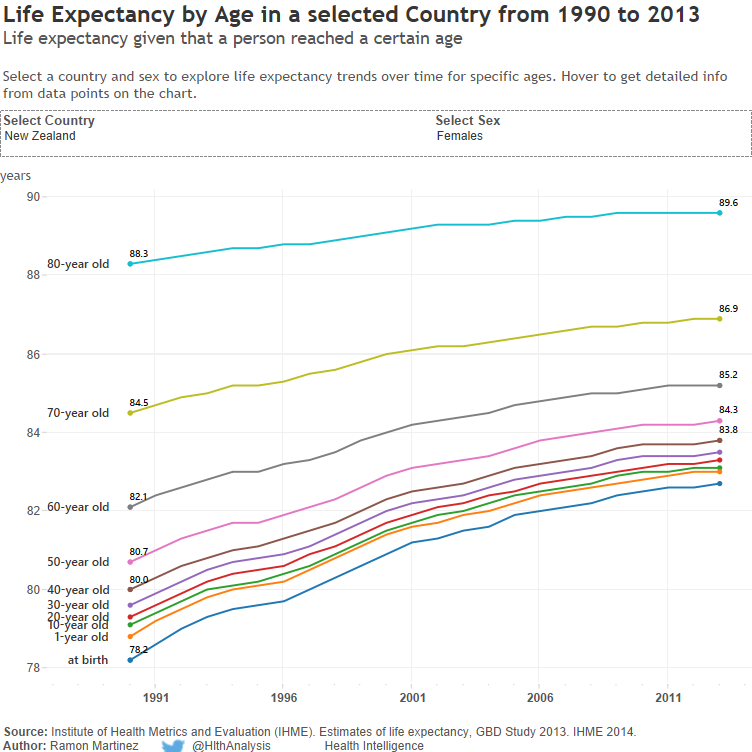
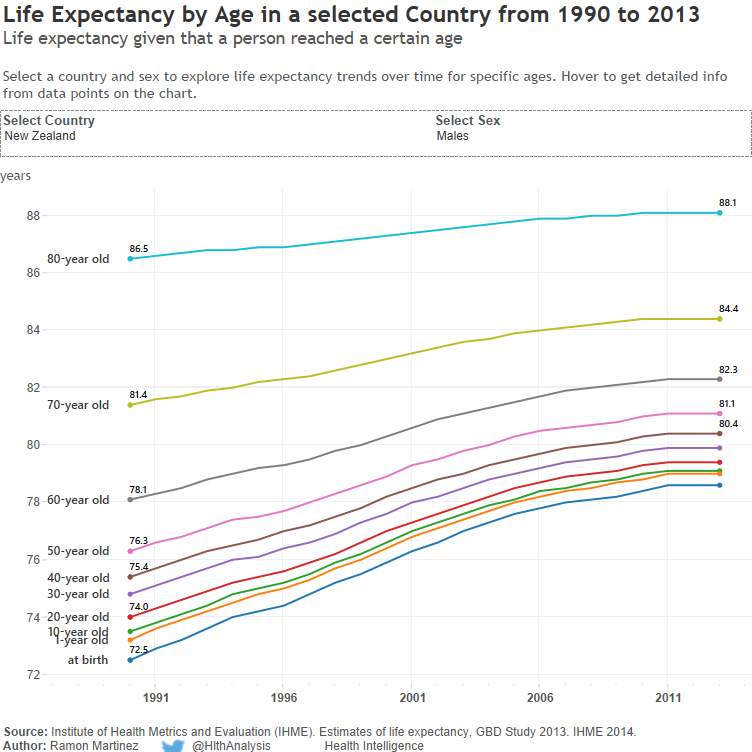
New Zealand life expectancy increases by age cohort from 1990
07 Jul 2015 Leave a comment
in health economics Tags: life expectancies, New Zealand, The Great Escape
The Great Escape in life expectancies over the last 40 years
01 Jul 2015 Leave a comment
in economic history, health economics, politics - Australia, politics - New Zealand, politics - USA Tags: life expectancies, mortality rates, The Great Escape
Would you rather make $50,000 in today’s New Zealand or $100,000 in the 1980s before neo-liberalism?
21 Jun 2015 1 Comment
in applied welfare economics, economic history, politics - New Zealand, population economics, technological progress Tags: good old days, left-wing fantasies, Leftover Left, life expectancies, neoliberalism, The Great Enrichment, time machine, welfare state
Ezra Klein and Matt O’Brien posed an interesting variation of Brad De Long’s Time Machine question. O’Brien asked:
Try this thought experiment. Adjusted for inflation, would you rather make $50,000 in today’s world or $100,000 in 1980’s? In other words, is an extra $50,000 enough to get you to give up the internet and TV and computer that you have now? The answer isn’t obvious.
And if $100,000 isn’t enough, what would be? $200,000? More? This might be the best way to get a sense of how much better technology has made our lives—not to mention the fact that people are living longer—the past 35 years, but the problem is it’s particular to you and your tastes. It’s not easy to generalize.
This doesn’t mean, though, that the middle class is doing well or even as well as it should be. Just that it’s doing better than the official numbers say it is.
Let them have iPhones is the new let them eat cake.
The same questions are asked in New Zealand in a different way when people go on about how much more unequal New Zealand is compared to the 1980s and how bad things have got because of that rise in inequality.
Would it better to be on the welfare benefit in the 1980s than on a benefit today in a less equal New Zealand than in the 1980s? It is certainly the case that the Gini coefficient is worse than it was in the 1980s – see figure 1.
Figure 1: Gini coefficient New Zealand 1980-2015
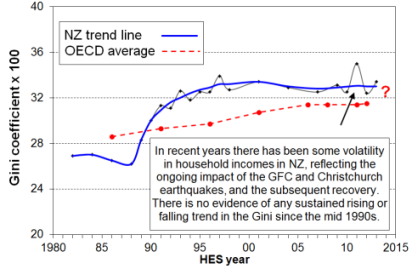
Source: Bryan Perry, Household incomes in New Zealand: Trends in indicators of inequality and hardship 1982 to 2013. Ministry of Social Development (July 2014).
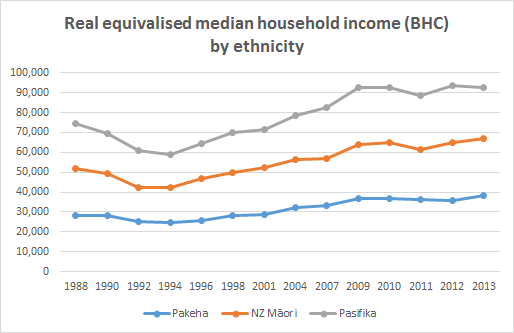
But household incomes on a real basis increased across the border in New Zealand – see figure 2 – including for Maori and Pasifika. As shown in figure 2 below, between 1994 and 2010, real equivalised median New Zealand household income rose by 47%; for Māori, this rise was 68%; for Pasifika, the rise in real equivalised median household income was 77%.
Figure 2: Real equivalised median household income (before housing costs) by ethnicity, 1988 to 2013 ($2013)
Source: Bryan Perry, Household incomes in New Zealand: Trends in indicators of inequality and hardship 1982 to 2013. Ministry of Social Development (July 2014).
The biggest worry for anyone longing to be on a welfare benefit or to be otherwise working back in the good old days in the 1980s on the more equal incomes of back then is instant death.

Stepping into that Time Machine to go back to the more equal, more egalitarian 1980s shaves about five years off your life expectancy, if not more! Death certainly is the great leveller when it comes to Left over Left fantasies about the good old days before the economic reforms of the 1980s. Indeed, the 1980s was a period where life expectancies started to increase again after a hiatus in the 1960s and 1970s.

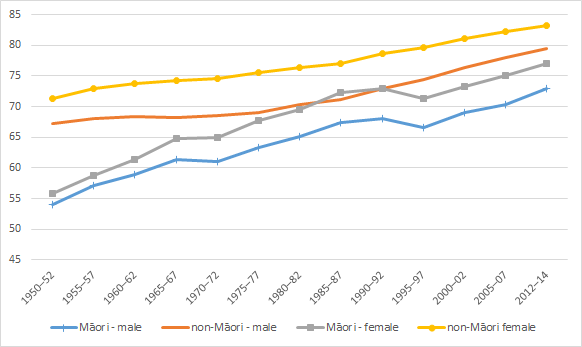
Time travel back to the good old days in the 1980s before neoliberalism would be particularly grim from Maori because of their much lower life expectancies of Maori back in the 1980s – see figure 3.
Figure 3: Life expectancy at birth, Maori and non-Maori by sex
Source: Statistics New Zealand.
The most apt summary of how bad it was in the 1980s compared to today is by veteran left-wing grumbler Max Rashbrooke. To paint pre-1984 New Zealand, pre-neoliberal New Zealand as an egalitarian paradise, he had to ignore the economic progress of two thirds of the population and the inequalities they suffered:
New Zealand up until the 1980s was fairly egalitarian, apart from Maori and women, our increasing income gap started in the late 1980s and early 1990s.


Recent Comments