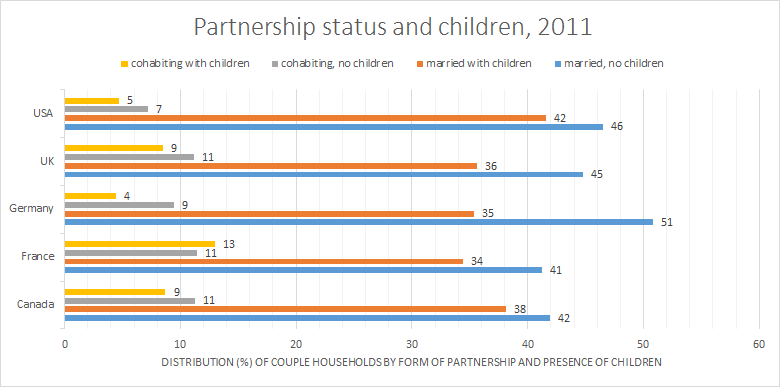
Source: OECD Family Database – OECD.
Celebrating humanity's flourishing through the spread of capitalism and the rule of law
25 Oct 2015 Leave a comment
in economics of love and marriage, population economics Tags: economics of fertility, marriage and divorce, search and matching, single parents, soul parents
Source: OECD Family Database – OECD.
19 Oct 2015 Leave a comment
in discrimination, economics of education, gender, human capital, labour economics, occupational choice Tags: asymmetric marriage premium, compensating differentials, economics of fertility, gender wage gap, marriage and divorce, reversing gender gap
Today’s women who are well-established in their careers in their 30s and 40s are doing better than their mothers who are also tertiary educated in terms of closing the gender wage gap. The gender wage gap in the chart below is unadjusted. It is the raw gender wage gap for women aged 35 to 44 and for women aged 55 to 64.

In Canada and the USA there is been no progress at all. In New Zealand, the gender gap between male and female tertiary educated workers is a little larger for today’s prime age women graduates than for older female workers who completed a tertiary education.
I suspect that gender gap be no smaller for today’s career women as compared to two decades ago has something to do with compensating differentials.

Today’s career women want it all: both motherhood and a career. They trade-off work-life balance for wages.
Women choose university degrees and occupations that are more agreeable to a balancing motherhood and a career.

19 Oct 2015 Leave a comment
in economics of love and marriage, economics of media and culture, television Tags: entrepreneurial alertness, marriage and divorce, search and matching, The battle of the sexes, The Simpsons
15 Oct 2015 4 Comments
in discrimination, economic history, gender, human capital, labour economics, politics - Australia, politics - New Zealand, politics - USA Tags: asymmetric marriage premium, compensating differentials, gender wage gap, marriage and divorce
It seems that the top 10% of men are so busy oppressing the top 10% of women that they forgot to keep up the violence inherent in the capitalist system against the bottom 10% of women. The gender pay gap at the bottom of the economic strata closed quite dramatically and consistently since 1970 or as far back as data was available in Australia, New Zealand, the UK and USA. Much of the closing of the gender pay gap for the low-paid was under the scourge of Reagan, Thatcher, Hawke and Keating and Rogernomics.
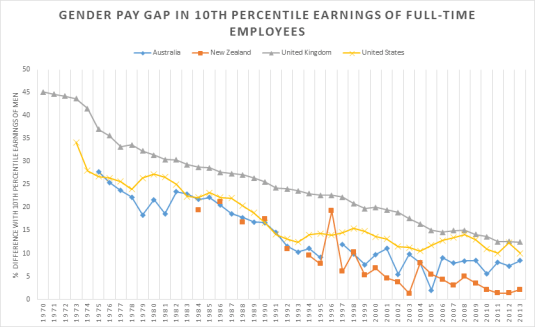
Source and Notes: OECD Employment Database. The gender gap plotted below is unadjusted. It is calculated as the difference between the 10th percentile earnings of men and the 10th percentile earnings of women relative to the 10th percentile earnings of men. Estimates of earnings used in the calculations refer to gross earnings of full-time wage and salary workers. However, this definition may slightly vary from one country to another.
By comparison to this dramatic liberation of women from the gender pay gap at the bottom, the gender pay gap for full-time employees has not really tapered down that much at the top of the income distribution and has been pretty flat for coming on 20 years. It seems the class war is over and has been won by women at the bottom but not at the top?
Younger, more educated women delay having families and can earn as much as their partners. bit.ly/1jw98Ky http://t.co/BaDIlBIBA2—
Ninja Economics (@NinjaEconomics) October 14, 2015
Rather than up the workers, the battle cry of the Posh Trots is up the managers, liberate them from insidious pay inequities imposed upon them by a vast sexist conspiracy of male managers.
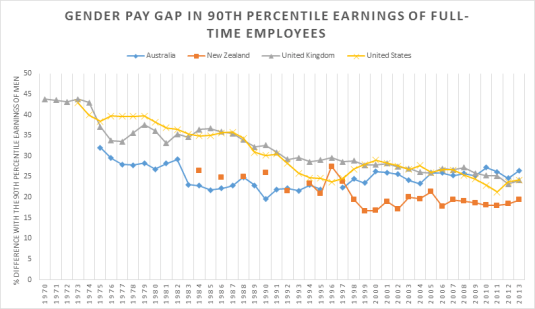
Source and Notes: OECD Employment Database. The gender gap plotted below is unadjusted. It is calculated as the difference between the 10th percentile earnings of men and the 10th percentile earnings of women relative to the 10th percentile earnings of men. Estimates of earnings used in the calculations refer to gross earnings of full-time wage and salary workers. However, this definition may slightly vary from one country to another.
This failure to close the gender pay gap at the top requires more investigation. The available of reliable contraceptives in the late 1960s led to an explosion of investment by women in long duration professional education and in careers where absences because of motherhood in their 20s and 30s was penalised in terms of human capital depreciation and promotional opportunities.

The reason for the endurance of the gender pay gap at the top of the income distribution is compensating differentials. Women at the top were able to have it all.

Professional women could invest in a career and a family and mix-and-match according to their own preferences for career and family and timing of births rather than the preferences of others who looked upon them as some sort of pathfinder for their gender. It is at the top of the income distribution where short absences from the workplace can has very large consequences for wages and promotion.
04 Oct 2015 Leave a comment
in economics of love and marriage Tags: asymmetric marriage premium, household production, marital division of labour, marriage and divorce
Men need to get off the sofa and do some housework, data show wapo.st/1LOS9OQ http://t.co/yRfwISaXaH—
Know More (@knowmorewp) September 30, 2015
30 Sep 2015 1 Comment
in labour economics, population economics, poverty and inequality Tags: asymmetric marriage premium, labour demographics, marriage and divorce, Population demographics, single mothers, single parents
26 Sep 2015 Leave a comment
in economic history, economics of love and marriage Tags: British economy, British history, British politics, economics of fertility, economics of the family, family demographics, marriage and divorce, single families, single mothers
https://twitter.com/ONS/status/624500831023407104/photo/1
Almost half of all babies (47.5%) are now born outside marriage/civil partnership ow.ly/PDqCi http://t.co/aVqG1GAqMA—
(@ONS) July 15, 2015
24 Sep 2015 2 Comments
in applied price theory, applied welfare economics, economic history, economics of bureaucracy, economics of education, human capital, labour economics, occupational choice, poverty and inequality, Public Choice Tags: assortative mating, asymmetric marriage premium, College premium, economics of higher education, economics of schooling, economics of universities, graduate premium, marriage and divorce, power couples, university premium
Whenever there is a crisis in the labour market, the standard policy response is send them on a course. That makes you look like you care and by the time they graduate the problem will probably fixed itself. Most problems do. I found this bureaucratic response to labour market crises to repeat itself over and over again while working in the bureaucracy.
Inequality – What can be done?
Stefan Thewissen reviews Tony Atkinson’s book
bit.ly/1h0KDDF http://t.co/KiiGgFQJau—
Max Roser (@MaxCRoser) September 27, 2015
The standard policy response to a normal problem in the labour market is send them on a course. Clever geeks as yourself sitting at your desk as a policy analysis or minister did well at university. You assume others will as well including those who have neither the ability or aptitude to succeed in education. Lowering university tuition fees and easing the terms of student loans simply means that those who do well at university will not have to pay back as much to the government. People who succeed at university already have above average IQs so they already had a good head start in life.
Will more education decrease inequality? A simulation provided an answer. nyti.ms/1xw5m9W http://t.co/paQp19BEWc—
The Upshot (@UpshotNYT) March 31, 2015
The standard solution to growing inequality is to send people on a course. Trouble is that just make smart people wealthier without helping the not so smart and increases the chance of smart men and women marrying off together. This increases the inequality between power couples and the rest.
22 Sep 2015 Leave a comment
in economic history, labour economics, politics - USA Tags: economics of families, marriage and divorce, Moynihan report, single mothers, single parents
20 Sep 2015 Leave a comment
in economics of love and marriage, labour economics, law and economics, poverty and inequality Tags: asymmetric marriage premium, economics of fertility, female labour force participation, male labour force participation, marriage and divorce, maternal labour force participation, single mothers, single parents
Marriage used to be a pairing of opposites: Men would work for pay and women would work at home. But in the second half of the 20th century, women flooded the labour force, raising their participation rate from 32 percent, in 1950, to nearly 60 percent in the last decade. As women closed the education gap, the very nature of marriage has changed. It has slowly become an arrangement pairing similarly rich and educated people. Ambitious workaholics used to seek partners who were happy to take care of the house. Today, they’re more likely to seek another ambitious workaholic.


The rich and educated are more likely to marry, to marry each other, and to produce rich and educated children. But this virtual cycle turns vicious for the poor.
Source: How America’s Marriage Crisis Makes Income Inequality So Much Worse – The Atlantic
19 Sep 2015 Leave a comment
in economics of love and marriage, law and economics Tags: China, dating markets, family demographics, India, marriage and divorce, marriage markets, Population demographics, search and matching, sex-ratios
For every 100 single women in China in 2050-54 there will be up to 186 single men
economist.com/news/asia/2164… http://t.co/ntkQxYR3Un—
Patrick Foulis (@PatrickFoulis) April 20, 2015
17 Sep 2015 Leave a comment
in economics of crime, economics of education, human capital, labour supply, occupational choice, poverty and inequality Tags: behavioural genetics, crime and punishment, criminal deterrence, economics of early childhood education, economics of families, economics of fertility, economics of personality traits, marriage and divorce, single parents


15 Sep 2015 Leave a comment
in economics of love and marriage, law and economics Tags: dating market, marriage and divorce, search and matching
12 Sep 2015 Leave a comment
in economics of crime, law and economics Tags: crime and punishment, criminal deterrence, law and order, marriage and divorce
Domestic murder rates in the U.S. have fallen by nearly 50 percent for female partners. buff.ly/1Nksz5C http://t.co/ihEfDir6mj—
HumanProgress.org (@humanprogress) September 07, 2015
An update on ‘Better Angels’ by S. Pinker bit.ly/1M4mhUJ
New data shows violence remains in retreat overall. http://t.co/zgR41QxsZO—
Max Roser (@MaxCRoser) September 12, 2015
31 Aug 2015 Leave a comment
in discrimination, economics of love and marriage, gender, labour economics, labour supply, politics - USA, poverty and inequality, welfare reform Tags: asymmetric marriage premium, child poverty, economics and fertility, engines of liberation, family poverty, marriage and divorce, marriage premium, single mothers, single parents
43.1% of single mothers are living in poverty this #MothersDay statusofwomendata.org http://t.co/OgWcmvLnDZ—
IWPR (@IWPResearch) May 10, 2015
Celebrating humanity's flourishing through the spread of capitalism and the rule of law
Scholarly commentary on law, economics, and more
Beatrice Cherrier's blog
Celebrating humanity's flourishing through the spread of capitalism and the rule of law
Celebrating humanity's flourishing through the spread of capitalism and the rule of law
Celebrating humanity's flourishing through the spread of capitalism and the rule of law
Why Evolution is True is a blog written by Jerry Coyne, centered on evolution and biology but also dealing with diverse topics like politics, culture, and cats.
Celebrating humanity's flourishing through the spread of capitalism and the rule of law
Celebrating humanity's flourishing through the spread of capitalism and the rule of law
A rural perspective with a blue tint by Ele Ludemann
DPF's Kiwiblog - Fomenting Happy Mischief since 2003
Celebrating humanity's flourishing through the spread of capitalism and the rule of law
The world's most viewed site on global warming and climate change
Tim Harding's writings on rationality, informal logic and skepticism
A window into Doc Freiberger's library
Let's examine hard decisions!
Commentary on monetary policy in the spirit of R. G. Hawtrey
Thoughts on public policy and the media
Celebrating humanity's flourishing through the spread of capitalism and the rule of law
Politics and the economy
A blog (primarily) on Canadian and Commonwealth political history and institutions
Reading between the lines, and underneath the hype.
Economics, and such stuff as dreams are made on
"The British constitution has always been puzzling, and always will be." --Queen Elizabeth II
Celebrating humanity's flourishing through the spread of capitalism and the rule of law
Celebrating humanity's flourishing through the spread of capitalism and the rule of law
WORLD WAR II, MUSIC, HISTORY, HOLOCAUST
Undisciplined scholar, recovering academic
Celebrating humanity's flourishing through the spread of capitalism and the rule of law
Res ipsa loquitur - The thing itself speaks
Celebrating humanity's flourishing through the spread of capitalism and the rule of law
Researching the House of Commons, 1832-1868
Articles and research from the History of Parliament Trust
Reflections on books and art
Posts on the History of Law, Crime, and Justice
Celebrating humanity's flourishing through the spread of capitalism and the rule of law
Exploring the Monarchs of Europe
Cutting edge science you can dice with
Small Steps Toward A Much Better World
“We do not believe any group of men adequate enough or wise enough to operate without scrutiny or without criticism. We know that the only way to avoid error is to detect it, that the only way to detect it is to be free to inquire. We know that in secrecy error undetected will flourish and subvert”. - J Robert Oppenheimer.
The truth about the great wind power fraud - we're not here to debate the wind industry, we're here to destroy it.
Celebrating humanity's flourishing through the spread of capitalism and the rule of law
Celebrating humanity's flourishing through the spread of capitalism and the rule of law
Economics, public policy, monetary policy, financial regulation, with a New Zealand perspective
Celebrating humanity's flourishing through the spread of capitalism and the rule of law
Restraining Government in America and Around the World

 Utopia, you are standing in it!
Recent Comments