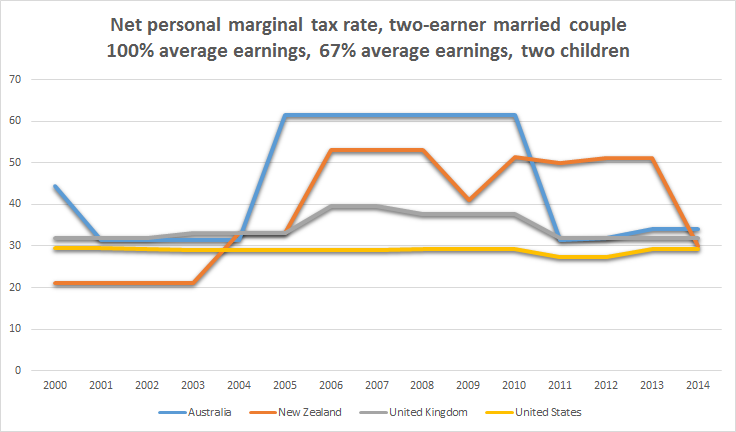
Source: OECD StatExtract.
Celebrating humanity's flourishing through the spread of capitalism and the rule of law
23 Aug 2015 Leave a comment
in economic history, economics of love and marriage, labour economics, labour supply, politics - Australia, politics - New Zealand, politics - USA, public economics Tags: Australia taxation and labour supply, British economy, marriage and divorce
Source: OECD StatExtract.
22 Aug 2015 Leave a comment
in economic history, economics of love and marriage, labour economics, labour supply, politics - Australia, politics - New Zealand, politics - USA Tags: Australia, British economy, marriage and divorce, taxation and labour supply
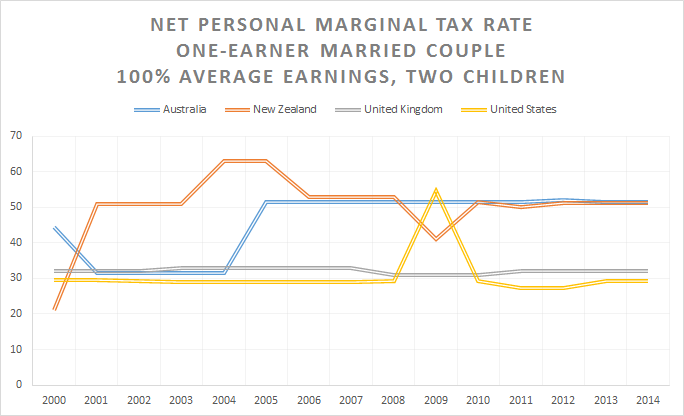
Source: OECD StatExtract.
19 Aug 2015 Leave a comment
in economic growth, fiscal policy, labour economics, labour supply, macroeconomics, politics - Australia, politics - New Zealand Tags: Australia, lost decades, marriage and divorce, productivity shocks, real business cycles, taxation and labour supply
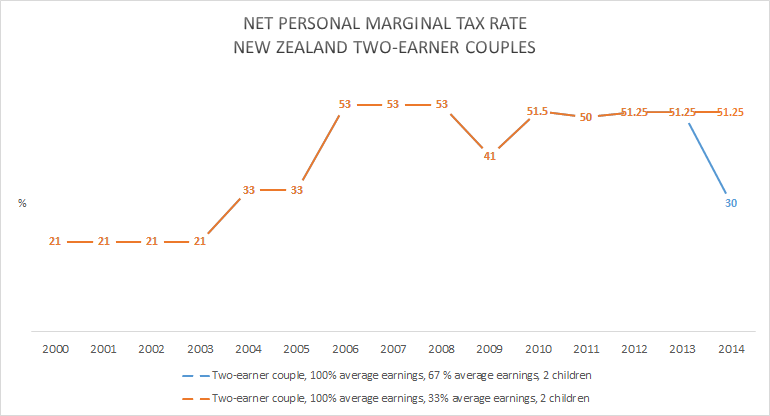
In 2000 in New Zealand, the marginal tax rates of single earners, married couples and dual income couples were 21%.
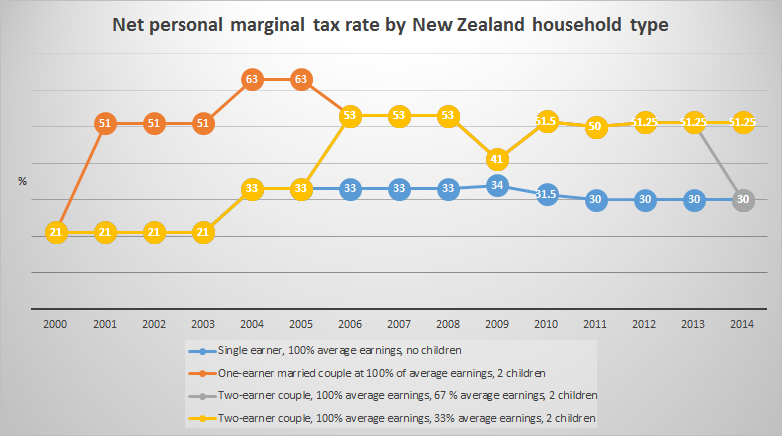
Sources: OECD StatExtract.and OECD Taxing Wages.
Net personal marginal income tax rates increased:
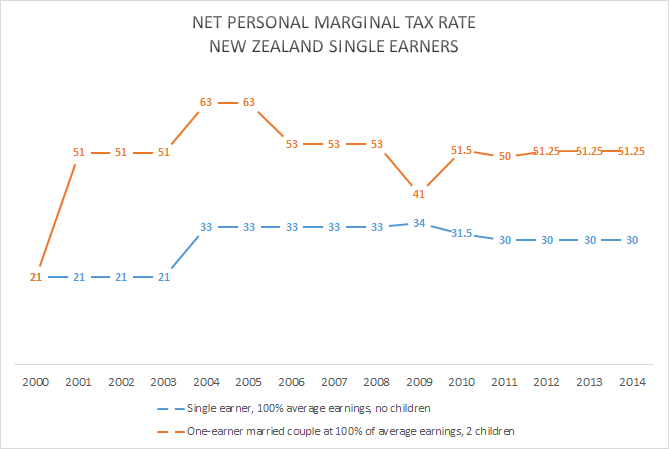
Sources: OECD StatExtract.and OECD Taxing Wages.
Net personal marginal income tax rates increased:
Sources: OECD StatExtract.and OECD Taxing Wages.
These large increases in marginal tax rates on single earners and families coincided with a slowing of the economy in about 2005. The economy started to pick up again when there were tax cuts introduced by the incoming National Party Government. Is that more than a coincidence?
Sources: Computed from OECD StatExtract and The Conference Board. 2015. The Conference Board Total Economy Database™, May 2015, http://www.conference-board.org/data/economydatabase/.
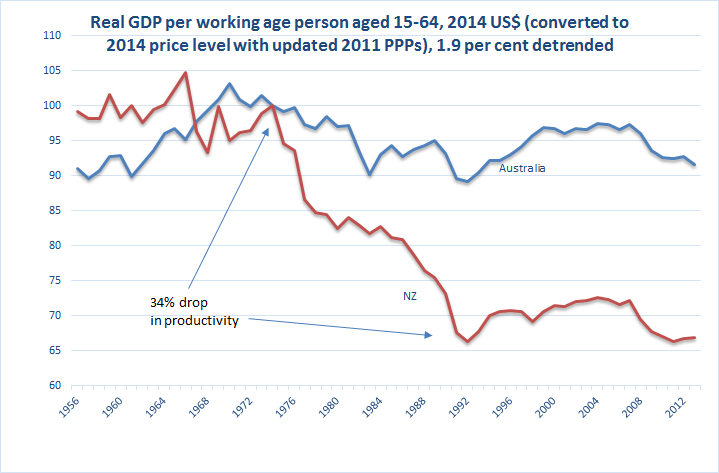
A flat line in the above figure is growth at the trend growth rate of 1.9% of the USA in the 20th century. A rising line is above trend growth for that year while a falling lined is below trend rate in GDP per working age person.
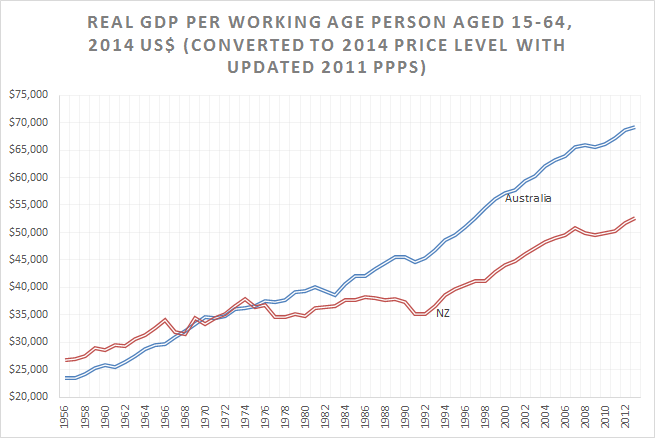
In the lost decades of New Zealand growth between 1974 In 1992, New Zealand lost 34% against trend growth which was never recovered. There was about 13 years of sustained growth at about the trend rate or slightly above that between 1992 and 2005. The entire income gap between Australia and New Zealand open up during these lost decades of growth between 1974 and 1992.
Sources: Computed from OECD StatExtract and The Conference Board. 2015. The Conference Board Total Economy Database™, May 2015, http://www.conference-board.org/data/economydatabase/.
Australia grew pretty much in its trend rate of growth since the 1950s. The so-called resources boom is not visible such as showing up as above trend rate growth.
16 Aug 2015 Leave a comment
in economic history, gender, labour economics, labour supply, politics - USA, population economics, welfare reform Tags: abortion, economics of fertility, marriage and divorce, single mothers, single parents, teen pregnancy
US Teen Pregnancy, Birth and Abortion Rates since 1972 http://t.co/mwR1U6WJg8—
Max Roser (@MaxCRoser) August 06, 2015
15 Aug 2015 Leave a comment
in economics of love and marriage, human capital, labour economics, law and economics, welfare reform Tags: child rearing, economics of families, marital division of labour, marriage and divorce
More time with mom has little to no effect on children's well-being: thesocietypages.org/socimages/2015… http://t.co/zyirz1QvQs—
(@SocImages) April 08, 2015
12 Jul 2015 Leave a comment
in discrimination, economics of love and marriage, gender, labour economics, labour supply, law and economics, occupational choice, politics - USA, poverty and inequality Tags: asymmetric marriage premium, British economy, Canada, gender wage gap, marriage and divorce, motherhood penalty
Figure 1: Female/male earnings ratio by partner status and motherhood, 2004 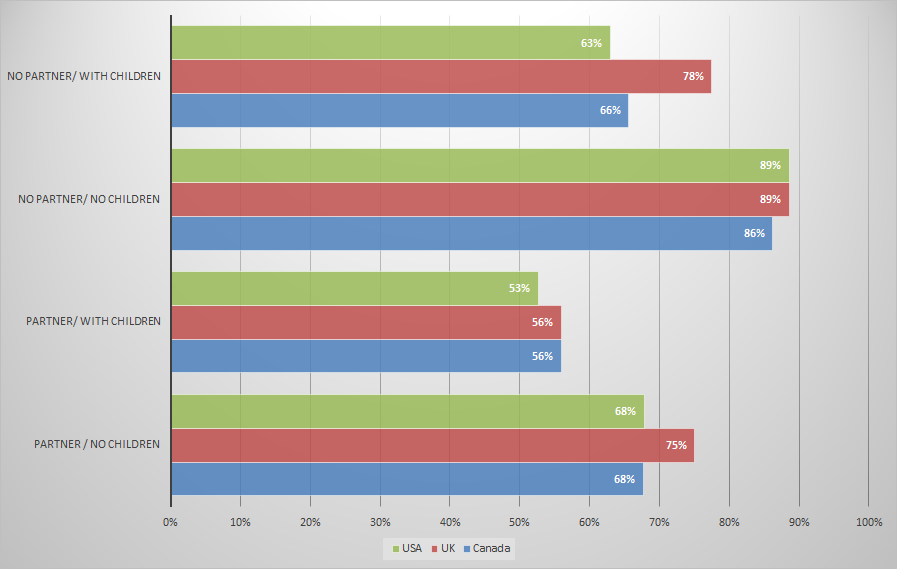 Source: LIS Cross-National Data Center in Luxembourg – Wave VI; individuals with positive earnings only. .
11 Jul 2015 Leave a comment
in economics of love and marriage, labour economics, labour supply, law and economics, politics - Australia, politics - USA, poverty and inequality, welfare reform Tags: Australia, British economy, Canada, child poverty, family poverty, marriage and divorce, single mothers, single parents
Figure 1: poverty rates by age of youngest child, 2004

07 Jul 2015 1 Comment
in economics of love and marriage, law and economics Tags: family demographics, marriage and divorce
Most People Marry Someone Their Own Age: dadaviz.com/i/3343 #dataviz http://t.co/bZ90LtK508—
Randy Olson (@randal_olson) February 24, 2015
07 Jul 2015 Leave a comment
in discrimination, economics of love and marriage, gender, labour economics, labour supply, law and economics Tags: economics of fertility, female labour force participation, household division of labour, marriage and divorce, maternal labour force participation
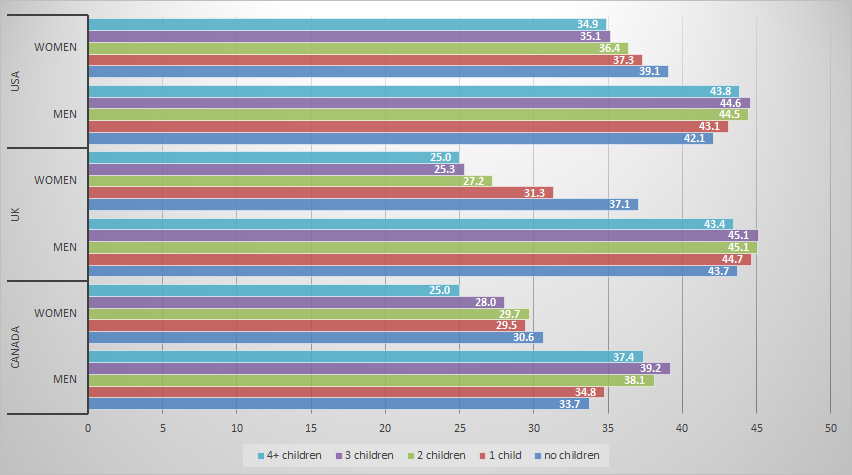
Figure 1: average weekly working hours for Current or Last Job(s) Held aged 20-54 by gender, 2004
05 Jul 2015 Leave a comment
in economic history, economics of love and marriage, economics of media and culture, law and economics, politics - USA Tags: economics of families, family demographics, marriage and divorce
Mawwiage. Mawwiage is wut bwings togetha… men who are about 2.5yrs older than their female counterparts. http://t.co/KQqKmNJn7P—
Tyler Vigen (@TylerVigen) May 25, 2015
03 Jul 2015 Leave a comment
in economics of love and marriage, law and economics Tags: household division of labour, household production, marriage and divorce
30 Jun 2015 Leave a comment
in economics of love and marriage, law and economics, politics - USA Tags: economics of marriage, gave marriage, marriage and divorce
Arnie had the perfect response to a man criticising his pro-gay marriage photo i100.io/sGqSNTQ http://t.co/kfweyy8xAW—
i100 (@thei100) June 30, 2015
12 Jun 2015 Leave a comment
in discrimination, economics of love and marriage, gender, labour economics, labour supply, law and economics, occupational choice Tags: economics of the family, home production, household division of labour, marriage and divorce
#Dailychart: How the average day of American mums and dads has changed since 1965 econ.st/1Hi43yt http://t.co/tY5DSpdVKN—
The Economist (@EconBizFin) June 08, 2015
11 Jun 2015 Leave a comment
Divorce used to be biggest engine of single parenthood in America. No more. It's nonmarital childbearing cc@davidfrum http://t.co/J5yZtUukNW—
W Bradford Wilcox (@WilcoxNMP) June 10, 2015
Celebrating humanity's flourishing through the spread of capitalism and the rule of law
Scholarly commentary on law, economics, and more
Beatrice Cherrier's blog
Celebrating humanity's flourishing through the spread of capitalism and the rule of law
Celebrating humanity's flourishing through the spread of capitalism and the rule of law
Celebrating humanity's flourishing through the spread of capitalism and the rule of law
Why Evolution is True is a blog written by Jerry Coyne, centered on evolution and biology but also dealing with diverse topics like politics, culture, and cats.
Celebrating humanity's flourishing through the spread of capitalism and the rule of law
Celebrating humanity's flourishing through the spread of capitalism and the rule of law
A rural perspective with a blue tint by Ele Ludemann
DPF's Kiwiblog - Fomenting Happy Mischief since 2003
Celebrating humanity's flourishing through the spread of capitalism and the rule of law
The world's most viewed site on global warming and climate change
Tim Harding's writings on rationality, informal logic and skepticism
A window into Doc Freiberger's library
Let's examine hard decisions!
Commentary on monetary policy in the spirit of R. G. Hawtrey
Thoughts on public policy and the media
Celebrating humanity's flourishing through the spread of capitalism and the rule of law
Politics and the economy
A blog (primarily) on Canadian and Commonwealth political history and institutions
Reading between the lines, and underneath the hype.
Economics, and such stuff as dreams are made on
"The British constitution has always been puzzling, and always will be." --Queen Elizabeth II
Celebrating humanity's flourishing through the spread of capitalism and the rule of law
Celebrating humanity's flourishing through the spread of capitalism and the rule of law
WORLD WAR II, MUSIC, HISTORY, HOLOCAUST
Undisciplined scholar, recovering academic
Celebrating humanity's flourishing through the spread of capitalism and the rule of law
Res ipsa loquitur - The thing itself speaks
Celebrating humanity's flourishing through the spread of capitalism and the rule of law
Researching the House of Commons, 1832-1868
Articles and research from the History of Parliament Trust
Reflections on books and art
Posts on the History of Law, Crime, and Justice
Celebrating humanity's flourishing through the spread of capitalism and the rule of law
Exploring the Monarchs of Europe
Cutting edge science you can dice with
Small Steps Toward A Much Better World
“We do not believe any group of men adequate enough or wise enough to operate without scrutiny or without criticism. We know that the only way to avoid error is to detect it, that the only way to detect it is to be free to inquire. We know that in secrecy error undetected will flourish and subvert”. - J Robert Oppenheimer.
The truth about the great wind power fraud - we're not here to debate the wind industry, we're here to destroy it.
Celebrating humanity's flourishing through the spread of capitalism and the rule of law
Celebrating humanity's flourishing through the spread of capitalism and the rule of law
Economics, public policy, monetary policy, financial regulation, with a New Zealand perspective
Celebrating humanity's flourishing through the spread of capitalism and the rule of law
Restraining Government in America and Around the World
 Utopia, you are standing in it!
Recent Comments