
From https://www.tandfonline.com/doi/full/10.1080/17419166.2013.802983?scroll=top&needAccess=true
Celebrating humanity's flourishing through the spread of capitalism and the rule of law
17 Dec 2018 Leave a comment
in applied price theory, comparative institutional analysis, constitutional political economy, defence economics, economics of bureaucracy, Public Choice Tags: Arab Spring, economics of revolutions, Gordon Tullock, military coups
16 Jul 2016 Leave a comment
in applied price theory, comparative institutional analysis, constitutional political economy, defence economics, economics of bureaucracy, Gordon Tullock, Public Choice, rentseeking Tags: economics of revolutions, fall of communism, military coups, people power, Romania
The obituaries today for Victor Stanculescu, the Romanian army chief at the time of the 1989 revolution, vindicated Gordon Tullock’s view that popular revolutions are in fact military coups.
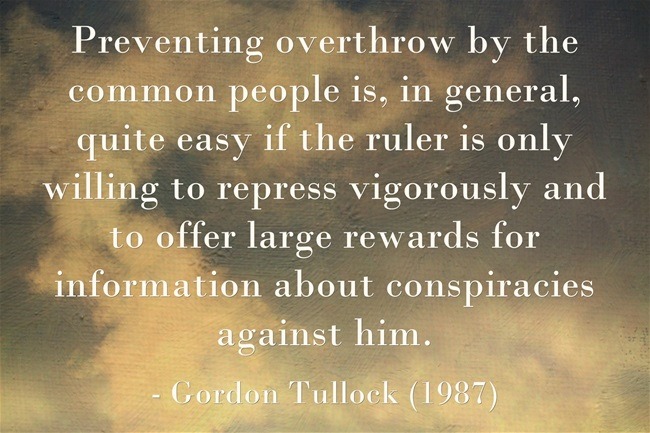
Tullock argues that any dictator can survive popular revolts as long as he has
Ordinary citizens obey dictators because if they don’t, they are highly unlikely to make any difference in any revolt and could get killed during the uprising even if it succeeds. Worse awaits them if the revolt fails.
Most dictators do not anoint a formal successor while they are in office. Tullock argued that as soon as a likely successor emerges, loyal retainers start to form alliances with that person and may see private advantage in bringing his anointed day forward.
More than a few autocrats were murdered in their sleep. To his very last day, Stalin locked his bedroom door because he did not trust the bodyguards who had been with him since the 1920s.
The role of street protests in the Arab Spring was to throw in the possibility of mutinies and desertions in the army and police. Previous alliances are thrown into doubt especially as the autocrat is old and sick, but had for many years grooming his 39 year-old son to inherit power.
Turning back to the Romanian revolution, Victor Stanculescu was the recently appointed army chief and initially stuck by the regime. He ordered the troops to open fire on protesters and at least 1000 died from in the shootings in the street.
In common with the Arab Spring, a large street protest did led him to reconsider his position:
Sniffing Mr. Ceausescu’s defeat, General Stanculescu quickly returned to Bucharest, where he faked a broken leg to avoid further counterrevolutionary deployment. Promoted to defense minister after the incumbent minister killed himself, he helped Mr. Ceausescu and his wife, Elena, flee by helicopter from the roof of party headquarters.
But fearing that the copter had been spotted by radar and would be shot down, the pilot hastily landed. Mr. Ceausescu hijacked a passing car, but he and his wife were soon surrounded and arrested.
After the couple were captured, General Stanculescu organized their trial by a military court and recruited the firing squad (before the verdict, by some accounts) that executed them on Christmas Day. He then joined the new government.
But for this late switch by the army chief, the popular revolt would never have succeeded. The army was needed to put down the still loyal security police. The army chief’s top priority was to execute Ceausescu as quickly as possible so that he was not a rallying point for a counter coup.
Ceausescu found out that his game was up when who he thought was his still loyal army chief arrived at his hideout with military judges to try and execute him.
About 10 years later, the Romanian government turned against the man who made the revolution and put him in prison for the many deaths in the street when he was on the side of the regime putting down the revolt.
Not so good an idea. A little bit of forgiveness carries a lot of weight encouraging late switching within the ruling elite and army that makes the difference to bringing down the old regime.
24 May 2016 Leave a comment
in constitutional political economy, defence economics, international economics, Public Choice, rentseeking Tags: autocracy, customs unions, emerging democracies, free trade agreements, military coups, preferential trading agreements
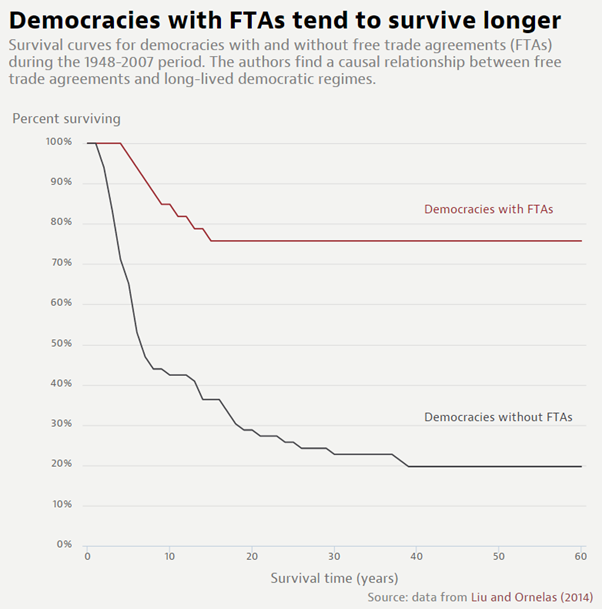
Source: “Free Trade Agreements and the Consolidation of Democracy” (April 2014) American Economic Journal: Macroeconomics. American Economic Association.
16 Nov 2015 Leave a comment
in constitutional political economy, Public Choice Tags: British politics, expressive voting, military coups, rational ignorance, rational rationality, voter demographics
01 Apr 2015 Leave a comment
in economics of bureaucracy, Gordon Tullock, income redistribution, Public Choice, rentseeking Tags: Arab Spring, autocracy, military coups, palace coups, popular revolutions
[I]n most revolutions, the people who overthrow the existing government were high officials in that government before the revolution.
If they were deeply depressed by the nature of the previous government’s policies, it seems unlikely that they could have given enough cooperation in those policies to have risen to high rank. People who hold high, but not supreme, rank in a despotism are less likely to be unhappy with the policy of that despotism than are people who are outside the government.
Thus, if we believed in the public good motivation of revolutions, we would anticipate that these high officials would be less likely than outsiders to attempt to overthrow the government.
From the private benefit theory of revolutions, however, the contrary deduction would be drawn. The largest profits from revolution are apt to come to those people who are (a) most likely to end up at the head of the government, and (b) most likely to be successful in overthrow of the existing government. They have the highest present discounted gain from the revolution and lowest present discounted cost.
Thus, from the private goods theory of revolution, we would anticipate senior officials who have a particularly good chance of success in overthrowing the government and a fair certainty of being at high rank in the new government, if they are successful, to be the most common type of revolutionaries.

23 Mar 2014 1 Comment
in Gordon Tullock, political change, Public Choice Tags: Arab Spring, autocracy, free-riders, military coups, people power, popular revolutions, succession crisis in politics
The Arab Spring is a good example of Gordon Tullock’s consideration of revolutions as palace coups that sometimes occur against the background of street protests. For Tullock, the puzzle is not that popular revolutions are so rare, but that they happen at all.
The role of street protests in the Arab Spring was to throw in the possibility of mutinies and desertions in the army and police. Previous alliances are thrown into doubt especially as the autocrat is old and sick, but had been for many years grooming his young son to inherit his power.
Ordinary citizens obey dictators because if they don’t, they are highly unlikely to make any difference in any revolt and could get killed during the uprising even if it succeeds. Worse awaits them if the revolt fails.
To stay in power, Tullock considers that an autocrat needs a moderately competent secret police willing to torture and kill, and a policy of rewarding generously those who betray coup plotters. Of course, the plotters must be shot.
Autocrats are fundamentally insecure. Wintrobe wrote of the “Dictator’s Dilemma” – the problem facing any ruler of knowing how much support he has among the general population, as well as among smaller groups with the power to depose him. Most dictators are overthrown by the higher officials of their own regime.
Most dictators do not anoint a formal successor while they are in office. Tullock argued that as soon as a likely successor emerges, loyal retainers start to form alliances with that person and may see private advantage in bringing his anointed day forward. Can’t have that.
More than a few autocrats were murdered in their sleep. To his very last day, Stalin locked his bedroom door because he did not trust the bodyguards who had been with him since the 1920s.
As for the populace, the autocrat must use both the carrot and the stick to buy loyalty. It is tricky to get the right mix of repression and co-optation due to lack of information. So dictators pay very high wages to select groups to secure their loyalty, especially the military and police. The communist party of the USSR started with 100,000 members in 1920. By the early 1980s, co-optation left it with 26 million members with the ensuing privileges.
Perfectly ordinary regular armed forces, with no counterinsurgency doctrine or training whatsoever, have in the past regularly defeated insurgents by using well-proven methods.
The simple starting point is that insurgents are not the only ones who can intimidate or terrorise civilians.
For instance, whenever insurgents are believed to be present in a village, small town, or city district, the local notables can be compelled to surrender them to the authorities, under the threat of escalating punishments, all the way to mass executions. That is how the Ottoman Empire controlled entire provinces with a few feared janissaries and a squadron or two of cavalry.
Terrible reprisals to deter any form of resistance were standard operating procedure for the German armed forces in the Second World War. Compare occupied France with the U.S. in Iraq:
On the side-lines, even better, watching it all on TV is the safest place for most to be in a popular revolution, uprising or insurgency.
Unless you control key military resources in the capital, what you do personally does not matter to the success of the revolution. Sticking your neck out can get you shot at or perhaps tortured. A classic ‘free rider’ dilemma.
If you must get involved, the best place to be in a mounting revolution is to be a ‘late switcher’. Switch sides when you are sure of joining the winning side. Back the winner just as he is about to win.
One reason for those post-revolution and post-coup purges is the small number of people actually involved in overthrowing the old autocrat and who actually stuck their necks out while plotting the coup do not trust their Johnny-come-lately new allies. They turn on these late-switchers before they change sides again to support a further coup of their own or a counter-coup.
People power in Manila in 1986 had a lot to do with late switching in a coup plot.
Originally, a military coup was planned by General Ramos and Defence Minister Enrile against the dying Marcos.
The coup plotters feared for their lives under Imelda. The plot was uncovered. Assassins were dispatched.
Ramos and Enrile gave up on forming a military junta and threw their lot with Cory Aquino and her popular movement in the hope that the army would split or hold off until the lay of the land was clearer, which the army did. That 1986 military coup and the coup attempts in succeeding years were staffed by different cabals of these late switchers.
Yeltsin on that tank in Moscow with a loud hailer was great TV, but remember he was calling for the army and security forces to switch sides or at least stay neutral. They did.
The mid-1980s Russian leaders were old and sick, so many ambitious younger army officers and nomenklatura saw their main chance if they boxed real clever and switched sides just at the right moment.
After every change of leadership in the USSR, there is a redistribution of patronage. Perestroika and Glasnost were, on closer inspection, another round of these reallocations of patronage. Patronage to their own entourages are routine for new autocrats throughout history.
Every Russian leader had his own reform initiatives after entering office and had periodic anti-corruption purges to redistribute the rents of high government offices and state-owned enterprise management positions to the up-and-comers he could trust more. Like Khrushchev, Gorbachev also wanted to transfer resources away from the military. Gorbachev went further and wanted to stop bleeding money and resources to the communist satellite states of Eastern Europe.
It also should be always remembered that Qadaffi got his main chance to take over when he was a mere Colonel Qadaffi leading a small group of junior officers. Colonels control strategic components of the military but are not as well paid as those in the autocrat’s inner circle.
Generals are often close to the leadership; their appointments are usually somewhat political and benefit from generous patronage from the autocrat. They have little to gain but their life to lose in a coup plot.
Enough military coups are led by more junior officers seizing their main chance. This make their generals nervous enough about their own survival in a colonels’ coup to strike first and displace the current autocrat before they are the next to be arrested and share his fate. There is then a post-coup realignment of patronage to buy off the junior officers.
Nasser did not believe that he, as a lieutenant-colonel, would be accepted by the Egyptian people and so he and the Free Officers Movement selected a general to be their nominal boss and lead the coup in 1952. Nasser did not become Prime Minister until 1954 after a spell as a minister and then as Deputy Prime Minister.
What appears to be a popular uprising is normally a split within the government. The Arab Spring, not by coincidence, occurred during a succession crisis in Egypt. President Mubarak has been very old and sick for a long time. Gamal Mubarak was old enough to covet the presidency but would have a large entourage of his own that would take many of the lucrative posts from his father’s retainers and courtiers.
A few autocrats call elections and retire abroad. The gratitude of the populace and the uncertain identity of his successors creates a big enough break in the traffic to allow the dictator to get to the airport alive.
Celebrating humanity's flourishing through the spread of capitalism and the rule of law
Scholarly commentary on law, economics, and more
Beatrice Cherrier's blog
Celebrating humanity's flourishing through the spread of capitalism and the rule of law
Celebrating humanity's flourishing through the spread of capitalism and the rule of law
Celebrating humanity's flourishing through the spread of capitalism and the rule of law
Why Evolution is True is a blog written by Jerry Coyne, centered on evolution and biology but also dealing with diverse topics like politics, culture, and cats.
Celebrating humanity's flourishing through the spread of capitalism and the rule of law
Celebrating humanity's flourishing through the spread of capitalism and the rule of law
A rural perspective with a blue tint by Ele Ludemann
DPF's Kiwiblog - Fomenting Happy Mischief since 2003
Celebrating humanity's flourishing through the spread of capitalism and the rule of law
The world's most viewed site on global warming and climate change
Tim Harding's writings on rationality, informal logic and skepticism
A window into Doc Freiberger's library
Let's examine hard decisions!
Commentary on monetary policy in the spirit of R. G. Hawtrey
Thoughts on public policy and the media
Celebrating humanity's flourishing through the spread of capitalism and the rule of law
Politics and the economy
A blog (primarily) on Canadian and Commonwealth political history and institutions
Reading between the lines, and underneath the hype.
Economics, and such stuff as dreams are made on
"The British constitution has always been puzzling, and always will be." --Queen Elizabeth II
Celebrating humanity's flourishing through the spread of capitalism and the rule of law
Celebrating humanity's flourishing through the spread of capitalism and the rule of law
WORLD WAR II, MUSIC, HISTORY, HOLOCAUST
Undisciplined scholar, recovering academic
Celebrating humanity's flourishing through the spread of capitalism and the rule of law
Res ipsa loquitur - The thing itself speaks
Celebrating humanity's flourishing through the spread of capitalism and the rule of law
Researching the House of Commons, 1832-1868
Articles and research from the History of Parliament Trust
Reflections on books and art
Posts on the History of Law, Crime, and Justice
Celebrating humanity's flourishing through the spread of capitalism and the rule of law
Exploring the Monarchs of Europe
Cutting edge science you can dice with
Small Steps Toward A Much Better World
“We do not believe any group of men adequate enough or wise enough to operate without scrutiny or without criticism. We know that the only way to avoid error is to detect it, that the only way to detect it is to be free to inquire. We know that in secrecy error undetected will flourish and subvert”. - J Robert Oppenheimer.
The truth about the great wind power fraud - we're not here to debate the wind industry, we're here to destroy it.
Celebrating humanity's flourishing through the spread of capitalism and the rule of law
Celebrating humanity's flourishing through the spread of capitalism and the rule of law
Economics, public policy, monetary policy, financial regulation, with a New Zealand perspective
Celebrating humanity's flourishing through the spread of capitalism and the rule of law
Restraining Government in America and Around the World

 Utopia, you are standing in it!
Recent Comments