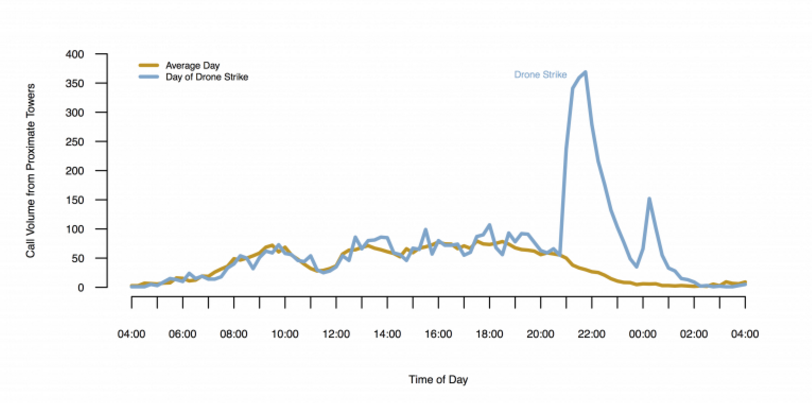
Drone strikes on terrorist cell phone users by time of day in Yemen

I will worry about terrorists in a more serious way when they stop using their mobile phones. I worry even more when they stop blabbing to everyone at the local mosque about their intentions.

image

Source: Fotini Christia, Leon Yao, Stephen Wittels, and Jure Leskovec | Seven Things Cell Data Shows About Life In Yemen, Foreign Affairs (July 2015).

Hypocritical Greens betray NZ sovereignty to US court decision but oppose investor state dispute settlement on sovereignty grounds

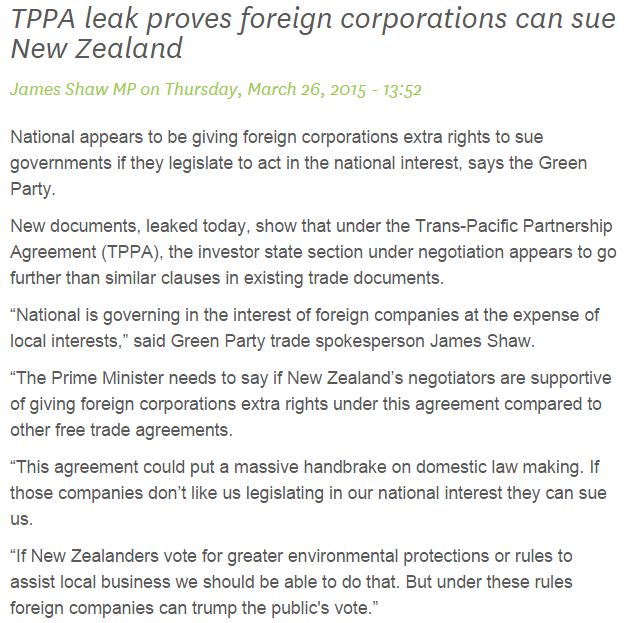
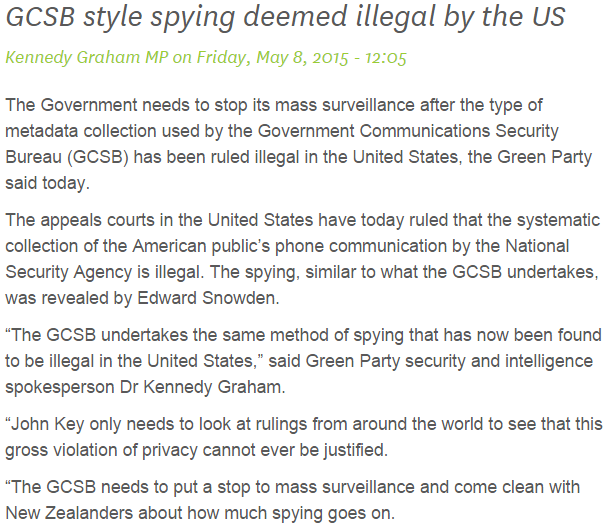
The Greens are happy to betray New Zealand’s sovereignty to a US court where New Zealand’s side of the story was not heard, New Zealand was not a litigant, New Zealand was not named in the proceedings and New Zealand had not agreed to waive its sovereign immunity under US law.

image

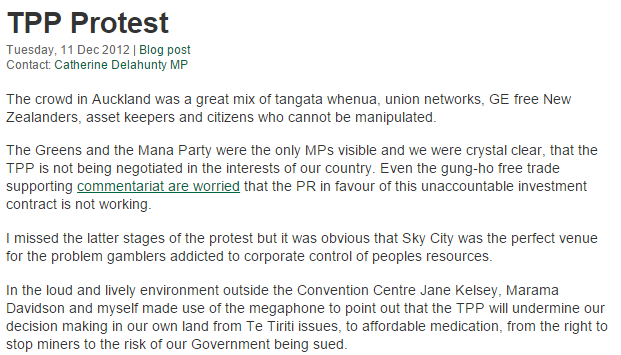
The Greens on the other hand are hysterical about the prospect of New Zealand voluntarily submitting to investor state disputes settlement through an international treaty. International treaties normally are about trading in sovereignty: you give up some form of sovereignty return for something you value more.

image

It is thoroughly hypocritical of the Greens to argue the New Zealand should bow down to a foreign court when that court rules in a way that it favours its ideological agenda but refuse to support the principle of international arbitration in circumstances where that may advance New Zealand’s national interests.

image

At a minimum, New Zealand itself chose to give up its sovereignty if it agrees to investor state dispute settlement in a trade agreement. The decision was not imposed by a foreign court where it was not heard nor was a party.

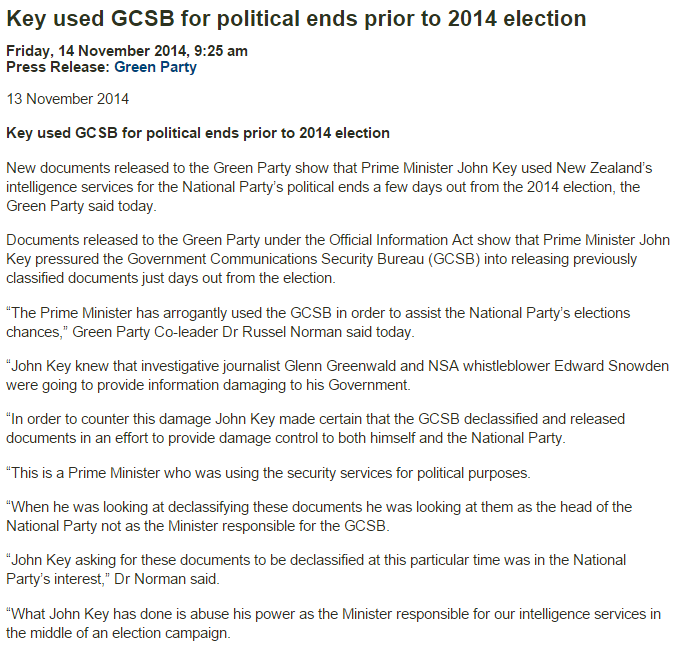
Of particular concern to the Greens is international arbitration could "trump the public’s vote vote". New Zealand has repeatedly elected parties that support the alliance with America, and support a robust security and intelligence policy, including electronic surveillance as part of the war on terror.

The last week of the 2014 general election campaign was dominated by the Government Security Communications Bureau and its cooperation with the National Security Agency and the extent to which New Zealand security services engaged in electronic surveillance in New Zealand and abroad.

image

The Greens want to subvert that democratic decision that has been repeated over many New Zealand elections about national security and foreign relations to defer to an American court when New Zealand didn’t even appear as a party.

image

The US Court of appeal was deciding an issue of statutory interpretation of the Patriot Act. There was no constitutional issues at hand.

The Patriot Act expires in a month unless it is extended. Congress has ample opportunity to amend the renewed law to overturn the appeal court’s decision for the future operation of its security and intelligence laws.

The Greens want a Court of Appeal interpretation of the American Patriot Act to extend to New Zealand without a vote of the New Zealand people or the parliament having any say on whether to give up New Zealand’s sovereignty or waive sovereign immunity in American courts.


.

On mass electronic surveillance and combating terrorism

Image

Richard A. Posner – Our Domestic Intelligence Crisis

via Richard A. Posner – Our Domestic Intelligence Crisis.

Edward Snowden Is No Hero – The New Yorker

Any marginally attentive citizen, much less N.S.A. employee or contractor, knows that the entire mission of the agency is to intercept electronic communications…

What makes leak cases difficult is that some leaking—some interaction between reporters and sources who have access to classified information—is normal, even indispensable, in a society with a free press.

It’s not easy to draw the line between those kinds of healthy encounters and the wholesale, reckless dumping of classified information by the likes of Snowden or Bradley Manning.

Indeed, Snowden was so irresponsible in what he gave the Guardian and the Post that even these institutions thought some of it should not be disseminated to the public. The Post decided to publish only four of the forty-one slides that Snowden provided. Its exercise of judgment suggests the absence of Snowden’s…

The American government, and its democracy, are flawed institutions. But our system offers legal options to disgruntled government employees and contractors. They can take advantage of federal whistle-blower laws; they can bring their complaints to Congress; they can try to protest within the institutions where they work.

But Snowden did none of this. Instead, in an act that speaks more to his ego than his conscience, he threw the secrets he knew up in the air—and trusted, somehow, that good would come of it. We all now have to hope that he’s right.

via Edward Snowden Is No Hero – The New Yorker.

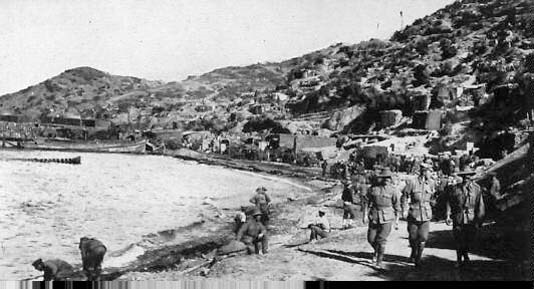
Anzac Day: why did we fight at Gallipoli?

Australia and New Zealand were filled with first and second generation migrants happy to rally to defend their mother country:

  • 12 per cent of the population of New Zealand volunteered to fight; and
  • 13 per cent of the male population of Australia volunteered to fight in World War 1.

The people and governments of New Zealand and Australia of that time were British to their boot straps. The Union Jack was in their flags for a reason.

Our specific quarrel with the Ottoman Empire was it joined Germany and others to be at war with the UK, Australia and New Zealand.

clip_image001

Removing the Ottoman Empire from that war would have strengthened Russia. A stronger Russia would have weakened Germany and its allies and brought the war to an earlier end.

The governments of Australian and New Zealand fell over themselves to declare war and pledge troops in 1914.

World War 1 started in the middle of an Australian election campaign in 1914.

In the September 1914 election, both opposition leader Andrew Fisher and Prime Minister Joseph Cook stressed Australia’s unflinching loyalty to Britain, and Australia’s readiness to take its place with the allied countries.

Labor Party leader Fisher’s campaign pledge was to:

stand beside the mother country to help and defend her to the last man and the last shilling.

Labor defeated the incumbent government to win majorities in both houses. Billy Hughes and his nationalist party won the 1917 election in a landslide.

New Zealanders had even a better chance to reflect on the war-making choices of their leaders in 1914.

Our election was in December of 1914. The passions of the moment had some chance to calm, and the fighting has started for real.

The will of the people was a 90 per cent vote for the war parties. New Zealanders could have voted for the Labour MPs, several of whom were later imprisoned for their anti-conscription activities or for refusing military service.

In New Zealand, after that wartime election, the Prime Minister was an Irish Protestant who formed a coalition with an Irish Catholic as his deputy.

Do you know of a superior mechanism to elections for measuring the will of the people? Are elections inadequate to the task of deciding if the people support a war and that support of the public is based on well-founded reasons?

The reasons for New Zealand and Australia fighting are the just cause of fighting militarism and territorial conquest, empire solidarity, regional security interests such as the growing number of neighbouring German colonies, and long-term national security. A victorious Germany would have imposed a harsh peace.

New Zealand and Australian national security is premised on having a great and powerful friend. That was initially Britain. When the USA arrived in 1941 as a better great and powerful friend, the British were dropped like a stone.
Truth on the Market

Scholarly commentary on law, economics, and more

The Undercover Historian

Beatrice Cherrier's blog

Matua Kahurangi

Celebrating humanity's flourishing through the spread of capitalism and the rule of law

Temple of Sociology

Celebrating humanity's flourishing through the spread of capitalism and the rule of law

Velvet Glove, Iron Fist

Celebrating humanity's flourishing through the spread of capitalism and the rule of law

Why Evolution Is True

Why Evolution is True is a blog written by Jerry Coyne, centered on evolution and biology but also dealing with diverse topics like politics, culture, and cats.

Down to Earth Kiwi

Celebrating humanity's flourishing through the spread of capitalism and the rule of law

NoTricksZone

Celebrating humanity's flourishing through the spread of capitalism and the rule of law

Homepaddock

A rural perspective with a blue tint by Ele Ludemann

Kiwiblog

DPF's Kiwiblog - Fomenting Happy Mischief since 2003

The Dangerous Economist

Celebrating humanity's flourishing through the spread of capitalism and the rule of law

Watts Up With That?

The world's most viewed site on global warming and climate change

The Logical Place

Tim Harding's writings on rationality, informal logic and skepticism

Doc's Books

A window into Doc Freiberger's library

The Risk-Monger

Let's examine hard decisions!

Uneasy Money

Commentary on monetary policy in the spirit of R. G. Hawtrey

Barrie Saunders

Thoughts on public policy and the media

Liberty Scott

Celebrating humanity's flourishing through the spread of capitalism and the rule of law

Point of Order

Politics and the economy

James Bowden's Blog

A blog (primarily) on Canadian and Commonwealth political history and institutions

Science Matters

Reading between the lines, and underneath the hype.

Peter Winsley

Economics, and such stuff as dreams are made on

A Venerable Puzzle

"The British constitution has always been puzzling, and always will be." --Queen Elizabeth II

The Antiplanner

Celebrating humanity's flourishing through the spread of capitalism and the rule of law

Bet On It

Celebrating humanity's flourishing through the spread of capitalism and the rule of law

History of Sorts

WORLD WAR II, MUSIC, HISTORY, HOLOCAUST

Roger Pielke Jr.

Undisciplined scholar, recovering academic

Offsetting Behaviour

Celebrating humanity's flourishing through the spread of capitalism and the rule of law

JONATHAN TURLEY

Res ipsa loquitur - The thing itself speaks

Conversable Economist

Celebrating humanity's flourishing through the spread of capitalism and the rule of law

The Victorian Commons

Researching the House of Commons, 1832-1868

The History of Parliament

Articles and research from the History of Parliament Trust

Books & Boots

Reflections on books and art

Legal History Miscellany

Posts on the History of Law, Crime, and Justice

Sex, Drugs and Economics

Celebrating humanity's flourishing through the spread of capitalism and the rule of law

European Royal History

Exploring the Monarchs of Europe

Tallbloke's Talkshop

Cutting edge science you can dice with

Marginal REVOLUTION

Small Steps Toward A Much Better World

NOT A LOT OF PEOPLE KNOW THAT

“We do not believe any group of men adequate enough or wise enough to operate without scrutiny or without criticism. We know that the only way to avoid error is to detect it, that the only way to detect it is to be free to inquire. We know that in secrecy error undetected will flourish and subvert”. - J Robert Oppenheimer.

STOP THESE THINGS

The truth about the great wind power fraud - we're not here to debate the wind industry, we're here to destroy it.

Lindsay Mitchell

Celebrating humanity's flourishing through the spread of capitalism and the rule of law

Alt-M

Celebrating humanity's flourishing through the spread of capitalism and the rule of law

croaking cassandra

Economics, public policy, monetary policy, financial regulation, with a New Zealand perspective

The Grumpy Economist

Celebrating humanity's flourishing through the spread of capitalism and the rule of law

International Liberty

Restraining Government in America and Around the World

Environmental and Urban Economics

Celebrating humanity's flourishing through the spread of capitalism and the rule of law