In another neoliberal victory, income taxes became more progressive in recent decades

In another neo-liberal victory, health and welfare spending shares have doubled in the last 50 years

Desperately seeking a neoliberal conspiracy to slash taxes to the bone in Australia and New Zealand

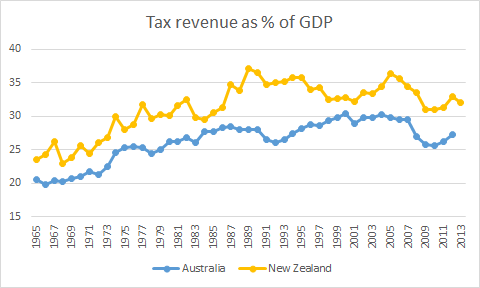
If our friends on the Left are to be believed, governments fell under the spell of a flying visit by Milton Friedman and his local neoliberal cronies and slashed taxes to the bone from about the mid-1980s in Australia and New Zealand.

image

Source: Revenue Statistics – Comparative tables.

In Australia’s case, the only time tax revenue as a percentage of GDP fell prior to the election of a Labour government in 2007 was during a deep recession in 1991. This was a recession bought on by irresponsible monetary policy by Paul Keating– the Keating recession.

As for New Zealand, the tax take increase quite considerably under tax reforms of the Labour Government  of the 1980s. Roger Douglas, far from being a neoliberal plant, seemed to be a double secret agent of a tax maximising Leviathan. Little wonder the New Zealand economy was sluggish in the late 1980s because of this large increases in the tax take.

Mendicant NZ artist denounces neoliberalism and tall poppy syndrome in same breath

Man Booker Prize author Eleanor Catton from New Zealand managed in the same interview in India to denounce the neoliberalism of New Zealand’s current government and then denounce the tall poppy syndrome that cuts down artistic elites such as herself down to size when they become successful.

At the moment, New Zealand, like Australia and Canada, (is dominated by) these neo-liberal, profit-obsessed, very shallow, very money-hungry politicians who do not care about culture

This is tremendous a hypocrisy: to denounce a neoliberal philosophy that supposedly favours the elite over the working class and then complain about members of the elite such as herself are not supported sufficiently from the taxpayers’ tough:

We have this strange cultural phenomenon called “tall poppy syndrome”; if you stand out, you will be cut down…

If you get success overseas then very often the local population can suddenly be very hard on you. Or the other problem is that the local population can take ownership of that success in a way that is strangely proprietal.

Catton manages to denounce neoliberalism and the capitalist competition that entails but then gets quite annoyed over the fact the successful people aren’t rewarded and recognised by the country.

What hypocrisy. She denounces neoliberalism and then complains about been cut down because of her success. If you’re an opponent of neoliberalism, there is some obligation on you to argue for a levelling of income and wealth, including your own.

It betrays an attitude towards individual achievement which is very, uncomfortable. It has to belong to everybody or the country really doesn’t want to know about it…

I’ve really struggled with my identity as a New Zealand writer. I feel uncomfortable being an ambassador for my country when my country is not doing as much as it could, especially for the intellectual world.

Catton is particularly upset over the fact that New Zealand is expected to share her fame with them some way.  Obviously, Catton believes in private profits, private fame at social losses and public subsidies for the arts. Having to share what she earns is not part of her opposition to neoliberalism.

From each in accordance with their ability, to each in according to their need is the heart of the anti-neoliberal philosophy, or is it Robert Nozick’s capitalistic acts between consenting adults where it is from each as they choose, to each as they are chosen, especially if you’re a successful artist.

Such is the price neoliberalism is Eleanor Catton, like every other able-bodied adult, is expected to earn a living for themselves by producing something that someone wants a profitable global for them rather than expect a hand-out from the government simply because of the desire of the recipients to receive the money. In her case, her claim for government hand-outs is because she happens to be artistic.

Jim Hacker: “So they insult me and then expect me to give them more money?”
Sir Humphrey: “Yes, I must say it’s a rather undignified posture. But it is what artists always do: crawling towards the government on their knees, shaking their fists.”
Jim Hacker: “Beating me over the head with their begging bowls.”
Bernard Woolley: “Oh, I am sorry to be pedantic, Prime Minister, but they can’t beat you over the head if they’re on their knees. Unless of course they’ve got very long arms.”

Apparently, this is how the Mont Pelerin Society rules the roost!?

Solid lines refer to funding and dashed lines refer to mostly ideological connections

HT:  old-rothschild-and-rockefeller-hands-controlled-the-libertarian-communist-dialectic/

How much of the political spectrum is neoliberal (and under the Svengali influence of the @MontPelerinSoc)?

When I feud with strangers on other blogs about neoliberalism, I often asked them is to nominate which parties are neoliberal. Obviously the right-wing parties are neoliberal.

What is routine, however, is for this remnant of the Left over Left to nominate the Labour Party as a cauldron of neoliberalism as well. Tony Blair, Bob Hawke, and Paul Keating are hate figures as is Roger Douglas in New Zealand.

Neoliberalism is more about smearing labour parties than the right-wing parties, and, in particular, factional enemies further to the right with you on the old Left. Looks like to be a neoliberal is what it was like to be a capitalist running dog in the days of the cultural revolution.

These days it’s quite common to nominate the Mont Pelerin Society as the global ringmaster of neoliberalism.

bookjacketCover: The Road from Mont Pèlerin in HARDCOVER

As global ringmasters go, they have a crap website. The super profits of supreme power should at least extend to a decent website.

Eric Crampton was tweeting live from his first meeting of the Mont Pelerin Society a few weeks ago. I asked him how did it feel to be in the inner circles of supreme power. His tweet was they must hold all the conspiratorial meetings in side rooms because he did not feel any more powerful than the previous day at his desk at his University

No one had ever heard of the Mont Pelerin society until the Twitter Left put it at the centre of a global conspiracy.

It is much easier to do to explain your defeat at elections on a conspiracy, rather than on your ideas having been tried and failed time and again.

These allegations  of a secret conspiracy led by the Mont Pelerin society is a rarity in the stock and fair of conspiracy theories. The leader of the conspiracy is actually unknown. Most conspiracy theories allege that the secret machinations are by relatively well-known people you are trying to smear or don’t like.

These allegations of a global conspiracy led by academics is the ultimate ego trip by proxy. Academics dream of supreme power. When they do not have this power themselves, they fantasise that the right-wingers at the other end of the corridor at their university have it instead.

The most fundamental fact about the ideas of the political left is that they do not work. Therefore we should not be surprised to find the left concentrated in institutions where ideas do not have to work in order to survive.  - Thomas Sowell

Fact check: conspiracy theories aren’t just for conservatives

Respondents were asked whether they agreed with four statements:

  • “Much of our lives are being controlled by plots hatched in secret places,”
  • “Even though we live in a democracy, a few people will always run things anyway,”
  • “The people who really ‘run’ the country are not known to the voters.”
  • “Big events like wars, the current recession, and the outcomes of elections are controlled by small groups of people who are working in secret against the rest of us.”

Source: monkey cage

American conservatives distrust science in part because they identify it with the regulatory state. When science means nuclear weapons, innovation and winning the space race, conservatives love it.  When they associate science with the EPA, regulation, and global institutions, they hate it.

Just as climate science is unpalatable for the Right, the Left is uncomfortable with, for example, genetic modification and nuclear power. Research into risks and benefits of these technologies are met with suspicion by the Left.

I find it bizarre the right wing politics is considered more conspiratorial than the left wing – a left-wing that is currently obsessed with the comings and goings of the top 1%.

A gentleman by the name of Karl Marx had a conspiracy theory of history, that the bosses were conspiring against the workers, there is a ruling class pulling the strings from behind the scenes, and there is an inherent inequality of bargaining power between workers and employers because the bosses plot to keep wages down.

It should be mentioned in this connection that Karl Marx himself was one of the first to emphasize the importance, for the social sciences, of these unintended consequences.

In his more mature utterances, he says that we are all caught in the net of the social system. The capitalist is not a demoniac conspirator, but a man who is forced by circumstances to act as he does; he is no more responsible for the state of affairs than is the proletarian.

This view of Marx’s has been abandoned – perhaps for propagandist reasons, perhaps because people did not understand it – and a Vulgar Marxist Conspiracy theory has very largely replaced it. It is a come-down – the come-down from Marx to Goebbels.

But it is clear that the adoption of the conspiracy theory can hardly be avoided by those who believe that they know how to make heaven on earth. The only explanation for their failure to produce this heaven is the malevolence of the devil who has a vested interest in hell.

Karl Popper

Don’t let me start on how the Left over Left goes on about neoliberal conspiracy with Hayek and Friedman ruling the roost through the truly obscure Mont Pelerin Society.

bookjacketCover: The Road from Mont Pèlerin in HARDCOVER

The IMF, World Trade Organisation and trade negotiations are riddled with conspiracies if I am to believe my friends in the  Left over Left.

Mention multinational corporations to a member of the Left of good standing and conspiracy theories pour fourth.

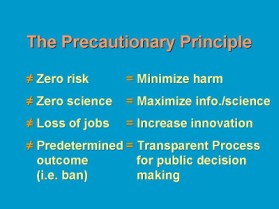
It would be unfair to bring up GMOs to remind the left of how anti-science it is. Don’t kick people when they’re down. The whole point of the precautionary principle is to allow the Left to reject good science.

At bottom, what call the barricades works if it’s not sexed-up with a conspiracy theory?

Some on the Left believe the @MontPelerinSoc is the ringmaster of a vast neo-liberal conspiracy

bookjacket Cover: The Road from Mont Pèlerin in HARDCOVER

Few had even heard of the Mont Pelerin Society until the late 1990s and the internet age. The ringmaster of the neoliberal conspiracy still has a very ordinary looking webpage.

Lead conspirator Hayek was so little known at his death in 1992 that finding extensive obituaries of him in newspapers is hard. Some may be behind pay walls. Of those that were found, they weren’t very long and forgot to mention Hayek as the leader of a global cabal that rule the waves  :

When Keynesian thought prevailed and his reputation went into eclipse, Mr. Hayek turned to philosophy and psychology, which he first taught at the University of Chicago, where he wrote what many consider to be a second masterpiece, “The Constitution of Liberty “.

His son’s obituaries in 2006 were longer and more fulsome than his father’s mostly on the back of who his now famous father were:

Lawrence Hayek escaped from the formidable shadow of his father, the great economist-philosopher, Professor F. A. Hayek, into high-level medical research within the NHS, only to spend much of his final decade responding to the worldwide interest in the scholar many regard — along with Milton Friedman — as the father of Thatcherism.

Hayek, the Mont Pelerin Society’s and neoliberal conspiracy’s alleged linchpin wasn’t even able to get a job in the University of Chicago economics department. Along with Mises, their salaries were paid by a private foundation. Neither could get paid university appointments in the United States. Hayek was Keynes’s principal critic in the 1930s, and upon Keynes’s death in 1946, the most famous economist in the world at that time.

Despite being a colony of the vast neo-liberal conspiracy, mentioning Milton Friedman’s name in the 1980s at job interviews in Canberra would have been extremely career limiting. Not much better in the early 1990s.

  • Back in the 1980s, the much less radical Milton Friedman was just graduating from being ‘a wild man in the wings’ to just a suspicious character in policy circles.
  • If you name dropped Hayek in the 1980s and 1990s, any sign of name recognition would have indicated that you were been interviewed by educated people.

How times has changed. The reasons are well summarised by Bruce Caldwell:

But how important were [members of the Mont Pèlerin Society] in the emerging global consensus that began in the 1980s in favour of trade liberalization and privatization?

Were not, for example, the dismal performance of Keynesian demand management policies in the United States, Britain, and elsewhere in the 1970s; the heavy-handed actions of the trade unions in Britain during the “Winter of Discontent”; the sclerotic performance of countries like India who had embraced a modified version of the planning model for their own; and, of course, the patent economic and political failures of the East Bloc, far more important in turning the tide, however briefly, towards globalization?

Was not George Stigler (himself a founding member of the Society) right in his comment about economists that “our influence appears to be powerful only when we support policies ripe for adoption” (Stigler 1987, p. 11)?

see Daniel Stedman Jones (2012). Masters of the Universe: Hayek, Friedman, and the Birth of Neoliberal Politics and P. Mirowski and D. Plehwe, eds. (2009), The Road from Mont Pelerin: The Making of the Neoliberal Thought Collective for the handbook on the cabal leading the vast right-wing conspiracy. For example,

The Road from Mont Pèlerin presents the key debates and conflicts that occurred among neoliberal scholars and their political and corporate allies regarding trade unions, development economics, antitrust policies, and the influence of philanthropy. The book captures the depth and complexity of the neoliberal “thought collective” while examining the numerous ways that neoliberal discourse has come to shape the global economy.

Masters of the Universe traces the ascendancy of neoliberalism from the academy of interwar Europe to supremacy under Reagan and Thatcher and in the decades since. Daniel Stedman Jones argues that there was nothing inevitable about the victory of free-market politics. Far from being the story of the simple triumph of right-wing ideas, the neoliberal breakthrough was contingent on the economic crises of the 1970s and the acceptance of the need for new policies by the political left.

Margaret Thatcher, Hayek & Friedman | Margaret Thatcher Foundation

Thatcher read Hayek’s Road to Serfdom as an undergraduate at Oxford. She took away two key lessons for her life: you cannot compromise with socialism, even the mild social democratic forms; and she saw her own party was doing just that, which put her deeply at odds with its leadership.

After she became Leader of the Opposition, Thatcher cut short a leftish member of her own  Conservative Party Research Department by showing him a copy of The Constitution of Liberty, slamming it down on the table declaring “this is what I believe”.

Thatcher’s relationship with Milton Friedman was different to that of Hayek and not as long standing. Friedman met Thatcher for the first time at a dinner in 1978.

After Thatcher came to office in 1979, Friedman was a critic of the monetary regime of the Thatcher government, questioning her monetary policy targets,  questioning the raising of the value added tax to finance income tax cuts,  and urging deeper spending cuts in the 1979 budget. Friedman was also a strong critic of the monetary policies of the Fed at that time as well, arguing that they lacked credibility, transparency and were very erratic.

In a letter to the Times on 3 March 1980 Friedman stated that he opposed “fine-tuning” and strongly preferred:

a steady monetary and fiscal policy announced long in advance and strictly adhered to

Hayek disagreed with Friedman about the role of gradualism in a letter to the Times on 26 March 1980:

The chief practical issue today is how fast inflation can be and ought to be stopped.

On this, I am afraid, my difference from Friedman makes me take an even more radical position.

The reason is that I believe that the artificial stimulus which inflation gives to business and employment lasts only so long as inflation accelerates, that is, so long as prices turn out to be higher than expected.

Inflation clearly cannot accelerate indefinitely, but as soon as it ceases to accelerate, all the windfalls due to prices turning out higher than expected, which kept unprofitable businesses and employment going, disappear.

Every slowing down of inflation must therefore produce temporary conditions of extensive failures and unemployment.

No inflation has yet been terminated without a “stabilization crisis”.

To advocate that inflation should be slowed down gradually over a period of years is to advocate a long period of protracted misery. No government could stand such a course.

Milton Friedman’s general views on Britain when Thatcher first came to office were clear-cut and were also stated in his letter to the Times on 3 March 1980:

…while monetary restraint is a sufficient condition for controlling inflation, it is a necessary but not sufficient condition for improving Britain’s productivity – the fundamental requirement for restoring Britain to full economic health.

That requires measures on a broader front to restore and improve incentives, promote productive investment, and give a greater scope for private enterprise and initiative.

Both Hayek and Friedman wrote privately about the Thatcher policies of the early 1980s, decrying them as gradualism. So much for the retired professors as the ring masters of neo-liberalism and Thatcher as their pawn.

Friedman and Hayek disagreed with each other, in important respects, about both gradualism in monetary policy and  macroeconomics in general.

Thatcher did not follow their conflicting policy advice to her. At best, Thatcher was a wayward disciple of squabbling prophets.

Friedman was a strong critic of Austrian macroeconomics and its supposed role in the 1930s policy response or lack of a response to the Great Depression:

I think the Austrian business-cycle theory has done the world a great deal of harm.

If you go back to the 1930s, which is a key point, here you had the Austrians sitting in London, Hayek and Lionel Robbins, and saying you just have to let the bottom drop out of the world.

You’ve just got to let it cure itself. You can’t do anything about it. You will only make it worse. You have Rothbard saying it was a great mistake not to let the whole banking system collapse.

I think by encouraging that kind of do-nothing policy both in Britain and in the United States, they did harm.

Hayek was equally critical of the macroeconomics of Milton Friedman and his methodology in general:

I do indeed regard the abandonment of the whole macroeconomics nonsense as very important, but it is for me a very delicate matter and I have for some time avoided stating my views too bluntly and would not have time to state them adequately.

The source of the difficulty is the constant danger that the Mont Pelerin society might split into a Friedmanite and a Hayekian wing.

 I have long regretted my failure to take time to criticise Friedman’s Positive Economics almost as much as my failure to return to the critique of Keynes General Theory after I had dealt with his Treatiese.

It still seems to me paradoxical that Keynes, who was rather contemptuous of econometrics, should have become the main source of the revival of macroeconomics – which incidentally was also the reason why Milton was for a time a Keynesian.

I believe a good and detailed critical analysis of macroeconomics would be very desirable.

Brad Delong pointed out in 2000 that the New Keynesian macroeconomic research program was developed in the 20th century monetarist tradition mostly in the work of Milton Friedman.

Tom Sargent argued in 1981 that Thatcher’s medium term economic strategy was gradualism, and the sustained budget deficits would result in unpleasant monetarist arithmetic:

…In order that the current British plan be viewed as credible it is necessary that the large prospective government deficits over the next several years be counterbalanced by prospective surpluses further down the line.

It is difficult to point to much either in current legislation,  or equally importantly, in the general British political climate that could objectively support such an outlook.

…Gradualism invites speculation about future reversals with U-turns in policy.

Large contemporary government deficits unaccompanied by concrete prospects for future government surpluses promote realistic doubts about whether monetary restraint must be abandoned sooner or later to help finance the deficits.

Such doubts not only call into question the likelihood that the plan can successfully permanently reduce inflation, but also can  induce high real cost in terms of depressed industry and lengthened unemployment in response to what may be viewed as only temporary downward movements in nominal aggregate demand that the monetary restraint induces.

What did Thatcher actually do?

by discrediting socialism so thoroughly, she prompted in due course the adoption by the Labour Party of free market economics, and so, as she wryly confessed in later years, “helped to make it electable”.

The archives of the Margaret Thatcher foundation has released extensive correspondence and other documents about Thatcher, Hayek and Friedman.

via MT, Hayek & Friedman | Margaret Thatcher Foundation.
What is neoliberalism? Please tell me – show me one.

I want to meet someone who believes neoliberalism was the leading light of the economic reforms since 1980. They can then tell me what neoliberalism is. Please, tell me.

The prefix “neo-” makes “neoliberalism” sound like something that morphed into something bad. Is neoliberalism something more than a sustained sneer – a personal attack as a way of avoiding debate?

Not only is there no single definition of neoliberalism, there is no one who identifies himself or herself as a neoliberal. At least communists and socialists were proud to be called so.

In Neoliberalism: From New Liberal Philosophy to Anti-Liberal Slogan, Taylor Boas & Jordan Gans-Morse went in search of anyone who identifies one’s self as a neoliberal:

  • They did not uncover a single contemporary instance in which an author used the term self-descriptively, and only one – an article by New York Times columnist Thomas Friedman (1999) – in which neoliberal was applied to the author’s own policy recommendations.
  • Digging into the archives, they did find that while Milton Friedman (1951) embraced the neoliberal label and philosophy in one of his earliest political writings, he soon distanced himself from the term, trumpeting “old-style liberalism” in later manifestoes (Friedman 1955). See “Neo-liberalism and its Prospects”, Milton Friedman Papers, Box 42, Folder 8, Hoover Institution Archives. 1951. Hardly a smoking gun?

What Boas and Gans-Morse found, based on a content analysis of 148 journal articles published from 1990 to 2004, was that the term is often undefined. It is employed unevenly across ideological divides; it is used to characterise an excessively broad variety of phenomena.

That is academic speak for neoliberalism is an empty slogan.

Neoliberalism was supposed to rule the roost under Reagan, Thatcher, Hawke and Lange-Douglas. The local branches of neoliberalism were Thatchernomics, Rogernomics, and Reaganomics.

Milton Friedman is said to have mesmerised several countries with a flying visit. The Friedman Monday Conference on ABC in 1975 and by Hayek in 1976 are still ruling the Australian policy roost, if some serious public commentators are to be believed.

In the 1980s and up to the mid-1990s, despite all the neo-liberal deregulation and Milton Friedman taking over monetary policy, mentioning Friedman’s name at job interviews would have been extremely career limiting, and that was at the Australian Treasury.

Back then, the much less radical Friedman was just graduating from being a wild man in the wings to just a suspicious character.

If you name dropped Hayek in the early 1990s, any sign of name recognition would have indicated that you were being interviewed by educated people.

When the Left gets on its high horse and goes on about Hayek and Friedman running neoliberalism, with Hayek as Friedman’s mentor, it is refreshing to remind all how little they had in common on macroeconomics. The University of Chicago Department of Economics did not offer Hayek a job in the late 1940s despite his outstanding record at LSE as Keynes’ principal critic in the 1930s.

While working at the next desk to a monetary policy section in the late 1980s, when mortgage rates were 18%, I heard not a word of Friedman’s Svengali influence:

  • The mantra for several years was that the market determined interest rates, not the Reserve Bank. Joan Robinson would have been proud that her 1975 Monday conference was still holding the reins.
  • Monetary policy was targeting the current account. Read Edwards’ biography of Paul Keating’s time as Treasurer and Prime Minister and his extracts from very Keynesian treasury briefings to Keating signed by David Morgan that reminded me of Keynesian Macro 101.

As a commentator on an Australian Treasury seminar paper in 1986, Peter Boxhall – freshly educated from the 1970s Chicago School – suggested using monetary policy to reduce the inflation rate quickly to zero. David Morgan and Chris Higgins almost fell off their chairs. These Treasury Deputy CEOs had never heard of such radical ideas.

In their breathless protestations, neither Morgan nor Higgins were sufficiently in tune with their Keynesian education to remember the role of sticky wages or even the need for monetary growth reductions to be gradual and, more importantly, credible, as per Milton Friedman.

By the way, Friedman’s presidential address to the AEA in 1967 is now recognised as perhaps the single most influential journal article of the 20th century. That article is the essence of good communication and empirical testing of competing hypotheses as was his 1976 Noble Prize lecture. No wonder both were hidden from impressionable undergraduates such as me a few years after.

Next Newer Entries

Bassett, Brash & Hide

Celebrating humanity's flourishing through the spread of capitalism and the rule of law

Truth on the Market

Scholarly commentary on law, economics, and more

The Undercover Historian

Beatrice Cherrier's blog

Matua Kahurangi

Celebrating humanity's flourishing through the spread of capitalism and the rule of law

Temple of Sociology

Celebrating humanity's flourishing through the spread of capitalism and the rule of law

Velvet Glove, Iron Fist

Celebrating humanity's flourishing through the spread of capitalism and the rule of law

Why Evolution Is True

Why Evolution is True is a blog written by Jerry Coyne, centered on evolution and biology but also dealing with diverse topics like politics, culture, and cats.

Down to Earth Kiwi

Celebrating humanity's flourishing through the spread of capitalism and the rule of law

NoTricksZone

Celebrating humanity's flourishing through the spread of capitalism and the rule of law

Homepaddock

A rural perspective with a blue tint by Ele Ludemann

Kiwiblog

DPF's Kiwiblog - Fomenting Happy Mischief since 2003

The Dangerous Economist

Celebrating humanity's flourishing through the spread of capitalism and the rule of law

Watts Up With That?

The world's most viewed site on global warming and climate change

The Logical Place

Tim Harding's writings on rationality, informal logic and skepticism

Doc's Books

A window into Doc Freiberger's library

The Risk-Monger

Let's examine hard decisions!

Uneasy Money

Commentary on monetary policy in the spirit of R. G. Hawtrey

Barrie Saunders

Thoughts on public policy and the media

Liberty Scott

Celebrating humanity's flourishing through the spread of capitalism and the rule of law

Point of Order

Politics and the economy

James Bowden's Blog

A blog (primarily) on Canadian and Commonwealth political history and institutions

Science Matters

Reading between the lines, and underneath the hype.

Peter Winsley

Economics, and such stuff as dreams are made on

A Venerable Puzzle

"The British constitution has always been puzzling, and always will be." --Queen Elizabeth II

The Antiplanner

Celebrating humanity's flourishing through the spread of capitalism and the rule of law

Bet On It

Celebrating humanity's flourishing through the spread of capitalism and the rule of law

History of Sorts

WORLD WAR II, MUSIC, HISTORY, HOLOCAUST

Roger Pielke Jr.

Undisciplined scholar, recovering academic

Offsetting Behaviour

Celebrating humanity's flourishing through the spread of capitalism and the rule of law

JONATHAN TURLEY

Res ipsa loquitur - The thing itself speaks

Conversable Economist

Celebrating humanity's flourishing through the spread of capitalism and the rule of law

The Victorian Commons

Researching the House of Commons, 1832-1868

The History of Parliament

Articles and research from the History of Parliament Trust

Books & Boots

Reflections on books and art

Legal History Miscellany

Posts on the History of Law, Crime, and Justice

Sex, Drugs and Economics

Celebrating humanity's flourishing through the spread of capitalism and the rule of law

European Royal History

Exploring the Monarchs of Europe

Tallbloke's Talkshop

Cutting edge science you can dice with

Marginal REVOLUTION

Small Steps Toward A Much Better World

NOT A LOT OF PEOPLE KNOW THAT

“We do not believe any group of men adequate enough or wise enough to operate without scrutiny or without criticism. We know that the only way to avoid error is to detect it, that the only way to detect it is to be free to inquire. We know that in secrecy error undetected will flourish and subvert”. - J Robert Oppenheimer.

STOP THESE THINGS

The truth about the great wind power fraud - we're not here to debate the wind industry, we're here to destroy it.

Lindsay Mitchell

Celebrating humanity's flourishing through the spread of capitalism and the rule of law

Alt-M

Celebrating humanity's flourishing through the spread of capitalism and the rule of law

croaking cassandra

Economics, public policy, monetary policy, financial regulation, with a New Zealand perspective

The Grumpy Economist

Celebrating humanity's flourishing through the spread of capitalism and the rule of law

International Liberty

Restraining Government in America and Around the World