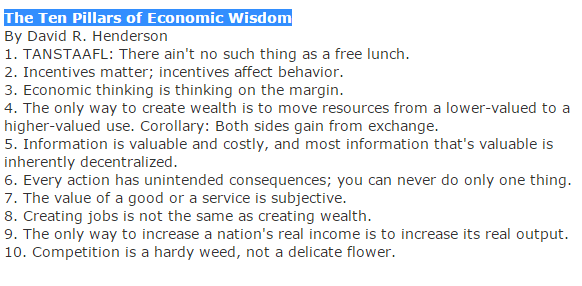
via The Ten Pillars of Economic Wisdom, David Henderson | EconLog | Library of Economics and Liberty.
Celebrating humanity's flourishing through the spread of capitalism and the rule of law
10 May 2015 Leave a comment
in applied price theory, applied welfare economics, Austrian economics, comparative institutional analysis, constitutional political economy, development economics, economic history, economics of education, economics of information, economics of media and culture, economics of regulation, energy economics, entrepreneurship, financial economics, health economics, history of economic thought, industrial organisation, survivor principle Tags: David Anderson, evidence-based policy, offsetting behaviour, pretence to knowledge, The fatal conceit, unintended consequences
via The Ten Pillars of Economic Wisdom, David Henderson | EconLog | Library of Economics and Liberty.
09 May 2015 Leave a comment
in applied price theory, applied welfare economics, Austrian economics, comparative institutional analysis, constitutional political economy, economics of regulation, F.A. Hayek Tags: Constitution of Liberty, cost benefit analysis, evidence-based policy, offsetting behaviour, The fatal conceit, The pretence to knowledge, unintended consequences
Happy Birthday, F.A. Hayek!
(8 May 1899 – 23 March 1992) http://t.co/K431Kj9nok—
Screwed by State (@ScrewedbyState) May 09, 2015
01 May 2015 Leave a comment
in economics of crime, economics of regulation, entrepreneurship, environmentalism, law and economics, property rights Tags: black markets, economics of prohibition, endangered species, offsetting behaviour, or unintended consequences
Animated #Dailychart: Bear bile, rhino horn, tiger bone–how much do animal products cost? econ.st/1nfrFKf http://t.co/oG5HtZvzOL—
The Economist (@ECONdailycharts) July 23, 2014
27 Apr 2015 Leave a comment
in applied price theory, applied welfare economics, comparative institutional analysis, Milton Friedman Tags: evidence-based policy, offsetting behaviour, The fatal conceit, The pretence to knowledge, unintended consequences
27 Mar 2015 Leave a comment
in applied price theory, applied welfare economics, Austrian economics, comparative institutional analysis, constitutional political economy, F.A. Hayek, liberalism, Public Choice, rentseeking Tags: evidence-based policy, offsetting behaviour, science and public policy, The fatal conceit, The pretence to knowledge, unintended consequences
Scientists dream about what could be.
Economists remind you of price tags and unintended consequences
28 Feb 2015 Leave a comment
in applied welfare economics, economics of regulation, rentseeking, transport economics Tags: gender neutral insurance premiums, offsetting behaviour, sex discrimination
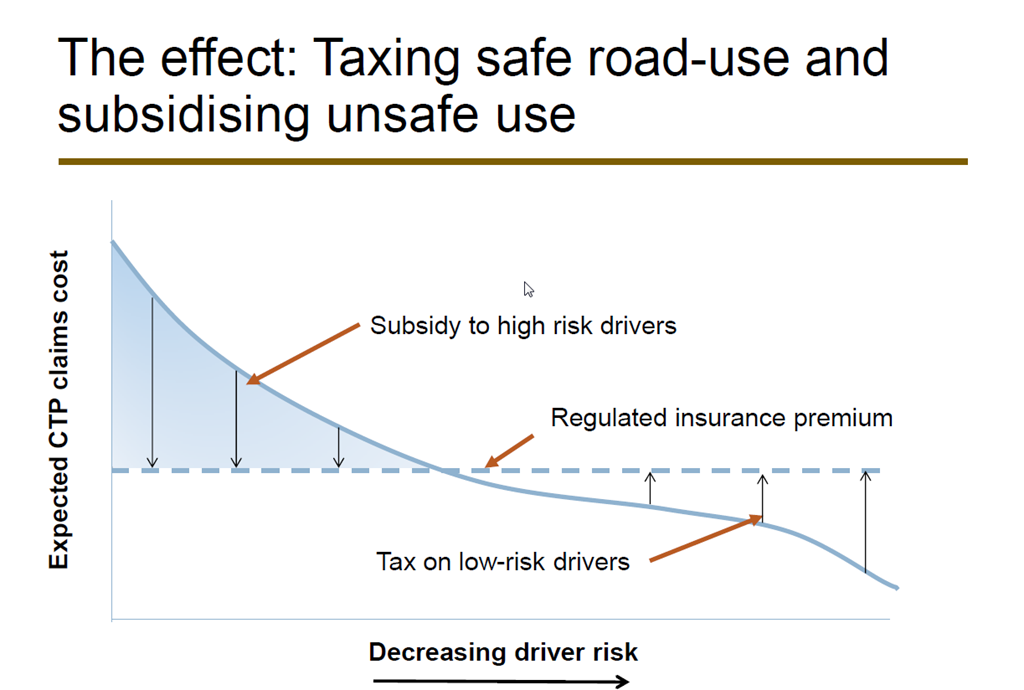
Thrill-seeking young men are prone to drive too fast, late at night, and cause horrific fatalities. Young males are 10 times more likely to be killed or injured than a driver aged over 35.

Young women’s car insurance premiums increased by 50% after insurers adjust their prices to comply with new European "gender neutral" rules on premiums.
.
25 Feb 2015 Leave a comment

27 Jan 2015 Leave a comment

07 Jan 2015 Leave a comment
in economics of regulation, health and safety, law and economics, Milton Friedman Tags: health and safety, Milton Friedman, offsetting behaviour, safety Nazis
11 Dec 2014 Leave a comment
in defence economics, war and peace Tags: bombing of Germany, game theory will, interrogation, offsetting behaviour, strategic behaviour, war on terror, World War II
Both the bombing of Germany and the CIA interrogation programmes of captured Al Qaeda terrorists have one thing in common. Their main achievement was not their intention.
Their main achievement was through the offsetting behaviour of their opponent to counter the bombing of Germany and the CIA interrogation program, respectively.

Much is made of whether the bombing of Germany did much damage to its targets and disrupted the German war economy.

The main benefit of the bombing of Germany is it destroyed the German air force. More than that, and much sooner than the destruction of the German air force by 1945, much of the German air force was withdrawn from the Eastern Front and the landing beaches of Normandy to defend Germany from bombing attack. The Germans conceded complete air superiority by the time of D-Day and conceded air supremacy to the Russian air force.

Another big bonus was a large number of those famous German 88 howitzers were withdrawn from the front for home air defence.

Another bonus was a substantial part of German aircraft production was moved to defensive capabilities rather than an attack capability. Munitions productions was redirected towards production of antiaircraft shells and flak. Substantial effort had to be redirected towards the construction of bomb shelters.
What cannot be denied is that 10 years ago when captured terrorists were in a sufficiently integrated organisation that they had useful information about each other, there was bipartisan support in the US Congress to be tough in interrogations. Congress knew exactly what was happening through classified briefings to select committees.
One of the results of these interrogations is it broke up Al Qaeda as a network. It degraded Al Qaeda as an organisation capable of launching major attacks with key terrorists at the centre with the skills and determination to be able to organise these large-scale attacks.

Because captured terrorists would be interrogated thoroughly, Al Qaeda had to change into a far more decentralised and less effective network to be less at risk to captured members informing on them sooner or later.
In its early days, Al Qaeda was happy to have key people going around with lots of information in their heads and coordinating everything from the centre because they thought they wouldn’t be interrogated thoroughly if captured. That is no longer the case. Al Qaeda translates as The Base. The jihad was supposed to have a structure, leadership and central direction and financing.

Al Qaeda was far more effective when directed from the centre. These days it can barely mount a random attack in the street by a mentally disturbed, barely literate recent recruit.

Anything more than these random attacks on the street risk exposure to the authorities through electronic interception and interrogation of captured terrorists followed quickly by a missile through the car window somewhere in the Middle East while tweeting.

As President Obama noted around the time that Bin Laden was killed, 20 out of the top 30 in the management structure of Al Qaeda had shared that fate under his administration along with their replacements not long after stepping into the dead man’s shoes.

Celebrating humanity's flourishing through the spread of capitalism and the rule of law
Scholarly commentary on law, economics, and more
Beatrice Cherrier's blog
Celebrating humanity's flourishing through the spread of capitalism and the rule of law
Celebrating humanity's flourishing through the spread of capitalism and the rule of law
Celebrating humanity's flourishing through the spread of capitalism and the rule of law
Why Evolution is True is a blog written by Jerry Coyne, centered on evolution and biology but also dealing with diverse topics like politics, culture, and cats.
Celebrating humanity's flourishing through the spread of capitalism and the rule of law
Celebrating humanity's flourishing through the spread of capitalism and the rule of law
A rural perspective with a blue tint by Ele Ludemann
DPF's Kiwiblog - Fomenting Happy Mischief since 2003
Celebrating humanity's flourishing through the spread of capitalism and the rule of law
The world's most viewed site on global warming and climate change
Tim Harding's writings on rationality, informal logic and skepticism
A window into Doc Freiberger's library
Let's examine hard decisions!
Commentary on monetary policy in the spirit of R. G. Hawtrey
Thoughts on public policy and the media
Celebrating humanity's flourishing through the spread of capitalism and the rule of law
Politics and the economy
A blog (primarily) on Canadian and Commonwealth political history and institutions
Reading between the lines, and underneath the hype.
Economics, and such stuff as dreams are made on
"The British constitution has always been puzzling, and always will be." --Queen Elizabeth II
Celebrating humanity's flourishing through the spread of capitalism and the rule of law
Celebrating humanity's flourishing through the spread of capitalism and the rule of law
WORLD WAR II, MUSIC, HISTORY, HOLOCAUST
Undisciplined scholar, recovering academic
Celebrating humanity's flourishing through the spread of capitalism and the rule of law
Res ipsa loquitur - The thing itself speaks
Celebrating humanity's flourishing through the spread of capitalism and the rule of law
Researching the House of Commons, 1832-1868
Articles and research from the History of Parliament Trust
Reflections on books and art
Posts on the History of Law, Crime, and Justice
Celebrating humanity's flourishing through the spread of capitalism and the rule of law
Exploring the Monarchs of Europe
Cutting edge science you can dice with
Small Steps Toward A Much Better World
“We do not believe any group of men adequate enough or wise enough to operate without scrutiny or without criticism. We know that the only way to avoid error is to detect it, that the only way to detect it is to be free to inquire. We know that in secrecy error undetected will flourish and subvert”. - J Robert Oppenheimer.
The truth about the great wind power fraud - we're not here to debate the wind industry, we're here to destroy it.
Celebrating humanity's flourishing through the spread of capitalism and the rule of law
Celebrating humanity's flourishing through the spread of capitalism and the rule of law
Economics, public policy, monetary policy, financial regulation, with a New Zealand perspective
Celebrating humanity's flourishing through the spread of capitalism and the rule of law
Restraining Government in America and Around the World



 Utopia, you are standing in it!
Recent Comments