Minimum standards for rental housing is back in the news in New Zealand. After some deaths in some rather nasty fires in rental houses without fire alarms, there are demands that landlords must put fire alarms in place and maintain those fire alarms. About a dozen people or so die in fires in New Zealand every year.
The fact that in the proposed regulation, landlords are also required to maintain those fire alarms – ensure they have batteries in them – is a microcosm of the economics of rental housing habitability laws.
Even when landlords put in fire alarms, low income tenants prefer to spend their money on something other than replacement batteries for those alarms. These tenants are presumed to be competent to vote and drive cars, but not manage the risk of fires in the houses in which they live.
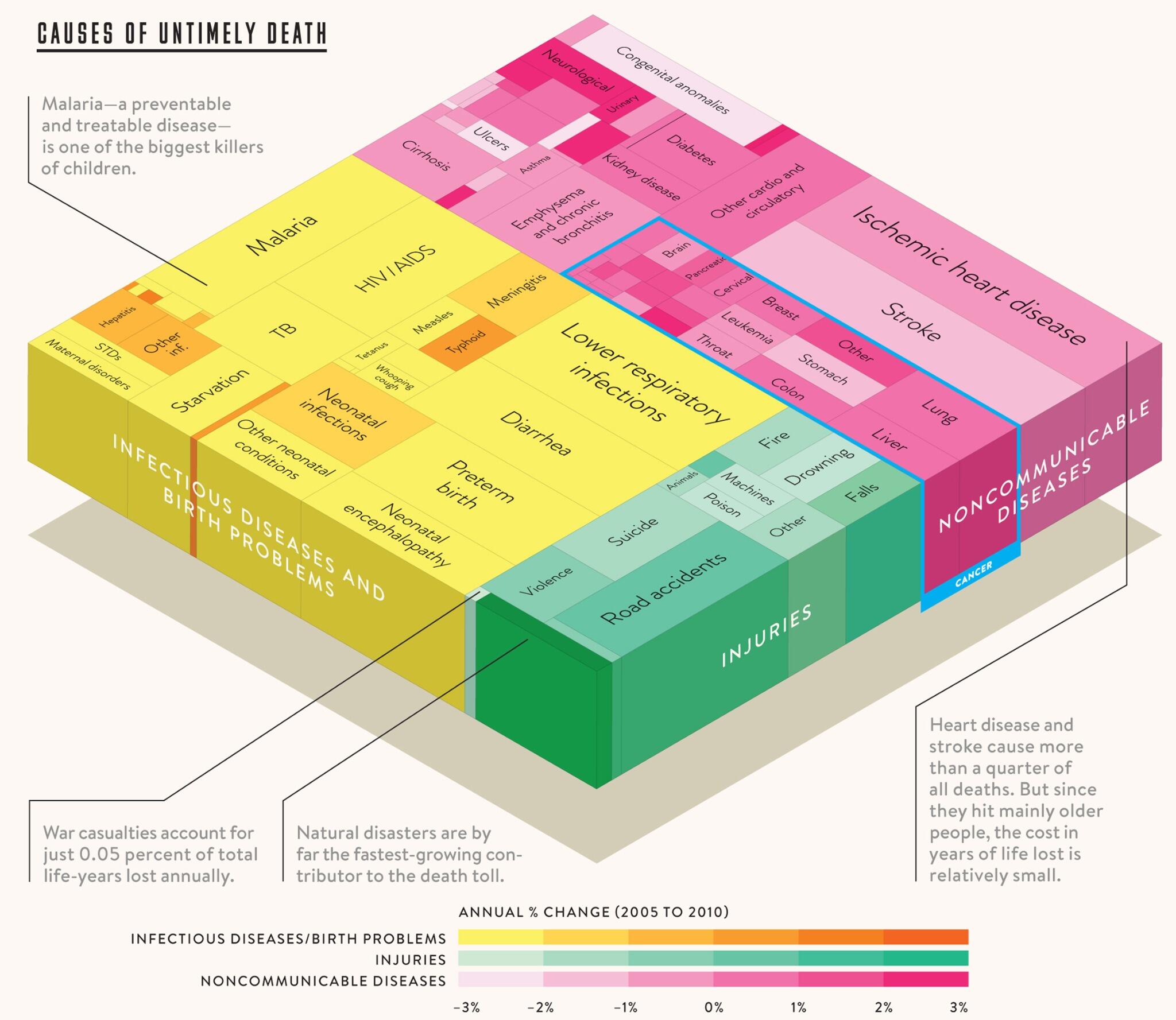
Maybe the reason for the lack of interest of low income tenants in putting batteries and fire alarms is domestic household fires are relatively rare these days. Fire is buried in the green area of the diagram below and is similar to drowning and falls.
The American data below suggests that your chances of dying by fire are about the same as dying from choking and a little worse from dying from post surgery complications.
Rather than in need of nudging, your average low income tenants seems to have it pretty right regarding the risks of dying in a fire.
When I went looking for some economics of housing habitability laws, Google was a bit of a disappointment. There are some empirical work done in the 1970s and early 1980s and then it fell away.
My suspicion is there is not so much empirical work on the economics of housing habitability laws because proving the obvious is not a good investment in Ph.D. topics or tenure track economic research.
The owner of ghetto housing differs little from any other purveyor of low-cost merchandise. In fact, he is no different from any purveyor of any kind of merchandise. They all charge as much as they can.
First consider the purveyors of cheap, inferior, and second-hand merchandise as a class. One thing above all else stands out about merchandise they buy and sell: it is cheaply built, inferior in quality, or second-hand.
A rational person would not expect high quality, exquisite workmanship, or superior new merchandise at bargain rate prices; he would not feel outraged and cheated if bargain rate merchandise proved to have only bargain rate qualities.
Our expectations from margarine are not those of butter. We are satisfied with lesser qualities from a used car than from a new car. However, when it comes to housing, especially in the urban setting, people expect, even insist upon, quality housing at bargain prices.
Richard Posner discussed housing habitability laws in his Economic Analysis of the Law. The subsection was titled wealth distribution through liability rules. Posner concluded that habitability laws will lead to abandonment of rental property by landlords and increased rents for poor tenants.
What do-gooder would want to know that a warranty of habitability for rental housing will lead to scarcer, more expensive housing for the poor! Surprisingly few interventions in the housing market work to the advantage of the poor.
It would be a mistake, however, to look upon a decline in substandard rental housing as an unmitigated gain. In fact, in the absence of substandard housing, options for indigent tenants are reduced. Some tenants are likely to end up in over-crowded standard units, or even homeless.
The objective of this paper is to analyse the extent to which membership of KiwiSaver has been associated with greater accumulations of net wealth.
The paper utilises two linked sources of data which cover the period 2002 to 2010: Statistics New Zealand’s Survey of Family, Income and Employment and Inland Revenue Department administrative data on KiwiSaver membership.
Two approaches are employed: difference-in-differences (where the outcomes of interest are changes in net wealth) and various panel regression techniques.
Results appear consistent with earlier evaluations of KiwiSaver. Neither approach suggests KiwiSaver membership has been associated with any positive effect on net wealth accumulation.
Legal bar closing times in England and Wales have historically been early and uniform.
Recent legislation liberalised closing times with the object of reducing social problems thought associated with drinking to “beat the clock.”
Colin P. Green, John S. Heywood and Maria Navarro (2013) showed that one consequence of this liberalization was a decrease in traffic accidents. This decrease was concentrated heavily among younger drivers. The effect was most pronounced in the hours of the week directly affected by the liberalization; late nights and early mornings on weekends.
On May 1, 1996, Ontario, Canada, amended the Liquor Licence Act to extend the hours of alcohol sales and service in licensed establishments from 1 AM to 2 AM.
Guest Blogger: Stephanie Gibson, Curator Contemporary Life & Culture Museum of New Zealand Te Papa Tongarewa
Many New Zealanders will remember the years of six o’clock closing of pubs. Urban pubs were often overcrowded, charmless places, where binge drinking took place in a race against the clock, resulting in the infamous ‘six o’clock swill’. Until the 1960s, alcohol could only be sold and consumed publicly in licensed places that provided accommodation. These were known as public hotels or ‘pubs’ for short.
In October 1917 New Zealand became the only country in the world to impose a nation-wide ban on the sale of liquor after six o’clock. Many believed that restricted access would result in less drinking. The ban lasted for 50 years until October 1967, when closing was brought forward to 10 o’clock by public vote.
Glassware, mid-1960s, by Crown Crystal Glass, New Zealand (GH021024-25, GH023164, GH024221, Te Papa) Standardised…
Reusable grocery bags often carry raw meat and are stored for convenience in the trunk of cars that sit outside in the sun. Reusable grocery bags are friendly breeding environment for E. coli bacteria, which can cause severe illness and death.
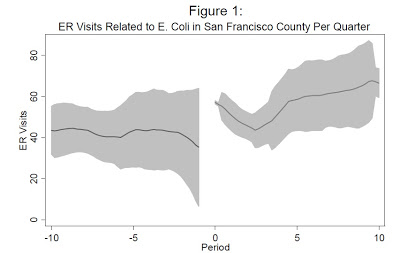
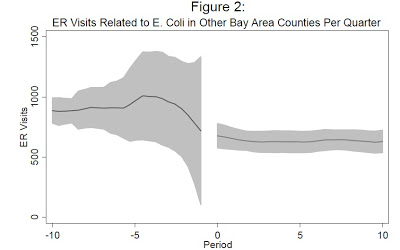
The above figure shows the number of emergency room visits in San Francisco County related to E. coli for the 10 quarters before and after the reusable grocery bags enactment of the ordinance: zero on the horizontal axis is the date the ordinance went into effect. The shaded area around the line is a 95% statistical confidence interval. There is a discontinuous jump in the number of emergency room visits immediately after the reusable grocery bags ordinance was enacted.
San Francisco experiences about 12 deaths per year from intestinal infections, and that the restrictions on plastic bags probably let to another 5-6 deaths per year in that city and several dozen additional hospitalisations.
John Schmitt lists 11 margins along which a minimum wage might cause changes:
Reduction in hours worked (because firms faced with a higher minimum wage trim back on the hours they want)
Reduction in non-wage benefits (to offset the higher costs of the minimum wage)
Reduction in money spent on training (again, to offset the higher costs of the minimum wage)
Change in composition of the workforce (that is, hiring additional workers with middle or higher skill levels, and fewer of those minimum wage workers with lower skill levels)
Higher prices (passing the cost of the higher minimum wage on to consumers)
Improvements in efficient use of labour (in a model where employers are not always at the peak level of efficiency, a higher cost of labour might give them a push to be more efficient)
“Efficiency wage” responses from workers (when workers are paid more, they have a greater incentive to keep their jobs, and thus may work harder and shirk less)
Wage compression (minimum wage workers get more, but those above them on the wage scale may not get as much as they otherwise would)
Reduction in profits (higher costs of minimum wage workers reduces profits)
Increase in demand (a higher minimum wage boosts buying power in overall economy)
Reduced turnover (a higher minimum wage makes a stronger bond between employer and workers, and gives employers more reason to train and hold on to workers)
Richard McKenzie argues that the biggest impact of a minimum wage increase is reductions to paid and unpaid benefits for minimum wage workers, including health insurance, store discounts, free food, flexible scheduling, and job security resulting from higher-skilled workers drawn to the higher minimum wage jobs:
Masanori Hashimot found that under the 1967 minimum-wage hike, workers gained 32 cents in money income but lost 41 cents per hour in training—a net loss of 9 cents an hour in full-income compensation. Several other researchers in independently completed studies found more evidence that a hike in the minimum wage undercuts on-the-job training and undermines covered workers’ long-term income growth.
Walter Wessels found that the minimum wage caused retail establishments in New York to increase work demands by cutting back on the number of workers and giving workers fewer hours to do the same work.
Belton Fleisher, L. F. Dunn, and William Alpert found that minimum-wage increases lead to large reductions in fringe benefits and to worsening working conditions.
Mindy Marks found that workers covered by the federal minimum-wage law were also more likely to work part time, given that part-time workers can be excluded from employer-provided health insurance plans.
McKenzie also argued that if the minimum wage does not cause employers to make substantial reductions in fringe benefits and increases in work demands, then an increased minimum should cause
(1) an increase in the labour-force-participation rates of covered workers (because workers would be moving up their supply of labour curves),
(2) a reduction in the rate at which covered workers quit their jobs (because their jobs would then be more attractive), and
(3) a significant increase in prices of production processes heavily dependent on covered minimum-wage workers.
Wessels found that minimum-wage increases had exactly the opposite effect:
(1) participation rates went down,
(2) quit rates went up, and
(3) prices did not rise appreciably—which are findings consistent only with the view that minimum-wage increases make workers worse off.
McKenzie was the first economist to argue that a minimum wage increase may actually reduce the labour supply of menial workers. Employment in menial jobs may go down slightly in the face of minimum-wage increases not so much because the employers don’t want to offer the jobs, but because fewer workers want these menial jobs that are offered.
The repackaging of monetary and non-monetary benefits, greater work intensities and fewer training opportunities make these jobs less attractive relative to their other options. This reduction in labour supply by low skilled workers is why the voluntary quit rate among low-wage workers goes up, not down, after a minimum wage increase. As McKenzie explains
Economists almost uniformly argue that minimum wage laws benefit some workers at the expense of other workers.
This argument is implicitly founded on the assumption that money wages are the only form of labour compensation.
Based on the more realistic assumption that labour is paid in many different ways, the analysis of this paper demonstrates that all labourers within a perfectly competitive labour market are adversely affected by minimum wages.
Although employment opportunities are reduced by such laws, affected labour markets clear. Conventional analysis of the effect of minimum wages on monopsony markets is also upset by the model developed.
McKenzie argues that not accounting for offsetting behaviour led to a fundamental misinterpretation in the empirical literature on the minimum wage. That literature shows that small increases in the minimum wages does not seem to affect employment and unemployment by that much.
…. wage income is not the only form of compensation with which employers pay their workers. Also in the mix are fringe benefits, relaxed work demands, workplace ambiance, respect, schedule flexibility, job security and hours of work.
Employers compete with one another to reduce their labour costs for unskilled workers, while unskilled workers compete for the available unskilled jobs — with an eye on the total value of the compensation package. With a minimum-wage increase, employers will move to cut labour costs by reducing fringe benefits and increasing work demands…
Proponents and opponents of minimum-wage hikes do not seem to realize that the tiny employment effects consistently found across numerous studies provide the strongest evidence available that increases in the minimum wage have been largely neutralized by cost savings on fringe benefits and increased work demands and the cost savings from the more obscure and hard-to-measure cuts in nonmoney compensation.
McKenzie is correct in arguing that the empirical literature on the minimum wage is dewy-eyed. The first assumption about any regulation is the market will offset it significantly. In the course of undoing the direct effects of the regulation, there will be unintended consequences such as the remixing of wage and nonwage components of remuneration packages of low skilled workers covered by the minimum wage.
Many states have passed mandatory arrest laws, which require the police to arrest abusers when a domestic violence incident is reported. These laws were justified by a randomized experiment in Minnesota which found that arrests reduced future violence.
Using the FBI Supplementary Homicide Reports, Iyengar found that mandatory arrest laws actually increased intimate partner homicides. He hypothesized that this increase in homicides is due to decreased reporting.
Iyengar investigate validity of this reporting hypothesis by examining the effect of mandatory arrest laws on family homicides where the victim is less often responsible for reporting. For family homicides, mandatory arrest laws appear to reduce homicides.
This study provided evidence that mandatory arrest laws may have perverse effects on intimate partner violence, harming the very people they were seeking to help.
Finding that mandatory arrests deters victim reporting rather than perpetrator abuse provides valuable insight into the intricacies facing attempts to decrease intimate partner violence.
Source: Radha Iyengar “Does Arrest Deter Violence? Comparing Experimental and Non-experimental Evidence on Arrest Laws” in The Economics of Crime (2010) Chapter 12.
But see “Explaining the Recent Decline in Domestic Violence” by Amy Farmer and Jill Tiefenthaler in Contemporary Economic Policy (2003) who found that three important factors were likely to have contribute to the decline in domestic violence in the USA in the 1990s:
(1) the increased provision of legal services for victims of intimate partner abuse,
(2) improvements in women’s economic status, and
(3) demographic trends, most notably the aging of the population.
When children arrive at school without breakfast, being the dismal economist I am, the question I ask is not why they didn’t have breakfast – I ask whether their parents had breakfast.
If these children are getting a free breakfast because their parents are too poor to buy them breakfast food, why aren’t their parents invited to school to have a free breakfast as well. How do these parents eat at all? Any good parent would give up their breakfast for their children.
They use experimental data collected by the US Department of Agriculture to measure the impact of two policy innovations aimed at increasing access to the school breakfast program.
The first, universal free school breakfast, provides a hot breakfast before school (typically served in the school’s cafeteria) to all students regardless of their income eligibility for free or reduced-price meals.
The second is the Breakfast in the Classroom program that provides free school breakfast to all children to be eaten in the classroom during the first few minutes of the school day.
The study grouped schools into treated groups (school decided between breakfast in class and cafeteria-based) and control (had normal meal tested before school breakfast which serves free or reduced-price (maximum price of 30 cents) breakfast to those that are income-eligible and can be purchased at full price for those ineligible for a meal subsidy).
The study showed that breakfast in the classroom substantially increased participation in the school breakfast program and the likelihood a child eats a high-quality breakfast. However, there was no evidence for positive impacts on other outcomes, including: overall dietary quality, health, attendance rates, and test scores.
Both policies increase the take-up rate of school breakfast, though much of this reflects shifting breakfast consumption from home to school or the consumption of multiple breakfasts and relatively little of the increase is from students gaining access to breakfast.
Eating in breakfast at home when I was kid was a good chance to talk to my mum and dad and brothers and sisters, but I wasn’t much of a morning person, so I might be understating the benefits of having breakfast at home. I was always running late, so I would always say to mum on the way out to the car to go to school
A policy designed to protect workers from unemployment, over time, will increase the duration of unemployment spells through a chilling effect on job creation. Employment protection laws are a tax on job creation. With fewer vacancies posted, the unemployed will take longer to find jobs.
Sam Peltzman likes to point out the road fatalities in the USA fell pretty much at a steady rate of 3% for the entire 20th century. There was no break in trend with the drop in fatalities after major road safety legislation was passed by Congress in 1966.
The composition of who died changed: Peltzman found fewer drivers and passengers died but the more pedestrians were killed because drivers drove faster and with less care. Alma Cohen and Linan Einav (2003) found that seat-belt laws, in the absence of any behavioural response, were expected to save three times as many lives as were in fact saved. This shortfall because of greater risk taking is the Peltzman effect:
the hypothesized tendency of people to react to a safety regulation by increasing other risky behaviour, offsetting some or all of the benefit of the regulation.
Raising the minimum wage by a substantial amount would price working poor people out of the job market.
A far better way to help them would be to subsidize their wages or – better yet – help them acquire the skills needed to earn more on their own…
Raise the legal minimum price of labour above the productivity of the least skilled workers and fewer will be hired.
If a higher minimum means fewer jobs, why does it remain on the agenda of some liberals?
A higher minimum would undoubtedly raise the living standard of the majority of low-wage workers who could keep their jobs. That gain, it is argued, would justify the sacrifice of the minority who became unemployable.
The argument isn’t convincing. Those at greatest risk from a higher minimum would be young, poor workers, who already face formidable barriers to getting and keeping jobs. Indeed, President Reagan has proposed a lower minimum wage just to improve their chances of finding work.
The minimum wage is specifically intended to take aim at the inherent imbalance in power between employers and low-wage workers that can push wages down to poverty levels.…
The weight of the evidence shows that increases in the minimum wage have lifted pay without hurting employment
Both the White House and the New York Times are not the best of Bayesian updaters because the author of the one study on which they are very much hang their hats for their policy conclusions about no job losses from a minimum wage increase interprets his results with very much less zeal than they do:
I think careful research on the topic has found that for this range of minimum wage increase, the almost unmistakable conclusion is that there will be little in the way of job losses, while the wages of low-end workers will get a boost (his underlining).
The claims of the White House and the New York Times that the minimum wage can be lifted without hurting employment are a long bow from what Andrajit Dube said about small changes in the minimum wage having small adverse effects on unemployment:
What Andrajit Dube said s not much different from everyone else on the minimum wage – Nuemark is an example:
a 10 per cent increase in the minimum wage could reduce young adult employment by up to 2 per cent
David Card was always very careful amount about how his pioneering research was about how small increases in the minimum wage not reducing employment in the presence of search and matching costs:
From the perspective of a search paradigm, these policies make sense, but they also mean that each employer has a tiny bit of monopoly power over his or her workforce.
As a result, if you raise the minimum wage a little—not a huge amount, but a little—you won’t necessarily cause a big employment reduction. In some cases you could get an employment increase.
There is always offsetting behaviour: Barry Hirsch found that when the federal minimum wage went up in 2007, businesses just made their employees work harder to justify the expense.
I am always surprised that people might think that the minimum wage will have anywhere near its intended effects after market participants have had time to act to counter its effects as Peltzman explains:
Regulation creates incentives for behaviour to offset some or even all of the intended effect of the regulation…
Regulation seldom changes the forces that produces the particular results the regulators seek to change. So we need to ask whether the regulation really changes result or only the form in which the market forces assert themselves.
Is a minimum wage increase a Pareto improvement – a policy action done in an economy that harms no one and helps at least one person?
Obviously there are winners and losers from a minimum wage increase and these wins and loses must be summed up in some way as they are for all public policy changes.
When there are winners and losers from deregulation, the only thing seems to matter to many of those who support a minimum wage increase are the losses to the incumbent industry and its often well-paid workers rather than the gains to consumers, rich or poor.
For there to be a Marshall improvement, the sum of all of the gains and losses must sum to a positive.
A Marshall improvement from a minimum wage or any other change is measured by adding utilities as if everyone receives the same utility from a dollar. A dollar is a dollar to everyone as David Friedman explains:
A net improvement in the sense used by Marshall–what I have elsewhere called a Marshall improvement–is a change whose net value is positive, meaning that the total value to those who benefit, measured as the sum of the number of dollars they would each, if necessary, pay to get the change, is larger than the total cost to those who lose, measured similarly.
The advantage of the Marshall improvement criterion is we commonly observe people’s values of different things by seeing how much they are willing to pay for it.
Alfred Marshall was aware that treating people as if they all had the same utility for a dollar was a stretch but this was considered less relevant for policy changes that affect large and diverse groups of people. Individual differences could be expected to cancel out over a broad suite of policies in a well-functioning democracy so that most people gain in net terms through time. David Friedman explains:
I prefer to use the Marshallian approach, which makes the interpersonal comparison explicit, instead of hiding it in the ‘could be made but isn’t’ compensating payment…
a change that benefits a millionaire by $10 and costs a pauper $9 is a potential Pareto improvement, since if combined with a payment of $9.50 from the millionaire to the pauper it would benefit both. If the payment is not made, however, the change is not an actual Pareto improvement.
The ‘potential Paretian’ approach reaches the same conclusion as the Marshallian approach and has the same faults; it simply hides them better. That is why I prefer Marshall…
It is worth noting that although a Marshall improvement is usually not a Pareto improvement, the adoption of a general policy of ‘Wherever possible, make Marshall improvements’ may come very close to being a Pareto improvement…
Add up all the effects and, unless one individual or group is consistently on the losing side, everyone, or almost everyone, is likely to benefit.
This is the latest review of the minimum wage research from David Neumark:
The potential benefits of higher minimum wages come from the higher wages for affected workers, some of whom are in poor or low-income families.
The potential downside is that a higher minimum wage may discourage employers from using the low-wage, low-skill workers that minimum wages are intended to help.
If minimum wages reduce employment of low-skill workers, then minimum wages are not a “free lunch” with which to help poor and low-income families, but instead pose a trade-off of benefits for some versus costs for others.
Research findings are not unanimous, but evidence from many countries suggests that minimum wages reduce the jobs available to low-skill workers.
George Stigler set-out the conditions for a minimum wage to achieve its purported objectives in 1946, which have not been bettered:
If an employer has a significant degree of control over the wage rate he pays for a given quality of labour, a skilfully-set minimum wage may increase his employment and wage rate and, because the wage is brought closer to the value of the marginal product, at the same time increase aggregate output…
This arithmetic is quite valid but it is not very relevant to the question of a national minimum wage. The minimum wage which achieves these desirable ends has several requisites:
1. It must be chosen correctly… the optimum minimum wage can be set only if the demand and supply schedules are known over a considerable range…
2. The optimum wage varies with occupation (and, within an occupation, with the quality of worker).
3. The optimum wage varies among firms (and plants).
4. The optimum wage varies, often rapidly, through time.
A uniform national minimum wage, infrequently changed, is wholly unsuited to these diversities of conditions.
The case for a minimum wage was therefore hung, drawn and quartered in 1946 by Stigler. Not every cause and effect is open to policy manipulation because of the lack of the necessary knowledge about the relationship and insufficiently deft policy tools to exploit that knowledge in a timely fashion and as circumstances change. This information and organisational burden is such that the process of setting minimum wage increases is an example of public policy making that is groping about in the dark. Success can be neither appraised in advance nor later retrospectively determined.
Why Evolution is True is a blog written by Jerry Coyne, centered on evolution and biology but also dealing with diverse topics like politics, culture, and cats.
“We do not believe any group of men adequate enough or wise enough to operate without scrutiny or without criticism. We know that the only way to avoid error is to detect it, that the only way to detect it is to be free to inquire. We know that in secrecy error undetected will flourish and subvert”. - J Robert Oppenheimer.






 Utopia, you are standing in it!
Recent Comments