On appeals to emotion
11 Apr 2015 Leave a comment
in development economics, energy economics, environmental economics, environmentalism, global warming, growth disasters, health economics, liberalism, resource economics Tags: activists, bootleggers and baptists, climate alarmism, conjecture and refutation, green rent seeking, peak oil, population bomb, precautionary principle
Fracking is expanding rapidly in the USA, much to the disappointment of the peak oil crowd
09 Apr 2015 Leave a comment
in energy economics, environmental economics, politics - USA Tags: fracking, peak oil
"Hydraulic fracturing has unleashed vast new quantities of crude oil and natural gas." on.wsj.com/19Gj92Y http://t.co/a2hzPq0i7e—
I Love Fossil Fuels (@ILoveFossilFuel) April 08, 2015
Simon-Ehrlich wager
20 Mar 2015 Leave a comment
in market efficiency, resource economics Tags: activists, commodity prices, doomsday prophecies, Julian Simon, Paul Ehrlich, peak oil, Simon-Ehrlich wager
Annual increases in US oil production since 1860 compared
26 Dec 2014 Leave a comment
in economic history, energy economics, politics - USA, technological progress Tags: peak oil

The wisdom of Homer Simpson: peak oil, oil pollution and the price at the pump
09 Dec 2014 1 Comment

W.S. Jevons and peak coal
24 Jun 2014 Leave a comment
in energy economics Tags: peak coal, peak oil, pessimism bias, W. S. Jevons

HT: The Oildrum
In The Coal Question from 1865, William Stanley Jevons examined for how long British prosperity could rely on cheap supplies of coal. His estimate was that within a hundred years, or perhaps one or two generations, coal production would decline due to increases in the cost of mining.

Given that coal was a non-renewable energy resource, Jevons raised the question
Are we wise in allowing the commerce of this country to rise beyond the point at which we can long maintain it?
His central thesis was that the UK’s economic prosperity was transitory given the finite nature of its primary energy resource, which was coal.
I must point out the painful fact that such a rate of growth will before long render our consumption of coal comparable with the total supply. In the increasing depth and difficulty of coal mining we shall meet that vague, but inevitable boundary that will stop our progress.
Although British coal production peaked in 1913, plainly Jevons got peak coal wrong in terms of limiting economic growth and this Industrial Revolution.

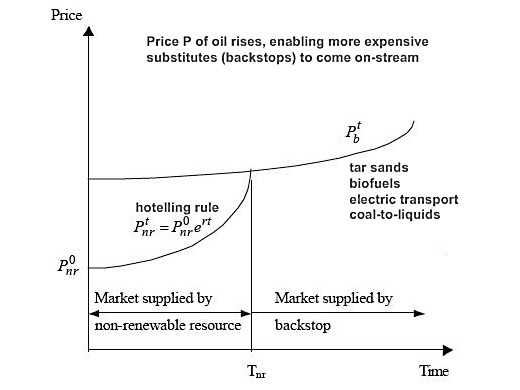
Jevons failed to appreciate that as the price of an energy source rises, entrepreneurs have a growing incentive to invent, develop, and produce alternatives, use coal more efficiently and develop technologies that cut the cost of discovering and mining resources.
The Peak Whale Oil Theory | Coyote Blog
18 Jun 2014 Leave a comment
in energy economics, entrepreneurship, environmental economics Tags: peak oil

As the US Population reaches toward the astronomical total of 40 million persons, we are reaching the limits of the number of people this earth can support. If one were to extrapolate current population growth rates, this country in a hundred years could have over 250 million people in it! Now of course, that figure is impossible – the farmland of this country couldn’t possibly support even half this number. But it is interesting to consider the environmental consequences.
Take the issue of transportation. Currently there are over 11 million horses in this country, the feeding and care of which constitute a significant part of our economy. A population of 250 million would imply the need for nearly 70 million horses in this country, and this is even before one considers the fact that “horse intensity”, or the average number of horses per family, has been increasing steadily over the last several decades.
It is not unreasonable, therefore, to assume that so many people might need 100 million horses to fulfil all their transportation needs. There is just no way this admittedly bountiful nation could support 100 million horses. The disposal of their manure alone would create an environmental problem of unprecedented magnitude.
Or, take the case of illuminant. As the population grows, the demand for illuminant should grow at least as quickly. However, whale catches and therefore whale oil supply has levelled off of late, such that many are talking about the “peak whale” phenomena, which refers to the theory that whale oil production may have already passed its peak. 250 million people would use up the entire supply of the world’s whales four or five times over, leaving none for poorer nations of the world.
The real beauty of this free-market price system is that it brings about its own kind of sustainability
17 Jun 2014 Leave a comment
in energy economics, entrepreneurship, environmental economics Tags: peak oil
This is not so much sustainability in the use of particular resources — for particular goods fall in and out of favour according to supply and demand factors — but sustainability of high economic growth and high standards of living in the economically developed, capitalist economies.
Take, as an example, the transition in the market for interior illumination: tallow candles were replaced by whale-oil lamps, which were replaced by kerosene lamps, which were replaced by incandescent bulbs powered by electricity.
There was no social or political pressure needed to accomplish this evolution; there was no “peak whale oil” movement, no kerosene conservationists, no sustainability crusade of yore. All it took was a functional price system, combined with the ever-present entrepreneurial drive for profits under a competitive, free-market order.
Peak oil versus global warming
16 Jun 2014 Leave a comment
in economics of climate change, energy economics, environmental economics, global warming Tags: global warming, peak oil
 |
 |
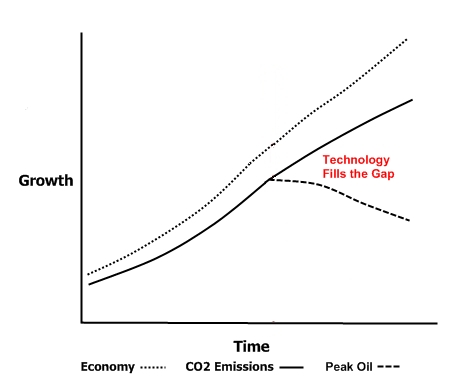
The environmental movement manages to believe in both peak oil – oil will run out in the next two decades or so – and global warming based on runaway carbon emissions for the rest of the century burning the increasingly expensive and increasingly scarce crude oil that had ran out a long time ago previously.
Global warming will solve itself as long as we are willing to accept that the environmental movement is genuine in its predictions about peak oil.
The ideal green share market portfolio would be made up of shares in green energy companies and futures contracts in the natural resources sector to take advantage of peak oil.
 Utopia, you are standing in it!
Recent Comments