Trump Is Terrible on Trade. Top 2020 Dems Are No Better.
07 Sep 2019 Leave a comment
in applied price theory, applied welfare economics, comparative institutional analysis, industrial organisation, international economic law, international economics, politics - USA, survivor principle Tags: 2020 presidential election, protectionism, tariffs and quotas, trade wars
To Beat the Trade War, Companies Get Creative Breaking the Rules @WSJ
17 Jan 2019 Leave a comment
in international economics, politics - USA, Public Choice, rentseeking Tags: free trade, protectionism
Trade wars, explained
07 Jun 2018 Leave a comment
in applied price theory, applied welfare economics, industrial organisation, international economic law, labour economics, politics - USA, Public Choice, rentseeking, unemployment Tags: protectionism, strategic trade theory
Good to see strategic trade theory has been driven from the temple
30 May 2018 Leave a comment
in applied price theory, applied welfare economics, international economics, politics - USA, Public Choice, rentseeking Tags: protectionism, strategic trade theory, tariffs, trade wars
What Donald Trump doesn’t understand about trade
10 Mar 2018 Leave a comment
in applied price theory, international economics, politics - USA Tags: protectionism, tariffs, trade policy
Some may not know what a VHS is
09 Mar 2018 1 Comment
in applied price theory, applied welfare economics, economic history, industrial organisation, international economics, survivor principle Tags: creative destruction, free trade, protectionism
What undergrads and @stevenljoyce need to know about trade @GreenCatherine
12 Apr 2016 Leave a comment
in applied price theory, applied welfare economics, development economics, international economics, job search and matching, labour economics, labour supply, macroeconomics, politics - New Zealand Tags: antiforeign bias, free trade, makework bias, Paul Krugman, protectionism, tariffs, trade policy
Minister for everything Stephen Joyce wrote some nonsense in the paper today about how trade agreements and more exports will mean more jobs:
I would like to make the point that trade access is hugely important for a small country like New Zealand.
Without fair and equal trade access we can’t sell as much of our goods and we get less for them. And that means fewer jobs.
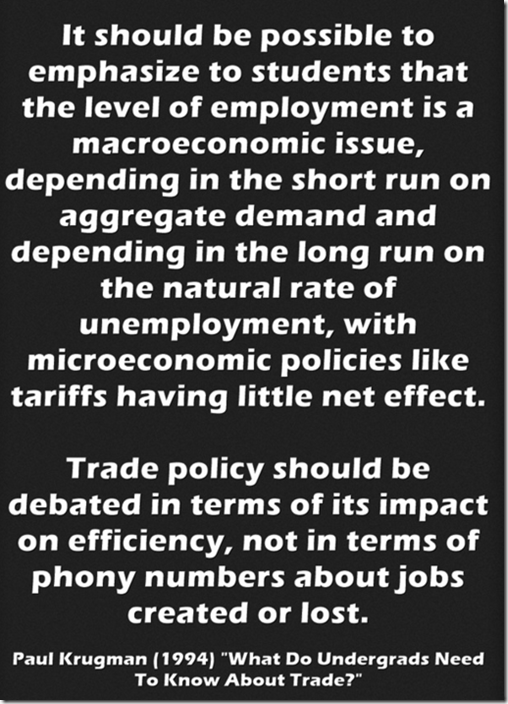
This make-work bias is as bad as those who oppose trade agreements on the grounds of an anti-foreign bias. Trade affects the composition of employment, not the number of jobs. Paul Krugman spent a good part of the 1990s trying to explain that to the general public and public intellectuals.
John Stuart Mill on who loses from trade barriers
15 Aug 2015 Leave a comment
in applied price theory, applied welfare economics, international economics, liberalism Tags: antiforeign bias, expressive voting, John Stuart Mill, protectionism, rational ignorance, rational irrationality, tariffs and quotas
Why do @NZGreens want NZ to lead the world by example on a carbon tax, but not unilateral free trade?
31 Jul 2015 Leave a comment
in David Friedman, environmental economics, global warming, international economics, Milton Friedman, Murray Rothbard, politics - New Zealand Tags: antiforeign bias, antimarket bias, carbon tax, carbon trading, climate treaties, expressive voting, free trade, global warming, left-wing double standards, Left-wing hypocrisy, New Zealand Greens, protectionism, rational ignorance, rational irrationality, unilateral free trade


NZ’s greenhouse gas emissions are high per person and unit of GDP but have fallen since 1990 oe.cd/10z http://t.co/f5BMLMvTjq—
OECD Publications (@OECD_Pubs) June 10, 2015
The difference between tariffs and quotas
18 Jun 2015 Leave a comment
in applied price theory, applied welfare economics, industrial organisation, international economics Tags: antimarket bias, import competition, international trade, protectionism, quotas, tariffs
What’s the difference between #tariffs and #quotas? Let’s find out buff.ly/1FS7QkZ http://t.co/hsx2VVG5e6—
MRUniversity (@MRevUniversity) May 30, 2015

Murphy’s Law of Economic Policy
26 Apr 2015 Leave a comment
in applied price theory, applied welfare economics, comparative institutional analysis, constitutional political economy, economic history, economics of bureaucracy, Public Choice, rentseeking Tags: Alan Blinder, evidence-based policy, expressive politics, free trade, protectionism, rational ignorance, rational irrationality, rent seeking
Greg Mankiw on one of the few things economists agree on: free trade. That's the problem. nyti.ms/1GrLisQ http://t.co/WrLuP3oBSW—
The Upshot (@UpshotNYT) April 25, 2015
Chiselling on the Closer Economic Relations agreement between New Zealand and Australia
10 Mar 2015 Leave a comment
in economics of media and culture, economics of regulation, politics - Australia, politics - New Zealand, rentseeking Tags: barriers to entry, closer economic relations, creative destruction, export pricing, free trade, Hollywood economics, price discrimination, protectionism, rent seeking
Back in the day, New Zealand television programming was sold cheaply into the Australian market. Many cultural and other products are exported into foreign markets and sold for whatever they can get above the price of shipping or digital transmission. What else explains all that rubbish on cable TV?
Under the Closer Economic Relations agreement that creates a single market between Australia and New Zealand, New Zealand made television programming content must be treated the same way as Australian content so it was included in their 50% local content rules for commercial television back from whenever I remember this story from. There was a Federal Court of Australia case that ruled that New Zealand television programming was Australian content programming for the purposes of the relevant media regulations because of Closer Economic Relations.

From the late 1990s, with revival of the New Zealand film and television industry, New Zealand content was starting to flood the Australian market, especially in the off-season in the summer when stations were looking for cheap content to fill a low ratings period.

Naturally, this Kiwi invasion did not please the rent seeking Australian television programme production industry and many a mendicant actor, writer and producer
Where there is a will, where there is a way: minimum quality standards are introduced into the Australian content rules defined by price – a price that happen to be above what the television stations used to pay for New Zealand made programming.
Adam Smith on growing grapes in Scotland
27 May 2014 Leave a comment
in applied price theory, industrial organisation Tags: Adam Smith, free trade, industry policy, protectionism
 |
By means of glasses, hotbeds, and hotwalls, very good grapes can be raised in Scotland, and very good wine too can be made of them at about thirty times the expense for which at least equally good can be brought from foreign countries. Would it be a reasonable law to prohibit the importation of all foreign wines, merely to encourage the making of claret and burgundy in Scotland? …As long as the one country has those advantages, and the other wants [lacks] them, it will always be more advantageous for the latter, rather to buy of the former than to make. |
 Utopia, you are standing in it!
Recent Comments