What’s the difference between embedded neoliberalism and Director’s Law of public expenditure?

I learnt a new word today off the back of Jane Kelsey winning a $600,000 Marsden grant to study embedded neoliberalism and her latest transnational conspiracy theory about trade agreements.

I’ve never heard of embedded liberalism before today despite a keen interest in popular and academic news. I don’t think I’m poorer for that ignorance but let’s push on. According to that source of all knowledge and truth Wikipedia, embedded neoliberalism’s been around for about 35 years:

Embedded liberalism is a term for the global economic system and the associated international political orientation as it existed from the end of World War II to the 1970s. The system was set up to support a combination of free trade with the freedom for states to enhance their provision of welfare and to regulate their economies to reduce unemployment. The term was first used by the American political scientist John Ruggie in 1982.[1]

Mainstream scholars generally describe embedded liberalism as involving a compromise between two desirable but partially conflicting objectives. The first objective was to revive free trade. BeforeWorld War I, international trade formed a large portion of global GDP, but the classical liberal order which supported it had been damaged by war and by the Great Depression of the 1930s. The second objective was to allow national governments the freedom to provide generous welfare programmes and to intervene in their economies to maintain full employment.[2] This second objective was considered to be incompatible with a full return to the free market system as it had existed in the late 19th century—mainly because with a free market in international capital, investors could easily withdraw money from nations that tried to implement interventionist and redistributive policies.[3]

The resulting compromise was embodied in the Bretton Woods system, which was launched at the end of World War II. The system was liberal[4] in that it aimed to set up an open system of international trade in goods and services, facilitated by semi fixed exchange rates. Yet it also aimed to “embed” market forces into a framework where they could be regulated by national governments, with states able to control international capital flows by means of capital controls. New global multilateral institutions were created to support the new framework, such as the World Bank and theInternational Monetary Fund.

Source: Embedded liberalism – Wikipedia, the free encyclopedia.

Decoding Marxist rhetoric is never easy, but I think what these academic Marxists are trying to do is describe the rise of the mixed economy and the welfare state over the course of the early and middle parts of 20th century.

The welfare state was never an easy thing for your card-carrying Marxist looking forward to the immiserisation of the proletariat as the trigger for the proletarian revolution.
Embedded neoliberalism mostly all about what Aaron Director in the 1950s explained as the reasons for the growth of government in the 20th century. He put forward what George Stigler label for him Director’s Law of Public Expenditure. George Stigler published an article on this law because Aaron Director published next to nothing for reasons no one understands. Director founded law and economics through teaching law classes at the University of Chicago law school.

Sam Peltzman pointed out that most of modern public spending is supported by the median voter –  the ‘swinging’ voter. He observed that governments at the start of the 20th century were a post office and a military; at the end of the 20th century, governments are a post office, a larger military and a very large welfare state.

Studies starting from Peltzman in 1980 showed that governments grew in line with the growth in the size and homogeneity of the middle class that was organised and politically articulate enough to implement a version of Director’s Law.

Director’s Law of public expenditure is that public expenditure is used primary for the benefit of the middle class, and is financed with taxes which are borne in considerable part by the poor and the rich. Based on the size of its population and its aggregate wealth, the middle class will always be the dominant voting bloc in a modern democracy. Growth in the size of governments across the developed world took off in the mid-20th century as the middle class blossomed. Peltzman maintained that:

“The levelling of income differences across a large part of the population … has in fact been a major source of the growth of government in the developed world over the last fifty years” because the levelling created “a broadening of the political base that stood to gain from redistribution generally and thus provided a fertile source of political support for expansion of specific programs. At the same time, these groups became more able to perceive and articulate that interest … [and] this simultaneous growth of ‘ability’ served to catalyse politically the spreading economic interest in redistribution.”

After the 1970s economic stagnation, the taxed, regulated and subsidised groups had an increasing incentive to converge on new, lower cost modes of income redistribution.

  • economic reforms ensued, led by parties on the left and right, with some members of existing political and special interest groupings benefiting from joining new coalitions.
  • More efficient taxes, more efficient spending, more efficient regulation and a more efficient state sector reduced the burden on the taxed groups.
  • Most of the subsidised groups benefited as well because their needs were met in ways that provoked less political opposition from the taxpaying groups.

Sweden, Norway and Denmark could be examples of Gary Becker’s idea that political systems converge on the more efficient modes of both regulation and income redistribution as their deadweight losses grew in the 1970s and 1980s and after. Unlike some of their brethren abroad, more of the Nordic Left and, more importantly, the Nordic median voter were cognizant of the power of incentives and to not killing the goose that laid the golden egg. Taxes on income from capital are low in Scandinavia.

The rising deadweight losses of taxes, transfers and regulation all limit the political value of inefficient redistributive policies. Tax and regulatory policies that are found to significantly cut the total wealth available for redistribution by governments are avoided relative to the germane counter-factual, which are other even costlier modes of redistribution.

An improvement in the efficiency of either taxes or spending reduces political pressure from taxed and regulated groups for suppressing the growth of government and thereby increases total tax revenue and spending because there is less political opposition. Efficient taxes lead to higher taxes.

Improvements in the efficiency of taxes, regulation and in spending reduce political pressure from the taxed and regulated groups in society. This suppressed the growth of government and thus increased or prevented cuts to both total tax revenue and spending since 1980. Economic regulation lessened after 1980 and there were privatisations, but social and environmental regulation grew unabated. Certainly in New Zealand the post-1984 economic reforms followed a good 10 years of economic stagnation and regular economic crises:

In the early 1980s, New Zealand’s economy was in trouble. The country had lost its guaranteed export market when Britain joined the European Economic Union in 1973. The oil crisis that year had also taken a toll.

The post-1980 reforms of Thatcher, Reagan, Clinton, Hawke and Keating, Lange and Douglas and others saved the modern welfare state for the middle class. Most income transfer programmes in modern welfare states disproportionately benefit older people. With an aging society, that trend can only continue. That is why these reforming policies survived political competition, election after election. The political parties on the left and right that delivered efficient increments and streamlined the size of government were elected, and in turn, got thrown out from time to time because they became tired and flabby.

The rest of embedded neoliberalism is trying to explain widespread economic deregulation and liberalisation of international trade along with the continual growth of social regulation. This is something that Gary Becker, George Stigler and Sam Peltzman have written on previously.

The continued growth of social regulation is best explained by the median voter theorem. Both Bryan Caplan and Sam Peltzman pointed out that it’s hard to think of any major government program or regulation that does not enjoy widespread popular support.

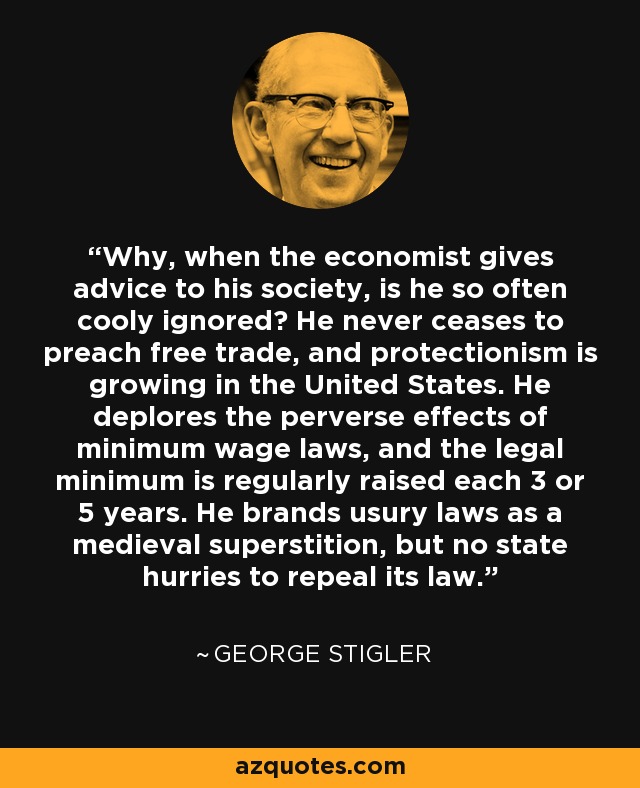
As for the public been duped by neoliberal economists, George Stigler argued that ideas about economic reform need to wait for a market. As Stigler noted, when their day comes, economists seem to be the leaders of public opinion but when the views of economists are not so congenial to the current requirements of special interest groups and voting public, these economists are left to be the writers of letters to the editor in provincial newspapers. These days they would run an angry blog.
@BernieSanders @HillaryClinton an average American works 11% less than in 1950, but earns 246% more

https://twitter.com/humanprogress/status/653920576457830402

@jeremycorbyn @BernieSanders oppose the one path to peace

Jeremy Corbyn is in trouble again, this time for describing World War I as pointless.

https://youtu.be/BbOYkjYwOV8

Corbyn has, for all his life, opposed the only means of securing peace either in Europe or anywhere else. He is against trade agreements, the European Union and NATO. Bernie Sanders is equally as misguided.

Corbyn and Sanders thinks you can make peace just by talking with people. Peace is made by trading with hostile countries to make them depend on you for their prosperity as well as yours. By growing rich through free trade, it’s in no ones interest to go to war or have poor relations with each other or each other’s friends.

Why are so many Silicon Valley start-up founders libertarian Democrats?

At least the good old days didn’t have the precautionary principle

@Noahpinion wants to use teenagers for policy experiments @arindube

Noah Smith is OK with local experiments with higher minimum wages such as a $15 minimum wage in San Francisco. At least half of these workers sold out for minimum wage policy experiments will be teenagers and young adults.

Source: Finally, an Answer to the Minimum Wage Question – Noah Smith.

My most grating experience in the public service was reversing the slope of the demand curve for labour and education and training to argue that a minimum wage would increase opportunities for the low paid.

I drafted a briefing to the minister pointing out that minimum wage increases make investments in training less attractive to lower skilled workers. This is because the minimum wage increase increases the opportunity cost of training and reduces the rewards in terms of the wage increase. The would be trainee must give up a higher minimum wage in return for a smaller wage increase because the minimum wage increase swallows part of the wage premium from the now an increasingly pointless investment in training. There is only a small literature on the impact of the minimum wage on investment in human capital.

My manager told me to argue that increases in the minimum wage will make low skilled workers more likely to seek training. That conclusion was based on a consultant’s machine-gun econometrics research showing that the confidence interval was plus or minus regarding the minimum wage and employment training. This study contradicted everything known about the minimum wage and the incentive to invest in human capital. You do not increase of demand for human capital by reducing the rewards for investments in human capital.

Back to Noah Smith. He admits freely that increases in the minimum wage reduce employment. He tries to ride out on the conclusion that that increase in unemployment after a small minimum wage increase isn’t much.

Source: Finally, an Answer to the Minimum Wage Question – Noah Smith.

Obviously the teenagers and adults thrown onto the scrapheap of society by the increased minimum wage don’t count in the brutal utilitarian calculus Noah Smith employs.

Fortunately, many economists prefer Pareto improvements. This is where after a policy change at least one person gains and no one loses or at least the winners compensates the losers for their losses. Not so bad and isn’t much as suggested by Noah Smith for the welfare consequences of a minimum wage increase on unemployment are not good enough from an applied welfare economics perspective.

Most of the Left over Left are of the same view about the priority of losers and the need to compensate them whenever those evil neoliberals want to deregulate or remove the tariff. The Left over Left are completely preoccupied the fate of the workers who have lost their privileges from regulation or tariff protection rather than the consumers who are now richer. Without missing a beat, the Left over Left changes sides and become brutal utilitarians when it comes to the minimum wage and unemployment and investment in human capital.

Minimum wage advocates fail to take seriously that low paid workers who lose their jobs because of minimum wage increases are real living people who suffer when their interests are traded off for the greater good of their fellow low paid workers, some of whom come from much wealthier households. As Rawls pointed out, a general problem that throws utilitarianism into question is some people’s interests, or even lives, can be sacrificed if doing so will maximize total satisfaction. As Rawls says:

[ utilitarianism] adopt[s] for society as a whole the principle of choice for one man… there is a sense in which classical utilitarianism fails to take seriously the distinction between persons.

What is underplayed in the minimum wage debate is Noah Smith, Arindrajit Dube and other scholars are careful in what they say but politicians and living wage lobbyists don’t listen to those careful qualifications.

The key qualification of these academics is there are policy trade-offs that cannot be avoided when the minimum wage is increased. Some jobs will be lost if the minimum wage increases. Some say this effect is small, others say this effect is large, hardly anyone says it’s zero.

The claims that the minimum wage can be lifted without hurting employment are a long bow from what Andrajit Dube said about small changes in the minimum wage having small adverse effects on unemployment. What Andrajit Dube said is not much different from everyone else on the minimum wage – Nuemark is an example:

a 10 per cent increase in the minimum wage could reduce young adult employment by up to 2 per cent

David Card was always very careful amount about how his pioneering research  was about how small increases in the minimum wage not reducing employment in the presence of search and matching costs:

From the perspective of a search paradigm, these policies make sense, but they also mean that each employer has a tiny bit of monopoly power over his or her workforce. As a result, if you raise the minimum wage a little—not a huge amount, but a little—you won’t necessarily cause a big employment reduction. In some cases, you could get an employment increase.

Noah Smith is wrong. We do know what will happen if the minimum wage is raised $15 per hour. Some people will lose their jobs. More importantly, there is a reduced incentive for the low paid to invest in skills to improve their earning power because the minimum wage is already delivered that assuming they still have a job.

How you handle these casualties of policy changes such as minimum wage increases is a central dilemma of applied welfare economics. This dilemma is usually solved by pointing out that it’s far less risky in terms of employment and welfare improvements and losses to increase the Earned Income Tax Credit (EITC) because that places no jobs at risk.

Now along comes Steve Landsburg to point out that the incidence of an Earned Income Tax Credit (EITC) changes when there is a minimum wage, when there is a price floor. Remember everyone agrees that when there is an earned income tax credit, some of the benefits go to the employer. When you raise the EITC, more people enter the labour market. This increase in the supply of labour drives wages down, which transfers some of the benefit of the tax credit from the workers you intended to help to the employers but not all of the benefits of the tax credit.

Steve Landsburg shows that in any labour market where the minimum wage is above the wage that would prevail but for the minimum wage law, the minimum wage cannot fall to cope with the increase in labour supply induced by the earned income tax credit. For that reason, all of the benefits of the earned income tax credit go to employers. Employers can hire more people without having to increase the wage they offer above the minimum wage. As long as the minimum wage is above the market clearing wage, more people get a job as a result of the tax credit, but no one takes home pay that is higher than the minimum wage.

One of the purposes of applied price theory, the study of economic history and even labour econometrics is to spare us policy experiments that we already know that they will not turn out well.

Malcolm Turnbull sure is popular

https://twitter.com/Mark_Graph/status/658769666748346368/photo/1

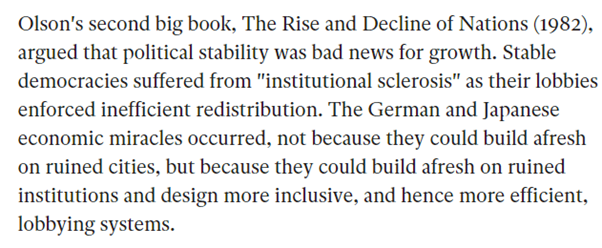
@NaomiAKlein agrees with #MiltonFriedman on Mancur Olson’s theory of how nations escape institutional sclerosis

Source: quoted by Naomi Klein in “The Shock Doctrine”.

https://youtu.be/mI_Z_oVYEkw

1. There will be no countries that attain symmetrical organization of all groups with a common interest and thereby attain optimal outcomes through comprehensive bargaining.

2. Stable societies with unchanged boundaries tend to accumulate more collusions and organizations for collective action over time.

3. Members of “small” groups have disproportionate organizational power for collective action, and this disproportion diminishes but does not disappear over time in stable societies.

4. On balance, special-interest organizations and collusions reduce efficiency and aggregate income in the societies in which they operate and make political life more divisive.

5. Encompassing organizations have some incentive to make the society in which they operate more prosperous, and an incentive to redistribute income to their members with as little excess burden as possible, and to cease such redistribution unless the amount redistributed is substantial in relation to the social cost of the redistribution.

6. Distributional coalitions make decisions more slowly than the individuals and firms of which they are comprised, tend to have crowded agendas and bargaining tables, and more often fix prices than quantities.

7. Distributional coalitions slow down a society’s capacity to adopt new technologies and to reallocate resources in response to changing conditions, and thereby to reduce the rate of economic growth.

8. Distributional coalitions, once big enough to succeed, are exclusive, and seek to limit the diversity of incomes and values of their membership.

9. The accumulation of distributional coalitions increases the complexity of regulation, the role of government, and the complexity of understandings, and changes the direction of social evolution.

image

Source: Obituary: Professor Mancur Olson | Obituaries | News | The Independent

@CarlyFiorina says it all on action to fight global warming @jamespeshaw @AndrewLittleMP @garethmorgannz

@SeumasMilne could @jeremycorbyn win?

While standard British Labour Party populist policies resonate with the electorate, all the policies that Jeremy Corbyn brings as a socialist, peacenik and renegade Liberal are deeply unpopular and will be used against him as wedge issues by the Tories.

The popularity of individual policies in the Labour Party manifesto didn’t do them any good at the 2015 general election.

What matters to the voters at the last British general election was that brand Labour was down on the nose. It was not a credible alternative government.

Jeremy Corbyn makes that gap into a chasm because of the vast difference between what his supporters on the left of the Labour Party want and what the voters who must be persuaded to switch their vote for Labour to win in 2020 want as government policies.

Jeremy Corbyn is much further to the left than Ed Miliband, who lost the election in 2015 rather badly because he was too far to the left for the taste of the British electorate.

Ed Miliband was rejected in the 2015 British election because he was not a fiscal conservative nor a credible economic manager. The anti-austerity message loses votes.

There is a yawning chasm between the reasons why the left of the Labour Party thinks their party lost the 2015 British general election and why Labour voters thought they lost the election.

The anti-austerity message was one of the reasons why Labour lost in the eyes of its own voters and would-be voters in the centre of politics

The deep unpopularity of Jeremy Corbyn cannot be understated as a barrier to British Labour winning the next election.

That deep unpopularity of Jeremy Corbyn sacrifices the one winning advantage that British Labour has under Jeremy Corbyn. That advantage is governments tend to lose elections rather than oppositions win them.

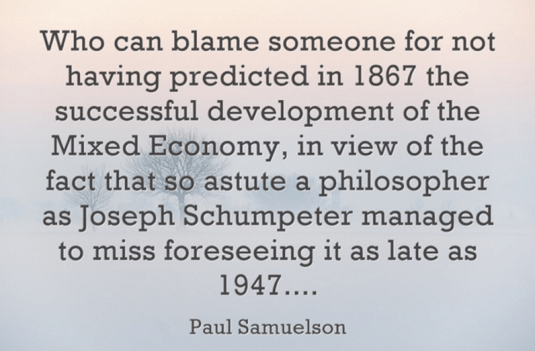
Schumpeter disputed the widely held view that democracy was a process by which the electorate identified the common good, and a particular party was then elected by the voters because it was the most suited to carrying out this agreed common good:

  • The people’s ignorance and superficiality meant that they were manipulated by politicians who set the agenda.
  • Although periodic votes legitimise governments and keep them accountable, their policy programmes are very much seen as their own and not that of the people, and the participatory role for individuals is limited.

Schumpeter’s theory of democratic participation is voters have the ability to replace political leaders through periodic elections.

Citizens do have sufficient knowledge and sophistication to vote out leaders who are performing poorly or contrary to their wishes. The power of the electorate to turn elected officials out of office at the next election gives elected officials an incentive to adopt policies that do not outrage public opinion and administer the policies with some minimum honesty and competence.

Power rotates in the Schumpeterian sense. Governments were voted out when they disappointed voters with the replacement not necessarily having very different policies.

The challenge for British Labour is Corbyn cannot win unless he projects minimal competence and stops having policies on defence, foreign affairs and terrorism that outrage public opinion.

Jeremy Corbyn has plenty of outrageous opinions and is yet to show even the most basic competence in running the office of opposition leader, working 24/7 as opposition leader, and showing some ability to win support from members of the Parliamentary Labour Party. If Jeremy Corbyn cannot win votes of his own MPs, what chance do he have with the British people whose interests he claims to champion.

@RusselNorman tried to outthink, outsmart @JohnKey unlike @nzlabour who just tried to smear him

Imagine if @HillaryClinton had a serious opponent, not @BernieSanders

An American President on what @nzlabour @NZGreens have become (on housing affordability and trade and investment)

https://youtu.be/JCliHGQy8-w

Leaked letter shows how @Oxfam @sierraclub lobbied to block cheap energy for poor nations @GreenpeaceNZ @oxfamnz

https://twitter.com/MichaelBTI/status/651503672002785281

https://twitter.com/MichaelBTI/status/651458416569909248

https://twitter.com/VoxMaps/status/608411758022291456/photo/1?ref_src=twsrc%5Etfw

George Stigler on the influence of economists on public policy

Image

Previous Older Entries Next Newer Entries

Bassett, Brash & Hide

Celebrating humanity's flourishing through the spread of capitalism and the rule of law

Truth on the Market

Scholarly commentary on law, economics, and more

The Undercover Historian

Beatrice Cherrier's blog

Matua Kahurangi

Celebrating humanity's flourishing through the spread of capitalism and the rule of law

Temple of Sociology

Celebrating humanity's flourishing through the spread of capitalism and the rule of law

Velvet Glove, Iron Fist

Celebrating humanity's flourishing through the spread of capitalism and the rule of law

Why Evolution Is True

Why Evolution is True is a blog written by Jerry Coyne, centered on evolution and biology but also dealing with diverse topics like politics, culture, and cats.

Down to Earth Kiwi

Celebrating humanity's flourishing through the spread of capitalism and the rule of law

NoTricksZone

Celebrating humanity's flourishing through the spread of capitalism and the rule of law

Homepaddock

A rural perspective with a blue tint by Ele Ludemann

Kiwiblog

DPF's Kiwiblog - Fomenting Happy Mischief since 2003

The Dangerous Economist

Celebrating humanity's flourishing through the spread of capitalism and the rule of law

Watts Up With That?

The world's most viewed site on global warming and climate change

The Logical Place

Tim Harding's writings on rationality, informal logic and skepticism

Doc's Books

A window into Doc Freiberger's library

The Risk-Monger

Let's examine hard decisions!

Uneasy Money

Commentary on monetary policy in the spirit of R. G. Hawtrey

Barrie Saunders

Thoughts on public policy and the media

Liberty Scott

Celebrating humanity's flourishing through the spread of capitalism and the rule of law

Point of Order

Politics and the economy

James Bowden's Blog

A blog (primarily) on Canadian and Commonwealth political history and institutions

Science Matters

Reading between the lines, and underneath the hype.

Peter Winsley

Economics, and such stuff as dreams are made on

A Venerable Puzzle

"The British constitution has always been puzzling, and always will be." --Queen Elizabeth II

The Antiplanner

Celebrating humanity's flourishing through the spread of capitalism and the rule of law

Bet On It

Celebrating humanity's flourishing through the spread of capitalism and the rule of law

History of Sorts

WORLD WAR II, MUSIC, HISTORY, HOLOCAUST

Roger Pielke Jr.

Undisciplined scholar, recovering academic

Offsetting Behaviour

Celebrating humanity's flourishing through the spread of capitalism and the rule of law

JONATHAN TURLEY

Res ipsa loquitur - The thing itself speaks

Conversable Economist

Celebrating humanity's flourishing through the spread of capitalism and the rule of law

The Victorian Commons

Researching the House of Commons, 1832-1868

The History of Parliament

Articles and research from the History of Parliament Trust

Books & Boots

Reflections on books and art

Legal History Miscellany

Posts on the History of Law, Crime, and Justice

Sex, Drugs and Economics

Celebrating humanity's flourishing through the spread of capitalism and the rule of law

European Royal History

Exploring the Monarchs of Europe

Tallbloke's Talkshop

Cutting edge science you can dice with

Marginal REVOLUTION

Small Steps Toward A Much Better World

NOT A LOT OF PEOPLE KNOW THAT

“We do not believe any group of men adequate enough or wise enough to operate without scrutiny or without criticism. We know that the only way to avoid error is to detect it, that the only way to detect it is to be free to inquire. We know that in secrecy error undetected will flourish and subvert”. - J Robert Oppenheimer.

STOP THESE THINGS

The truth about the great wind power fraud - we're not here to debate the wind industry, we're here to destroy it.

Lindsay Mitchell

Celebrating humanity's flourishing through the spread of capitalism and the rule of law

Alt-M

Celebrating humanity's flourishing through the spread of capitalism and the rule of law

croaking cassandra

Economics, public policy, monetary policy, financial regulation, with a New Zealand perspective

The Grumpy Economist

Celebrating humanity's flourishing through the spread of capitalism and the rule of law

International Liberty

Restraining Government in America and Around the World