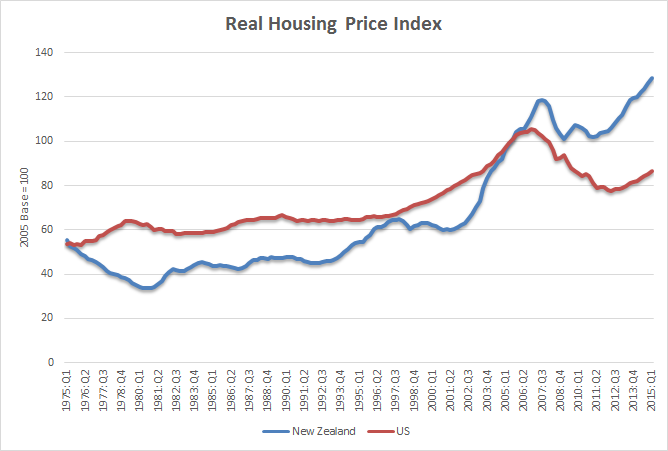
Mortgage interest rates were last in the double digits in the late 1980s and early 1990s. Since then, housing prices have exploded in New Zealand and barely paused for the recession in the wake of the Global Financial Crisis.
With house prices and mortgages several times what they used to be, the ability for any household income to absorb the sudden return of high mortgage interest rates because of a return of even moderate CPI inflation and double-digit mortgage rates is well-nigh impossible, politically.
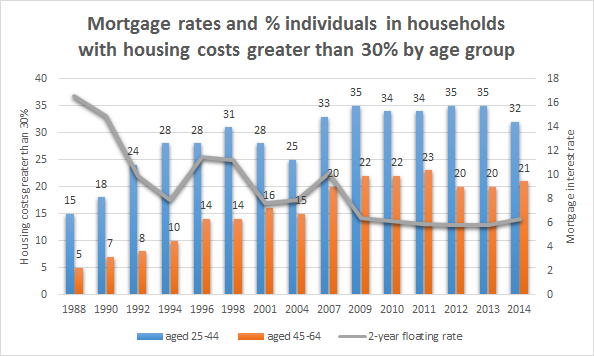
The chart above shows that the number of 25 to 44-year-olds in New Zealand who have more than 30% of their income going to housing expenses has doubled since 1988 to nearly a third of all households. The number of 45 to 64-year-olds who pay more than 30% of their income in housing expenses has quadrupled to 20%. That is a lot of voters who would be offended by mismanagement of monetary policy.
None of these households would have much left over to absorb an increasing mortgage interest rates. That is very different political arithmetic too the last time both mortgage rates and CPI inflation were in double digits, which was more than 20 years ago. Not many New Zealanders under the age of 40 or 45 have an adult memory of high inflation and high mortgage rates.
Rob Salmond has written a great blog this week on the ideological spectrum of New Zealand voters based on the New Zealand Election Study.
In the course of his blog he drove a tremendously big stake through the heart of the old left fantasy that if Labour or Greens goes left, a large block of voters not voting for them now or not voting at all (the missing million voters) will shake lose its false consciousness and follow you:
But “pulling the centre back towards the left” is massively, massively hard.
You win those people over by being relevant to them as they are, not by telling them they’re worldview needs a rethink. It is just basic psychology. Tell people they were right all along; they like you. Tell people they were wrong all along; they don’t.
And if you win a majority of centrists, you win. The New Zealand Election Study series records six MMP elections in New Zealand – the three where Labour did best among centrists were the three Labour won.
That’s another message from the academic study I quoted above – in Germany, Sweden, and the UK, the elections where the left did best among centrists were the elections where they took power. As their popularity among centrists declined, so did their seat share.
What is more disturbing for the old left fantasy of the missing million is voting for the Labour Party or Greens is correlated with ignorance rather than knowledge.
Furthermore, the more people know about economics, the less likely they are to vote for the left as Eric Crampton explains:
When they get to the polls, the ignorant are significantly more likely to support the Labour Party (4% increase in predicted probability for a standard deviation increase in ignorance) and significantly less likely to support the Green party (1% decrease in predicted probability) and United Future (0.5% decrease in predicted probability).
Understanding economics strongly predicted supporting National in 2005, which comes as little surprise: the National Party leader was former Governor of the Reserve Bank of New Zealand. A standard deviation increase in our “economic thinking” index correlates with a 5.7% increased probability of voting National, a 1.5% decreased probability of voting NZ First, and a slight decrease in the probability of voting United Future and Maori.
To make matters worse, Crampton found that joining political organisations does little to cure ignorance of politics or otherwise lead to a political awakening. Sometimes active political affiliation reduces ignorance, other times such organisational membership intensifies ignorance.
Ratio of Median Salary of Top 25 Highest Paid MLB Player to Avg. Worker Pay Increased from 100:1 to 700:1 Since 1988 http://t.co/5zLktBXS3D— Mark J. Perry (@Mark_J_Perry) August 18, 2015
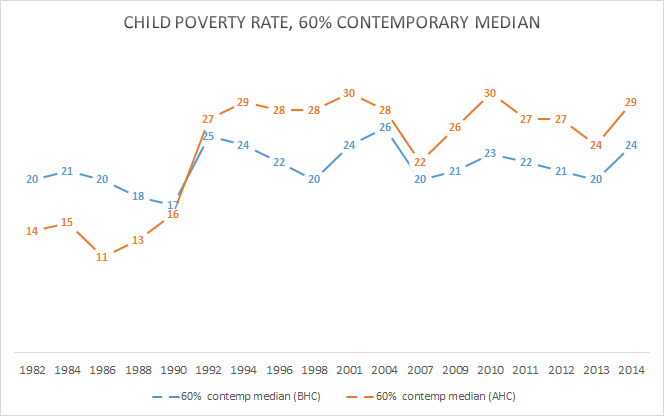
Nothing much has happening to child poverty before housing costs in New Zealand since the early 1980s. It is after housing costs poverty that is crucifying the children in New Zealand.
From HES 2013 to HES 2014 median household income rose 5% in real terms (5% above the CPI inflation rate)…
On the AHC moving line measures, child poverty rates in HES 2014 are around the same as their peak after the GFC. A good amount of the rise from HES 2013 to HES 2014 is due to the large rise in the BHC median, as noted above, rather than a change in the numbers in low income per se.
The parties that oppose measures to increase the supply of land and reduce the cost of housing through reform of the Resource Management Act and its many restraints on the supply of land are the New Zealand Labour Party and New Zealand Greens.
All homeowners have an incentive to stop new housing because if developers build too many homes, prices fall, and housing is many families’ main asset. But in cities with many Democrats and Green Party members, environmental concerns might also be a factor. The movement might be too eager to preserve the past.
Why Evolution is True is a blog written by Jerry Coyne, centered on evolution and biology but also dealing with diverse topics like politics, culture, and cats.
“We do not believe any group of men adequate enough or wise enough to operate without scrutiny or without criticism. We know that the only way to avoid error is to detect it, that the only way to detect it is to be free to inquire. We know that in secrecy error undetected will flourish and subvert”. - J Robert Oppenheimer.



 Utopia, you are standing in it!
Recent Comments