09 Aug 2015
by Jim Rose
in economics of regulation, environmental economics, environmentalism, health economics, Public Choice, rentseeking
Tags: antiscience left, expressive voting, GMOs, green rent seeking, Greenpeace, Left-wing hypocrisy, precautionary principle, rational ignorance, rational irrationality
05 Aug 2015
by Jim Rose
in applied price theory, applied welfare economics, comparative institutional analysis, economic history, economics of regulation, entrepreneurship, income redistribution, industrial organisation, politics - Australia, politics - New Zealand, politics - USA, Public Choice, rentseeking, survivor principle
Tags: airline deregulation, antimarket bias, bootleggers and baptists, expressive voting, Leftover Left, rational ignorance, rational irrationality
04 Aug 2015
by Jim Rose
in development economics, economic history, energy economics, environmental economics, global warming, growth miracles, politics - Australia, politics - New Zealand, politics - USA
Tags: climate alarmism clock, climate treaties, expressive voting, free-riders, Kyoto Protocol, rational ignorance, rational irrationality
04 Aug 2015
by Jim Rose
in labour economics, minimum wage, politics - USA, unemployment
Tags: aggressive voting, antimarket bias, living wage, offsetting behaviour, rational ignorance, rational irrationality, The fatal conceit, The pretence to knowledge, unintended consequences
01 Aug 2015
by Jim Rose
in applied price theory, applied welfare economics, Austrian economics, comparative institutional analysis, constitutional political economy, development economics, economics of media and culture, economics of regulation, growth disasters, growth miracles, income redistribution, industrial organisation, law and economics, liberalism, Marxist economics, property rights, Public Choice, rentseeking, survivor principle
Tags: anticapitalist mentality, antimarket bias, capitalism and freedom, China, Cuba, expressive voting, Hong Kong, Leftover Left, public intellectuals, rational ignorance, rational irrationality, Twitter left
31 Jul 2015
by Jim Rose
in David Friedman, environmental economics, global warming, international economics, Milton Friedman, Murray Rothbard, politics - New Zealand
Tags: antiforeign bias, antimarket bias, carbon tax, carbon trading, climate treaties, expressive voting, free trade, global warming, left-wing double standards, Left-wing hypocrisy, New Zealand Greens, protectionism, rational ignorance, rational irrationality, unilateral free trade
30 Jul 2015
by Jim Rose
in income redistribution, labour economics, minimum wage, politics - Australia, politics - New Zealand, politics - USA, population economics, poverty and inequality, Public Choice, rentseeking
Tags: British politics, Director's Law, expressive voting, living wage, rational ignorance, rational irrationality
26 Jul 2015
by Jim Rose
in applied welfare economics, economic history, economics of media and culture, health economics, industrial organisation, politics - USA, Public Choice, rentseeking, survivor principle
Tags: adverse selection, expressive voting, health insurance, Leftover Left, media bias, medicaid, Medicare, moral hazard, Obamacare, rational ignorance, rational irrationality
26 Jul 2015
by Jim Rose
in constitutional political economy, economic history, economics of media and culture, health economics, politics - USA, Public Choice
Tags: abortion, constitutional law, expressive voting, median voter, rational ignorance, rational irrationality, social change
On abortion, the USA is split on pro-life versus pro-choice. State legislatures pass laws safe in the knowledge that they will be struck down the next day. they were playing to a grandstand made up of values voters.
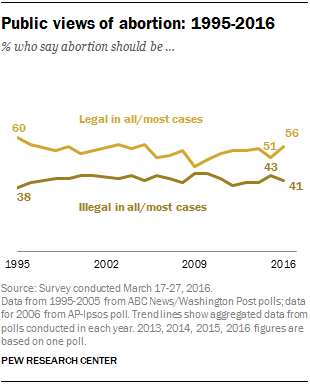
When the supreme court became a little vague on some procedural aspects of abortion law in the early 1990s, the state legislatures started showing much more restraint because the median voter would be annoyed.
Where Roe v. Wade to fall, some states would permit abortion, some would not. The Center for Reproductive Rights predicts that 21 states are likely to outlaw abortion immediately where Roe v. Wade to fall. This assessment is based not only on current law, but on the political makeup of the state legislatures. On the other hand, abortion is likely to remain legal in many states, according to these groups.
25 Jul 2015
by Jim Rose
in applied price theory, applied welfare economics, comparative institutional analysis, constitutional political economy, economic history, economics of bureaucracy, economics of education, economics of regulation, economics of religion, energy economics, environmental economics, income redistribution, industrial organisation, international economics, Murray Rothbard, politics - Australia, politics - New Zealand, politics - USA, Public Choice, rentseeking, survivor principle
Tags: antiforeign bias, antimarket bias, Catholic social thought, climate alarmism, expressive voting, global warming, makework bias, Pope Francis, rational ignorance, rational irrationality, voter demographics
24 Jul 2015
by Jim Rose
in business cycles, econometerics, economic growth, economic history, job search and matching, labour economics, labour supply, macroeconomics, politics - New Zealand, Public Choice, unemployment, unions, welfare reform
Tags: antimarket bias, Don Brash, economic reform, expressive voting, Homer Simpson, Leftover Left, lost decades, makework bias, neoliberalism, rational ignorance, rational irrationality, Sir Roger Douglas, Twitter left
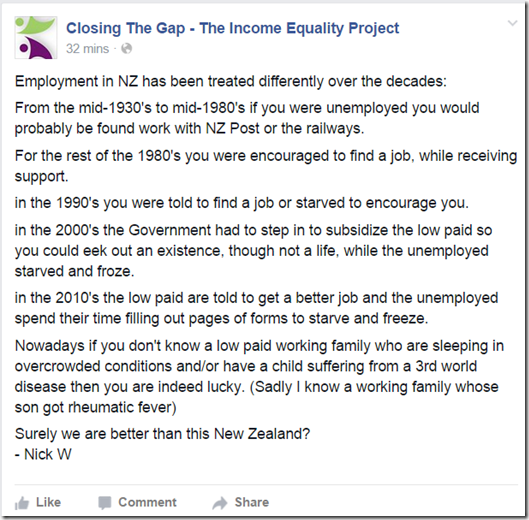
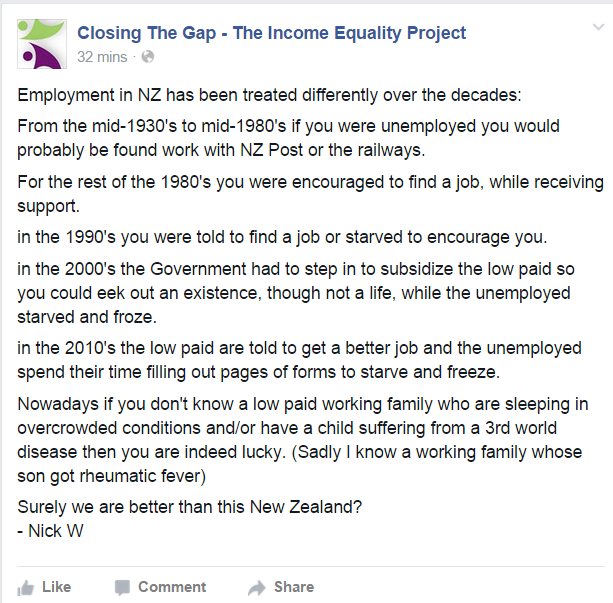
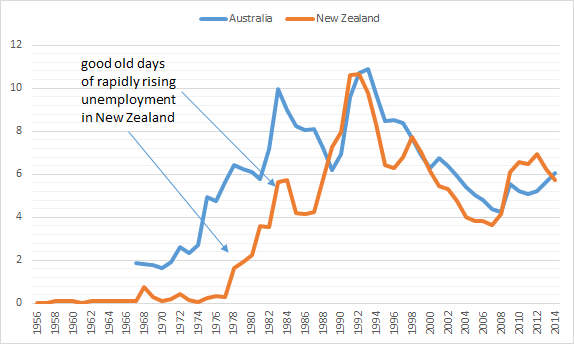
Today, Closing The Gap – The Income Inequality Project boldly claimed today that there was next to no unemployment in New Zealand prior to the onset of the curse of neoliberalism.
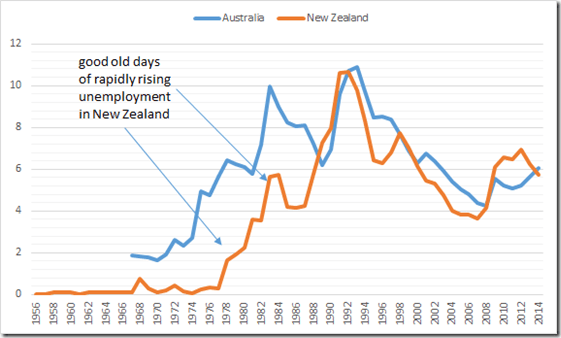
There is an Internet on computers now where it is easy to find data showing that the unemployment rate was rising rapidly in New Zealand in the 1970s and in double digits by the end of the 1980s – see figure 1.
Figure 1: harmonised unemployment rates, Australia and New Zealand, 1956-2014
Source: OECD StatExtract.
Figure 1 shows unemployment was rising rapidly in the 1970s and wasn’t much different by the end of the 1970s to the unemployment rates recorded after about 2000 in New Zealand.

One of the reasons that Sir Roger Douglas wrote There’s Got To Be A Better Way was the rapidly rising unemployment in New Zealand and the stagnant economic growth in the late 1970s and early 1980s.

New Zealand was one of the most regulated economies, so much so that Prime Minister David Lange said:
We ended up being run very similarly to a Polish shipyard.
As for those jobs on the railways, the then Reserve Bank Governor Don Brash said in 1996:
Railways cut its freight rates by 50 percent in real terms between 1983 and 1990, reduced its staff by 60 percent, and made an operating profit in 1989/90, the first for six years.
Previous Older Entries Next Newer Entries


 Utopia, you are standing in it!
Recent Comments