The Myth of the Rational Voter: Why Democracies Choose Bad Policies – Annual Casey-McIlvane Lecture
24 Feb 2020 1 Comment
in comparative institutional analysis, constitutional political economy, economics of bureaucracy, economics of education, economics of information, economics of regulation, environmental economics, financial economics, industrial organisation, international economics, James Buchanan, labour economics, law and economics, macroeconomics, Marxist economics, politics - USA, Public Choice, public economics, rentseeking Tags: rational ignorance, rational irrationality
The Myth of the Rational Voter
16 Feb 2020 Leave a comment
in applied price theory, economics of information, politics - USA, Public Choice Tags: anti-foreign bias, anti-market bias, make-work bias, pessimism bias, rational irrationality
Public Opinion for Libertarians – Bryan Caplan (2010)
10 Feb 2020 Leave a comment
in economics of bureaucracy, economics of education, economics of information, economics of regulation, income redistribution, international economics, labour economics, law and economics, politics - USA, Public Choice, rentseeking Tags: anti-foreign bias, anti-market bias, make-work bias, pessimism bias, rational irrationality
The Myth of the Rational Voter – Bryan Caplan
08 Feb 2020 Leave a comment
in applied price theory, comparative institutional analysis, constitutional political economy, econometerics, economic history, economics of bureaucracy, economics of information, economics of regulation, income redistribution, industrial organisation, international economics, labour economics, labour supply, law and economics, macroeconomics, politics - Australia, politics - New Zealand, politics - USA, Public Choice, public economics, rentseeking Tags: anti-foreign bias, anti-market bias, make-work bias, pessimism bias, rational ignorance, rational irrationality
The Myth of the Rational Voter | Bryan Caplan & Will Wilkinson
22 Jul 2019 Leave a comment
in applied price theory, comparative institutional analysis, constitutional political economy, economics of information, Public Choice, public economics Tags: rational ignorance, rational irrationality
The Myth of the Rational Voter
19 Jun 2019 Leave a comment
in applied price theory, comparative institutional analysis, constitutional political economy, law and economics, Public Choice Tags: rational irrationality
Save the oceans – stop recycling plastic @greenpeace
20 Feb 2019 Leave a comment
in development economics, environmental economics Tags: expressive voting, rational irrationality, recycling
4 Ways Economists Think We’re All Wrong – Econ Chronicles – Learn Liberty
16 Feb 2019 Leave a comment
in applied price theory, applied welfare economics, comparative institutional analysis, constitutional political economy, economic history, economics of regulation, income redistribution, international economics, labour economics, labour supply, law and economics, politics - USA, Public Choice, public economics, unemployment Tags: anti-foreign bias, anti-market bias, make-work bias, rational irrationality
Public Opinion for Libertarians – Bryan Caplan (2010)
20 Jan 2019 Leave a comment
in comparative institutional analysis, constitutional political economy, economics of education, economics of information, economics of regulation, energy economics, environmental economics, industrial organisation, labour economics, law and economics, poverty and inequality, Public Choice, public economics Tags: anti-foreign bias, anti-market bias, make-work bias, pessimism bias, rational irrationality
The politically clueless consider themselves particularly well informed
12 Apr 2018 2 Comments
in constitutional political economy, economics of information, Public Choice Tags: Dunning-Krueger, rational ignorance, rational irrationality
50% of @PaulineHansonOz @OneNationAus votes come from @AustralianLabor voters
22 Sep 2016 1 Comment
in constitutional political economy, politics - Australia, Public Choice Tags: 2016 Australian federal election, antiforeign bias, antimarket bias, expressive voting, free trade, globalisation, left-wing popularism, makework bias, rational irrationality, right-wing popularism
How can Pauline Hanson be an extreme right-winger if half of her votes come from people who 2nd preference the Australian Labour Party? This strong support for her populism has been well-known since she won the safest Labour Party seed in Queensland in the 1996 Australian Federal Election but is hardly ever mentioned by the media or her critics.
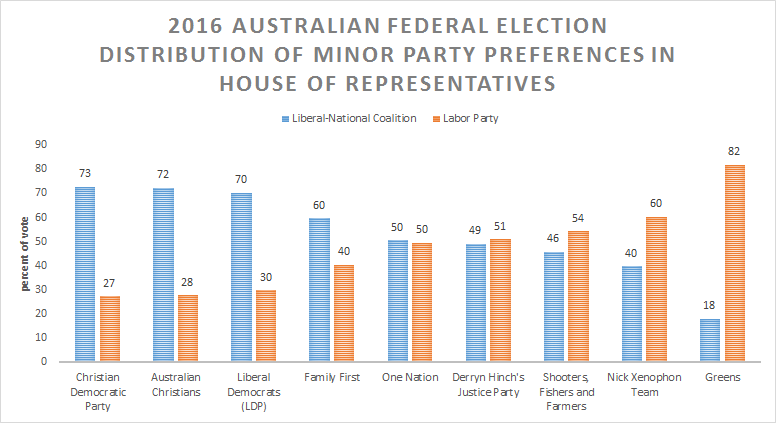
Source: Antony Green’s Election Blog: Preference Flows at the 2016 Federal Election.
It should be therefore no surprise that a lot of her views have popular support because she has support across the political spectrum. Not knowing that will means you will be not very good at combating her views which you simply do not understand where they come from.
Few of her supporters see themselves as extremists and will be insulted when you suggest they are. Listen here dummy is no way to win back votes of people who just voted for you recently.
Hanson’s support among Labour voters is increasing. Only 42% of her voters gave their 2nd preference to Labour in previous federal elections for the House of Representatives.
Does it Feel Good or Does it Do Good?
08 Sep 2016 Leave a comment
in applied price theory, applied welfare economics, comparative institutional analysis, constitutional political economy, economics, labour economics, minimum wage, Public Choice Tags: expressive voting, rational irrationality
.@NZGreens do not understand business: minimum wage for contractors version
25 Aug 2016 Leave a comment
in applied price theory, applied welfare economics, economics of regulation, industrial organisation, labour economics, politics - New Zealand, poverty and inequality, survivor principle Tags: expressive voting, market process, New Zealand Greens, price signals, rational irrationality, The meaning of competition
The Greens are most upset that a Labour party private members bill to specify a minimum wage for contractors was voted down by one vote in parliament yesterday.
If you earn than the minimum wage as a contractor, that is a signal wrapped in an incentive. Your poor hourly earnings is a signal to you that maybe you should get out of that contracting business and go back to being an employee where you will be paid at least the minimum wage.
Many small businesses make no profits at all in the first year or so as they build the business. The founders of the business get by on savings, which they anticipated when they drew up their business plan. No one expects a business to make an immediate profit or always be profitable.
Contractors are entrepreneurs chancing their arm. They need crisp signals about whether they are succeeding, failing or could succeed if they try harder or do something different. A minimum wage for contractors masks those important market signals of success and failure.
If your dream of owning your own business is not even paying the minimum wage, maybe it is time to get out of the contracting business.
 Utopia, you are standing in it!
Recent Comments